Showing posts with label Dr. Brewster M. Higley VI. Show all posts

Thursday, February 23, 2017

Inspiration & Motivation


Isaac Beckley Werner's Journal
Searching for an old journal, kept by a man I had never heard of that allegedly contained references to my ancestors, resulted in my manuscript about Isaac Werner, his community, and the Populist Movement in Kansas.  As a by-product, it resulted in my weekly sharing of Kansas history through this blog.  We never know what may inspire us and motivate us to do something we might never otherwise have imagined!

For Ken Spurgeon, it was a collection of Civil War letters.  As a graduate student in history, he learned that if a Kansas settler were a non-combatant or claimed no allegiance in the free state vs pro-slavery bloody years when Kansans and Missourians fought, a sheet over their chimney would signal their lack of alliance to either side.  Among the letters that Spurgeon read was one written by a woman who explained that to leave a chimney bare, or "lone," was a declaration of who you were and what you stood for.

Memioral on side of Dr. Higley's cabin
In 2003, when Ken Spurgeon and Jonathon Goering formed their company to make their first documentary, "Touched by Fire:  Bleeding Kansas, 1854-1861," Ken remembered that letter and it became the inspiration for naming their company Lone Chimney Films. Since then have come "Bloody Dawn:  The Lawrence Massacre," "The Road to Valhalla," and most recently "Home on the Range, The Story of America's Iconic Song."

Lone Chimney Films represents, for them, their commitment to historical accuracy. They place great importance in using academic scholars to advise them and serve on their board.  Their purpose is to share history in an accurate way with study guides and teacher aids to accompany their films.  Beyond the classroom, they reach out to communities, providing lecturers to civic organizations and for historic events.

Such random events, like my search for an old journal and Ken's encounter with the words of a stranger in an old letter, can inspire and motivate.  My memories of going to the Stafford County Courthouse with my father when I was a little girl may very well be at the root of my decision to study and practice law.  As parents, teachers, and adults in general, every day we have the opportunity to strike a spark of interest and enthusiasm, or sadly, to miss that opportunity or even discourage a dream.  Poets, writers, athletes, actors, dancers, musicians, and other famous people inspire and motivate us, but so do every day people, and that should be reason enough to make each of us smile.

A very special personal letter to me
Lone Chimney Films was founded in 2003, but in 2006 it became a 501 (c) (3) not-for-profit organization.  Their films have been shown on Public Television stations beyond Kansas, and schools and public libraries have benefited from the use of their films.  Neither Isaac B. Werner nor the woman writing her letter in Kansas could have imagined the lives their actions have touched.

Dr. Higley did not sit down to pen "My Western Home" with the intention of writing the Kansas State Song.  Harper Lee's father did not leave for the courthouse to try cases with a plan to set an example for his daughter's influential novel "To Kill a Mockingbird."  Every day millions of people influence the lives of others, and that should inspire all of us to be the examples we hope to be.  Someone just might be watching...


Thursday, February 9, 2017

A Visit to Dr. Higley's Cabin

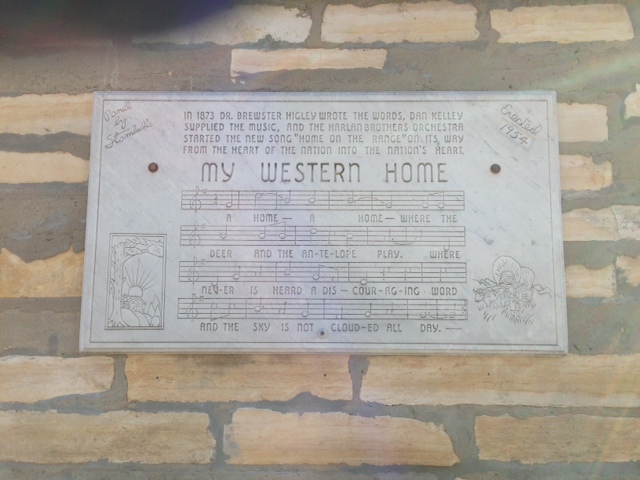
At the west end of the restored cabin of Dr. Brewster Higley is a commemorative plaque of "My Western Home," the original title of the poem and the song we now know as "Home on the Range."  I begin with this image because it is clearly not part of the attempt to restore the cabin as it would have appeared during Dr. Higley's occupancy.  Rather, it commerates the events that have made the cabin famous as the birthplace of "Home on the Range."  My blog of that name, posted 1-29-2015 describes the way in which Dr. Higley's poem was put to music and the investigation to prove that "My Western Home" and the music performed by the Harlan Orchestra truly were the original version of "Home on the Range.  You may wish to read my 2015 blog to acquaint yourself with that wonderful Kansas story!

Mark McClain gives us a tour
Last week's post described the home town preview of Ken Spurgeon's "Home on the Range, The Story of America's Iconic Song," and if you missed reading that you may continue reading at the botton of this week's post.  We attended Saturday's showing, and Sunday morning we visited the cabin with Mark McClain and his family.

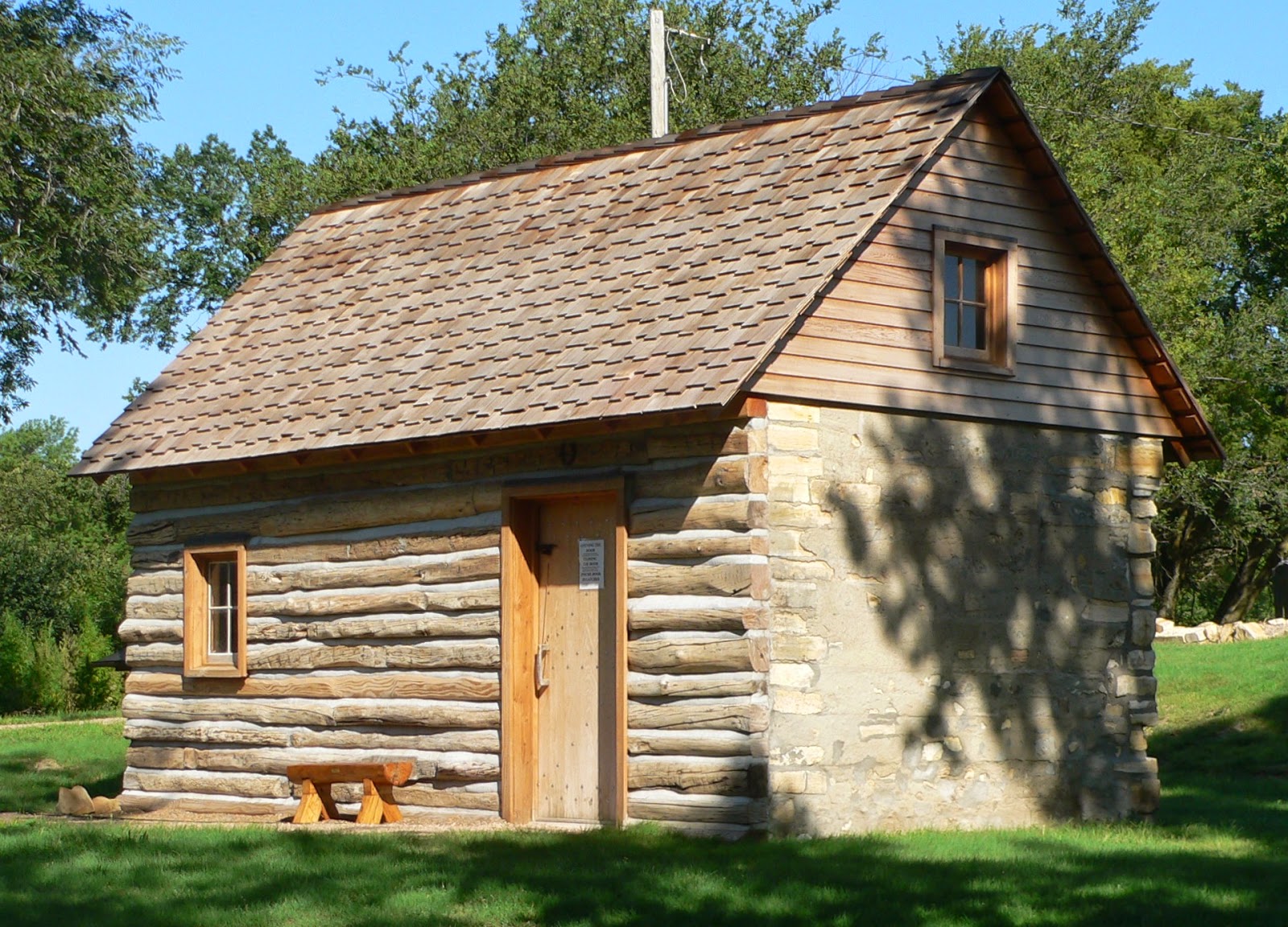
If our stay at the Ingleboro Mansion B&B in Smith Center gave us a hint of how a wealthy man in earlier times might have lived, the visit to Dr. Higley's cabin, not terribly far away in distance but very far away in character, showed us how a man whose life had been disappointing might have chosen to make a fresh start by going West to stake a claim.  Dr. Higley found a beautiful site near the West Beaver Creek and built his cabin from logs and stone that he found at the site. Most of this blog will consist of the photographs taken while we were there, with a bit of information about Dr. Higley and his relatives among the photographs.
Renovation display inside the cabin
Detail of stones and logs


Dr. Higley came to Kansas from Indiana, and his homestead claim was filed in 1871.  His attempts at marriage back in Indiana had been unhappy, but in 1875 he married Sara Clemens, and they lived in the cabin until 1886, moving first to Arkansas and then to Shawnee, OK where they lived until both of their deaths, his death only four months after hers.  Family oral history recounts Dr. Higley's saying that living in their Oklahoma home after her death was like "living in a tomb."  

By 1936 the property had passed to Ellen and Pete Rust, and they farmed it until Pete's death in 1986.  His widow Ellen died in 2008, but prior to her death she established a Trust to manage the farm and preserve the cabin.  How fortunate for generations to come that Ellen Rust recognized the importance of the cabin where "Home on the Range" originated.

More about the 240-acre land she saved in next week's blog, but for now, the story of the cabin continues.

The property had been a working farm, beginning with the homestead claim of Dr. Higley, and once the cabin was no longer used as a residence, it was put to utilitarian use on the farm.  Many local people remember its use as a chicken house.  In April of 2011 a campaign was begun to raise funds for the restoration of the cabin and grounds.  The goal was $100,000.

Western singer, Michael Martin Murphy did a benefit concert and nearly a quarter of the funds were raised in that first month, thanks to the benefit.

The pair of pictures above show a display of the careful renovation, including a picture of its use as a chicken house prior to the renovation.  The logs and stones were carefully marked and catalogued as the cabin was disassembled in preparation for the repairs necessary before reassembling the cabin.  As far as possible, the original materials were used to rebuild the cabin, but some rotted logs had to be replaced with vintage logs from other demolished structures of that period.

The reassembled cabin has a loft accessed by stairs.  There are no vertical walls in the loft, just the angled pitch of the roof.  In the small alcove beside and beneath the stairs a single bed is fitted.  The rope springs reminded me of the old saying, "sleep tight," a reference to keeping the ropes taught so the mattress would not sag.  The other part of that old saying is "...and don't let the bed bugs bite."    Entries in Isaac B. Werner's journal make it plain just how hard it was to keep bed bugs out of his bed!  It is likely that Dr. Higley experienced the same challenges.

In October of 2016, when the cabin renovation had been completed, two of Dr. Higley's relatives came to spend the night, Distant nephews of Dr. Higley, brothers Greg and Mike Higley traveled from Texas and Oklahoma to experience something of what their uncle might have felt.  Mike told reporter Ivan Schoone, "So peaceful, experiencing the beauty of the morning with the sun shining through the cabin window, the sounds of birds singing, coyotes howling in the night and the quietness of this place."  The brothers said it was hard to describe their feelings, but they also mentioned wondering what it would have been like as a homesteader when Native Americans were still living in what was a frontier.

Much of the filming of "Home on the Range, The Story of America's Iconic Song" was done in the cabin and the surrounding property.  Ken Spurgeon's wife, Amy, a CPA who  normally serves as Production Accountant for Lone Chimney Films,  remembers a very different role while they were filming during the hottest months of summer.  "It was really important that I kept everyone well hydrated in that heat!" she told me, remembering how she made sure everyone had water and that they remembered to drink it.

Next week's blog will share pictures of the creek, trees, and meadows on the 240-acre Trust lands.


Wednesday, February 1, 2017

Home on the Range Film Festival

Fans leave 1st showing as others await 2nd showing
As I was doing my research for my manuscript about Isaac B. Werner, I came across Kansas historian and Wichita State University professor Craig Minor's books, particularly his book "West of Wichita."  I immediately became a fan and hoped to arrange an opportunity to meet him.  Sadly, when I reached out to contact him, I learned of his untimely death only two months earlier.  I still regret that  missed opportunity.  In preparing this blog about the new docudrama, "Home on the Range, The Story of America's Iconic Song," I discovered a comment about Craig Minor made by the director of that new film, Ken Spurgeon.  Ken recalled how Craig Minor's encouragement to tell the wonderful stories about the history of Kansas had motivated him to pursue his goals of telling those stories, continuing with the story of "Home on the Range."  I am sad that I never had the opportunity to meet Kansas historian Craig Minor, but Ken's Spurgeon's recollection made me feel that my blogs  about Kansas history, posted weekly since 2011, would have pleased him.  Those of you who follow my blog regularly may remember the January 29, 2015 blog post, "Home on the Range." .

Ken Spurgeon introduces the film
I was fortunate to have the opportunity to meet Ken Spurgeon this past weekend when we traveled to Smith Center to attend the home town premier of Spurgeon's movie "Home on the Range."  His movie about Kansas history, "Road to Valhalla, received the Best Documentary at the Cowboy Hall of Fame on April 18, 2015, as part of the Western Heritage Awards, and I hope his current film is as successful.

Showings were scheduled for Saturday and Sunday in Smith Center, and when both scheduled performances sold out, second showings were quickly scheduled for both days so that all the people who had come to see the movie could be accommodated.

Buck Taylor & Rance Howard
The film tells the story about how Dr. Higley's poem became the lyrics for "Home on the Range" and of the legal investigation that proved Higley's poem and the music written for it were indeed the original version.  Because those details are contained in my blog, "Home on the Range," posted 1-29-2015, I will not repeat that information here.  You may go to the blog archives, click on 2015, then on May to scroll down to read the blog titled "Home on the Range."  

Stone of Clarence Harlan
The film also includes the story of the Harlan brothers and their brother-in-law, Daniel E. Kelley, who wrote and performed the music.  Rance Howard, father of child star and director Ron Howard, plays the part of Clarence Harlan.  It was Clarence Harlan's testimony regarding how and when their band put Dr. Higley's poem to music and performed it at dances from 1878-1885 that established the true originators of "Home on the Range."  While we were in Smith Center we visited the grave site of Clarence Harlan.

Also appearing in "Home on the Range" are Buck Taylor, Mark Mannette, and Michael Martin Murphy, both as an actor and a singer.  You can read more about the film by going to Lone Chimney Films website or Ken Spurgeon's face book page.

Greatgranddaughter with Ken
Among the special performers and other guests was the great-granddaughter of Clarence Harlan, appearing in the photo with director Ken Spurgeon.  Another very special member of the audience Saturday was El Dean Holthus, brought from the hospital (probably against his doctor's orders?) to be seated in the back row to attend the film with which he had so much to do.  I was so sorry I did not get to speak with him, to thank him for his support of my 2015 blog and his invitation to my husband and me to return for a personal tour of the Home on the Range cabin and surrounding grounds.  We did finally get a wonderful tour from Mark McClain  while we were there for the preview, but we will be glad to take a rain check for a personal tour from El Dean when he is once again healthy!  

While we were in Smith Center we stayed at Ingleboro Mansion Bed & Breakfast, a Victorian home, which cetainly put us in the mood for going back in history.


Ingleboro Mansion B&B
It was definitely a special day, and next week's blog will share our visit to Dr. Higley's cabin where much of the movie was filmed.  Be sure to watch for the movie "Home on the Range, The Story of America's Iconic Song" if it appears near you, and perhaps it will appear on a local PBS station in the future.

The film will be shown February 18th at the Brown Grand Theater in Concordia, Ks at 3 p.m. and February 24th at the Murdock Theater in Wichita, Ks at 7 p.m. as part of a scholarship fundraiser.  More showings are currently being scheduled. 

Craig Minor was right--there are countless great stories about Kansas left to tell!

Thursday, January 29, 2015

Home on the Range

Photo credit:  Ammodramus
The recent death of Russell Bomhoff, a well-known name to the aviation world and especially in Wichita, KS, brought to the attention of his family his charitable contributions to certain historical projects, among them the saving of the cabin of Dr. Brewster Higley VI.  Higley built the cabin in 1875, but it had fallen into extreme disrepair until a group organized to rescue this important Kansas historical site.  Why are Dr. Higley and his cabin important?  Because Higley was the author of the poem that we know as lyrics for the Kansas State Song, "Home on the Range."

Dr. Brewster Higley VI

Dr. Higley came to Smith County, KS in 1871 to claim a Homestead, first living in a dugout before building his cabin alongside West Beaver Creek.  He was so charmed by his beautiful claim that he wrote a 6-verse poem that he titled "My Western Home," describing the land and its plants and animals.  In 1874 his poem was published in the Smith County Pioneer, the Kansas Farmer in Topeka, and the Kirwin Chief.  These publications leave no room for doubt concerning the authorship of the poem used as lyrics for "Home on the Range."  

Among Dr. Higley's friends was Daniel E. Kelley, a Civil War veteran who came to Smith County in 1872.  Daniel and his wife Lulu, together with the Harlan brothers (Lulu's siblings), formed the Harlan Orchestra, which frequently performed in the area between 1878 through 1885.  Daniel set Higley's poem to music, and "My Western Home" became a popular dance tune.


Photo credit:  How do you turn this on
  Enter David W. Guion, born Dec. 15, 1892, in Ballinger, TX, son of Judge John I. Guion (1854-1920), a former President of the Texas A&M Board of Directors.  David grew up on his father's ranch where he admired the cowboy life, as well as being introduced to African-American music when he attended church with a family servant.  As a boy he was sent to San Antonio by train for piano lessons, and the influence of both the music of the cowboys and the Negro church services came to play a large role in Guion's fame as a composer.  Unfortunately, Guion was not always careful to credit the sources of his musical adaptations.  Innocently or otherwise, he claimed to have first heard "My Western Home" from cowboys, and in 1925 when the song was published as sheet music in San Antonio, TX, Guion revised the song in 1930 for a Broadway show, retitled "Home on the Range.  FDR claimed "Home on the Range" as a favorite!  Both the sheet music and Guion's Broadway show tune claimed that no composer or author was known.  

The credit due Higley and Kelley might have been lost but for the greed of William and Mary Goodwin who, in 1934 filed a $500,000 lawsuit claiming copyright infringement on their own "My Arizona Home," copyrighted in 1905.  The search was on to determine the rightful ownship of the song.  The Museum Publishers Protective Association discovered that a Texas University professor named John Lomax who collected folk songs had published a collection in 1910.  The professor had recorded a soloonkeeper singing "Home on the Range" in 1908, and that man had once driven cattle on the Chisholm Trail to Kansas.  A Colorado mining song was similar, and early Dodge City cowboys had also sung a version.  The final proof linking the song to Higley and Kelley came from an 86-year-old resident of Smith County named Clarence B. 'Cal' Harlan who had sung the song 60 years earlier with the Harlan Orchestra.

The effort to designate a state song began with Kansas Governor Arthur Capper in 1915, but it took over three decades before the Kansas Legislature finally adopted "Home on the Range" as the official state song in 1947.  The Kansas State Song is recognized internationally, and Higley and Kelley finally have received the credit they are due. 

The Home on the Range Cabin was listed on the National Register of Historic Places in 1973, and the cabin site including 240 acres of range and cultivated land is owned by Peoples Heartland Foundation. With the help of volunteers and generous donors, the cabin was restored in 2013 to its 1870s appearance. 

Story Board Cartoon now housed in the Baylor University David W. Guion Collection