Showing posts with label antique quilts. Show all posts

Thursday, November 29, 2018

More History Sewn Into Quilts

One of my favorite quilt designs is called Wild Geese, which is still popular today.  A handmade quilt by Mary Melissa Groves Ratcliffe (1854-1939) uses the Wild Geese pattern.  One of the special things about quilting is discovering that many of the patterns go back generations.
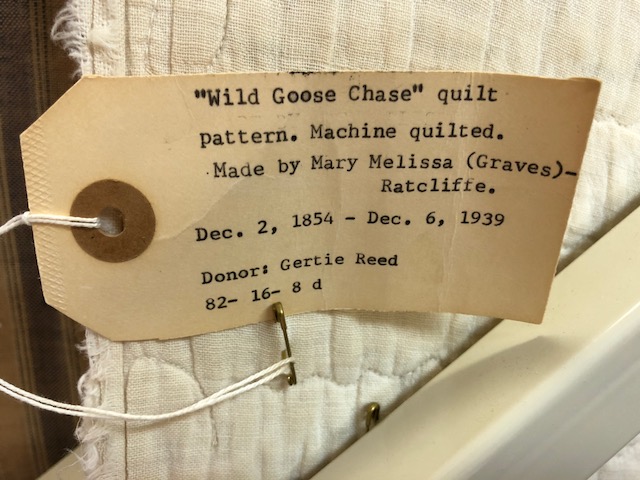


In addition to the repetition of quilt patterns, many quilters pass fabric down to younger generations.  My own mother was not a quilter, but she was a dressmaker, and I have some of her fabrics.  My mother-in-law, however, was a quilter, and I have many of her fabrics, among which are fabrics from her mother and from an older friend of hers who made dresses for other ladies in the community.  Consequently, I have quite a few treasured fabrics from several decades in the past.  

This log cabin quilt top was fun for me to study, because I thought I saw some fabrics from the same era as my inherited fabric collections.  This quilt top was made by Sarah Adeline McCandless Soice (1863-1936).  It was lined but never quilted, and because it was never completed for use on a bed, the colors remain fresh and bright.  The log cabin pattern remains a popular pattern, modified into many different designs.  It is especially useful for smaller scraps.


The next pair of quilts are interesting to compare because both were made by church ladies and both used the circle pattern to display names.  The quilt above was made by the Methodist Ladies and purchased at a fund raiser by Mrs. J.B.C. (Nancy) Cook, who died at the age of 93 in 1940.  

The Methodist Ladies used a white background with deep red rails and embroidery, but the ladies of the First Christian Church chose only the white background in 1954, omitting the bars, or rails, as they are also called.  However, they too chose a deep red for the embroidery.  Their group was called the Mizpah Class, which is Hebrew for "watchtower."

One of the especially striking quilts on display uses the fan pattern, bright colors on a black background.  Many years ago I made a pair of twin quilts using men's ties my husband no longer wore to create the wedge shapes required for the fan pattern.  I used old suits for the background behind the fans and navy blue solid rails between the fan blocks.  They are a very striking pair of quilts, but because of the wool in the background and rails, they are only suitable during winter months.  I realized while drafting this blog that I packed them away quite some time ago, and this winter I need to get them out and use them again.

There are more beautiful quilts to admire at the museum, and I recommend a visit.  If you missed last week's blog sharing more of the quilts from this collection, you may wish to scroll down to read that blog.  Next week's blog will feature the antique sewing machines that are also exhibited at the Stafford County Museum Quilt Exhibit.  Remember, you can click on the images to enlarge them.

P.S.  Thank you to Jim Clopton, who shared photographs of two lovely quilts at my face book post blog reminder, and to Mary Callaway Vandenberg who also shared a photograph of a beautiful family quilt dating back to 1865!  I have downloaded all three photographs and might do a future blog sharing those images if more of you post family quilts!


Thursday, November 22, 2018

History Sewn into Quilts

We had not been in the Stafford County Museum exhibit of quilts more than a minute when my husband insisted that I walk away from the quilt I was looking at and come join him.  No wonder.  When I walked to the back of the exhibit to see what he had found, there was my great grandmother's name stitched into one of the rectangles of the quilt.  Michael Hathaway, Executive Director, said we were the first people to have visited the exhibit and have found an ancestor's name on a quilt.  (Of course, some of the quilts were gifted by family members, and Michael was referring to visitors who had simply come to see the exhibit.)


It was a very special quilt.  People in the community were asked to pay $1 to have their name embroidered into the quilt to raise money for the Red Cross during W.W. I.  Four hundred eight people paid the dollar, but more money was raised when the quilt was auctioned.  As people were the highest bidders, they immediately handed it back to be auctioned again, and in that way more and more money was raised.  The funds were used to purchase yarn and other materials to make items for soldiers.  Some women embroidered their own block, and my great grandmother's appeared to have been such a block.

Susan L. Beck's daughter-in-law, my grandmother, was born in England but came to America as a toddler.  Her father, my great grandfather, had family in the village where he was raised, and that village sent many young men to the war, including some family.  In my blogs "The Steadfast Tin Soilder" posted 9-25-2014 and "The Steadfast Tin Soldier, a Sequel" posted 10-2-2014,  about the discovery of a W.W. I toy soldier, I write about that village and its service to the war effort.  It was a particular thrill to see my paternal great-grandmother Susan's name on that quilt.

Many of the quilts on display were made by a group of ladies, rather than a single seamstress, and the signatures of those working on the quilt were often sewn into the pattern.  Perhaps that contributed to the survival of the quilt, since the owner may have cherished the quilt too much to use it on a bed where it would receive every-day wear and tear.  The quilt above was purchased at an estate sale in 1981 and was made by ladies in the Taylorville community, with a reference that suggests a regular quilting group that called themselves the "Merrymakers."

The ribbon cutting of the Stafford County Museum's permanent quilt collection was held May 18, 2018.  The exhibit contains 39 quilts, many of them friendship quilts and fund raiser quilts filled with names of former residents from Stafford and surrounding communities.  The quilts are beautifully displayed on professional quilt hangers that are hinged to be opened like the pages of a book for easy viewing


Not all of the bed coverings in the exhibit are quilts, and fortunately, one lovely example was labeled by a subsequent owner to document the history of the spread.  It reads in part:  "This bedspread was made by Ann Eliza Riddell.  She spun the yarn and wove it into strips.  The strips were then sewn together to make the spread.  Ann Eliza Riddell born March 21, 1843, died April 24, 1914.  John Richardson born Sept. 28, 1839, died Oct. 5, 1915.  They were wed June 28, 1877, Ann being his second wife.  They lived in Estell County, Kentucky, near Irvine, Ky.  They came to Stafford County, Kansas in 1888 and homesteaded 7 miles northwest of Stafford."  (Remember to click on the images to enlarge.)

I have a particular affection for crazy quilts because they represent for me how precious even the tiniest scraps of special fabrics were to these ladies. Velvets and silks and other expensive fabrics of such small pieces that seamstresses today would deposit them into the trash without guilt were carefully saved by their ancestors and turned into something beautiful by patching the small pieces together and ornamenting the seams with their fancy stitching.  To create even more beauty, the patches themselves were decorated with embroidery.  This round crazy quilt, displayed on the wall of the museum exhibit, is a particularly beautiful example.

Next week I will share a few more quilts from the exhibit.