![]() |
| People's Party Political Cartoon |
Sharing history and news about my books, most recently "Prairie Bachelor" and a new manuscript under review, "Footprints on the Prairie."
Wednesday, September 18, 2024
Looking to the Past as a Reminder
Wednesday, January 24, 2024
What is Populism?
![]() |
| Isaac Werner's Journal |
Therefore, I am often perplexed by what is being called Populism today. While I was doing research for my book, I found present day politicians described as populists who were unlike the people I came to know in my research for Prairie Bachelor. It did not seem to make sense that very different politicians today are being called Populists.
Watching news during the recent 2024 primary election in New Hampshire, I heard someone say, "You know there is both Negative Populism and Positive Populism." I decided it was time for me to do some research to explore how the term Populism had evolved since Isaac Werner's time. In the era of my book, during the late 1800s, Populism began with the common people, such as farmers, ranchers, miners, and small business owners. They believed the two major political parties, Republican and Democrat, had become overly influenced by wealthy men, to the extent that they were ignoring the intensions of the founding fathers. Although the wealthy had more money with which to influence government, the common people had greater numbers of voters. They formed a party of their own--The People's Party, and although their party was short-lived, it remains the most successful third party in our nation's history. Many of their ideas were implemented by the two old parties.
My current research found that the term Populism had practically disappeared in common use by the 1950s; however, historians began to apply the word to those who were Anti-Elites. With the rejuvenation of the word Populism, it's original meaning expanded, becoming so broad that the meaning from the late 1800s, as well as the achievements of the people of the Populist movement, were nearly forgotten.
One political scientist noted the modern ambiguity of the term by describing the range of meanings for the word. It was used for farmers' radicalism, peasant movements, and intellectual agrarian socialism, as well as populist dictatorships, populist democracy, reactionary populist, and politicisms' populism. If you followed all of those adaptations of the meaning of Populism, your head must be spinning. Some have observed the contradictory meanings of these uses and have suggested that the word should be abandoned entirely. (Wikipedia, Populism)
What would Isaac Werner and other Populists of the late 1800s think of the use of the word they created as it is being used today. If there is the word Populism in today's politics, who defines what is Negative Populism and what is Positive Populism? I am inclined to agree that the journalists, news commentators, and politicians of today return the word to the Populists of the late 1800s and come up with new words for the political turmoil of today!
Wednesday, July 6, 2022
Pausing to Remember the Past
![]() |
| Photo credit Lyn Fenwick |
As it turned out, there was a lot to see, and this blog is not only about our visit from Isaac's cousins but is really about the things around us that we no longer give our attention--that we fail to share with our children and grandchildren. While the things available to share are not exactly like they were when our ancestors lived, there are still things to see and stories to share. That is what this week's blog is about.
![]() |
| Photo credit Larry Fenwick |
The picture above of David Werner, Isaac's 1st cousin 3 times removed, having slipped back to take one more picture of Isaac's grave, particularly touched me. As did the light touch on the corners of Isaac's stone by each of the cousins--LaRita, David, and Cynthia--as the group gathered around for a photograph. (Also in the picture is Deann Werner.) The emotions for this once forgotten bachelor cousin were real.
I walked them around the quiet country cemetery, pointing out the graves of friends of Isaac, many of whom are mentioned in Prairie Bachelor, and I directed their attention to the number of settlers whose stones displayed their military service in the Civil War. Particularly emotional were the many stones of infants and young children.
We drove around Isaac's timber claim and homestead, although both are changed by cultivation for more than a century. The second day we returned, first for a farewell to Isaac and then for a tour of his community. As we drove through the community, I read brief excerpts from Prairie Bachelor, connected with the particular locations where we paused, such as the land where Isaac stayed with neighbors in his final days, the locations of the country post offices, the location of the home of the young man who visited Isaac every day until Isaac could no longer remain in his home--sharing details at each pause related to each of his neighbors in some way. They couldn't believe how far he walked in his community for visits, jobs, and other reasons.
They discovered their own surprises--how sandy the soil was, how pretty the wild flowers were, how many animals they saw on the country roads, how the cottonwood trees had looked like a snowfall had covered the bark, and because of the blackened trees from a recent fire in our community that burned many acres, how frightening prairie fires must have been in Isaac's time.
![]() |
| Lyn, Dave & LaRita: Photo credit Larry Fenwick |
Although I had worried that there would be too little to show them, that was never the case. Of course, I have written this blog to share their visit with you, but I hope that it may encourage you to consider your own family tour, whether to see sights specifically relevant to your family or just to explore the community that we sometimes take for granted.
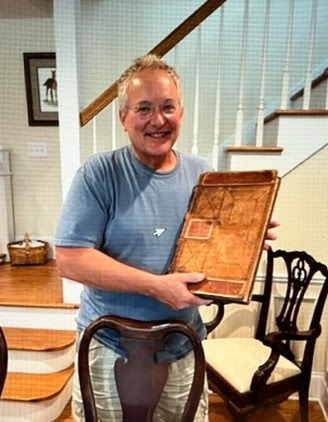
I will close with a final photograph that perhaps best displays the joy of connection with roots from the past. I had covered the dining room table with examples of my research, and added to the display was an incredible research collection compiled by Cynthia McClanahan Cruz, tracing the Direct Descendants of Henry and Magdalena Meyer Werner, (Isaac's grandparents), genealogy that stretched back to the generation that connected all of the guests to one another. Among these items placed on the table to be explored was Isaac's Journal. I will close with the picture that seems to say it all.
![]() |
Photo credit Larry Fenwick |
Without Isaac Werner's daily entries in this 480 page oversized journal, there would never have been a Prairie Bachelor, The Story of a Kansas Homesteader and the Populist Movement. Many of you who had never heard of the Populist Movement in which Kansas and other states played such a significant role, might never have known about it, its influence today, and the roots of Populism and Progressivism. For many readers of the book, they now understand the challenges their own ancestors faced during that time. Today, Kansas is sometimes referred to as a "flyover state," but those who know its full history know better!
Wednesday, March 11, 2020
Truth vs. Interpretation
![]() |
| Cicero: Credit, Liam Clarkson-Holborn |
![]() |
| Friedrich Nietzsche - 1861 |
"What is morally wrong can never be advantageous, even when it enables you to make some gain that you believe to be to your advantage. The mere fact of believing that some wrongful course of action constitutes an advantage is pernicious." Marcus Tullius Cicero, (106-43 BCE)
Thursday, June 27, 2019
Corporations and the People's Party
| Isaac's journal kept during the Populist Movement |
![]() |
| Power of Wall Street & Railroads political cartoon |
![]() |
| United States Supreme Court |
For Scalia, the individual shareholder in the corporation has not only his voice but also the voice of the corporation of which he is a part. One might say such a person has his own tiny voice but also the megaphone volume of his voice amplified by the wealth and influence of the corporation. Others might see it as unfair for both individual shareholders and the corporation of which they are a part to have the protection of the 1st Amendment's freedom of speech, but the Supreme Court did not.
Thursday, July 13, 2017
What is Populism?
| Isaac Werner's Journal |
![]() |
| Political cartoon from the County Capital in St. John, KS |
| FDR and Populist ideas |
Thursday, December 15, 2011
Isaac & "The Wizard of Oz"
For most readers, especially the children for whom L. Frank Baum wrote, The Wonderful Wizard of Oz is as Baum intended, "a modernized fairy tale, in which the wonderment and joy are retained and the heartaches and nightmares are left out." In his Introduction for the book, Baum left little doubt about his intentions: "Folklore, legends, myths, and fairy tales have followed childhood through the ages, for every healthy youngster has a wholesome and instinctive love for stories fantastic, marvelous, and manifestly unreal. The winged fairies of Grimm and Andersen have brought more happiness to childish hearts than all other human creations." However, Baum believed, "...the time has come for a series of newer 'wonder tales' in which the stereotyped genie, dwarf, and fairy are eliminated, together with all the horrible and blood curdling incidents devised by their authors to point a fearsome moral to each tale." Baum never outgrew his capacity for creative fantasy, and he believed it was important to encourage a child's sense of wonder and imagination.
Yet, as clearly as Baum stated his intention, adults have repeatedly imposed their own interpretations and ideas upon Baum's work. The 1939 movie has several minor changes, ruby rather than silver slippers being one example. The biggest change, however, was to begin the movie with a sepia-colored sequence at Dorothy's prairie home, with actors that were easily recognizable later in the movie as the Scarecrow, the Tin Woodsman, the Cowardly Lion, and the Wicked Witch. The movie, as wonderful as it is, declined to trust children's imaginations to accept that the tornado actually transported Dorothy to a real Land of Oz, suggesting instead that Dorothy's trip to Oz had only been a dream. While L. Frank Baum would surely have loved the movie, as so many generations of children already have, I suspect he would have been disappointed by the movie producers' decision to present Dorothy's visit to Oz as a dream.
So, why am I writing about L. Frank Baum and Oz on Isaac B. Werner's blog? One reason is to share how some scholars have gone even further in pre-empting Baum's fairytale for children. In 1954 a history teacher named Henry M. Littlefield suggested that The Wonderful Wizard of Oz could be interpreted as a parable of the Populist movement, using Baum's characters as stand-ins for people or places connected to The People's Party: the Scarecrow as the farmer; the Tin Woodsman as the industrial laborer; the Emerald City as Washington, D.C.; the Wicked Witch of the East as Eastern millionaires, monopolists, and bankers; and depicting the Populist opposition to the gold standard and belief in a return to bimetallism and renewed coinage of silver represented as the Yellow Brick Road misleading people toward reliance on the gold standard; Dorothy's silver slippers representing the untested power of returning to silver; and the Cowardly Lion as Populist (and Democratic) 1896 Presidential candidate William Jennings Bryan. Littlefield's theories about the allegorical meanings of the book led others to propose their own historical and political interpretations, one of the most interesting being that the name of Oz itself came from the bimetallism ratio of sixteen ounces of silver to one ounce of gold, suggesting to one scholar that Baum had used the abbreviation for an ounce as the name of the Emerald City.
Eventually, Michael Patrick Hearn, who is widely recognized as the leading scholar on L. Frank Baum and who authored the Introduction, Notes & Bibliography for The Annotated Wizard of Oz, weighed in on the debate with a letter to the New York Times, stating that he had found "no evidence that Baum's story is in any way a Populist allegory." A few weeks later, Henry M. Littlefield wrote a letter in reply, agreeing that "there is no basis in fact to consider Baum a supporter of turn-of-the-century Populist ideology." All of this makes an interesting connection between Baum and Isaac, and although Isaac died before the book was published, he was active in the Farmers' Alliance and supportive of Populist candidates.
A second reason is historical, since Dorothy's adventure begins on a farm on the Kansas prairie during the hard times Isaac described in his journal. While I agree with Michael Patrick Hearn that Baum intended to write a book for children and not an elaborate allegory about the populist movement and the election of 1896, I think it is natural that Baum was influenced by the events of his time. After the collapse of the Baum family's theatrical business, L. Frank Baum moved his family to Aberdeen, South Dakota to open a general store, but the hard times meant there were too few customers with money to purchase his goods, and the bank foreclosed on his store. He then purchased and ran a newspaper, which certainly made him familiar with the news of the day. It seems inevitable that some of what he saw around him would weave its way into his story.
Except for the fact that Isaac and some of his neighbors had planted trees on their timber claims and homesteads, Baum's fictional description of the Kansas plains on the opening pages of the book is not too different from what farmers in parts of Kansas might have seen during the years of drought in the late 1880s and 1890s. Baum wrote: "When Dorothy stood in the doorway and looked around, she could see nothing but the great gray prairie on every side. Not a tree nor a house broke the broad sweep of flat country that reached the edge of the sky in all directions. The sun had baked the plowed land into a gray mass, with little cracks running through it. Even the grass was not green, for the sun had burned the tops of the long blades until they were the same gray color to be seen everywhere."
The connection between Isaac's Journal and L. Frank Baum's Oz book was recalled to my attention as we prepared for a special event. The Macksville City Librarian, Jody Suiter, asked my husband and me to share our love of Oz with the K thourgh 5th grade students, and it was decided to use the larger space of the grade school library for the presentations. The picture at the right is of my husband handing out diplomas, signed by Oz and awarding each student a Degree of ThD (Doctor of Thinkology).
We had a wonderful time preparing for the day--baking cookies, making bookmarks, selecting which parts of the book to read to the students, printing diplomas, and choosing pictures from some of our favorite Oz illustrators to show them--Michael Hague, Charles Santore, W.W. Denslow, Robert Ingpen, Scott Gustafson, Robert Sabuda, and the unusual Lisbeth Zwerger. We decorated a tree with our collection of Oz ornaments, shared our one-of-a-kind Oz chess board with the 4th & 5th graders, told the story of Oz to the kindergarten & 1st graders with the help of hand-crafted Oz dolls, and compared how different illustrators imagined Oz in unique ways with 2nd & 3rd graders. In short, the innocence and enthusiasm of the students provided us with an afternoon of the very magic Baum wished for children when he wrote his stories, and through them, we experienced it too.
So, the movie makers can be forgiven for using artistic license to alter Baum's story for the screen, and the scholars can be humored for twisting Oz into a historical & political allegory, so long as children can still find magic in the Land of Oz as Baum intended.
(To see more pictures and information about our sessions with the children, visit Jody Suiter's wonderful website at http://macksville.mykansaslibrary.org/.)