Showing posts with label Robert Sabuda. Show all posts

Wednesday, June 11, 2014

Learning Early


Whatever the cost of our libraries the price is cheap compared to an ignorant nation.  Walter Cronkite

Jody Suiter introduces Lyn Fenwick as the day's speaker.
Everyone watches for the next pop-up illustration!
The flyleaf of Isaac's journal included a notation, "Vol. 5th."  At that time, Isaac was in his mid-20s, apparently having already filled four earlier journals!  His twin brother also kept a journal, now in a library in Reading, PA.  According to school records, Isaac and his brother were both attending school at the age of seventeen, longer than many students of that era.  Apparently Isaac's parents taught their children a love for learning, a quest for reading, and a habit of regular journaling.  (See "Advice from Henry Ward Beecher," 12/7/2012.)  

The training to learn these things is best taught early, and Isaac's old community is fortunate to have excellent small-town libraries. (See "April Delight," 4/30/2014 about the Kinsley Library.)  St. John has a wonderful library located next to the school so that it can be utilized by the students.  Several old photographs appearing in previous blogs were found there.  (See "Music on the Prairie," 1/24/2013 and "Women on the Prairie," 2/2/2013.)

I am particularly impressed by the Macksville City Library and its librarian, Jody Suiter.  It was Jody who contacted me to do a program about "The Wizard of Oz."  (See "Isaac and the Wizard of Oz," 12/15/2011.)  That program, initiated by Jody, was held in the library of the Macksville Grade School, with several grades attending a series of programs planned for the different grade levels throughout the afternoon.
Sharing Robert Sabuda's art.

The Summer Reading Program for Macksville kids is amazing for such a small town.  I was pleased when Jody asked me to do a presentation about engineered books.

Remember, you can click on the images to enlarge them.


Sometimes a little help is really appreciated.
I began with a fairly simple engineered book from the 1950s, "Santa Claus in Toyland," and followed with another Christmas book by Tasha Tudor.  I told the children about the National Center for Children's Illustrated Literature in Abilene, TX and shared  "Knick-Knack Paddywhack!" by Paul Zelinsky, whom we met at the NCCIL.
This young artist needs no help.

When I shared the beautiful pop-up book illustrated by Kees Moerbeek, an artist from the Netherlands, depicting the classic "Raggedy Ann and Andy and the Camel with the Wrinkled Knees," I told them about checking out this original story by Johnny Gruelle from the old St. John Library over the fire station, a magical place in my memory from my pre-school visits many years ago.  I followed that with a recently published pop-up book of the classic by Antoine De Saint-Exupery's, "The Little Prince."

A special card for Dad!
I had asked the children if they could ever imagine a trip to the dentist as being a wonderful memory to one famous artist of children's pop-up books.  I explained that it was in a dentist office where Robert Sabuda saw his first engineered book, and I told them to remember to listen for his name.

Young artists pose with their cards.
When it was finally time to enjoy the Sabuda books, several hands shot up to show that they remembered his name.  I began with "Fairies and Magical Creatures." Next I turned every page and read aloud Maurice Sendak's "Mommy?" engineered by Sabuda's partner Matthew Reinhart, and they loved all the ghoulish creatures!  Many of the children remembered Sabuda's "Wonderful Wizard of Oz" from seeing it when we did the Oz programs at the school, followed by Sabuda's "Peter Pan."  I saved Sabuda's "Alice in Wonderland" for last, finishing with the dramatic scene of Alice throwing all of the playing cards into the air.

The children help each other make their cards.
When my part of the program ended, Jody had a special project for the children, inspired by ideas from http://robertsabuda.com.  Using the ideas for creating pop-ups that she found there, she provided the materials for the children to make pop-up Father's Day cards, or cards for anyone they wanted to surprise with a hand-crafted card.

Mrs. Loomis helps with a pop-up card.
All of the photographs on this blog were taken in the Macksville City Library on a rainy day where a group of eager children learned about the magic of engineered books and created their own special pop-up cards.  Walter Cronkite and Isaac Werner would have smiled at the enthusiasm of these children as they selected the books they wanted to take home to read!  It certainly looked as if they were well on their way to a lifetime love of reading!!


To see more photographs and read more about the Summer Reading Program you may visit macksville.scklf.info.  


Friday, December 30, 2011

Year's End

So much of 2011 has been spent with Isaac--first, completing the transcription of his journal after eleven months of looking over his shoulder at what he wrote every day from a distance of more than a century; second, reading old newspapers until I sometimes knew more about the people and events of Isaac's place and time than current goings-on in my own world; third, researching Isaac's neighbors until I knew the names of their children and their final resting places; fourth, discovering significant history about my home state and the nation that I had never learned; fifth, feeling that I was finally ready to begin writing Isaac's story; and sixth, introducing Isaac on the internet with my blog as I shared my adventures in researching and writing the book about Isaac B. Werner. [I Love History, 10/17/2011]

Before beginning this post, I went back to Isaac's entries on December 31st for each year of his journal, [Finding Isaac's Journal, 10/23/2011] thinking I would include his words about the closing of the year. In fact, those entries were no different from what he wrote every day of the year--weather, work to be done, his health--just another day. Apparently Isaac would have agreed with NYT journalist and author Hal Borland (1900-1978) who wrote: "Year's end is neither an end or a beginning but a going on, with all the wisdom that experience can instill in us."

Rather than sharing Isaac's words about the closing of the year, I decided to share some of the comments followers of this blog have sent to me. At first, most of the e-mails I received were encouragement or brief expressions of delight with Isaac. "I love this stuff--here's to Isaac and his loquaciousness." M.C. Many of you described how you were connecting with things mentioned in the posts. "You write so well it feels lyrical. I savored every word. I stopped at the word commode--my grandmother used that term, and it came to life..." A.M. [Small Town Museums--Lucille M. Hall Museum, 10/29/2011]

I had no idea so many people loved cottonwood trees until I began receiving messages about that post. Among those who wrote: "I loved your piece on the cottonwoods and on the land. It's sad that once everything is bulldozed and leveled how hollow it all seems, and how much history and how many life stories are lost." J.Y. "How I loved to listen to the leaves when visiting the farm on vacation. I loved the belt lines of trees and was so disappointed to see so many dying when we went to the reunion. Hasn't history shown the need for those tree belts? The trees and their music are so soothing, as well as beautiful." N.H. "When my first husband and I built a home north of Slater, Missouri, I pulled up a cottonwood tree growing on the banks of the Mississippi River and replanted it in the yard so I could hear the clacking of the leaves. I loved it." L.K. I was naturally flattered when someone admired how I described the dying trees: "I enjoyed the cottonwood blog. I especially liked 'Today, many tree rows look like graveyards, the trunks of fallen trees bleaching white in the sun as aging neighbors await their turn to fall.' I know exactly what you are describing, and I cannot think of a better way to have done so." D.B. [Isaac Plants Cottonwood Trees, 12/2/2011]

When I mentioned in the post about Isaac's childhood in Wernersville, PA that his teacher, Francis Trout Hoover, had written a novel with characters and plot loosely based on Isaac's hometown, one of you who lives in that area told me that "Hoover wrote that book so close to the truth, that people in Berks County were angry and embarrassed, and they didn't want their 'history' getting out..." K.R. [Isaac's Birth & Childhood, 11/4/2011]

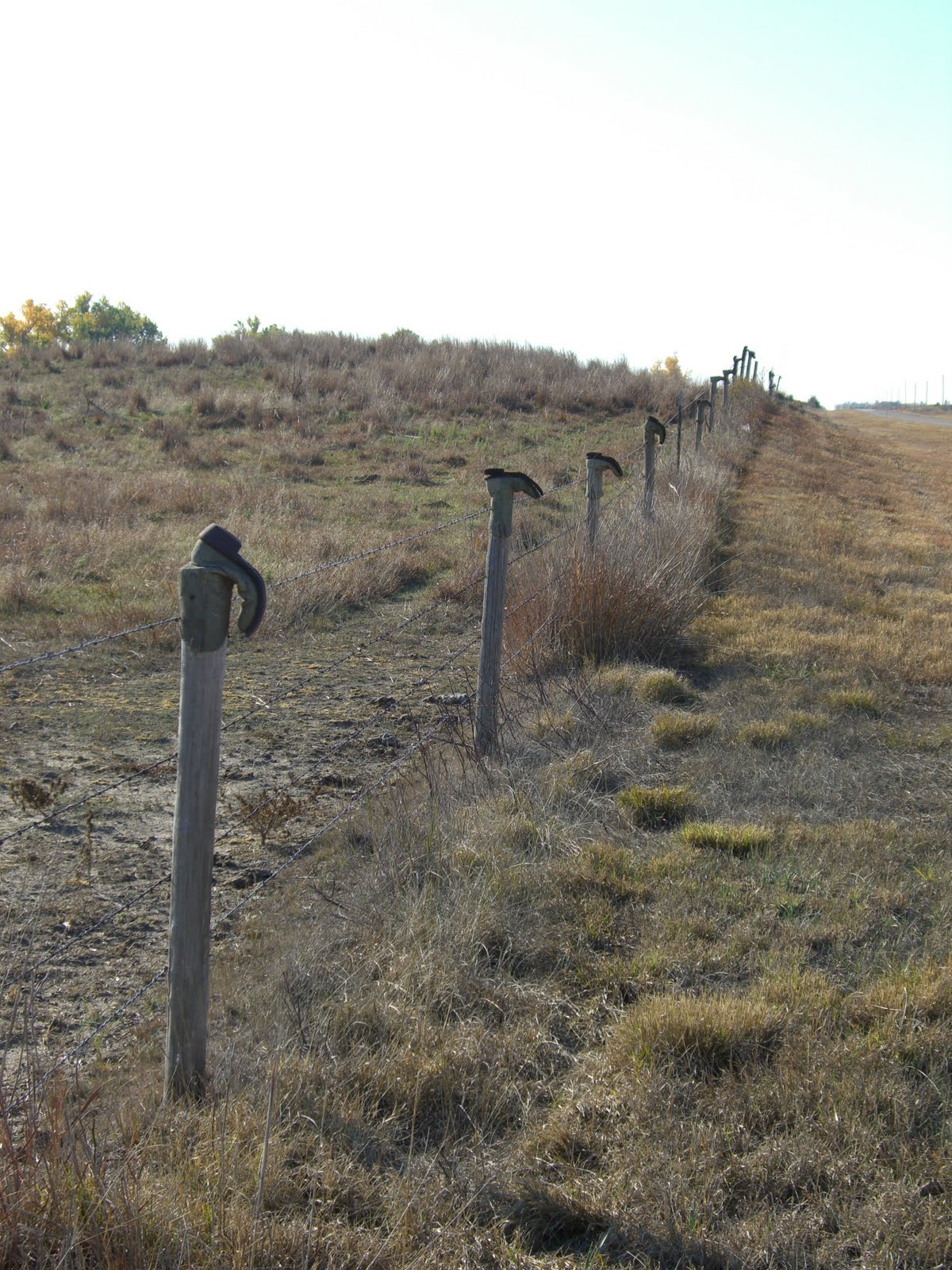
The tornado post, with a picture that included old boots on fence posts, drew this response: "The story was told that when a cowboy died his boots went up on the fence posts." A.M. [Isaac Sees 1st Tornado, 12/9/2011]

As more of you began to check the boxes at the ends of each post to let me know which ones you found particularly interesting and what you wanted to read more of, I was glad that so many of you enjoyed the political cartoons. Kansas was the center of the Farmers' Alliance and the political party that grew out of grass roots organizations formed by farmers and other laborers. Much of Isaac's Journal includes his political experiences and opinions. It is remarkable how many parallels there are between politics in the 1890s and today. [Politics Hardly Seem to Change, 11/24/2011]

When I mentioned some of my favorite illustrators of children's books in the post about Isaac and L. Frank Baum, I was delighted to receive e-mails from two of those illustrators. Michael Hague wrote, "I think it is important for the kids to value their creativity and imaginations and have people around them who are active in the arts and embrace it as an important part of their lives." Pop-up engineer and artist Robert Sabuda's animated tornado in his Oz book certainly drew excited Ohs and Ahs from the children. Sabuda wrote to me, "I love to see everyone enjoy my books. It makes the hard work worthwhile." [Isaac & the Wizard of Oz, 12/15/2011]

No post generated more enthusiasm among those of you who follow my blog than the one about disappearing traces of the past, and part of that was the impact of the photographs. "...so poignant and haunting. Those images and emotions speak to me as no other. I've always been that way, finding interest and increased curiosity toward the lonely, the forgotten, the lost." T.K.B. "Of the hundreds of reasons that houses might be left as you portrayed that house, surely one of them is that people live their lives until the end, but they don't 'finish' them as one might finish a skein of knitting." S.S. "I, like you, remember my grandfather farming and how all the homes have disappeared." J.R. "Just finished your latest blog. It makes me sad to confront what I already know about the familiar things we grew up with." A.B.C. "The older I get the more I miss what I had when I was a kid. That is life for most folks, I guess." R.B. [Disappearing Traces of the Past, 12/23/2011]

The encouragement and support that so many people, friends and strangers, have extended to me since I began this blog three months ago matter very much on a personal level, but I am especially pleased that what I am doing touches the feelings of many of you. Writing the blog has made me observe things that in my hurry to tend to business I was overlooking. It has enriched every day for me to practice the habit of seeing and reflecting, and I hope some of that has been transmitted to all of you.

Yesterday as my husband and I drove a road we've traveled hundreds of times, I saw an old house in a grove of dying cottonwood trees, and I had to have a photograph of it to share with all of you who loved the posts about cottonwoods and disappearing traces of the past. My husband, who generously tolerates my affection for another man--Isaac, of course--patiently turned around and went back so I could photograph the old house.

Thanks to all of you who are following my blog and who communicate with your checks in the boxes, clicks on +1, e-mails, and face-to-face encouragement. The comments at the end of posts are wonderful, and if you haven't been opening those, you might enjoy going back to read them, or adding comments of your own. Of all the wonderful responses people have shared with me, this simple statement sums up very well what I am trying to accomplish: "I feel like I knew Isaac!" D.K. I hope you will enjoy the future posts and will spread the word so more people can get to know Isaac too!!

Since Isaac did not provide me with a New Year's message to share, I will pass along the words of Benjamin Franklin: "Be always at war with your vices, at peace with your neighbors, and let each new year find you a better man."

Thursday, December 15, 2011

Isaac & "The Wizard of Oz"


For most readers, especially the children for whom L. Frank Baum wrote, The Wonderful Wizard of Oz is as Baum intended, "a modernized fairy tale, in which the wonderment and joy are retained and the heartaches and nightmares are left out." In his Introduction for the book, Baum left little doubt about his intentions: "Folklore, legends, myths, and fairy tales have followed childhood through the ages, for every healthy youngster has a wholesome and instinctive love for stories fantastic, marvelous, and manifestly unreal. The winged fairies of Grimm and Andersen have brought more happiness to childish hearts than all other human creations." However, Baum believed, "...the time has come for a series of newer 'wonder tales' in which the stereotyped genie, dwarf, and fairy are eliminated, together with all the horrible and blood curdling incidents devised by their authors to point a fearsome moral to each tale." Baum never outgrew his capacity for creative fantasy, and he believed it was important to encourage a child's sense of wonder and imagination.

Yet, as clearly as Baum stated his intention, adults have repeatedly imposed their own interpretations and ideas upon Baum's work. The 1939 movie has several minor changes, ruby rather than silver slippers being one example. The biggest change, however, was to begin the movie with a sepia-colored sequence at Dorothy's prairie home, with actors that were easily recognizable later in the movie as the Scarecrow, the Tin Woodsman, the Cowardly Lion, and the Wicked Witch. The movie, as wonderful as it is, declined to trust children's imaginations to accept that the tornado actually transported Dorothy to a real Land of Oz, suggesting instead that Dorothy's trip to Oz had only been a dream. While L. Frank Baum would surely have loved the movie, as so many generations of children already have, I suspect he would have been disappointed by the movie producers' decision to present Dorothy's visit to Oz as a dream.

So, why am I writing about L. Frank Baum and Oz on Isaac B. Werner's blog? One reason is to share how some scholars have gone even further in pre-empting Baum's fairytale for children. In 1954 a history teacher named Henry M. Littlefield suggested that The Wonderful Wizard of Oz could be interpreted as a parable of the Populist movement, using Baum's characters as stand-ins for people or places connected to The People's Party: the Scarecrow as the farmer; the Tin Woodsman as the industrial laborer; the Emerald City as Washington, D.C.; the Wicked Witch of the East as Eastern millionaires, monopolists, and bankers; and depicting the Populist opposition to the gold standard and belief in a return to bimetallism and renewed coinage of silver represented as the Yellow Brick Road misleading people toward reliance on the gold standard; Dorothy's silver slippers representing the untested power of returning to silver; and the Cowardly Lion as Populist (and Democratic) 1896 Presidential candidate William Jennings Bryan. Littlefield's theories about the allegorical meanings of the book led others to propose their own historical and political interpretations, one of the most interesting being that the name of Oz itself came from the bimetallism ratio of sixteen ounces of silver to one ounce of gold, suggesting to one scholar that Baum had used the abbreviation for an ounce as the name of the Emerald City.

Eventually, Michael Patrick Hearn, who is widely recognized as the leading scholar on L. Frank Baum and who authored the Introduction, Notes & Bibliography for The Annotated Wizard of Oz, weighed in on the debate with a letter to the New York Times, stating that he had found "no evidence that Baum's story is in any way a Populist allegory." A few weeks later, Henry M. Littlefield wrote a letter in reply, agreeing that "there is no basis in fact to consider Baum a supporter of turn-of-the-century Populist ideology." All of this makes an interesting connection between Baum and Isaac, and although Isaac died before the book was published, he was active in the Farmers' Alliance and supportive of Populist candidates.


A second reason is historical, since Dorothy's adventure begins on a farm on the Kansas prairie during the hard times Isaac described in his journal. While I agree with Michael Patrick Hearn that Baum intended to write a book for children and not an elaborate allegory about the populist movement and the election of 1896, I think it is natural that Baum was influenced by the events of his time. After the collapse of the Baum family's theatrical business, L. Frank Baum moved his family to Aberdeen, South Dakota to open a general store, but the hard times meant there were too few customers with money to purchase his goods, and the bank foreclosed on his store. He then purchased and ran a newspaper, which certainly made him familiar with the news of the day. It seems inevitable that some of what he saw around him would weave its way into his story.

Except for the fact that Isaac and some of his neighbors had planted trees on their timber claims and homesteads, Baum's fictional description of the Kansas plains on the opening pages of the book is not too different from what farmers in parts of Kansas might have seen during the years of drought in the late 1880s and 1890s. Baum wrote: "When Dorothy stood in the doorway and looked around, she could see nothing but the great gray prairie on every side. Not a tree nor a house broke the broad sweep of flat country that reached the edge of the sky in all directions. The sun had baked the plowed land into a gray mass, with little cracks running through it. Even the grass was not green, for the sun had burned the tops of the long blades until they were the same gray color to be seen everywhere."


The connection between Isaac's Journal and L. Frank Baum's Oz book was recalled to my attention as we prepared for a special event. The Macksville City Librarian, Jody Suiter, asked my husband and me to share our love of Oz with the K thourgh 5th grade students, and it was decided to use the larger space of the grade school library for the presentations. The picture at the right is of my husband handing out diplomas, signed by Oz and awarding each student a Degree of ThD (Doctor of Thinkology).


We had a wonderful time preparing for the day--baking cookies, making bookmarks, selecting which parts of the book to read to the students, printing diplomas, and choosing pictures from some of our favorite Oz illustrators to show them--Michael Hague, Charles Santore, W.W. Denslow, Robert Ingpen, Scott Gustafson, Robert Sabuda, and the unusual Lisbeth Zwerger. We decorated a tree with our collection of Oz ornaments, shared our one-of-a-kind Oz chess board with the 4th & 5th graders, told the story of Oz to the kindergarten & 1st graders with the help of hand-crafted Oz dolls, and compared how different illustrators imagined Oz in unique ways with 2nd & 3rd graders. In short, the innocence and enthusiasm of the students provided us with an afternoon of the very magic Baum wished for children when he wrote his stories, and through them, we experienced it too.

So, the movie makers can be forgiven for using artistic license to alter Baum's story for the screen, and the scholars can be humored for twisting Oz into a historical & political allegory, so long as children can still find magic in the Land of Oz as Baum intended.

(To see more pictures and information about our sessions with the children, visit Jody Suiter's wonderful website at http://macksville.mykansaslibrary.org/.)