Our spontaneous road trip to the Willa Cather Seminar at Smith College that led to the unplanned side trips to Rossville and Hoopeston (See my January 20 & 27, 2012 posts) resulted in other impromptu visits to authors' homes and historical sites, and when we wandered off the planned route as far as Gettysburg, I just had to go to Wernersville. Having made none of the research preparations I should have, I convinced my husband that it was nevertheless an opportunity we should not miss. As it turned out, we crowded more into our brief visit to Wernersville than I could have imagined if I had planned the visit for weeks.
Initially, I just wanted to see the land, to experience the mountain ranges that embrace the Lebanon Valley--the Blue Mountains to the north, the South Mountains to the South, and Mount Penn and Neversink in the distance to the east. I wanted to see the hillside farms of Isaac's youth, so different from the flat, sandy loam prairie where he did his farming. As I stepped out of the car to take a photograph of one of those Berks County, Pennsylvania farms, I experienced a moment when I almost felt that Isaac was arranging the experience, for the air was filled with more bird songs than I ever remember hearing at once. It was a twirping, twilling, whistling cacophony. Isaac loved birds, noting in his journal when favorite birds arrived back after winter, scattering grain for what he called his "pet flock of quail," posting his farm to protect the prairie chickens and quail from hunters before there were protective laws, pausing to watch the seasonal passage of geese over head. I stood there, listening to the chorus of bird songs and understood how quiet the prairie must have seemed to Isaac in comparison.
We had arrived in Reading, east of Wernersville, in late afternoon, and after checking into the hotel we had driven the few miles to Wernersville. About all we had time to do that evening was make sure we knew the way to Wernersville and how to find the cemetery at Hain's Church. That evening, as the sun went down, we found Isaac's twin brother's family gravesite in the "new" cemetery across the road from the church, with Henry, his wife, Eva, and their son, Charles, buried there, and Eva's parents buried nearby.
The next morning we had breakfast at the Red Plate Diner and met Reading Principal Joe Torchia, who was having breakfast with his daughter in the booth next to ours. When he overheard us discussing whether to order scrapple, he introduced himself and praised the local pork specialty so enthusiastically that we had to try it. I fear scrapple may be an acquired taste, but meeting him and his daughter in the pleasant surroundings of the diner was a great start to our day.
Despite a light rainfall, we wandered the old cemetery, located at St. John's (Hain's) Church, finding William Werner's grave and many other Werner aunts, uncles, and cousins buried there. The history of this church is too rich and wonderful for me to share in this post, but next week I will tell you about our unexpected discoveries when we stepped inside the church.
Part of my eagerness to visit Wernersville was to see the town William Werner had founded, although I realized that little would remain from that long ago. The Heidelburg Historical Society is housed in one of the oldest buildings remaining in Wernersville, originally a tavern, but the Society building was closed. We drove the streets that William had named with family names--William, Rebecca, Werner, Beckley and Reber. The old depot is in the process of being restored, but it was built after the original depot upon which the name "Wernersville" first appeared, negotiated by William as part of his consideration for allowing the railroad tracks to cross his farm. (To see pictures of the 1855 survey map and William Werner's grave, click on the 2011 blog archives for my November 4, 2011 post, "Isaac's Birth & Childhood.")
Having seen the popularity of the local Twisty Freeze, crowded with people of all ages enjoying the summer evening as we drove through town the previous night, we were tempted into taking a late afternoon break to sample their ice cream before ending our visit to Wernersville. We sat at one of their outdoor tables and reflected on how much we had learned during the past few hours. As former Michigan governor John Engler said when he entered the 2008 presidential race: "Sometimes it is better to begin the journey, to get underway, than it is to sit back and wait until such time that you're convinced that all conditions are perfect and that there'll be no surprises along the route." Our decision to visit Wernersville seems to have worked out better for me than his presidential race did, but I like his encouragement of daring the impromptu. In next week's post I will tell you just how wonderful the surprises that we found at St. John's (Hain's) Church turned out to be.
Sharing history and news about my books, most recently "Prairie Bachelor" and a new manuscript under review, "Footprints on the Prairie."
Showing posts with label Wernersville. Show all posts
Thursday, February 16, 2012
Friday, December 30, 2011
Year's End
So much of 2011 has been spent with Isaac--first, completing the transcription of his journal after eleven months of looking over his shoulder at what he wrote every day from a distance of more than a century; second, reading old newspapers until I sometimes knew more about the people and events of Isaac's place and time than current goings-on in my own world; third, researching Isaac's neighbors until I knew the names of their children and their final resting places; fourth, discovering significant history about my home state and the nation that I had never learned; fifth, feeling that I was finally ready to begin writing Isaac's story; and sixth, introducing Isaac on the internet with my blog as I shared my adventures in researching and writing the book about Isaac B. Werner. [I Love History, 10/17/2011]
Before beginning this post, I went back to Isaac's entries on December 31st for each year of his journal, [Finding Isaac's Journal, 10/23/2011] thinking I would include his words about the closing of the year. In fact, those entries were no different from what he wrote every day of the year--weather, work to be done, his health--just another day. Apparently Isaac would have agreed with NYT journalist and author Hal Borland (1900-1978) who wrote: "Year's end is neither an end or a beginning but a going on, with all the wisdom that experience can instill in us."
Rather than sharing Isaac's words about the closing of the year, I decided to share some of the comments followers of this blog have sent to me. At first, most of the e-mails I received were encouragement or brief expressions of delight with Isaac. "I love this stuff--here's to Isaac and his loquaciousness." M.C. Many of you described how you were connecting with things mentioned in the posts. "You write so well it feels lyrical. I savored every word. I stopped at the word commode--my grandmother used that term, and it came to life..." A.M. [Small Town Museums--Lucille M. Hall Museum, 10/29/2011]
I had no idea so many people loved cottonwood trees until I began receiving messages about that post. Among those who wrote: "I loved your piece on the cottonwoods and on the land. It's sad that once everything is bulldozed and leveled how hollow it all seems, and how much history and how many life stories are lost." J.Y. "How I loved to listen to the leaves when visiting the farm on vacation. I loved the belt lines of trees and was so disappointed to see so many dying when we went to the reunion. Hasn't history shown the need for those tree belts? The trees and their music are so soothing, as well as beautiful." N.H. "When my first husband and I built a home north of Slater, Missouri, I pulled up a cottonwood tree growing on the banks of the Mississippi River and replanted it in the yard so I could hear the clacking of the leaves. I loved it." L.K. I was naturally flattered when someone admired how I described the dying trees: "I enjoyed the cottonwood blog. I especially liked 'Today, many tree rows look like graveyards, the trunks of fallen trees bleaching white in the sun as aging neighbors await their turn to fall.' I know exactly what you are describing, and I cannot think of a better way to have done so." D.B. [Isaac Plants Cottonwood Trees, 12/2/2011]
When I mentioned in the post about Isaac's childhood in Wernersville, PA that his teacher, Francis Trout Hoover, had written a novel with characters and plot loosely based on Isaac's hometown, one of you who lives in that area told me that "Hoover wrote that book so close to the truth, that people in Berks County were angry and embarrassed, and they didn't want their 'history' getting out..." K.R. [Isaac's Birth & Childhood, 11/4/2011]
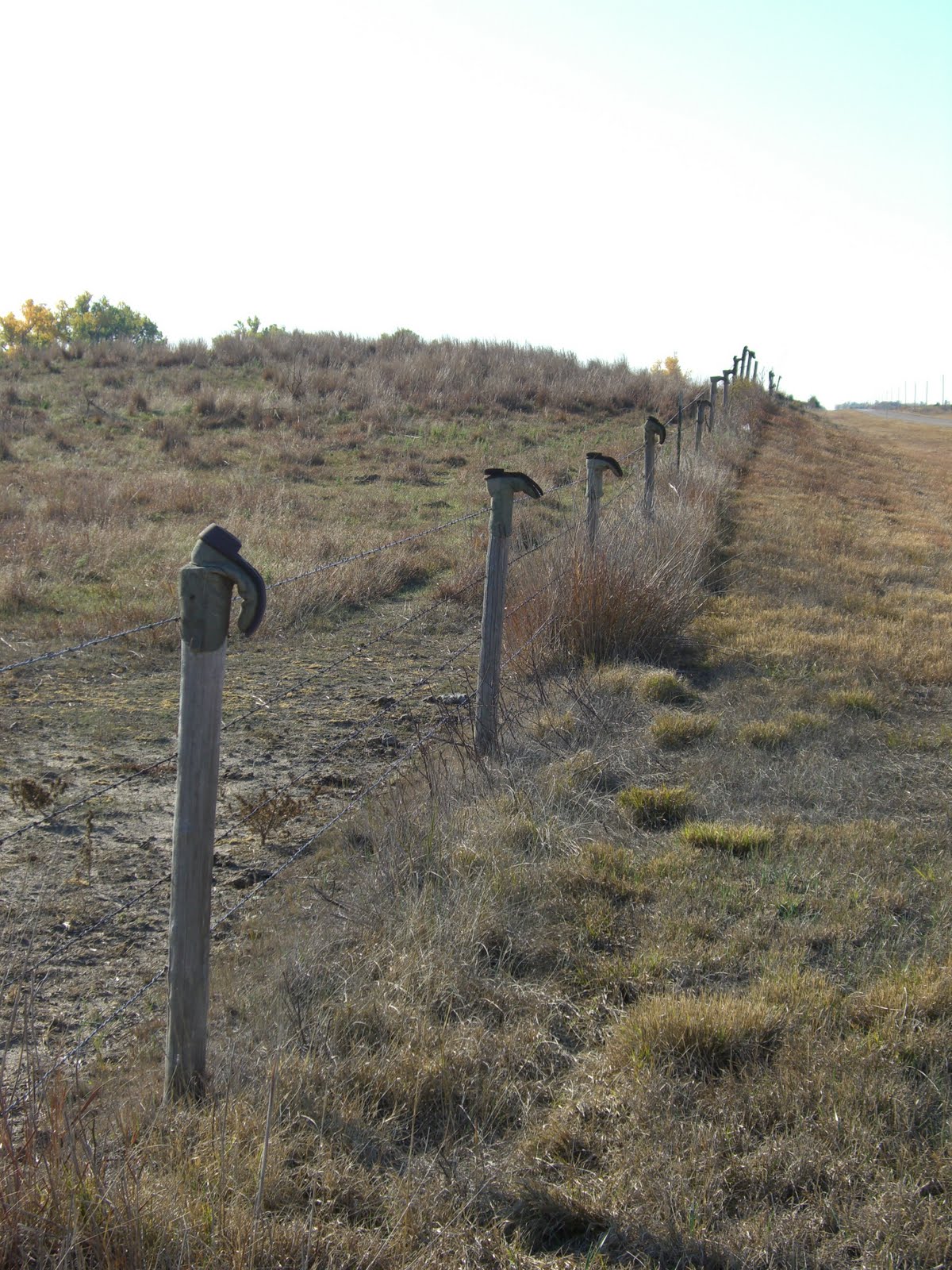
The tornado post, with a picture that included old boots on fence posts, drew this response: "The story was told that when a cowboy died his boots went up on the fence posts." A.M. [Isaac Sees 1st Tornado, 12/9/2011]
As more of you began to check the boxes at the ends of each post to let me know which ones you found particularly interesting and what you wanted to read more of, I was glad that so many of you enjoyed the political cartoons. Kansas was the center of the Farmers' Alliance and the political party that grew out of grass roots organizations formed by farmers and other laborers. Much of Isaac's Journal includes his political experiences and opinions. It is remarkable how many parallels there are between politics in the 1890s and today. [Politics Hardly Seem to Change, 11/24/2011]
When I mentioned some of my favorite illustrators of children's books in the post about Isaac and L. Frank Baum, I was delighted to receive e-mails from two of those illustrators. Michael Hague wrote, "I think it is important for the kids to value their creativity and imaginations and have people around them who are active in the arts and embrace it as an important part of their lives." Pop-up engineer and artist Robert Sabuda's animated tornado in his Oz book certainly drew excited Ohs and Ahs from the children. Sabuda wrote to me, "I love to see everyone enjoy my books. It makes the hard work worthwhile." [Isaac & the Wizard of Oz, 12/15/2011]
No post generated more enthusiasm among those of you who follow my blog than the one about disappearing traces of the past, and part of that was the impact of the photographs. "...so poignant and haunting. Those images and emotions speak to me as no other. I've always been that way, finding interest and increased curiosity toward the lonely, the forgotten, the lost." T.K.B. "Of the hundreds of reasons that houses might be left as you portrayed that house, surely one of them is that people live their lives until the end, but they don't 'finish' them as one might finish a skein of knitting." S.S. "I, like you, remember my grandfather farming and how all the homes have disappeared." J.R. "Just finished your latest blog. It makes me sad to confront what I already know about the familiar things we grew up with." A.B.C. "The older I get the more I miss what I had when I was a kid. That is life for most folks, I guess." R.B. [Disappearing Traces of the Past, 12/23/2011]
The encouragement and support that so many people, friends and strangers, have extended to me since I began this blog three months ago matter very much on a personal level, but I am especially pleased that what I am doing touches the feelings of many of you. Writing the blog has made me observe things that in my hurry to tend to business I was overlooking. It has enriched every day for me to practice the habit of seeing and reflecting, and I hope some of that has been transmitted to all of you.
Yesterday as my husband and I drove a road we've traveled hundreds of times, I saw an old house in a grove of dying cottonwood trees, and I had to have a photograph of it to share with all of you who loved the posts about cottonwoods and disappearing traces of the past. My husband, who generously tolerates my affection for another man--Isaac, of course--patiently turned around and went back so I could photograph the old house.
Thanks to all of you who are following my blog and who communicate with your checks in the boxes, clicks on +1, e-mails, and face-to-face encouragement. The comments at the end of posts are wonderful, and if you haven't been opening those, you might enjoy going back to read them, or adding comments of your own. Of all the wonderful responses people have shared with me, this simple statement sums up very well what I am trying to accomplish: "I feel like I knew Isaac!" D.K. I hope you will enjoy the future posts and will spread the word so more people can get to know Isaac too!!
Since Isaac did not provide me with a New Year's message to share, I will pass along the words of Benjamin Franklin: "Be always at war with your vices, at peace with your neighbors, and let each new year find you a better man."
Before beginning this post, I went back to Isaac's entries on December 31st for each year of his journal, [Finding Isaac's Journal, 10/23/2011] thinking I would include his words about the closing of the year. In fact, those entries were no different from what he wrote every day of the year--weather, work to be done, his health--just another day. Apparently Isaac would have agreed with NYT journalist and author Hal Borland (1900-1978) who wrote: "Year's end is neither an end or a beginning but a going on, with all the wisdom that experience can instill in us."
Rather than sharing Isaac's words about the closing of the year, I decided to share some of the comments followers of this blog have sent to me. At first, most of the e-mails I received were encouragement or brief expressions of delight with Isaac. "I love this stuff--here's to Isaac and his loquaciousness." M.C. Many of you described how you were connecting with things mentioned in the posts. "You write so well it feels lyrical. I savored every word. I stopped at the word commode--my grandmother used that term, and it came to life..." A.M. [Small Town Museums--Lucille M. Hall Museum, 10/29/2011]
I had no idea so many people loved cottonwood trees until I began receiving messages about that post. Among those who wrote: "I loved your piece on the cottonwoods and on the land. It's sad that once everything is bulldozed and leveled how hollow it all seems, and how much history and how many life stories are lost." J.Y. "How I loved to listen to the leaves when visiting the farm on vacation. I loved the belt lines of trees and was so disappointed to see so many dying when we went to the reunion. Hasn't history shown the need for those tree belts? The trees and their music are so soothing, as well as beautiful." N.H. "When my first husband and I built a home north of Slater, Missouri, I pulled up a cottonwood tree growing on the banks of the Mississippi River and replanted it in the yard so I could hear the clacking of the leaves. I loved it." L.K. I was naturally flattered when someone admired how I described the dying trees: "I enjoyed the cottonwood blog. I especially liked 'Today, many tree rows look like graveyards, the trunks of fallen trees bleaching white in the sun as aging neighbors await their turn to fall.' I know exactly what you are describing, and I cannot think of a better way to have done so." D.B. [Isaac Plants Cottonwood Trees, 12/2/2011]
When I mentioned in the post about Isaac's childhood in Wernersville, PA that his teacher, Francis Trout Hoover, had written a novel with characters and plot loosely based on Isaac's hometown, one of you who lives in that area told me that "Hoover wrote that book so close to the truth, that people in Berks County were angry and embarrassed, and they didn't want their 'history' getting out..." K.R. [Isaac's Birth & Childhood, 11/4/2011]
The tornado post, with a picture that included old boots on fence posts, drew this response: "The story was told that when a cowboy died his boots went up on the fence posts." A.M. [Isaac Sees 1st Tornado, 12/9/2011]
As more of you began to check the boxes at the ends of each post to let me know which ones you found particularly interesting and what you wanted to read more of, I was glad that so many of you enjoyed the political cartoons. Kansas was the center of the Farmers' Alliance and the political party that grew out of grass roots organizations formed by farmers and other laborers. Much of Isaac's Journal includes his political experiences and opinions. It is remarkable how many parallels there are between politics in the 1890s and today. [Politics Hardly Seem to Change, 11/24/2011]
When I mentioned some of my favorite illustrators of children's books in the post about Isaac and L. Frank Baum, I was delighted to receive e-mails from two of those illustrators. Michael Hague wrote, "I think it is important for the kids to value their creativity and imaginations and have people around them who are active in the arts and embrace it as an important part of their lives." Pop-up engineer and artist Robert Sabuda's animated tornado in his Oz book certainly drew excited Ohs and Ahs from the children. Sabuda wrote to me, "I love to see everyone enjoy my books. It makes the hard work worthwhile." [Isaac & the Wizard of Oz, 12/15/2011]
No post generated more enthusiasm among those of you who follow my blog than the one about disappearing traces of the past, and part of that was the impact of the photographs. "...so poignant and haunting. Those images and emotions speak to me as no other. I've always been that way, finding interest and increased curiosity toward the lonely, the forgotten, the lost." T.K.B. "Of the hundreds of reasons that houses might be left as you portrayed that house, surely one of them is that people live their lives until the end, but they don't 'finish' them as one might finish a skein of knitting." S.S. "I, like you, remember my grandfather farming and how all the homes have disappeared." J.R. "Just finished your latest blog. It makes me sad to confront what I already know about the familiar things we grew up with." A.B.C. "The older I get the more I miss what I had when I was a kid. That is life for most folks, I guess." R.B. [Disappearing Traces of the Past, 12/23/2011]
The encouragement and support that so many people, friends and strangers, have extended to me since I began this blog three months ago matter very much on a personal level, but I am especially pleased that what I am doing touches the feelings of many of you. Writing the blog has made me observe things that in my hurry to tend to business I was overlooking. It has enriched every day for me to practice the habit of seeing and reflecting, and I hope some of that has been transmitted to all of you.
Yesterday as my husband and I drove a road we've traveled hundreds of times, I saw an old house in a grove of dying cottonwood trees, and I had to have a photograph of it to share with all of you who loved the posts about cottonwoods and disappearing traces of the past. My husband, who generously tolerates my affection for another man--Isaac, of course--patiently turned around and went back so I could photograph the old house.
Thanks to all of you who are following my blog and who communicate with your checks in the boxes, clicks on +1, e-mails, and face-to-face encouragement. The comments at the end of posts are wonderful, and if you haven't been opening those, you might enjoy going back to read them, or adding comments of your own. Of all the wonderful responses people have shared with me, this simple statement sums up very well what I am trying to accomplish: "I feel like I knew Isaac!" D.K. I hope you will enjoy the future posts and will spread the word so more people can get to know Isaac too!!
Since Isaac did not provide me with a New Year's message to share, I will pass along the words of Benjamin Franklin: "Be always at war with your vices, at peace with your neighbors, and let each new year find you a better man."
Friday, November 4, 2011
Isaac's Birth & Childhood
On the 23rd of May, 1844, twin boys were born to William and Rebecca Werner, the couple's first children. Just over two months later, on August 4th, the baby boys were baptized at St. John's (Hain's) Reformed Church in Lower Heidelberg, Berks County, Pennsylvania. One of the boys was named Henry Beckley Werner; the other boy was named Isaac Beckley Werner, both boys having been given their mother's maiden name as their middle name. The church in which the babies were baptized was the center of their community, built on a hill said to be the highest point in Lebanon Valley.
The boys' parents had married in November of 1842, when William was forty-one years old and Rebecca twenty-five. The year the twins were born, William built a two-story limestone house for his family on the fifty-two acre farm he owned. In 1855, with two surviving daughters added to the family (one daughter having died as an infant), William hired a surveyor to plat a town on twenty-two acres of his farm. He used family names for the streets--William, Werner, Rebecca, Beckley, and Reber, his mother's maiden name. It is believed that part of the consideration for granting the Lebanon Valley Railroad passage through the platted town was requiring that the depot built by the railroad be called Wernersville.
Isaac and his siblings grew up in a community with many aunts, uncles and cousins living nearby. Schooling for children had been provided by the Hain's Church in earlier years, but when Isaac and his brother were five years old, Lower Heidelberg erected its first public school building. In 1861, Isaac and Henry were seventeen years old and still attending school, offering some indication of the importance their parents placed on giving their children a good education. The teacher, Francis Trout Hoover, taught seventy-two students, the youngest age 4 and the oldest age 17. Over three decades later, Isaac's old teacher published a book titled, Enemies in the Rear, or a Golden Circle Squared, about a community modeled after Wernersville. The plot of Hoover's novel involved a secret society of draft resisters during the Civil War, and locals said of the book that it was probably based on two-thirds fact and one-third fiction. Historians agree that there was organized draft resistance in that region of Pennsylvania. Neither young Isaac nor Henry served during the Civil War, but Werner cousins did fight to preserve the Union.
Isaac's father William died on June 13, 1865, and Isaac left soon after with an older cousin who had been a Union soldier during the Civil War. Eventually both cousins ended up in Rossville, Illinois. By 1878 Isaac was homesteading in Kansas. No record was found to indicate that Isaac ever returned to his home of Wernersville after leaving in about 1865.
Richard Bach wrote: "The simplist questions are the most profound. Where were you born? Where is your home? Where are you going? What are you doing? Think about these once in a while and watch your answers change." Isaac Werner knew where he was born. At different times during his life he changed locations and occupations, and sometimes imagined moving on, even after he seemed to have settled on the Kansas plains, so his answers to the last two questions Bach suggested would definitely have changed. What I cannot know is how he would have answered the second question--Where was Isaac's home? Was it back in Pennsylvania where he was born and raised, or was it in Rossville where he kept for many years the lots he had bought, or was his heart on the Kansas prairie where he had staked his claim and built a beautiful farm of which he was deservedly proud?
What I do know is that Isaac was an intriguing man. He read widely about history, the Bible, the arts, philosophy, engineering, law and business; when he could not find equipment to do the job for which it was purchased he modified it or invented something better; when he learned of the illness of a neighbor boy, he intervened and probably saved the boy's life; when he observed the world around him he recognized its changing nature and photographed the present to preserve it.
It is always beneficial to start at the beginning, so I have included this post of Isaac's beginnings to help you appreciate the posts about him which will follow.
The boys' parents had married in November of 1842, when William was forty-one years old and Rebecca twenty-five. The year the twins were born, William built a two-story limestone house for his family on the fifty-two acre farm he owned. In 1855, with two surviving daughters added to the family (one daughter having died as an infant), William hired a surveyor to plat a town on twenty-two acres of his farm. He used family names for the streets--William, Werner, Rebecca, Beckley, and Reber, his mother's maiden name. It is believed that part of the consideration for granting the Lebanon Valley Railroad passage through the platted town was requiring that the depot built by the railroad be called Wernersville.
Isaac and his siblings grew up in a community with many aunts, uncles and cousins living nearby. Schooling for children had been provided by the Hain's Church in earlier years, but when Isaac and his brother were five years old, Lower Heidelberg erected its first public school building. In 1861, Isaac and Henry were seventeen years old and still attending school, offering some indication of the importance their parents placed on giving their children a good education. The teacher, Francis Trout Hoover, taught seventy-two students, the youngest age 4 and the oldest age 17. Over three decades later, Isaac's old teacher published a book titled, Enemies in the Rear, or a Golden Circle Squared, about a community modeled after Wernersville. The plot of Hoover's novel involved a secret society of draft resisters during the Civil War, and locals said of the book that it was probably based on two-thirds fact and one-third fiction. Historians agree that there was organized draft resistance in that region of Pennsylvania. Neither young Isaac nor Henry served during the Civil War, but Werner cousins did fight to preserve the Union.
Isaac's father William died on June 13, 1865, and Isaac left soon after with an older cousin who had been a Union soldier during the Civil War. Eventually both cousins ended up in Rossville, Illinois. By 1878 Isaac was homesteading in Kansas. No record was found to indicate that Isaac ever returned to his home of Wernersville after leaving in about 1865.
Richard Bach wrote: "The simplist questions are the most profound. Where were you born? Where is your home? Where are you going? What are you doing? Think about these once in a while and watch your answers change." Isaac Werner knew where he was born. At different times during his life he changed locations and occupations, and sometimes imagined moving on, even after he seemed to have settled on the Kansas plains, so his answers to the last two questions Bach suggested would definitely have changed. What I cannot know is how he would have answered the second question--Where was Isaac's home? Was it back in Pennsylvania where he was born and raised, or was it in Rossville where he kept for many years the lots he had bought, or was his heart on the Kansas prairie where he had staked his claim and built a beautiful farm of which he was deservedly proud?
What I do know is that Isaac was an intriguing man. He read widely about history, the Bible, the arts, philosophy, engineering, law and business; when he could not find equipment to do the job for which it was purchased he modified it or invented something better; when he learned of the illness of a neighbor boy, he intervened and probably saved the boy's life; when he observed the world around him he recognized its changing nature and photographed the present to preserve it.
It is always beneficial to start at the beginning, so I have included this post of Isaac's beginnings to help you appreciate the posts about him which will follow.
Subscribe to:
Posts (Atom)