Showing posts with label tornado. Show all posts

Thursday, January 2, 2020

Look at the Stars

A fairy ring in our yard
Some time ago our nephew, who lives in a city, visited our farm with his family.  They had come for the day and had meant to get  home before dark, but they stepped out our door just at that magical time when the sky is a deep velvet blue but not completely dark.  The stars truly were like diamonds in that deep blue sky.  Yet, it was simply that time of evening when, if we bother to look up and the night isn't cloudy, anyone who lives in the country can see such a sky.

In a voice filled with awe, our nephew said, "Look at the stars."

A garden spider's web
The rest of his family looked up, and someone may have said, "Yes, pretty" as they hurried toward their car, anxious to be on their way.

I have never forgotten the wonder in his voice as he saw stars usually obliterated by the city lights where he lived.  He was young enough that those stars seemed like a miracle.  

Living in the country, after spending our adult lives in urban environments, we appreciate the magnificent sunsets and sunrises we see most days.  Recently we experienced the most incredible double rainbow that reached nearly to the ground at both ends.  It cast a spell on both of us that made us unable to walk away from something so very beautiful.

Cicada exuviae on an iris leaf
Imagine what our ancestors must have seen as settlers on the open prairie.  Isaac writes in his journal about watching an eclipse from a rooftop he was shingling.  He describes, almost poetically, the first tornado he watched, dipping down from the clouds and raising a cloud of dirt before pulling back into the cloud from which it had dropped.  He admits his dislike of walking at night during a lightning display, although in fair weather he walked under moonlight and starlight regularly.  

After living in large cities, we bought acreage when we moved to Texas, and we built a home miles from the city, but we could not enjoy the blue-velvet sky we now see at our farm.  Even in the deep of night the lights from the city and the businesses along the interstate had bleached the sky over our Texas country home, to say nothing of the constant rumbling of the trucks on the interstate several miles away.  One night I set the alarm to awaken in the middle of the night to watch the spectacular meteor shower predicted for our location.  I lay in our driveway and looked to the northeast where the meteors were said to be most prevalent, and I saw a few faint drifting dots during the half-hour or so I watched, but the urban lights faded nature's meteor display and, disappointed, I returned to bed.

A wing more delicate than leaded glass
The first entry every day that Isaac made in his journal was weather.  Most of his day was spent out-of-doors, and even indoors weather intruded with the cold winds of winter and the blistering heat of summer.  Yet, Isaac's journal contains few complaints about the weather, except for truly extreme temperatures.  Rather, he writes more about the pleasures of crooking frogs at evening and the return of song birds in spring.

For many of us, weather is something to hurry through on our way between an air-conditioned car and an air-conditioned building, or its opposite, rushing through winter's chill between our centrally heated houses and seat-warmed cars.  Like our nephew, suddenly seeing the stars that are always over his head but are obscured by city lights, all of us are guilty of ignoging the beauty nature offers us constantly, and we obliterate her offerings with lights, earphones, and indoor comforts and entertainments.  

Living at the farm has reawakened my notice of the small everyday things I have included in this blog--things that Isaac Werner cherished in his daily life--and I feel very lucky. 

Remember, you can enlarge the images by clicking on them.


Thursday, June 6, 2019

Isaac Werner Visits Cullison, Part 2

James B. Cullison moved on to Oklahoma with his family, but the town named for him began to grow.  (You may visit last week's blog to learn about the young family's arrival on the prairie and the roots of Cullison.)  By 1887, the new town was thriving, and Isaac B. Werner  decided to travel south of his claims in search of markets for his potatoes.  On July 21, 1887 he loaded 4 bushels of a neighbor's corn and 9 bushels of his own potatoes "...and by 2 p.m. got started off & by sun down in Cullison, staied [sic] at feed stable."

When Isaac arose the next morning he left Cullison for "...Spring Valley with my potatoes and sold same to Bridge camp at 87 1/2 cents a bushel."  The camp he mentions was an encampment of rail road workers building a bridge for the rails headed west.  He passed through Cullison on his way home, but the next morning he took a load of potatoes north to St. John.

On July 12, 1887, he decided to travel further south in search of potato markets, and although he passed through Cullison, he continued in the dark to stay with Judge Purdy overnight.  He was headed for Sun City, and "...by 11 got in there, among winding hollows & green trees."  Isaac commented on the corn, only fit for fodder, and the dry crops.  

Isaac's library contained books of all sorts, and his guesses about the terrain he was passing through  suggests his knowledge of geology.  "[C]urious country around there, once a flat country but gullies started and washed by ages & frosts crumpling projecting rock flatten bluff sides down to gentle sloping & now green grass covered."  In Sun City he got a dollar and more for his potatoes and fifty cents for his corn, and with storm clouds coming from the west, he returned to Cullison for the night.

Near the end of August, Isaac made another trip to Cullison, again spending the night in the feed stable.  Given the recent history of severe storms in the Greensburg area, I read this passage written in Isaac's journal on August 30, 1887, with particular interest:  "Trifling shower working from NW against light-sprinkling clouds coming up from S tending to sprinkle from both directions, but the NW movement conquered finally, some lightning & thunder & towards 4 p.m. some of steadiest showering for a good hour's duration seldom witnessed; seemed like 6" of water fell, ground flowing & covered, the upper part of shower going S and lower part blown by on strong wind from S at wind of almost cyclonic for short spell tearing down some buildings and several at Greensburg.  I staied [sic] over night in Metropolitan feed stable, its floor flooded 6".

Despite the conditions and the hard pull for the horses, he went to Greensburg the next morning and "by 4 p.m. soon disposed of my 18 bushel corn at 45 cents and ten and a half bushel potatoes at $1.25," calling Greensburg "a live town, business booming on all sides."  He headed east for 12 miles, spending the night in Haviland to let the roads dry over night for easier travel.

Of particular interest to history is that when he reach Cullison the next morning, the "...Rock Island R.R. track entered town by noon"

Next week I will continue with Isaac's return to Cullison in October. 

Thursday, August 9, 2018

The Importance of Weather

Every day, Isaac B. Werner recorded the weather in his journal--the temperature, the rainfall, the condition of his crops.  As a farmer, he followed the markets, relying on trips to town or reports from neighbors, having no radio, television, or internet to check for the latest reports.  Neither did he have a local weather man or woman to advise him of projected changes in the weather nor NOAA to warn him of approaching severe weather.

What he did have, however, were folk sayings and a keen sense of observation with which to make his own weather predictions.  "Red sky in the morning, sailors take warning."  He learned the signs of his region and was constantly alert.  After seeing his first tornado, like a sock hanging down from the clouds, he became more watchful of cloud formations like the ones from which the sock-shape had developed, better understanding what had preceded the tornado that touched down and darkened with the dirt it carried upward as he watched. He consulted his journal entries to observe weather patterns from year to year, and bought the pamphlets containing not only weather predictions but also solar and lunar events.  He also corresponded with Professor Shelton at Kansas State College, Director of the first Experimental Station, and he subscribed to farming journals.

Today we have so many sources of information, and most important is the National Oceanic and Atmospheric Administration, founded October 3, 1970 by President Richard Nixon within the Department of Commerce.  In the words of President Nixon, by bringing earlier scientific agencies within the government together, it would provide "better protection of life and property from natural hazards  ...for a better understanding of the total environment...[and] for exploration and development leading to the intelligent use of our marine resources."  The need for such information and intelligent use of resources was recognized early, and agencies to achieve those goals were among some of the oldest in our federal government, for example:  United States Coast and Geodetic Survey, 1807; Weather Bureau of the United States, 1870; Bureau of Commercial Fisheries (research fleet) 1871; Coast and Geodetic Survey Corps, 1917.   

The breadth of essential responsibilities under the umbrella of NOAA is remarkable and, I suspect, largely under appreciated by most of us.  At a cost of about $3 per person, the following services exist:  Weather Service; Ocean Service; Environmental Satellite, Data, and Information Service; Marine Fisheries Service; Oceanic and Atmospheric Research; Marine and Aviation Operations; Geodetic Survey; Integrated Drought Information System; NOAA Commissioned Corps; and Intergovernmental Panel on Climate Change.

Walt Whitman
Walt Whitman (1819-1892), who was living throughout Isaac Werner's entire life, wrote in his book Specimen Days under the heading 'Nature And Democracy--Mortality', "American Democracy, in its myriad personalities, in factories, work-shops, stores, offices--through the dense streets and houses of cities, and all their manifold sophisticated life--must either be fibred, vitalized, by regular contact with out-door light and air and growths, farm-scenes, animals, fields, trees, birds, sun-warmth and free skies, or it will morbidly dwindle and pale.  We cannot have grand races of mechanics, work people, and commonalty, (the only specific purpose of America,) on any less terms."  

During a very dry season, when farmers desperately needed rain, I was in the local Wal-Mart when a woman came running into the store, proclaiming loudly in disgust to everyone close enough to hear, "I just got my hair done and this rain is spoiling it."  The economy of our community is based almost entirely on agriculture and ranching, and whether this woman lived in town or not, her family's livelihood was probably dependent on farms and ranches surrounding the town.  Yet, she seemed unaware of the need for the rain she found so unwanted because it spoiled her freshly styled hair.

Whitman was right.  Isaac Werner and those early settlers knew the importance of those things under the umbrella of NOAA today, but those who have lived their lives in cities may forget how essential all of that is.  Perhaps even some of us who live in the country may fail to reflect on the importance of all the interconnected responsibilities "for a better understanding of the total environment" as described by President Nixon.  The flooding and wildfires may be making more Americans aware of that.

Remember, you can click on the images to enlarge them.


Friday, December 30, 2011

Year's End

So much of 2011 has been spent with Isaac--first, completing the transcription of his journal after eleven months of looking over his shoulder at what he wrote every day from a distance of more than a century; second, reading old newspapers until I sometimes knew more about the people and events of Isaac's place and time than current goings-on in my own world; third, researching Isaac's neighbors until I knew the names of their children and their final resting places; fourth, discovering significant history about my home state and the nation that I had never learned; fifth, feeling that I was finally ready to begin writing Isaac's story; and sixth, introducing Isaac on the internet with my blog as I shared my adventures in researching and writing the book about Isaac B. Werner. [I Love History, 10/17/2011]

Before beginning this post, I went back to Isaac's entries on December 31st for each year of his journal, [Finding Isaac's Journal, 10/23/2011] thinking I would include his words about the closing of the year. In fact, those entries were no different from what he wrote every day of the year--weather, work to be done, his health--just another day. Apparently Isaac would have agreed with NYT journalist and author Hal Borland (1900-1978) who wrote: "Year's end is neither an end or a beginning but a going on, with all the wisdom that experience can instill in us."

Rather than sharing Isaac's words about the closing of the year, I decided to share some of the comments followers of this blog have sent to me. At first, most of the e-mails I received were encouragement or brief expressions of delight with Isaac. "I love this stuff--here's to Isaac and his loquaciousness." M.C. Many of you described how you were connecting with things mentioned in the posts. "You write so well it feels lyrical. I savored every word. I stopped at the word commode--my grandmother used that term, and it came to life..." A.M. [Small Town Museums--Lucille M. Hall Museum, 10/29/2011]

I had no idea so many people loved cottonwood trees until I began receiving messages about that post. Among those who wrote: "I loved your piece on the cottonwoods and on the land. It's sad that once everything is bulldozed and leveled how hollow it all seems, and how much history and how many life stories are lost." J.Y. "How I loved to listen to the leaves when visiting the farm on vacation. I loved the belt lines of trees and was so disappointed to see so many dying when we went to the reunion. Hasn't history shown the need for those tree belts? The trees and their music are so soothing, as well as beautiful." N.H. "When my first husband and I built a home north of Slater, Missouri, I pulled up a cottonwood tree growing on the banks of the Mississippi River and replanted it in the yard so I could hear the clacking of the leaves. I loved it." L.K. I was naturally flattered when someone admired how I described the dying trees: "I enjoyed the cottonwood blog. I especially liked 'Today, many tree rows look like graveyards, the trunks of fallen trees bleaching white in the sun as aging neighbors await their turn to fall.' I know exactly what you are describing, and I cannot think of a better way to have done so." D.B. [Isaac Plants Cottonwood Trees, 12/2/2011]

When I mentioned in the post about Isaac's childhood in Wernersville, PA that his teacher, Francis Trout Hoover, had written a novel with characters and plot loosely based on Isaac's hometown, one of you who lives in that area told me that "Hoover wrote that book so close to the truth, that people in Berks County were angry and embarrassed, and they didn't want their 'history' getting out..." K.R. [Isaac's Birth & Childhood, 11/4/2011]

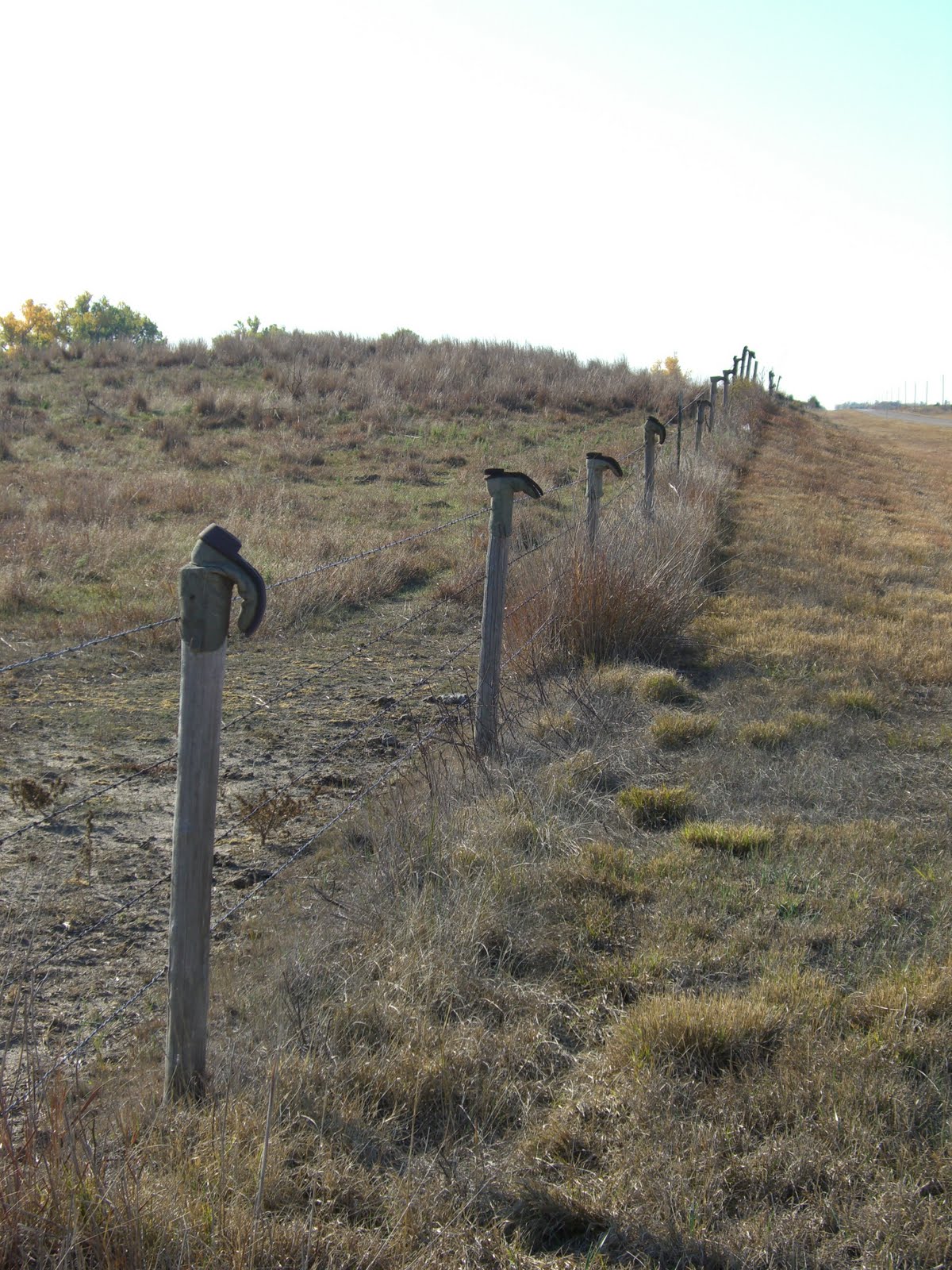
The tornado post, with a picture that included old boots on fence posts, drew this response: "The story was told that when a cowboy died his boots went up on the fence posts." A.M. [Isaac Sees 1st Tornado, 12/9/2011]

As more of you began to check the boxes at the ends of each post to let me know which ones you found particularly interesting and what you wanted to read more of, I was glad that so many of you enjoyed the political cartoons. Kansas was the center of the Farmers' Alliance and the political party that grew out of grass roots organizations formed by farmers and other laborers. Much of Isaac's Journal includes his political experiences and opinions. It is remarkable how many parallels there are between politics in the 1890s and today. [Politics Hardly Seem to Change, 11/24/2011]

When I mentioned some of my favorite illustrators of children's books in the post about Isaac and L. Frank Baum, I was delighted to receive e-mails from two of those illustrators. Michael Hague wrote, "I think it is important for the kids to value their creativity and imaginations and have people around them who are active in the arts and embrace it as an important part of their lives." Pop-up engineer and artist Robert Sabuda's animated tornado in his Oz book certainly drew excited Ohs and Ahs from the children. Sabuda wrote to me, "I love to see everyone enjoy my books. It makes the hard work worthwhile." [Isaac & the Wizard of Oz, 12/15/2011]

No post generated more enthusiasm among those of you who follow my blog than the one about disappearing traces of the past, and part of that was the impact of the photographs. "...so poignant and haunting. Those images and emotions speak to me as no other. I've always been that way, finding interest and increased curiosity toward the lonely, the forgotten, the lost." T.K.B. "Of the hundreds of reasons that houses might be left as you portrayed that house, surely one of them is that people live their lives until the end, but they don't 'finish' them as one might finish a skein of knitting." S.S. "I, like you, remember my grandfather farming and how all the homes have disappeared." J.R. "Just finished your latest blog. It makes me sad to confront what I already know about the familiar things we grew up with." A.B.C. "The older I get the more I miss what I had when I was a kid. That is life for most folks, I guess." R.B. [Disappearing Traces of the Past, 12/23/2011]

The encouragement and support that so many people, friends and strangers, have extended to me since I began this blog three months ago matter very much on a personal level, but I am especially pleased that what I am doing touches the feelings of many of you. Writing the blog has made me observe things that in my hurry to tend to business I was overlooking. It has enriched every day for me to practice the habit of seeing and reflecting, and I hope some of that has been transmitted to all of you.

Yesterday as my husband and I drove a road we've traveled hundreds of times, I saw an old house in a grove of dying cottonwood trees, and I had to have a photograph of it to share with all of you who loved the posts about cottonwoods and disappearing traces of the past. My husband, who generously tolerates my affection for another man--Isaac, of course--patiently turned around and went back so I could photograph the old house.

Thanks to all of you who are following my blog and who communicate with your checks in the boxes, clicks on +1, e-mails, and face-to-face encouragement. The comments at the end of posts are wonderful, and if you haven't been opening those, you might enjoy going back to read them, or adding comments of your own. Of all the wonderful responses people have shared with me, this simple statement sums up very well what I am trying to accomplish: "I feel like I knew Isaac!" D.K. I hope you will enjoy the future posts and will spread the word so more people can get to know Isaac too!!

Since Isaac did not provide me with a New Year's message to share, I will pass along the words of Benjamin Franklin: "Be always at war with your vices, at peace with your neighbors, and let each new year find you a better man."

Friday, December 9, 2011

Isaac Sees First Tornado

When our careers took my husband and me away from Kansas, we quickly learned what many people's impression of our home state was. When they learned we had been born and raised in Kansas, they were likely to ask, "Have you ever seen a tornado?" Today, sport's fans might be more inclined to comment on Kansas University basketball or Kansas State University football, but the Wizard of Oz has definitely left the impression with many people that Kansas is the land of tornadoes.

In fact, I have never seen a tornado, and I hope I never do. Kansas is not even in the top three states with the most reported tornadoes, those being Oklahoma, Texas and Florida. Every state has a reported tornado on record, although for a few states, tornadoes are extremely rare. The Great Plains is frequently called 'Tornado Alley,' and the states in the Mid-West with the greatest number of tornadoes are Kansas, Missouri, Nebraska, Iowa and South Dakota. During 2011 severe tornadoes struck states where that seemed an unexpected weather phenomena.

Isaac came to Kansas to stake his claim in 1878, yet it was a decade before he saw his first tornado. On May 9, 1888, he wrote in his journal,"Clouds gathering over S. of us and a 'Twister' down S.E., the first I seen, a tapering white sock hanging down, slanting from clouds and in a mere streak connecting down to ground raising the dust at time[s] then raising & vanishing & moving on down again & renewing the dark dust funnel." The tornado disappeared before coming near Isaac's homestead and timber claim, but the power and potential for destruction left a lingering impression with Isaac, for he later wrote,"One looks for 'Twisters' now at any cloud raising."

If Isaac had been living on his homestead in May of 2007, he would surely have seen the nest of tornadoes that hung from the clouds over three nights of destruction in his community. Homes were destroyed, lives were lost, and the small city of Greensburg about twenty-five miles to the southwest was nearly obliterated. Although Greensburg dominated the news reports, the rural area around my childhood home also suffered two deaths and severe property damage.


Tornadoes are certainly frightening, but they are also quirky in their destruction. Recently I took this photograph of two tree rows on opposite sides of a road. The edge of the 2007 tornado can be seen from the destruction of the tree belt on the east side of the road, while the tree belt on the west side was practically untouched. Devastation or survival may be the result of a distance of only a few feet. Many groves and rows of trees in our community are little more than mutilated remants of once stately shelter belts.


About a mile to the south of the tree rows, the home of our friends was destroyed, along with the farm equipment and the metal grain bins of their farming operation. Metal from those grain bins, and from the bins and metal buildings of other farms, was carried by the tornadoes for miles, driven into tree trunks and buried in fields to ruin tractor tires, unless sharp-eyed farmers spot the protruding metal. Perhaps the piece of heavy metal wrapped around the guywire of this pole to create a piece of nature's art from tragedy came from our friends' farm several miles to the south. The force of the whirling tornado bent the metal around the guywire like a sheet blowing on a clothes line.

The pasture posts topped with old boots extend in both directions for a quarter of a mile or so--just a bit of rural whimsy for passersby to enjoy.

May of 2008 also brought serious injuries and loss of property from tornadoes in our community. Although winter is the likely time for tornadoes in the South, it is spring when Kansans make sure the NOAA (National Oceanic & Atmospheric Administration's weather alert) is plugged into an outlet and the storm shelter has been sprayed to get rid of spiders and is stocked with candles, matches, flashlights, blankets, and maybe a gallon of water and some packaged peanut butter crackers--just in case. It was May when Isaac saw his first tornado, and luckily for him, he never saw another.

Friday, December 2, 2011

Isaac Plants Cottonwood Trees

Cowboy poet Larry McWhorter had a business building pipe and cable fencing in Texas, and his business card read "Fiddlestrings." He prided himself on building sturdy and beautiful fences with taut cable--like a well-tuned fiddle. Because he took such pride in his work, he took his time about it. That also allowed him to write poems in his head as he worked, and he didn't mind a bit of conversation when I stopped by. One hot day he noticed a little volunteer cottonwood tree growing on our property, and he walked over to remove a few leaves and slip them around the inner hatband of his cowboy hat. He laughed at my perplexed expression, saying, "That's an old cowboy trick to help keep a fella' cool when he's workin' in the sun."

I don't know if Isaac knew that trick or not, but he definitely knew how to grow cottonwood trees from cuttings. He explained the procedure he had perfected, writing on April 22, 1885: "...cottonwoods quite leaved [sic] out too much so to make reliable cuttings...I lately making my cuttings 15 inches long, 3 to stick out & 12 in ground, to better withstand droughty spells, and surer to grow." Isaac arrived to stake a homestead and a timber claim in 1878, when there were no trees on the prairie. On March 1, 1885, he wrote in his journal: "During middle of day counted the trees on my homestead alive & thrifty...on Homestead & Timber claim...total 3400 growing trees."

Among the trees on the prairie, the cottonwood towers above most of the others. The spade- or heart-shaped leaves have a smooth, shiny texture, and when the trees are stirred by a breeze, the leaves make a rustling noise like a lady's taffeta petticoats or that gentle sound of light rainfall on the roof. The shiny surfaces catch the light and reflect the movement of each leaf, a shimmering gold when the leaves turn in the autumn.

Cottonwood trees are fast growing--seven feet or more per year, and long-living--up to one hundred years, and they tolerate drought better than most trees. Naturally, they were a popular tree with the early settlers. During the dust bowl years in the "dirty thirties" cottonwood trees were usually included among the other varieties of trees planted in rows as windbreaks to help control soil erosion. These strong, healthy giants are the trees of my childhood memories, their cottony seeds drifting down in late spring, their sturdy limbs great for climbing and building tree houses in summer, and their bright yellow leaves for raking into piles, jumping into, and raking again in autumn.

Today, many tree rows look like graveyards, the trunks of fallen trees bleaching white in the sun as aging neighbors await their turn to fall. Many old shelterbelts have been bulldozed to make more room for farming; others have been destroyed by tornadoes and ice storms; and even more are succumbing to old age, as few of today's farmers plant trees as Isaac and his neighbors did.

The actress Kim Novak wrote: "...when you touch these trees, you have such a sense of the passage of time, of history. It's like you're touching the essence, the very substance of life." I understand her feelings of connection with ancient trees, knowing that ancestors enjoyed standing in their shade. Perhaps that is why I find it so sad to watch the gradual disappearance of the prairie cottonwoods.

While their numbers may be declining and their vigor nearing an end, those that remain lift their golden crowns into the clear blue of the autumn sky with the same regal beauty that Isaac must have admired over a century ago.

(Please continue to let me know what you enjoy with your comments, clicking on +1, and checking boxes.)