Showing posts with label Kansas. Show all posts

Thursday, January 24, 2013

Music on the Prairie

St. John Band
Isaac Werner loved music.  When he was a young druggist in Rossville, Illinois, the only day of the week that his store was closed was Sunday.  His younger cousin, Ezra Werner, had come to Rossville following Isaac's arrival, bringing with him an accordion.  During the week on winter evenings, Isaac loved to sit by the fire and listen to Ezra play the accordion, but what he especially enjoyed were outdoor concerts.  Isaac, Ezra, and another friend named Frederick often enjoyed their Sundays with a walk to a shady grove to sit on a log or a soft patch of grass to be entertained by Ezra.  When the birds joined in with their singing, Isaac was convinced that no concert hall in the city could have provided finer music.
 
When he came to Kansas, Isaac treasured opportunities to hear music.  A few evenings he enjoyed visiting the Eggleston family, who had brought musical instruments with them when they homesteaded.  There were also some fine singers in Isaac's community, and in the Clear Creek community, William Wilson was known for his beautiful singing voice.  In fact, Wilson offered a singing school during the winter evenings when he was not busy in the fields.
 
Isaac described an evening at the Emerson School House when Wilson and some other men visited a Farmers' Alliance meeting.  The Albano membership attendance was small that night, so the meeting was quickly adjourned, and the men enjoyed singing until midnight.
 
About his own musical talent Isaac never commented, although his personal library included a book on organ stops.
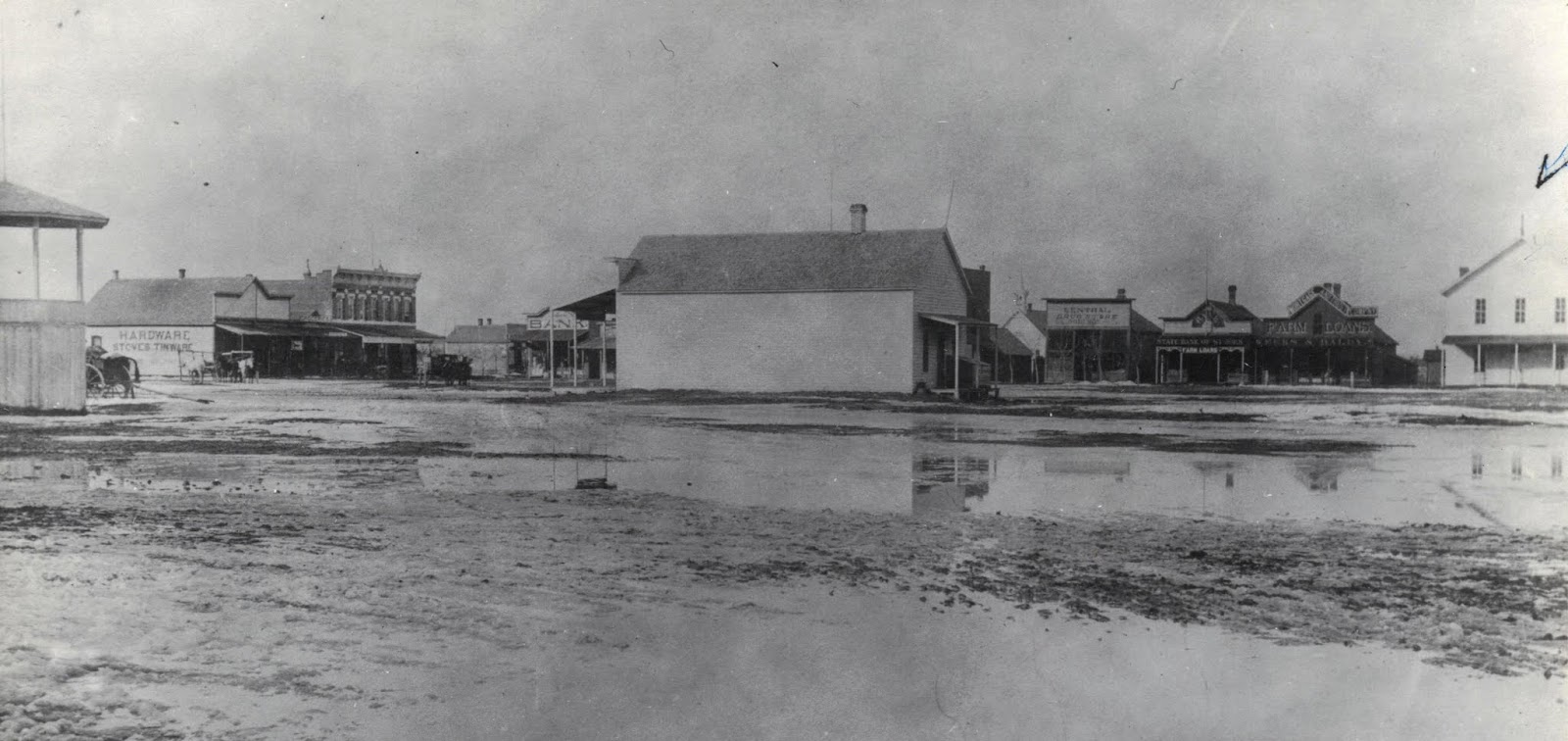
 
       St. John Town Square with Band Shell at far left
The reputation of the St. John Town Band was so impressive that they were often called upon to play in other towns.  When the Pratt County People's Party held it first political rally parading down Main Street, it was the St. John band that furnished the music for the parade.  The band was often asked to play for political events, organizers knowing that the band would draw a larger crowd.
 
So highly regarded were these musicians that a band shelter was built in the St. John Square, although the rest of the town square was nothing more than a muddy eyesore in wet weather and a source of dust blowing through the town when the season was dry.  (The first photograph of the St. John Band was taken in front of the City Stable, where Isaac often slept  with his horses when he needed to stay in St. John overnight.  The second photograph shows the band shell at the far left with the rain soaked bare town square in the foreground.  Remember, the photographs can be viewed larger by clicking on them.)
 
The opportunity to enjoy music with friends was one of Isaac's greatest pleasures!  Those of us living in a time when music is available in our homes, our cars, and while we go for a jog, as well as the many places where we can enjoy live performances, need to be reminded what a special treat hearing music was for those living in earlier times. 


Thursday, September 27, 2012

How Investors Created Pratt

Lyn in Pratt County Museum lobby near books for sale
Pratt County lay alongside the south boundary of Isaac's homestead, and its earliest towns were Iuka and Saratoga, both of which Isaac visited.  Iuka was established in 1878, the year Isaac came to Kansas, and although Saratoga was not incorporated until 1884, the settlement existed earlier.  Pratt Center was also incorporated in 1884; however, the method of its creation differed from the earlier towns.  Rather than evolving naturally from a cluster of settlers at its core, Pratt Center was formed by a syndicate.  In fact, the early town site was mockingly called "Dog Town," because the only genuine residents were the prairie dogs.
 
Briefly, Kansas required all counties to set aside land to be used for schools as the population grew and families with children settled the area.  Frequently, however, families preferred to donate an acre from their own homesteads for building a school nearer their homes.  With these small one-room schools dotting the countryside, one or two in each township, the land reserved for schools was often unusued.  Predictably, settlers chose to run the risk of treating these lands as homesteads, planning to make an official claim when the land was released from the school set aside requirements.  It was just such land that became involved in a legal scandal when Pratt Center was formed.  Leaving the details of that legal dispute for a later post, or to read in my book, for now it is enough to say that Saratoga settlers alleged a fraudulent conspiracy to get their lands, while Pratt investors claimed they had utilized proper legal actions available to businessmen to develop their town.  Ultimately the pre-emptive settlers lost their farms and the businessmen created a town.
 
Having entered the battle for the county seat late, Pratt Center nevertheless gained the prize in 1888.  Many Iuka businesses and residents chose to move into Pratt Center, and the remaining Iuka businesses focused on services for surrounding farmers, becoming a center for marketing and shipping grain.  Saratoga, however, disappeared, having lost its post office in 1895, and so many businesses and residences having been literally moved into Pratt Center by 1900 that few landmarks of the town that Isaac had known remained.  


The North School Building with its basement
 
Part of the problem was the close proximity of Pratt Center and Saratoga, so close that Isaac seemed to use the two names interchangeably in his journal.  After getting the patents to his homestead and timber claim, Isaac's friend Doc Dix decided to move into town to resume his medical practice, and Isaac referred to the location of Doc's new residence by both names.  In December of 1887, Isaac helped the Dix family move, and when he finished helping his friends, he went over to Pratt Center to ride the new street cars which had been operating for only two weeks.  However, there is an old photograph showing the house of Dr. Dix in Pratt.  These and other clues make it seem likely that Dr. Dix did move his family to Saratoga but participated in the subsequent exodus to Pratt Center.

 
Pratt Center thrived.  In his journal entry of April 27, 1887, Isaac wrote:  "Pratt Center laboring under a new boom, outfit at grading Rock Island R. R.  W. of road at town water tank, lots of new buildings going up all round along main street digging out foundations for several brick business blocks." 
 
Many of Isaac's trips to Pratt Center were to Blaine Bros. Implement Dealers.  He bought implements from them and they carried his notes given in partial payment.  When Isaac invented a 3-horse cultivator, he turned to them for advice about patenting his invention.  The 1993 publication by the Pratt County Historical Society, a re-publication of a 1911 book published by the Pratt Commercial Club, contains a picture (at left) of the distinguished D. W. Blaine, who was then engaged in the automobile business.  In 1888, with a population of 3,000, Pratt Center had twenty brick buildings; a city waterworks, electric lights, and a street railway; five churches (Methodist, Christian, Presbyterian, African, and Catholic); four banks, three newspapers, and a 3-story school that included a high school.  The long list of businessmen included proprietors of about every business that could be imagined for a bustling prairie town. 

Lyn beginning the museum tour
The name Pratt Center had been adopted during the county seat battle to refute Iuka's claim that it was the best choice because of its central location.  (A change in the county's boundaries impacted Iuka's claim and allowed Pratt Center to assert its own location advantage, although neither town was actually the geological center of the county.)  After winning the county seat battle, Pratt Center no longer needed to assert the distinction of occupying the center of the county, and "Center" was dropped from the town's name in 1893 after a newspaper poll indicated that citizens favored the simpler name of Pratt.
 
Visit the Pratt County Historical Society Museum online at http://prattcountymuseum.org or at its location at 208 S. Ninnescah, Pratt, Kansas, to enjoy their wonderful displays or do research from their collection.
 
Remember, you can enlarge the images in this blog by clicking on them.


Thursday, June 7, 2012

Are you one of 93 million descendants?

Isaac B. Werner had no descendants, but many homesteaders raised families.  Today it is estimated that 93 million people are descendants of homesteaders.  I am among that number, and perhaps many of you following my blog are too. 


This past weekend my husband and I attended the 57th Annual Willa Cather Spring Conference in Red Cloud, Nebraska, and I will be sharing that great American Writer and her hometown with you in future posts.  However, I mention our trip to Nebraska to share some side trips we took after the Conference.


The Homestead National Monument operated by the National Park Service is located near Beatrice, Nebraska, northeast of Red Cloud.  We enjoyed the drive through some of Nebraska's beautiful rural landscape and realized only when we arrived at the national park that it is the 150th Anniversary of the Homestead Act of 1862. 

Those of us who know the Great Plains region tend to think of homesteading as having occurred on the plains, overlooking the extent of America opened for settlement by homesteaders.  Upon arrival at the park site, visitors are immediately presented with the question:  "Do you live near a Homestead?"  A map shows that there were 30 homesteading states, although in 1862 when Abraham Lincoln signed the Homestead Act, not all of the territory had yet achieved statehood.  According to the park ranger who greeted us, Montana is the state with the largest homestead acreage, and Nebraska is the state with the largest percentage of its land having been homestead.  Kansas, where Isaac homesteaded, also has a great homesteading heritage.


As visitors approach the Heritage Center, the sidewalk parallels a wall showing the 30 homesteading states, with a box cut from each state's silhouette representing the proportion of that state's total area that was available for homesteading.  The photograph taken looking down a portion of the wall shows Nebraska at the far left, with Kansas next in the line of state silhouettes on the wall.


After an informative conversation with the ranger, we viewed the film and walked out just in time to see a Junior Ranger being sworn in.  It was great seeing how seriously the young man took the responsibilities he was assuming with his oath to learn about the prairie and help care for it and teach others to respect the land.  Notice particularly the tall Plexiglas tube on the left side of the photograph.  A bunch of prairie grass has been carefully extracted from the soil to show the blades of grass above the surface (above the top band on the tube) but also the length of the roots extending deeply into the soil.  Grass such as this formed the sod that homesteaders plowed to clear the land for cultivation of crops.  I will never again think that the common garden weeds that I pull have deep roots!

Isaac staked his claim in 1878, and it was not until 1886 that he finally bought a horse, having avoided the indebtedness necessary to purchase a horse until that year.  During his early years of farming, he traded his own labor in exchange for help from neighbors with horses and machinery to break the sod. This exchange of labor allowed him to break so little sod that much of his time was spent raising trees rather than planting fields.  Even when the sod was broken, he had to use hand tools for farming the ground.

The implements displayed near the homesteader's cabin on the grounds of the Heritage Center are those pulled by horses, mules, or oxen; however, at the Education Center the exhibit included man-powered implements like Isaac initially used.  When we arrived there, I spotted the sign directing visitors to that exhibit.  "Oh, look!" I exclaimed.  "This is where the farm implements are!"  I noticed two rangers exchanging perplexed expressions, and I said, "I suppose that is not something you usually hear from the women visiting your exhibits."  They laughed and nodded.  They had no idea that it was my time spent with Isaac that had caused my enthusiastic response to the opportunity to see the implements he used on his homestead.  In a future post I will share pictures of some of the implements I photographed.

Not only the Homestead National Monument has wonderful events planned throughout the summer commemorating the 150th Anniversary of the Homestead Act of 1862 but also the Nebraska Humanities Council is celebrating their state's homesteading legacy.  It is a great year to visit Nebraska, and when you do, be sure to include the Willa Cather Memorial Prairie and Willa's hometown of Red Cloud in your planning.  http://willacather.org/; http://nebraskahumanities.org/; and http://www.nps.gov/home/planyourvisit/150th-anniversary-of-the-homestead-act.htm.   


Thursday, February 9, 2012

A Young Man's Fancy...

Ferreting out something about Isaac B. Werner's private thoughts on love & romance isn't easy. There are, however, clues to his feelings, and with the approach of Valentine's Day it seems like the right time to peek into Isaac's heart.

Isaac's father William did not marry until he was forty years old, and that may have influenced Isaac's view that marriage should not be rushed. As a young druggist in Rossville, he was very ambitious. He wrote: "As each man is the architect of his own fortune, there is a great deal also in what materials we make use of, and what plans we follow out." When his twin brother Henry sent a letter sharing news that several of Isaac's mischief-maker friends had married, Isaac wrote in his Journal: "...the Home boys still continue pretty fast tampering with the cup of Sorrow--till ending in wedlock. Then simmer down--like a final anchor and enjoy the ups and downs of married life and the animated fruits of their toiling; while I a thousand miles away, like a Hermit delighting mostly in my ever so dear and trustful best companions, Books, and intend continuing so at least for coming 5 or 10 years--no telling though how circumstances unexpected might interfere..."

The young ladies of Rossville certainly were among the distracting circumstances that threatened Isaac's literary plans, particularly when fellow merchants hired a new employee. "To-day Miss Wilky commencing as Book-Keeper for Henderson Lee & Co., a little novelty for Rossvillions--Female clerks--not agreeing very best with some of those vulgar minds, resorting to such places to give vent to their vulgar thoughts and general conversations..." Despite Isaac's prediction that customers who gathered to cuss and discuss in that store might resent the presence of a young lady, forcing some moderation in their language, there were at least some customers who found Miss Wilky a new reason to frequent the store. He wrote: "...J.R. Lee called in and we indulged in a leisure conversation concerning their late feminine clerk, he telling me how of late some of the young country Romeos tried to coax his Bookkeeper into their society attending country dances, but he kindly advising the said clerk concerning her best course of associating to retain creditably said clerkship, which she is filling at present." Isaac was not among those young Romeos inviting her to country dances, but he was one of her admirers, writing: "For first time fairly seen--as she called in for trifle--the late arrived feminine Book-keeper of Henderson Lee, appearing in quite fashionable 'Harness' partly approaching the Grecian Trend, eyes pure and bright as crystals, not quite so bad."

Isaac was not one to indulge in insincere flirtations. "Valentine's Day, Birds pairing out. Few calls for Valentine's by city youths but city merchants neglected to supply themselves, consequently not much libeling." Isaac might have been awkward at expressing his feelings, but if he sent a message of love, he believed it should speak the truth.

The young lady who could win Isaac's heart needed to appreciate books, although he was willing to lead her in that direction if she had not acquired the habit of reading by herself. Proof of this is found in a conversation he recorded in his Journal: "In morning dark-eyed 'Belle A' called in and returned loaned book 'Cave on Coloring.' I inquired, 'Why, have you read it through already?'" "Yes." "Well, could you understand it?" "No, not at all." "How do you like it?" "Oh, I don't like such reading." At this point, unwilling to give up on the young lady, Isaac said, "Ah, you must not expect to learn all at once. Here, I have another small book..." The young lady took the book, but that was the last mention of her in the Journal--probably a romance it was better for both of them to have avoided.

No one could assume that Isaac was immune to the charms of a pretty young woman after reading this passage in his Journal: "The figure of a tall woman, black furs and veiled Highness...I glancing and thinking to myself, 'What looking incarnation of the East may you be?' She halted before showcase, throwed back her veil, behold! If it wasn't 'Juliet' in all her beauty and plumpness. She bought her wanted goods, and soon exit[ed] again, the first time she been in store for couple of months, she looking fair and bright enough to tempt one to lean over counter [and] osculate those pretty pouting scarlet lips, and fresh cheeks." Whoever the young lady was to inspire this uncharacteristically flowery passage must have been exactly the sort of "circumstances unexpected" Isaac was thinking of when he confessed that his plan to defer marriage for 5 or 10 years might meet with interference!

So, scattered among the serious passages about his determination to acquire a fine library and study the wisdom of learned men of past and present generations and the responsible descriptions of his commitment to maintaining a reputable business is the voice of a man in his mid-twenties, charmed by pretty women and occasionally making a fool of himself as a result. As Jules Renard, a Frenchman born only a few years after Isaac, wrote, "Love is like an hourglass, with the heart filling up as the brain empties."

By the time Isaac left Rossville to homestead in Kansas he was thirty-three, and still a bachelor. In a later post I will share some more clues about Isaac's encounters with cupid on the plains of Kansas. I hope Valentine's Day is happy for everyone, and I'll add this quote by Scottish Evangelist, Henry Drummond (1851-1897): "You will find when you look back upon your life that the moments when you have truly lived are the moments when you have done things in the spirit of love."

Osculate means kiss.

Friday, December 9, 2011

Isaac Sees First Tornado

When our careers took my husband and me away from Kansas, we quickly learned what many people's impression of our home state was. When they learned we had been born and raised in Kansas, they were likely to ask, "Have you ever seen a tornado?" Today, sport's fans might be more inclined to comment on Kansas University basketball or Kansas State University football, but the Wizard of Oz has definitely left the impression with many people that Kansas is the land of tornadoes.

In fact, I have never seen a tornado, and I hope I never do. Kansas is not even in the top three states with the most reported tornadoes, those being Oklahoma, Texas and Florida. Every state has a reported tornado on record, although for a few states, tornadoes are extremely rare. The Great Plains is frequently called 'Tornado Alley,' and the states in the Mid-West with the greatest number of tornadoes are Kansas, Missouri, Nebraska, Iowa and South Dakota. During 2011 severe tornadoes struck states where that seemed an unexpected weather phenomena.

Isaac came to Kansas to stake his claim in 1878, yet it was a decade before he saw his first tornado. On May 9, 1888, he wrote in his journal,"Clouds gathering over S. of us and a 'Twister' down S.E., the first I seen, a tapering white sock hanging down, slanting from clouds and in a mere streak connecting down to ground raising the dust at time[s] then raising & vanishing & moving on down again & renewing the dark dust funnel." The tornado disappeared before coming near Isaac's homestead and timber claim, but the power and potential for destruction left a lingering impression with Isaac, for he later wrote,"One looks for 'Twisters' now at any cloud raising."

If Isaac had been living on his homestead in May of 2007, he would surely have seen the nest of tornadoes that hung from the clouds over three nights of destruction in his community. Homes were destroyed, lives were lost, and the small city of Greensburg about twenty-five miles to the southwest was nearly obliterated. Although Greensburg dominated the news reports, the rural area around my childhood home also suffered two deaths and severe property damage.


Tornadoes are certainly frightening, but they are also quirky in their destruction. Recently I took this photograph of two tree rows on opposite sides of a road. The edge of the 2007 tornado can be seen from the destruction of the tree belt on the east side of the road, while the tree belt on the west side was practically untouched. Devastation or survival may be the result of a distance of only a few feet. Many groves and rows of trees in our community are little more than mutilated remants of once stately shelter belts.


About a mile to the south of the tree rows, the home of our friends was destroyed, along with the farm equipment and the metal grain bins of their farming operation. Metal from those grain bins, and from the bins and metal buildings of other farms, was carried by the tornadoes for miles, driven into tree trunks and buried in fields to ruin tractor tires, unless sharp-eyed farmers spot the protruding metal. Perhaps the piece of heavy metal wrapped around the guywire of this pole to create a piece of nature's art from tragedy came from our friends' farm several miles to the south. The force of the whirling tornado bent the metal around the guywire like a sheet blowing on a clothes line.

The pasture posts topped with old boots extend in both directions for a quarter of a mile or so--just a bit of rural whimsy for passersby to enjoy.

May of 2008 also brought serious injuries and loss of property from tornadoes in our community. Although winter is the likely time for tornadoes in the South, it is spring when Kansans make sure the NOAA (National Oceanic & Atmospheric Administration's weather alert) is plugged into an outlet and the storm shelter has been sprayed to get rid of spiders and is stocked with candles, matches, flashlights, blankets, and maybe a gallon of water and some packaged peanut butter crackers--just in case. It was May when Isaac saw his first tornado, and luckily for him, he never saw another.