Showing posts with label algorithms. Show all posts

Thursday, March 1, 2018

Then & Now--Influences

Late 1800's Ad from the County Capital
In doing research for my manuscript about Isaac Werner and the Populist Movement, I read both the Populist newspaper to which Isaac subscribed, The County Capital, and the Republican newspaper to which my paternal great grandfather subscribed, The St. John News.  There were certainly significant differences in the way news was reported by those two St. John newspapers.  I suspect, however, that the advertisements I am including in this blog from The County Capital were much the same.

Then and now, we are all influenced by where and how we obtain our information.  Of course, that definitely applies to politics, but this blog is not about politics.  Then and now we are promised cures and beauty products that we want to believe but deep down know better.  We are lured to buy things that are exciting but unnecessary, updates when our old things are still serviceable, beautiful when what we have is just a little faded. I am sharing ads from the County Capital of Isaac's era, but there is no need for me to share modern ads, since you are bombarded with them on television and teased by them in magazines.  The art of propaganda to influence our decisions is nothing new; however, the ability to influence our decisions is encountering new territory.

Late 1800's Ad from the County Capital
Recently I read an article by Justin Brown concerning remarks made by a former Facebook executive, warning the Stanford University students to whom he was speaking that they must decide how much of their intellectual independence they are willing to give up.  Chamath Palihapitiya is a former Facebook vice-president who left in 2011, so he should know about that which he speaks when he says, "you don't realize it, but you are being programmed."

I previously blogged about algorithms  (Adapting to Changing Technologies, 3-30-2017)  and about what we visit and how we purchase online are being used to track our activities, interests, and tastes, as well as how much we are willing to pay for things we want.  Palihapitiya revealed another sophisticated method being used to influence us.  "The short-term, dopamine-driven feedback loops that we have created are destroying how society works.  No civil discourse, no cooperation, misinformation, mistruth.  ...This is a global problem  ...  It is eroding the core foundations of how people behave by and between each other."

1800s Ad, County Capital
He explained how what he called 'bad actors' can manipulate large populations, "...because we get rewarded in these short-term signals (hearts, likes, thumbs ups) and we conflate that with value and we conflate that with truth."

When asked for a solution to the damage this is causing, Palihapitiya admitted that he had no broad remedy.  "My solution is, I don't use these tools anymore.  I haven't for years."

Reflecting on his warning, I thought about whether he was being too alarmist.  Perhaps as you read this, you are doing the same thing.  I have blogged about the disappearing significance of letters between friends. (Isaac's Penmanship, 5-2-2012)  I have noticed how young people no longer join community groups as their parents once did.  The St. John Victorian Teas I blogged about (11-8-2011) have been discontinued because the women who planned and hosted the teas have grown older and were unable to recruit younger women to take their places.  Of course, part of that is the result of more women in the workplace, too busy to assume more responsibilities.  But even lodges and clubs that are merely gathering places are failing to attract younger members.  Movie theaters are closing because people prefer to watch movies at home on their own televisions with Netflix or  cable.  Friends have admitted that they often text because they don't want to get involved in a long phone conversation, and I have watched two people in the same room communicate by text rather than conversationally, excluding others in the room from their comments.  Social courtesies and common interactions are definitely changing.

Brown's article also cites Facebook's founding president, Sean Parker, who acknowledges their purpose was to "consume as much of your time and conscious attention as possible."  Parker also admitted the intentional effects of  "giv[ing] you a little dopamine hit every once in a while, because someone liked or commented on a photo or a post or whatever.  And that's going to get you to contribute more content."  ..."It's a social-validation feedback loop...exploiting a vulnerability in human psychology."  http://www.ideapod.com/social/user/Justin 

Late 1800s Ad from County Capital
Justin Brown, the author of the article from which these quote are taken, is CEO and co-founder of a digital media platform providing commentary on the ideas shaping our lives.

Did the County Capital  shape Isaac Werner's ideas about populism and community issues?  Of course.  Did The St. John News shape my great grandfather's ideas, and the ideas of his son and grandson who continued to be subscribers for their entire lives? Certainly.  However, Isaac and my great grandfather knew one another and shared conversations.  Their interactions were not restricted to like-minded people.  The St. John News editor once joked that some of his subscribers stopped taking the paper in order to subscribe to the County Capital.  "Now they have to borrow someone else's paper to read The News," he teased. But as the way we communicate changes, those interactions change too.

Solo local newspapers generally tried to minimize their bias, not only from professional ethics but also because they needed as many subscribers as possible to stay in business.  Where are those newspapers today?  Small towns that once supported 2 or 3 newspapers now have none.  Small cities shrink their size and publish only once or twice a week to survive.  Even bigger cities' newspapers are slim editions.  Many families no longer subscribe to any newspaper.  

Late 1800s Ad from County Capital 
Our opinions are shaped by national news on television, which doesn't always accurately reflect regional news, reducing their reporting about a state or region to a single point of view.

When was the last time you received a letter from a friend?  Do your friends correspond regularly by e-mail as they did before facebook or other social media.  Are we often too busy to pause for conversations with friends at the post office and the grocery store?  As past means of communication decline, and social organizations lose membership, where do we get our news about friends' new babies and high school sports victories if not on social media.  

And by the way, could you take a moment to ❤❤❤❤me?  We all do it.  And we are pleased when we receive hearts and likes and thumbs up, but hearts are not conversations.  Hearts are not the exchange of ideas and opinions.  Isaac liked it when he received compliments for his ideas, newspaper articles, and speeches at community meetings, but he was also aware of opposing views in his community, expressed during informal conversations and public meetings.  Is what is happening now through social media really that different?  I just thought you might enjoy reading what people with expertise in social media think.  If they are alarmed, should we be??  

Remember, you can click on these antique ad to enlarge them.

Thursday, March 30, 2017

Adapting to Changing Technologies

Rossville, Illinois Rail Road Station
Every generation must adapt to changing technologies.  When the railroad came to Rossville, IL Isaac Werner was the proprietor of a drug store, and he opposed its arrival.  In 1871, he had joined other merchants in arguing that the town was not yet ready for a railroad.  He believed that the workers laying the track would bring a disreputable class of men to the town, and the bonds that were needed to pay for the railroad's arrival would be a burdensome expense without the promised benefits. However, the farmers around Rossville nearly all supported the railroad, eager for a way to get their crops to markets, just as Isaac did a decade or so later, when he was marketing his own crops in Kansas.

New technologies nearly always result in conflicting opinions about their worth, opinions that are often generational.  The present technological changes are no exception, and this blog shares some that concern me.

As a writer, I pay particular attention to changes in book marketing, legal protections for authors, and readership trends.  Past blogs have bemoaned the drop in book readership and the importance of encouraging the habit of reading in our children.  On the Madison Building of the Library of Congress is inscribed the following quote from James Madison:  "Knowledge will forever govern ignorance: and a people who mean to be their own Governours, must arm themselves with the power which knowledge gives."
Stereoscope for viewing 3-D Images

In the most recent issue of my writers' bulletin, the Executive Director expressed her concern about the unsettled state of distrust and accusations about fake news, altnews, and "alternative facts." She described how including copyright law in the Constitution was a measure of how much the Founding Fathers valued cultivating an American "...class of writers, thinkers, and artists, not beholden to government or private patronage." She predicted that as we become less confident in the accuracy of newspapers and television news, people may turn to well-researched books, vetted by reputable publishers, for accurate information.  Her closing words to authors were "your work is more important than ever."  I would like to think so, but only if more people read the books that are written!

In that same issue a writer shared a troubling discovery.  Because both the author and her assistant had purchased a used copy of the same book from the same online bookseller at about the same time, they discovered that each of them had been shown a different list of the same book available for purchase.  The graduate student with a history of spending less for the books she bought from the online bookseller was shown less expensive books, while the author with a history of buying more expensive books if she needed them for her research was shown a different list of the same title at higher prices.  The author continued to check the online bookseller for several days without buying, and eventually a cheap paperback copy appeared on the list, with the more expensive books omitted, leading the author to assume that when she didn't buy a higher priced copy, the seller showed her a cheaper choice. The bottom line to the story is that apparently algorithms had been used to track both of their purchasing habits, and the selections each was shown were modified, according to what each of them might be willing to pay, cheaper prices for the graduate student and more expensive prices for the author.

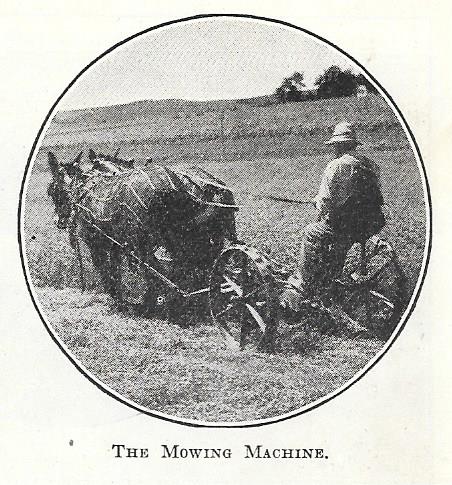
'Modern' replacement for the scythe
It had never occurred to me that with my own online used book buying my purchasing habits might be followed or that an online seller might offer books at different prices based on my apparent willingness to pay.  I frequently shop online for used and out-of-print books, and I bought several books that were titles Isaac Werner had owned, choosing the oldest editions I could find in an attempt to replicate what Isaac would have been reading.  Algorithms!  I had never heard of that!!  I don't know if all online used booksellers engage in this practice, but this very popular one--which sells both new and used books-- apparently does.

Most of us are willing to pay the market price for what we need or want, but are we willing to pay a different price to get the same thing?

Recently my husband and I were watching the Academy Awards and I was surprised to hear Amazon mentioned several times in connection with the making of films nominated for awards.  The special Hollywood edition of Vanity Fair had an article titled "That's All Folks!" which offered comments of how technologies are changing entertainment, using the music industry as an early example of CD sales declining as younger buyers preferred downloading a single song that they liked rather than buying the complete album, getting a single song for a dollar or so versus an album for about twenty dollars. With the change in buying habits, profits dropped, and according to the article, the music industry has shrunk to about half its former size in just a decade.

The article continued using print news as another example, quoting newspaper advertising revenues as having fallen from $67 billion in 2000 to $19.9 billion in 2014.  No wonder newspapers are failing and surviving newspapers are shrinking in content.  With my own awareness of merged and failed publishing houses, and some universities downsizing or eliminating their university presses, I was already familiar with the changes in the publishing world, which the article cited next, noting that many people prefer paying $9.99 for a digital book rather than $25. for the hardcover.

Antique still Camera
But, the main subject of the article was the movies, which indicated that movie theater attendance is at a 19-year low, and between 2007 and 2011 overall profits for the big-5 movie studios fell by 40%.  According to the article, 70% of box office comes from abroad, which impacts the type of movies being made.  In addition, the big studios are facing competition from companies from outside the entertainment industry.

According to the article, in the 1950s movies were the third largest retail business in the U.S. at a time when people looked forward to going out to the movies.  Now the trend is toward enjoying entertainment in our homes.  Theaters are much more expensive for traditional studios to build and maintain than the cost to new companies entering the business and catering to those who would rather stay home and have a movie delivered to their TV, laptop, or phone.  Only if enough people want to go to theaters to watch movies will it be economically feasible for traditional movies intended to be shown on the big screens in theaters to continue to be made.  Otherwise, theaters may give way to the new technology bringing movies to our homes.

Ironically, theaters seem to be countering this trend by making the theater experience more 'home-like,' with reclining seats and food delivered to trays built into the seats--just like kicking back at home with a sandwich and a cold drink to watch a movie on the large screen of your TV!  

Even more futuristic to my way of thinking is the technology that can create human images.  A recent television program showed the technology that allowed one of the main actors to appear in a popular movie series long after he had died.  The face of Peter Cushing was superimposed on another actor's body in Rogue One.  A man who has done special effects for several films is quoted in the Vanity Fair article as predicting that by 2022 graphics will be "indistingishable from reality."

At an American Bar Association meeting in Atlanta that I attended years ago, I learned about digital cameras for the first time.  I knew by heart the questions necessary to authenticate photographs I wanted to have introduced into evidence during a trial, and I couldn't imagine how digital photographs could be used as evidence, with their capacity for easy alteration.  Technology will not stand still, and we must adapt, but I do worry about how difficult reality and truth will be to ascertain in a world already tending toward "alternate facts."

Chicken Little thinks the sky is falling!  (antique book)
In the early 1880s a settler could claim a quarter-section of 180 acres and keep a cow and raise crops to feed his family, and maybe produce enough to sell some wheat or corn or potatoes in town for a little extra cash.  In a decade or so those farmers had needed to expand their farms if they were to survive.  Isaac Werner invented a 3-horse cultivator that allowed him to plow more ground in less time, proud that he had created something that would allow one farmer to buy or rent more ground, raise more crops, and improve his standard of living.  Isaac never mentioned in his journal any awareness that his cultivator might also displace small farmers and could reduce the number of farmers able to survive in his community.  Technology will happen and life will change.  It is all the more reason for us and the generations that follow to see education as an ongoing responsibility.  The capacity to hood-wink and mislead is only growing, and we must be prepared not to be fooled.  As journalist Dan Rather wrote in reply to the notion of "alternate facts:"  "Facts and the truth are not partisan.  They are the bedrock of our democracy.  And you are either... with our Constitution, our history, and the future of our nation, or you are against it.  Everyone must answer that question."

It has been my premise since the first posting of this blog that we have much to learn from history, and I still believe that is true.  Nearly every generation has had a Chicken Little 'the sky is falling' moment, and we must not view technology as the enemy.  However, we must recognize that the potential of technology presents new challenges along with its benefits and we must rise to the challenge or fail as never before.`