Showing posts with label technology. Show all posts

Thursday, February 2, 2023

Cheating Ourselves?

 This is not the first time I have blogged about my feelings that eliminating cursive penmanship from school curriculums was a bad idea, although I realize beating that drum is a lost cause.  This time, however, the joke is on those professors who decided that with most correspondence being done on laptops, penmanship was no longer needed.  It has turned out that bypassing handwritten assignments has made cheating easier.

Reading Great Books rather than a summary

Watching the interview of a professor on television, I learned that technology has now advanced so far that it is nearly impossible to assign such a unique topic that it can stump the technology.  He described how even a unique subject can be entered online, with a request to produce an essay of the assigned length on that topic, and the internet will promptly supply a suitable composition.  Without requiring the paper to be written in the classroom, how can the professor know whether it is the student's own work, Unless the students' phones are removed, there are still temptations available during classes.

That professor didn't seem very happy about the prospect of requiring the students to write their essays in the classroom by hand.  Given the penmanship of most students today, I can understand why a professor might hate grading hand written papers!

Recently I blogged about the ability to create art by entering a few details about the subject, with a few additional details to use in the composition--such as 'a golden retriever hunting quail in a field of harvested corn at sunset.'  With that much information, assuming a computer with access to thousands of images entered into its resources, a computer could create an attractive composition using artificial intelligence. 

Seeing a sheep being sheered instead of a computer describing it

A few days ago, I learned of the ability to use computers filled with enough information to create that  person's image so that the person's voice could be imposed on the image to create what appeared to be a live talk.  In short, the old saying "Seeing is believing" is no longer trustworthy.   

So, here is the problem:  While we can create professional papers on about any subject in minutes, create art that is beautiful, and appear to be delivering a recorded live program, are we really teaching  and interacting?  Are those using technology to supply the content of an assigned essay, or the art student using artificial intelligence to create a composition, or the speaker and his audience truly interacting?  Are we neglecting the development of our own minds, our sensitivity for observing and creating beauty, our skill of interacting with others by listening not just to their words but also body language and drawing out those hesitant to speak.   

Decades ago when I was teaching, I discovered cheating by my students.  When I expressed my disappointment to an older teacher, he replied:  "Cheating isn't bad, cheating badly is bad."  I was astonished by his comment.   Unfortunately, I fear that since that teacher's comment was made to me years ago, the honor system has plummeted.  It does seem to me that technology has opened up an entire new world for cheating.  However, isn't it possible that in many cases the person we are cheating is ourselves?   


Wednesday, December 16, 2020

Two Special Blog Followers

 The challenges of Covid-19 have reminded  us just how important friends are.  I am certainly appreciative of my friends, made so visible by their support for my book and by their continued following of my blog.  And, I must add, the appreciation of staying in touch through many years with their annual Christmas cards and letters, and the new novelty of zoom.  I have missed seeing or hearing from others, as the opportunities which would have allowed us to stay in touch in the past are now impossible.

Many of us have stayed in touch through face book, and others have followed my blog.  This week's blog shares the fun of both ways I have connected with friends.

What fun to open my face book reminder about Isaac Werner's construction of a neighbor's house, posted December 10, 2020, to discover that somebody "Loved It."

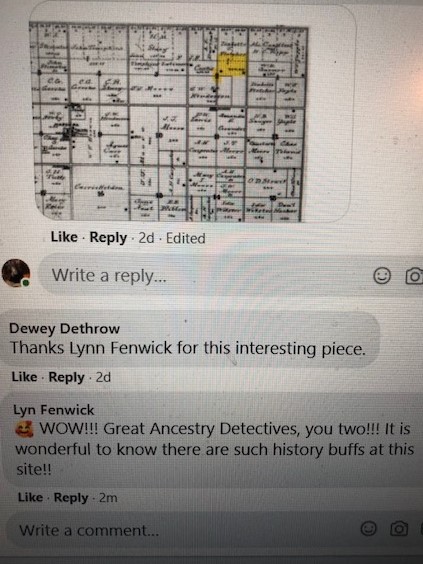
Unfortunately for me, they loved it so much they wanted more information about the county section number, information that I did not have.  My blog had only indicated the general direction and distance from Isaac's claim.  While I was considering how to reply, I realized someone else had answered the question.

That was a relief, since my research records compiled while writing the book focus more on Stafford County legal descriptions, although Isaac had many friends and business acquaintances in Pratt County.

However, what it also reminded me was how much is now available online that I needed to use other reference sources to find when I was doing my research.  The conversation between my two face book friends had not only shared the certificate number and date of issue , but also an image of the certificate.
My information about this particular topic had come from Isaac's journal, a rare source material that included the number of days the construction took and the amount Isaac was paid for his labor.  I had also interviewed a family descendant, which was helpful in distinguishing for whom the work was done, since two brothers had the same surname and lived in the same community.  However, since the Moore brothers were friends but not major characters in my book, I did not take the time to go further.  My face book friends found the information online in no time at all.


 However, this story does not end.  An image of the location was also supplied before I had time to praise the two online sleuths for sharing their research.  

In past blogs I have commented on the disappointments that technology has brought to communication--the extreme rarity of a personal letter, the greater likelihood that people will correspond by text that by e-mail, and the rarity of a chatty phone call.  

Yet, this face book exchange illustrates the other side of technology.  Three people shared information, and the chain of the conversation was not begun by a request.  Perhaps that is one part of the technology that is overlooked.  I posted my blog without any expectation that I would receive information that I didn't have, and unexpectedly, all three of us learned something new.

The challenge to all of us, young and old, is to discover and utilize the new possibilities, but to do so without the loss of benefits from the old possibilities.  If nothing else, the Covid-19 isolation has shown us that we miss the smiles behind the masks (and bless us for wearing those!), we miss the impromptu meetings with friends at the grocery store, and we miss the traditional rituals that bring strangers together--the clerks in stores, the strangers we are seated beside at programs and sporting events, the distant relatives at family reunions...  If Covid-19 should have taught us anything, it should have reminded us that privilege and class mean nothing to the virus, and neither should our sadness for those the virus has taken.  If we have missed those impromptu connections with friends, acquaintances, and strangers, perhaps we have also learned the significance of smiles, thank yous, and traditional courtesies (like holding the door for someone whose hands are full).  And, like remembering the common humanity in all of us.   


Thursday, August 29, 2019

Threshing Machines

Although we have often visited Red Cloud, Nebraska for the Willa Cather gatherings, we have always been too busy with the Cather events to take the time to visit the local Museum  in Red Cloud.  During the 2019 visit we decided to correct that omission.

I am always on the lookout for information related to the era of the Populist Movement, and while the Thrashing Machine pictured in this blog is a bit later than Isaac's time, it is an example of the advances in farming equipment occurring during Isaac's lifetime.  In the late 1800s, wheat was being harvested by machine in Isaac's community.

You may see the verb thresh as well as thrash  used in reference to the process of harvesting, and Thrashing Machine as used in the label shown above is actually the less common spelling, although both are used.

The process of threshing removes the seeds from the stalks and husks by beating the plant to make the seeds fall.  Isaac mentions using a buffalo wallow (apparently with some kind of canvas over the sandy soil) and walking his horses over the stalks to  remove the grain he raised.


At the museum in Red Cloud we had the opportunity to stand beside the giant thrasher in these photographs, so massive it dwarfed everything around it.

With the early threshing machines of the 1880s the grain had to be harvested separately, by hand or machine, and then fed into the thresher.  Isaac described the mowers that might have been used to cut the wheat.  Until threshing machines were invented, the threshing process was primitive.


The equipment was a simple flail, a stick with a shorter stick attached to the end which was capable of flexing or flailing about as the laborer beat the grain out of the stalks.

Threshing Flail
Obviously, the process was very strenuous for the laborers.  However hard the work was, and despite the low wages and high taxes workers paid, the arrival of the mechanized threshing machines led farm workers to strike.  Thousands of men who had been employed as farm laborers were put out of work, which put these former workers on the brink of starvation, resulting in what was called the Swing Riots.  Despite the obvious suffering of the laborers, the English government dealt harshly with the strikers, hanging nine of them and transporting 450 to Australia.

As with many new inventions, what was seen as a welcome mechanical advance for humanity was for others the end of their means of livelihood.  The improvements to the early threshing machines led to steam powered machines that could harvest the crops in the fields, and the threshing process advanced from a pile of grain, straw and chaff to belts and blowers that separated the waste from the grain.  

Now the monster machines that harvest the crop can pour the cleaned grain into a bin pulled along beside the combine, while men in air conditioned cabs move around the field, the harvesting guided by GPS.  Although far fewer farm laborers are needed, hiring those workers capable of managing the technology can be a challenge.  So far, humans are still needed in our technologically advancing world!  


Remember, you can enlarge the images by clicking on them.  


Thursday, March 1, 2018

Then & Now--Influences

Late 1800's Ad from the County Capital
In doing research for my manuscript about Isaac Werner and the Populist Movement, I read both the Populist newspaper to which Isaac subscribed, The County Capital, and the Republican newspaper to which my paternal great grandfather subscribed, The St. John News.  There were certainly significant differences in the way news was reported by those two St. John newspapers.  I suspect, however, that the advertisements I am including in this blog from The County Capital were much the same.

Then and now, we are all influenced by where and how we obtain our information.  Of course, that definitely applies to politics, but this blog is not about politics.  Then and now we are promised cures and beauty products that we want to believe but deep down know better.  We are lured to buy things that are exciting but unnecessary, updates when our old things are still serviceable, beautiful when what we have is just a little faded. I am sharing ads from the County Capital of Isaac's era, but there is no need for me to share modern ads, since you are bombarded with them on television and teased by them in magazines.  The art of propaganda to influence our decisions is nothing new; however, the ability to influence our decisions is encountering new territory.

Late 1800's Ad from the County Capital
Recently I read an article by Justin Brown concerning remarks made by a former Facebook executive, warning the Stanford University students to whom he was speaking that they must decide how much of their intellectual independence they are willing to give up.  Chamath Palihapitiya is a former Facebook vice-president who left in 2011, so he should know about that which he speaks when he says, "you don't realize it, but you are being programmed."

I previously blogged about algorithms  (Adapting to Changing Technologies, 3-30-2017)  and about what we visit and how we purchase online are being used to track our activities, interests, and tastes, as well as how much we are willing to pay for things we want.  Palihapitiya revealed another sophisticated method being used to influence us.  "The short-term, dopamine-driven feedback loops that we have created are destroying how society works.  No civil discourse, no cooperation, misinformation, mistruth.  ...This is a global problem  ...  It is eroding the core foundations of how people behave by and between each other."

1800s Ad, County Capital
He explained how what he called 'bad actors' can manipulate large populations, "...because we get rewarded in these short-term signals (hearts, likes, thumbs ups) and we conflate that with value and we conflate that with truth."

When asked for a solution to the damage this is causing, Palihapitiya admitted that he had no broad remedy.  "My solution is, I don't use these tools anymore.  I haven't for years."

Reflecting on his warning, I thought about whether he was being too alarmist.  Perhaps as you read this, you are doing the same thing.  I have blogged about the disappearing significance of letters between friends. (Isaac's Penmanship, 5-2-2012)  I have noticed how young people no longer join community groups as their parents once did.  The St. John Victorian Teas I blogged about (11-8-2011) have been discontinued because the women who planned and hosted the teas have grown older and were unable to recruit younger women to take their places.  Of course, part of that is the result of more women in the workplace, too busy to assume more responsibilities.  But even lodges and clubs that are merely gathering places are failing to attract younger members.  Movie theaters are closing because people prefer to watch movies at home on their own televisions with Netflix or  cable.  Friends have admitted that they often text because they don't want to get involved in a long phone conversation, and I have watched two people in the same room communicate by text rather than conversationally, excluding others in the room from their comments.  Social courtesies and common interactions are definitely changing.

Brown's article also cites Facebook's founding president, Sean Parker, who acknowledges their purpose was to "consume as much of your time and conscious attention as possible."  Parker also admitted the intentional effects of  "giv[ing] you a little dopamine hit every once in a while, because someone liked or commented on a photo or a post or whatever.  And that's going to get you to contribute more content."  ..."It's a social-validation feedback loop...exploiting a vulnerability in human psychology."  http://www.ideapod.com/social/user/Justin 

Late 1800s Ad from County Capital
Justin Brown, the author of the article from which these quote are taken, is CEO and co-founder of a digital media platform providing commentary on the ideas shaping our lives.

Did the County Capital  shape Isaac Werner's ideas about populism and community issues?  Of course.  Did The St. John News shape my great grandfather's ideas, and the ideas of his son and grandson who continued to be subscribers for their entire lives? Certainly.  However, Isaac and my great grandfather knew one another and shared conversations.  Their interactions were not restricted to like-minded people.  The St. John News editor once joked that some of his subscribers stopped taking the paper in order to subscribe to the County Capital.  "Now they have to borrow someone else's paper to read The News," he teased. But as the way we communicate changes, those interactions change too.

Solo local newspapers generally tried to minimize their bias, not only from professional ethics but also because they needed as many subscribers as possible to stay in business.  Where are those newspapers today?  Small towns that once supported 2 or 3 newspapers now have none.  Small cities shrink their size and publish only once or twice a week to survive.  Even bigger cities' newspapers are slim editions.  Many families no longer subscribe to any newspaper.  

Late 1800s Ad from County Capital 
Our opinions are shaped by national news on television, which doesn't always accurately reflect regional news, reducing their reporting about a state or region to a single point of view.

When was the last time you received a letter from a friend?  Do your friends correspond regularly by e-mail as they did before facebook or other social media.  Are we often too busy to pause for conversations with friends at the post office and the grocery store?  As past means of communication decline, and social organizations lose membership, where do we get our news about friends' new babies and high school sports victories if not on social media.  

And by the way, could you take a moment to ❤❤❤❤me?  We all do it.  And we are pleased when we receive hearts and likes and thumbs up, but hearts are not conversations.  Hearts are not the exchange of ideas and opinions.  Isaac liked it when he received compliments for his ideas, newspaper articles, and speeches at community meetings, but he was also aware of opposing views in his community, expressed during informal conversations and public meetings.  Is what is happening now through social media really that different?  I just thought you might enjoy reading what people with expertise in social media think.  If they are alarmed, should we be??  

Remember, you can click on these antique ad to enlarge them.