Showing posts with label buffalo. Show all posts

Thursday, June 4, 2015

Shared stories of Bison

Photo credit:  Larry D. Fenwick
I never know what the comments and mail will bring in response to my blog postings, and last week's post about the American Bison brought some great surprises.  My husband shared this photograph taken at the Pratt, Kansas airport of Ted Turner's airplane with the image of a bison on the tail.  According to Turner's website, he has approximately two million acres of personal and ranch land, part of which lies south of Pratt in the vicinity of land Isaac B. Werner traveled on his potato trips to Sun City.  (See "The Trip to Sun City," 2-20-2014 in the blog archives.)  Reputedly the second largest individual landholder in North America, Turner advocates for progressive environmental projects and practices, which he practices on his own lands.  With George McKerrow, Jr. (founder of Longhorn Steakhouse), Turner established Ted's Montana Grill in 2002, with 46 restaurants in 16 states today.  On the menu, described as "American Classics," are a variety of bison entrees.

When our niece and her husband visited after having read last week's blog, they mentioned their own use of bison, preferring it over beef.  A quick check on the internet showed me that bison compares favorably in fat, calories, cholesterol and protein ratings, but cattlemen and steak lovers in Isaac's old community and elsewhere are unlikely to switch!  My husband and I were curious, however, and enjoyed a delicious bison burger, using meat purchased at our local grocery store.

I was very excited to hear from a follower in Idaho who shared the story of a buffalo removal project in which her son-in-law, Clint Sampson, participated.  A group of Biologists and Wildlife Officers flying in a fixed-wing aircraft located a group of buffalo in the Henry Mountains of southern Utah and called in a 4-person helicopter.  The helicopter herded the buffalo enough to tire them and then dropped a net to cover one of the bison.  Two men, so-called "muggers," then tipped the netted buffalo and hobbled its front and back legs together, putting the buffalo in a canvas 'bag' securely to allow it to be lifted by the helicopter for transport to a corral.  From the corral the bison was put into a horse trailer, where it was ear tagged and a veterinarian drew blood to check for brucellosis.  

Photo credit:  Clint Sampson
 We have Clint to thank for this first-hand account of the project involving 35 bison the first year and 40 the second year he participated in the removal project.  The bison were transported to Antelope Island, and the two photographs Clint shared were taken recently at Book Cliffs.  His mother-in-law, Celinda Winters, was particularly interested because of the place to which the buffalo were relocated, for her great-great grandfathers, Lot Smith and Judson Lyman Stoddard worked with cattle there decades ago.  Once the buffalo reach Antelope Island they are held for about 30 days for further testing.  Clint has continued to check on the buffalo and reports that they are doing well.

You may have read the comment left by another follower at the end of last week's blog, which included the suggestion that I visit the face book page of his Canadian friend, Gord Vaadeland.  Gord works on Sturgeon River Ranch at Big River, Saskatchewan.  You may want to visit http://Ibackpackcanada.com/horseback-riding-in-Prince-Albert-National-Park-with-Sturgeon-River-Ranch to get a taste of Gord's skills and the beautiful region in which he lives and works.  The photograph at the close of this blog was 'borrowed' from Gord's face book page.


Thursday, May 28, 2015

Bison on the Prairie

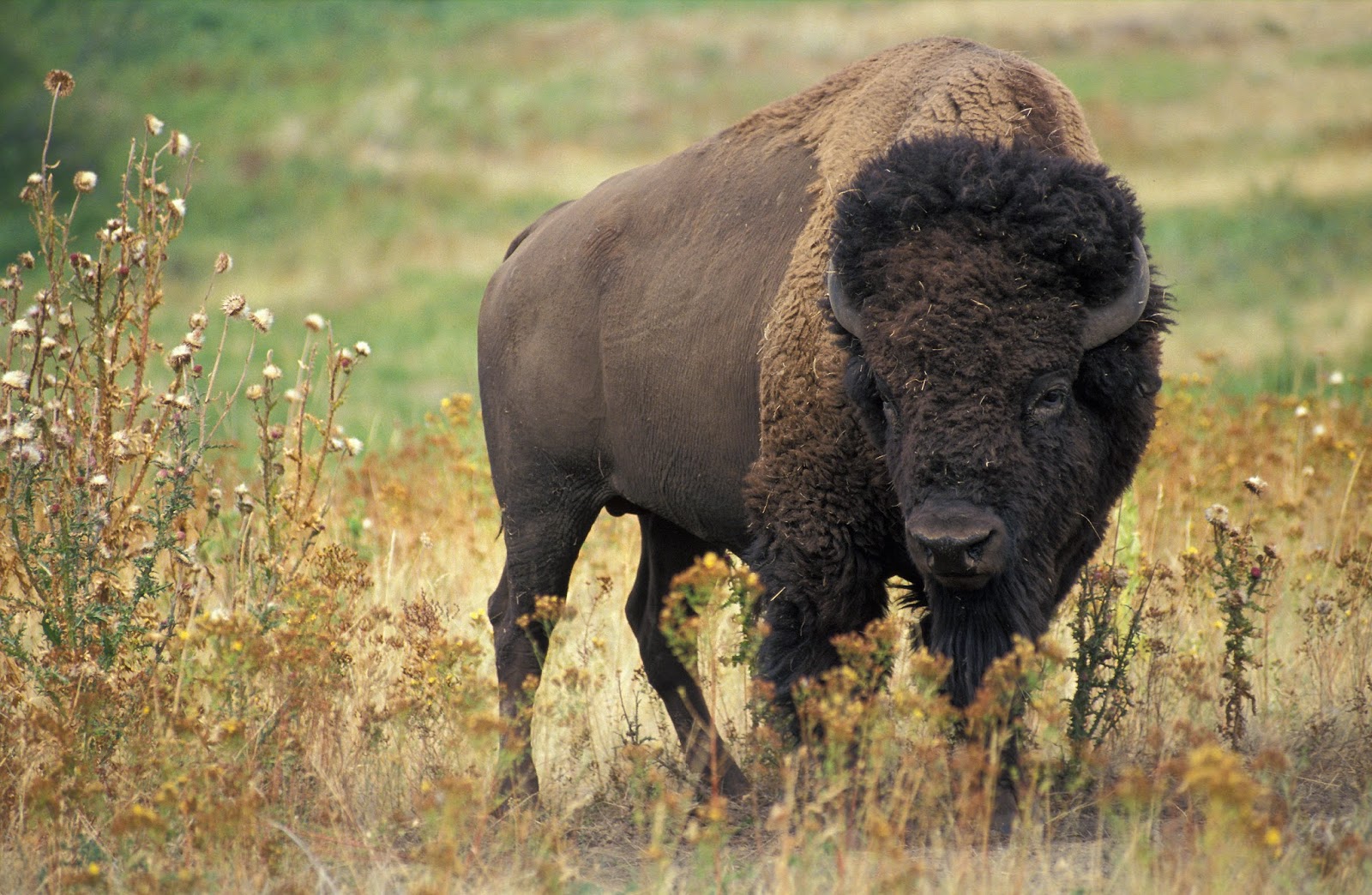
American Bison
When homesteaders like Isaac B. Werner arrived on the prairie, they found few trees.  They had not yet planted corn, the stalks and cobs of which they would in the coming years use for fuel (See "Corn Harvest, Then and Now," 9-18-2014 in the blog archives).  Lacking the traditional fuel sources, like wood and coal, these homesteaders found an unexpected source--the dried dung of the American bison, or buffalo as the bison were commonly known.  The dung, nicknamed 'prairie coal,' burned slowly and the odor was barely noticeable, according to contemporary accounts.

In the early years of settlement of the prairie, there were unimaginably vast herds of buffalo. Native Americans used the animal not only for food and hides but also found uses of other parts of the buffalo.  Because the buffalo was so important to Native Americans, religious rituals were often a part of the hunts.

A pile of American Bison skulls
As the plains were settled by people from other cultures, the animals seemed to be inexhaustible.  It was estimated that at least 25 million American bison roamed the United States and Canada, but by the late 1880s perhaps as few as 600 remained in the US!  They were often killed for their hides, the meat left on the prairie to rot, or they were killed simply for sport.  Sadly, they were also killed as a way to defeat the Indian populations, for slaughtering the buffalo meant less food and materials available for used by the Native American populations.  Cattlemen did not like grazing competition from the buffalo for their cattle's range.  However, it is also true that one method used by the Indians in their bison hunts was driving huge herds off cliffs to kill or wound them.

Fortunately, a few people recognized the importance of preserving this great prairie animal.  One of the earliest proponents of reintroducing the North American Bison to the region of its historic range was James "Scotty" Phillip of South Dakota.  He bought five calves roped during the Last Big Buffalo Hunt on the Grand River in 1881 and took them back to his ranch on the Cheyenne River.  When he died in 1911 he had a herd of over a thousand bison, from which other privately owned herds originated.

Painting by George Carlin
The Yellowstone Park Bison herd was formed from a few bison that survived the mindless slaughter of the 1800s, and the the Park's bison numbering over 4,000 are the descendants of those 23 hidden bison.

Today the US Department of Interior is seeking lands on which to move animals from the Yellowstone herd.  Because the bison migrate during winter, cattlemen outside the Park fear the spread of brucellosis to their cattle.  As a result, the government has allowed bison slaughters to avoid the risk of the disease spreading to surrounding cattle herds.

Some Yellowstone bison have been quarantined for years to make sure they are free from the disease, with the intention of moving them to appropriate areas outside Yellowstone.  Kansas is among the states with possible sites for these animals with the pure genetics of the original American bison.  The Tallgrass Prairie National Preserve was identified as potentially suitable for relocating these bison.

Small herds of buffalo can occasionally be seen in pastures in agricultural areas, but they are nearly always bison-cattle hybrids that lack the pure genetics of the Yellowstone herds.

Millions of acres of public lands have been leased to ranchers for grazing livestock, and the National Wildlife Federation has established a program to negotiate a fair market price with ranchers to retire their grazing leases and return these acres to the exclusive use of natural wildlife, including the bison.  Their program uses the catch line "Adopt a Wildlife Acre.  Give Bison Room to Roam."  

Perhaps there were a few American bison left on the prairie when Isaac Werner arrived in 1878, but for most settlers at that time the only resource left by the bison were their dried dung used for fuel and their bones, which could be collected and sold for use in fertilizer.