Showing posts with label evolving communication. Show all posts

Thursday, March 21, 2019

Send a Message

One of the things that is such fun about this photograph is that the picture was taken to be put on a postcard--a postcard showing three young women reading a postcard!

Of course Isaac Werner received mail in the late 1800s.  The post offices were in some neighbor's home.  The earliest reference to a postal address in Isaac's journal is to the Vosburgh Post Office, but the post offices during most years of his journal were in the homes of "Doc" Dix and Aaron Beck.  Nearby Antrum delivery was in the home of the Gibbs sisters.

But how was a message sent if immediacy was important, as in the case of serious illness or death?  That information is not contained in Isaac's journal, although I know that he was quickly made aware of the deaths of his sister and of his mother.

I have done some research on the telegraph of that era.  One of the issues the populists included in their Peoples' Party Platform was government ownership of telephone and telegraph, just as the government has the U.S. Mail.
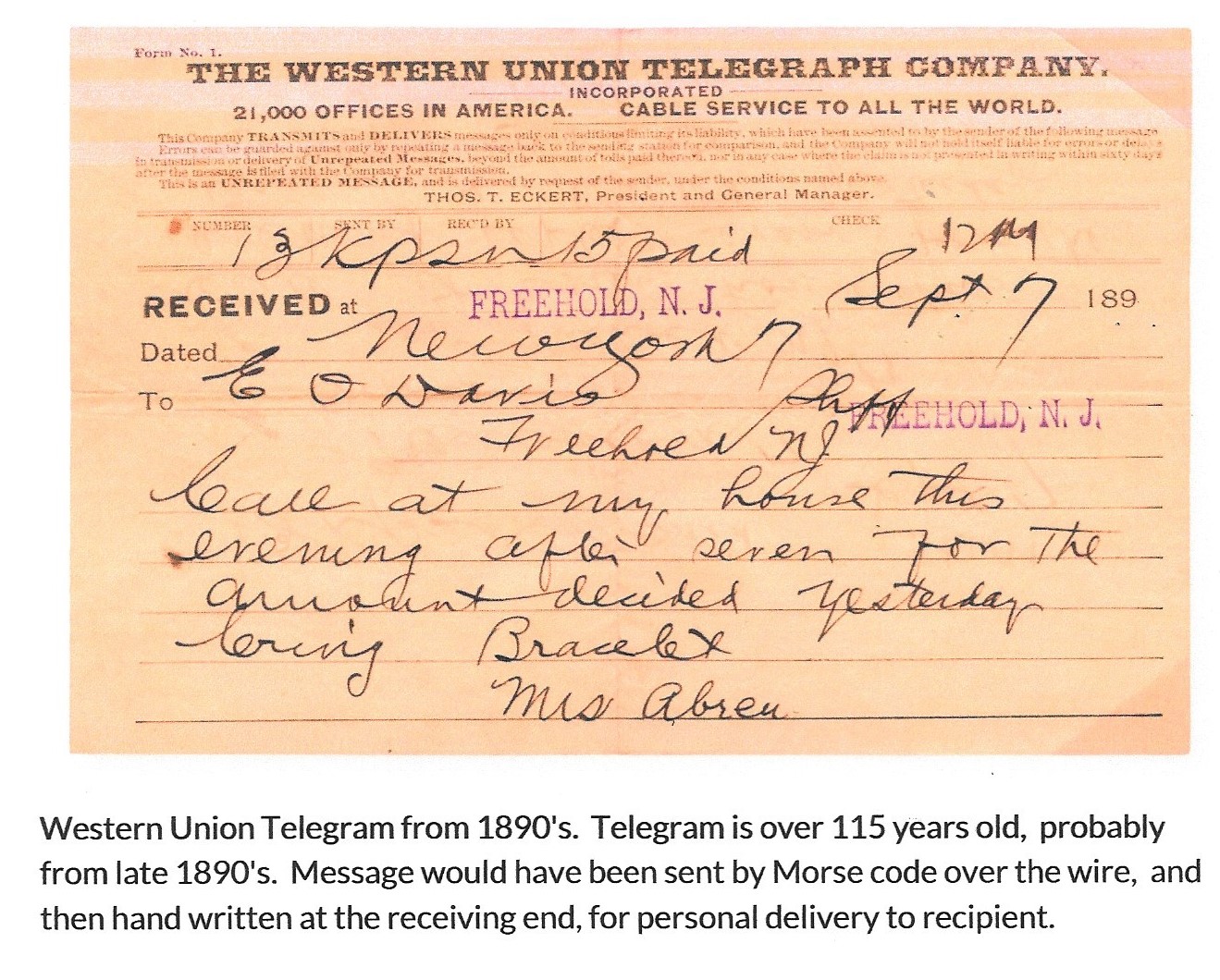
According to the website from which the image at right was taken, it is likely that the messages Isaac would have received about family deaths would have been sent by Morse code, transcribed, and hand delivered in some way.  By 1900, 63.2 million messages were sent each year.  The distance from town of his homestead does raise the question of hand delivery.

Western Union was the first nationwide industrial monopoly, and in almost every session of Congress, bills urged either regulation or government takeover.  However, the greatest threat to Western Union was technology in the form of the telephone.

It is always technology that is nipping at the heels of the existing status quo.  Remember when you actually had long conversations with your friends over the phone?  And, do you remember letters!--not just a signed greeting card but actual newsy letters?!  And for sweethearts, love letters!

Then came e-mail, whose primitive beginnings happened in 1965 at MIT.  Within 2 or three decades most of us were enjoying chatty e-mails from our friends.  Today, if you are like me, most of my past e-mail friends are posting travel photographs and kids' pictures on face book!

Portrait of the End of a Romance
And, now there is Twitter, which did not exist until March of 2006.  By the 10 year anniversary of its creation there were 319 million monthly active users.  Evan Williams, one of its founders, said "Twitter actually changed from what we thought it was in the beginning, which we described as status updates and a social utility.  It is that in part, but the insight we eventually came to was Twitter was really more of an information network than it is a social network."  I would add that it is also a 'misinformation network.'  

Like all the communication methods just described, something new will surely come along to replace Twitter.  One of my earlier blogs pointed out that young people prefer texts over phone calls because it spares them from being trapped in a conversation.  I do understand that.  When you are busy or immersed in a project or even in the middle of a great book, being interrupted by the phone can be an annoyance.  However, it seems less likely that Twitter, or even texts, can develop relationships in the same way that conversation can.

Although it is difficult to predict what new technology may replace Twitter, history would predict that something will.


Thursday, September 20, 2018

Diagram that Sentence!

Recently I noticed an article by Lorraine Berry titled "The Lost Art of Sentence Diagramming."  According to the article, in most current school curriculums, diagraming sentences has been declared to have "no educational value."  Once, its use was explained in this way: "Sentence diagramming is a means by which a sentence is parsed and represented by a structure of lines that establish the relationship among the words in the sentence."  Stated more simply, the diagram created a map of the sentence.

Some of you may remember the process.  First, you started with a straight line.  You identified the subject and the predicate and wrote them on that line with a vertical line separating the two words.  If there were an adjective modifying the subject of your sentence, you drew a diagonal line under the subject and wrote the adjective.  If there were an adverb modifying the predicate, you placed it on a diagonal line under the verb.  The diagraming continued as the relationship of each word to the others was connected, teaching students how words in a sentence relate to each other.  Diagraming sentences went beyond memorizing rules to understanding how words work together.

As a teacher, an attorney, and an author, putting words together so that my meaning is clear and the content is interesting is important.  However, do I evaluate that importance differently from other people?

Isaac's Journal
The journal of Isaac Beckley Werner has occupied my time for nearly a decade.  He was an educated man who attended school longer than most people of that time, and throughout his life he cherished books and learning.  Yet, the daily entries in his journal did not conform with formal rules of composition.  As an example, on February 2, 1886, his entry was the following:

Feb 2d @ 5 degrees above zero Snowing somewhat Blizzard like still continuing, drifting good deal during A.M. & last night, letting up during day, continual cloudy and varying 5 to 3 degrees above zero during day, keeping quite cold disagreeable outdoors, bad weather on stock and to tend to them, I busy indoors all day at S.W. cupboard hanging doors etc. by sun set @ zero, darker cloudy in E. & like clearing off W.

Isaac was often asked by neighbors to write contracts and other agreements for them, and he was elected to serve as the secretary for nearly every organization of which he was a member.  His farming and progressive articles were published in newspapers and journals.  However, he was keeping his journal for himself, and he took no particular pains with punctuation and complete sentences.

It is nothing new for us to write notes to ourselves in haphazard ways, so long as we know what we meant.  What is new and evolving is how we communicate with others.

In an article by Larry Alton titled "Phone Calls, Texts or Email?  Here's How Millennials Prefer To Communicate," he pointed out that the way millennials prefer predicts the manner of "the future of workplace communication overall--and whether you like it or not, you'll need to prepare for those changes."  According to him, millennials don't like phone calls, particularly because they "require a kind of interruption to someone's day, while text messages and emails can be opened and read at the recipient's leisure," and I would add, they spare the caller's having to become involved in a lengthy phone conversation with the person they called.  Haven't most of us been entangled in a phone call with someone who simply wouldn't let us get off the phone?

According to Alton, millennials like texting because it can be done anyplace and anytime, and it avoids their having to make immediate responses as they would be required to do in a phone call or personal conversation.  If longer messages or more organized presentation of the messaging is needed, emails are preferred.

Alton suggests that the changes in communication relate to many other changes making the workplace less formal, such as flexible hours, relaxed dress codes, and more casual environments.  Those of us who learned to diagram sentences probably expected an 8 to 5 job (assuming we actually ended our day at 5 p.m.), we probably would never have considered wearing jeans to an office job or  a classroom, and our workplace was very unlikely to have yoga classes and gyms.

Since May of 2017, when Alton wrote his article, the popularity of Twitter has grown. According to an article by Paul Gil, "it provides a stream of quick updates from friends, family, scholars, news journalists, and experts."  People are using Twitter as a marketing tool, and President Trump sends multiple tweets most days, preferring that method of communication to the formal addresses to the nation and the opportunities to answer questions from the press in the manner of past presidents.

How we communicate is changing, and it is unlikely that the more formal means of communication that offered time for reflection and editing our thoughts before they were sent may be disappearing, or at least, may be reserved for particular communications.  Yet, should we pause to consider whether we are losing something important in the neglect of how we use words?  Are we becoming more careless and less reflective as we send our words out into the world, are our ideas less considered, do we weigh our words less before we express our thoughts, and have we determined whether our best ideas are necessarily the first things that pop into our heads?  Even our electronic devices sometimes ask us whether we are really ready to hit send.

Maybe diagraming sentences is old-fashioned, but when we become sloppy about how we express ourselves, we may be misunderstood.  Or worse, we may be understood for having said something we wish we had considered a bit longer before we hit "Send."