Showing posts with label women homesteaders. Show all posts

Tuesday, January 4, 2022

She Didn't Marry a Farmer

Continuing last week's blog that shared 3 generations of women who married a famer and concluded with a husband who married a farmer's daughter, I will remind all of us that while it may be true that young women today may be choosing farming for themselves, they are far from the first Female Farmers!

The Homestead Act of 1862 identified "heads of households" as the family member allowed to stake a homestead claim.  Since husbands were always the ones considered as the head of the family, married women could not stake a claim unless they could prove that their husband did not provide support for them in any way.  That was often difficult, since even the worst of husbands usually managed to bring home some bit of revenue occasionally.  

The picture above right compares the roots of prairie grass that the homesteaders had to break through to plow their fields for crops to the shallow roots of cultivated grass.  Breaking the native prairie sod was no easy task for male or female farmers!

Single persons, male or female, could stake a claim to prove up, as could widows and divorced women.  Adjacent to Isaac Werner's timber claim were two such women.  Persis Vosburg lived across the road to the west of Isaac's timber claim.  She had never married, but she had her own home and staked the quarter section on which it set.  Her widowed brother's claim was just to the north of hers.  She helped take care of his motherless children and he helped with some of her farm work in exchange.  A neighbor, coveting her land, raised a complaint that she was not complying with the requirements of a homesteader.  Isaac spoke up for her, saying that if two brothers had claims side-by-side and shared work, no one would object.  The fact that the work she did for her brother involved childcare should be treated no differently than the case of two brothers sharing work.  Persis was allowed to prove up her claim.

Just to the east of Isaac's timber claim was a divorced woman with children who had staked a claim.  No one seemed to object to Isabel Ross staking her claim, since it was obvious that she was supporting herself and her children.  Isaac often did simple kindnesses for her, including hiring Isabel and her children occasionally to help with his potato crops. 

Homesteading Chrisman Sisters

Perhaps the most famous female homesteaders are the four Chrisman sisters, Hattie, Lizzie, Lutie, and Ruth, who all staked claims in Custer County, Nebraska in1886.  They were not alone.  Historians today have estimated that about 20% of the homesteaders in Nebraska, Kansas, Colorado, Wyoming, Montana, North & South Dakota, Utah, and Idaho were single women.  Not every person staking a claim managed to endure the hardships of survival or the loneliness and hard work, and many claims were abandoned.  However, the success rate for proving up their claim was higher among women than men.

These brave, resourceful, stubborn women homesteaders were generations ahead of the Pioneer ad that inspired last week's blog, which is continued this week.  In the book "Letters of a Woman Homesteader," a widow with a young daughter decided to stake a claim.  Her Pastor advised her to "get a position as a housekeeper for some rancher who would advise [her] about land and water rights."  As you might guess, the widow and the rancher didn't quite stay single for five years, but she maintained her own land and he continued paying his bride the housekeeper wages he had paid before their marriage, so that she had her own money for maintaining her claim.  The government accepted the arrangement and awarded her the land at the end of the required 5 years.  Isaac Werner's neighbor ladies Persis and Isabel had no such romantic entanglements and proved up their claims 'by the book.'  Perhaps for some of these ladies, a man may have come along after her hard work of proving up a claim and asked for the lady's hand in marriage.  I'm not sure whether these ladies would have accepted a marriage proposal after proving they could manage on their own, especially since the laws of their time would have taken away some of their rights if they married!

But, like the woman in the Pioneer ad that inspired the two blogs starting last week and concluding this week, perhaps some of those homesteading women could eventually say "Her husband married a farmer." 


Thursday, June 23, 2016

Surnames of early settlers

Last week's blog shared the importance of preserving information descendants have about their ancestors so that future generations will not forget their past ancestry.  Often in writing my manuscript about Isaac B. Werner and his community, I have asked readers to look for old photographs.  This week I am urging readers of the blog to review the surnames I am sharing to see if family names appear.

Homesteads and Timber Claims, Albano, Stafford Co., KS


This map was copied by me from  Stafford County History, 1870-1990 and I do not know who to credit with making the original map.  It identifies those settlers who originally claimed homesteads and timber claims in Albano Township.  I copied it while doing research in order to enlarge it, and this copy is of my enlargement, which is still difficult to read because of labeling each of the 36 square mile sections in the township, all of which are subdivided.  The sections are numbered 1-36, beginning in the upper right and continuing in horizontal rows until concluding with #36 in the lower right corner.  Some of the divisions differ, with a larger or smaller claim.  The identification "TC" indicates a timber claim.

You will recognize some of the names from earlier blogs, for example Isaac H. "Doc" Dix has both a homestead and a timber claim in the north half of Section 31.  Isaac's two claims are in Section 33, his homestead in the lower-left corner and the timber claim that was assigned to his brother Henry in the upper-left corner.

Claims were limited to 160 acres, but you will notice that not all claims were in the corners of the sections.  For example, California Smith claimed 160 acres in the center of Section 21 and Mattie M. Beck and Peter A.N. Beck (no known relation) claimed rectangular properties in Section 18.  In addition, not all the claims were a full 160 acres.

To help you read the surnames, I will list them by section number:  #1 Pelton, Hunt, Frack, Wenzel; #2 Eddingfield, Long, Toland; #3 Smith, Williams, Webber; #4 Wasson, Neelands, Dunlap; #5 Neil, Bowling, Weeks, Clark; #6 McKibben, Mainline, Lynch; #7 Curtis, Smith, Goodwin, Markham, Martin; #8 Stambaugh, Shilt, Osgood, Curtis, Rex; #9 Neelands; #10 Cubbage, Neelands, Loftiss; #11 Frack, Pixley, Bowker, Bair; #12 Wenzel, Moody, Moore; #13 Cubbage, Davidson; #14 Tanner, Kackelman, Newton; #15 Toland, Loomis, Bedenhamer, Dilley, Stimatze; #16 Neelands, #17 Grunder, Hart, Frazee, Toland; #18 Beck, Rea, Hainline, James; #19 Smith, Skinner, Fox, Tousley; #20 Hall, Furman, Fitch, Rice; #21 Blanch, Rice, Smith, Stimatze; #22 Tobias, Frack, Carnahan; #23 Tanner, Davison, McHenry; #24 Davison, Hazelton, Goodman, Tompkins, Gibbs; #25 Bushell, Goodman; #26 Davison, Tobias, Cullison; #27 Stimatze, Campbell, Graff; #28 Shattuck, Frack, Henn; #29 Holbrook, Wasson, Vosburgh; #30 Webber, Rearick, Smith; #31 Dix, Fountain, Rogers; #32 Barker, Vosburgh, Rowe; #33 Werner, Ross, Bentley; #34 Mayes, Bonsall, Gareke, Shoop; #35 Young, Cullison, Smith, Tompkins, Dumen; #36 Reynolds, Jacobs.

You will notice as you read the surnames that I did not repeat the surname if the property extended into another section nor if more than one person with that surname made a claim.  You will also notice that many of the claimants were women.   For example, in Sections 24 and 25 you will see the surname of Gibbs, which indicates a claim by two unmarried sisters who occasionally visited Isaac to admire his trees or buy seed potatoes. Sometimes when families arrived they would each build separate residences, whether dugouts, soddies, or shanties, so that each member of the family could claim 160 acres.  This was especially true of siblings.  For example, Jerome M. Vosburgh and his wife claimed the southeast quarter of Section 29 and his unmarried sister Persis Vosburgh claimed the adjacent northeast quarter of Section 32.  Single women were entitled to claim their own homestead; however, when Jerome's wife died and Aunt Persis assisted her brother in caring for his children, some neighbors attempted to claim Persis' quarter, saying that she no longer maintained her own home on the land.  Isaac Werner and other neighbors supported the right of Persis to claim the property as a single woman and supported her contention that she did maintain her own home there.

I hope some of you with ancestors in this region will take time to study this drawing of Albano, Stafford Co., KS and consider whether you have stories or images to share with me.


Thursday, January 8, 2015

Isaac's Neighbors

On November 18, 2011 I posted a blog titled "Isaac's Land From the Air Today" which explained how land in Kansas was divided into square mile Sections and then divided again into four squares called quarter sections, or more simply, Quarters.  Homesteaders could claim a quarter, containing 160 acres.  In addition, a timber claim of 160 acres could be claimed by planting 10 acres in trees and keeping them alive for 8 years.  Isaac claimed both, which gave him 320 acres.  To read more about this process, as well as information about the population density on the prairie in Isaac's time in comparison to today's population density, you may visit that blog in the archives.  I promised in that blog to return to a further description of the neighbors living around Isaac, and at last, this blog will keep that promise.

First, orient yourself to Isaac's Homestead and Timber Claim identified in the center of the photograph, easily spotted because they are bright green from the winter wheat growing in the circles under irrigation.  (The gravestones of neighbors can all be found in Neeland's Cemetery, located in the image above to the north of Isaac's claims.  To see more interesting stones in that country cemetery, you may visit "Woodmen's Gravestones," 3-8-2012 in the blog archives.  Click on the images if you wish to enlarge them.)


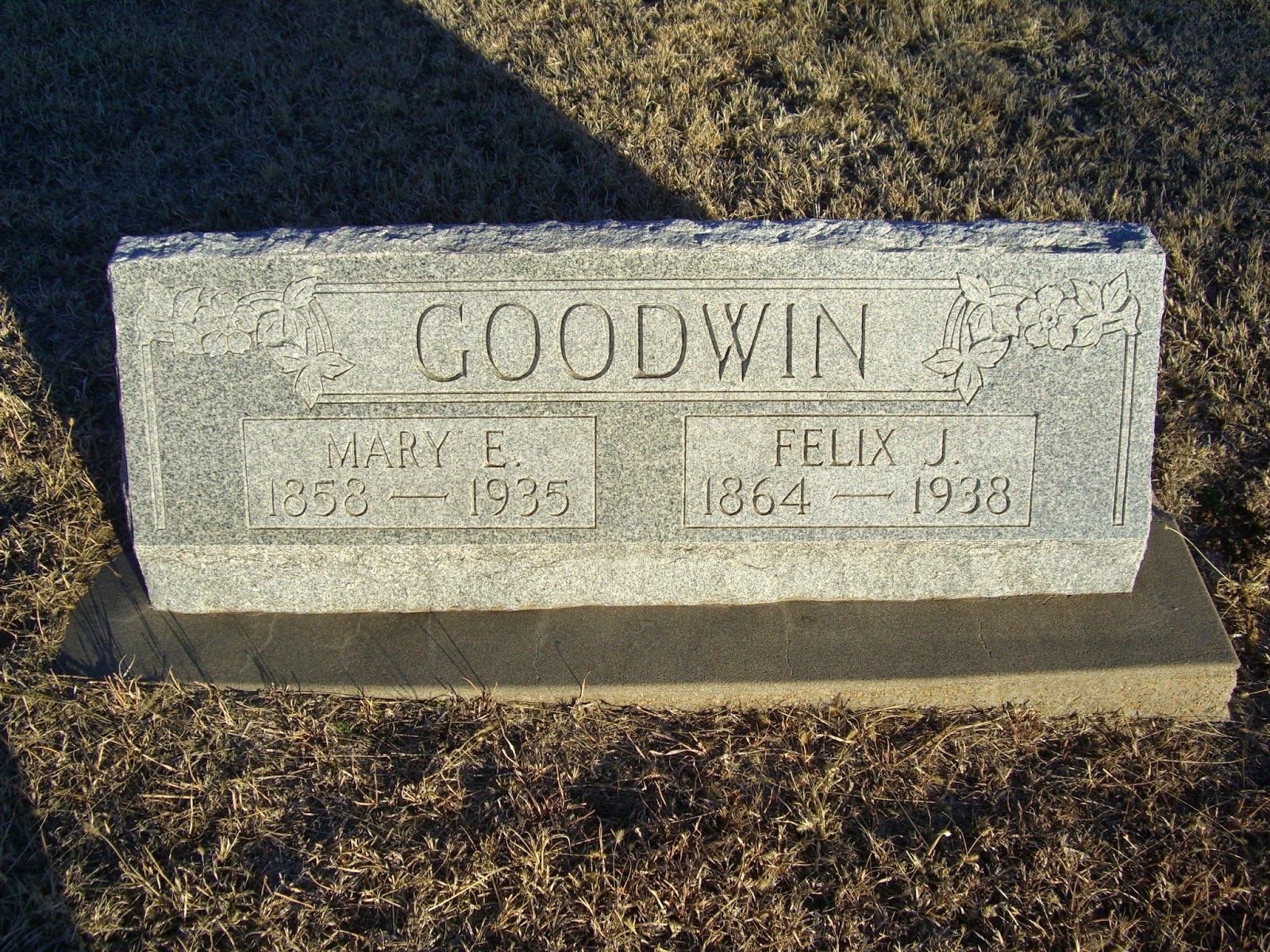
Felix and Mary E. Clouse Goodwin's stone in Neeland's Cemetery 
To the south of Isaac's homestead is the Pratt-Stafford County Line.  Directly across the line was the claim of William and Felix Goodwin in Pratt County.  Both of these men are mentioned frequently in Isaac's journal.  William often shared work with Isaac, and when his younger brother Felix came to live with him, they built a larger dugout, which Isaac helped with installing its roof.  When Isaac's friend Lou Clouse died about 1894, his widow married Felix.  It is believed that Lou may be buried near Felix and Mary in the Neeland's Cemetery, but if so, his is an unmarked grave.

Just to the east of Isaac's claim first lived the Green family, who moved to Pratt.  Following them was the Bentley family, who moved to Colorado and later to Salt Lake City.  After a brief occupancy by tenants, Frazee moved onto the land.  Isaac was particularly close to both the Green and Bentley families, and he and Frazee often worked together.

Eliza Campbell's stone, wife of William
Just east of Isaac's Timber claim lived Isabelle Ross, a divorced lady with children who claimed that quarter as a female head of household.  Isaac was kind to Mrs. Ross, often helping her with chores she couldn't do for herself, and she and her children frequently helped him with his potatoes.

North of Mrs. Ross lived William Campbell and his family.  He was elected State Representative for his district, first for the Union Labor Party and then twice for the People's Party.  He and Isaac were good friends and often shared political conversations.  He was frequently mentioned as a potential People's Party candidate for Governor, but family responsibilities forced him to decline.  William's wife died only a few days after Isaac's death, and William did not remain in the community very long following her death.

Just west of Campbell and north of Isaac's Timber claim lived George and Nancy Henn.  They were the couple who cared for Isaac in his final illness, and their claim for payment for that care was the largest claim against his estate, an excessively large amount, considering the favors he had given them in prior years, as well as the depressed wages during the time they cared for him.  In fact, Isaac's advice may have saved the life of Nancy's son, Frank Curtis, when the boy was young.  Nancy predeceased George by several years, and no one had his death date engraved on the stone, although he lived nearby according to census records and is probably buried next to her.

Neeland's Cemetery, George and Nancy Henn
West of Henn's and of Isaac's Timber claim are the claims of brother and sister, Jerome and Persis Vosburgh.  Persis claimed as an unmarried head of her own household, although she did help care for Jerome's children after the death of his wife.  Neighbors eager to claim Persis' homestead challenged her claim, saying she didn't work the land nor live on it full time, but Isaac and other neighbors supported Persis and she retained her claim.  She died in New York state while visiting relatives, but Jerome is buried with his wife in Neeland's Cemetery.  After the death of Persis, her land was acquired by G.G. John, and during the final months that Isaac lived in his home, John looked in on him every day.

To the north are identified Emerson, where Isaac helped build the school (See "Isaac Builds a School," 10-11-2012 in the blog archives), and beyond is the Rattlesnake Creek (See "The Rattlesnake Creek," 11-26-2012).  Near the left edge of the photograph is the name of my great grandfather George Hall, whose timber claim was along the creek.  A small white dot in the trees is visible below his name, and that is the location of his house.  George and Theresa Hall were close friends of Isaac, and they cared for him briefly in their creekside home when he was first unable to live alone.
Neeland's Cemetery, Jerome & Ann Vosburgh

The Stafford County seat of St. John is identified on the horizon.  Before Isaac acquired his horse Dolly, he walked to St. John.  The towns of Macksville and Naron are not within the photograph, but arrows show their direction at upper left and lower right.  Also shown at left by arrows are the direction of the homes of Doc Dix and the Beck family.  To the far right is the Gus Gereke claim.  In the early years Gus and Isaac frequently worked together.

As you can see from the photograph, the claims that surrounded Isaac with neighbors are now nearly all open fields without families living on the land.  Most of the trees planted by the early settlers have died or been removed, and the prairie is once again nearly without trees except along the creek and at the few homes that remain.

Very few descendants of those early homesteaders remain in the community, although homesteaders believed they were struggling to save their claims to be passed from generation to generation of future descendants.  Isaac's land passed to his brother, his sister, and the children of a sister who predeceased Isaac, but they sold Isaac's beautiful farm without ever seeing the prosperous homestead he had created on the prairie.


Thursday, February 21, 2013

Women on the Prairie

City Hotel in St. John, Kansas
In searching for images to accompany this blog I observed that often the women photographed in everyday scenes were at the back of the picture, standing behind the men.  You will need to click on the image at the right to enlarge it enough to find the women at the rear door of the City Hotel in St. John, Kansas.  That is an appropriate allegory for how the role of women in homesteading the prairie is often seen--a wife surrounded by children standing behind her husband.  Certainly many of the women on the prairie were wives who came with their husbands to stake a claim, but it must be remembered that those wives, and the children as well, worked side-by-side with their husbands, not necessarily doing the same chores but doing other things that needed to be done if they were to survive and prosper.
 
The requirements for homesteading were that the claimant be the head of the household or be single and at least 21 years of age.  The claimant's gender was not specified.  As a result, many homesteaders were women--single, widowed, or divorced.  The ratio of men to women homesteaders varied from place to place and year to year, but estimates range from five to twenty percent of homesteaders being women.
 
 
Woman gathering buffalo chips for fuel
The women in my family who came to Isaac's community to build a new life on the prairie came with their husbands--Susan Beck, Theresa Hall, and Mary Wilson.  However, two of Isaac's nearest neighbors were women homesteaders.
 
Persis Vosburgh was an unmarried lady, born in New York state in about 1837.  She came to Kansas with her younger brother Jerome and his wife Ann.  After Ann's death, Persis helped raise her brother's children who were still at home--Fay, Leila, and Fannie.  Because of her close connection with her brother, (she was counted in his household in both the 1880 Federal Census and the 1885 Kansas Census), there were those who raised an objection to her claim as a homesteader, believing Persis had not maintained a residence on her claim.  At a vigilance meeting at the Naron School in the spring of 1885 to discuss what to do about claim jumpers, Isaac, William Campbell, and C. W. Shattuc supported Persis against those who said she did not meet the requirement of residing on her land.
 
In 1888 Persis Vosburgh died while on a visit to New York state to see family.  Isaac farmed her land following her death, growing corn and plowing fire guards to protect her trees from prairie fires.  Her heirs eventually conveyed it to G. G. John, the man who cared for Isaac during the final five months Isaac was able to remain in his own home.
 
Isaac's other unmarried neighbor was Isabel Ross, a divorced woman with children still at home.  When Mrs. Ross made the decision to claim her homestead just to the east of Isaac's timber claim, Isaac called on her to make out a lumber list for what would be necessary to build her soddy.  He wrote in his journal that she had so many architectural ideas that he was glad the job of contractor went to Tousley, another neighbor.  However, Isaac worked on the job from the time the soddy was staked until he dug her well after the structure was finished.
 
Although divorce was rather uncommon in those times, the court records on file explain why Isabel Ross filed against her husband.  She claimed he abused her and their children and he claimed she was an unfit mother, but she prevailed in the suit and was given custody of their children.  Over time, Isaac's initial opinion of her changed, and his journal records many kindnesses he showed her--taking corn husks and cobs to her for fuel in storms, helping tie down her stable roof in winds, papering inside her soddy roof to reduce drafts in the winter.  Despite these acts of thoughtfulness, Isaac continued calling her Mrs. Ross, avoiding the more personal use of her first name.
 
Susan Beck & daughter Anna Marie
My great grandmother Susan Beck is a good example of women who remained on the land with their children after misfortune.  Her husband, Aaron, suffered a stroke in about 1891, and Isaac's journal describes a sale at the Beck's about that time. During the 1890s, Susan taught in nearby Pratt County country schools.  Their older child, Royal, was a teenager, old enough to do work on the farm with direction, and by the time of Aaron's death in 1900, Royal and Susan had bought land and had begun building a house.  Daughter Anna Marie was already following her mother's footsteps as a teacher in Stafford County schools, and both mother and daughter spent a year teaching in Colorado before setting up their household in St. John.  Royal remained on the farm and brought his bride, Lillian Hall, to the home he and his mother had built.  Although Susan was not initially widowed, she did become the primary provider for her family as her husband's health failed, and she kept the family together in their prairie home.
 
The roles of women on homesteads, whether as the claimant or the wife, daughter, or unmarried sister or aunt of the male claimant, should not be overlooked or minimized in the settling of the prairie.  You might enjoy Staking Her Claim:  Homesteading the West, by Marcia Meridith Hensley,  http://newwest.net/topic/article/no_husband_no_problem_problem_for_women_staking_her_claim/C39/L39

 P.S.  The woman pictured gathering buffalo chips is Ada McColl, believed to be the first female photographer in Kansas.  She is known for documenting everyday life on the prairie, as well as for portraiture.  Her homestead was in Kearny County, and she began working as a photographer in the late 1800s in Garden City.  The image is taken from an old postcard.