Showing posts with label 4-H. Show all posts

Wednesday, March 30, 2022

Pratt County 4-H Clubs of 1962


 The Pratt Pride magazine of 1962 devoted a large article to the role of 4-H Clubs in Pratt County, consisting at that time of 356 young members among 12 organized clubs throughout the county, with 96 adults involved in leadership posts.

The first 4-H memberships in Pratt County, organized in 1927, by 1962 had involved 6,331 boys and girls, although technically the early clubs were called "Project Clubs."  Those organizations became 4-H Clubs in 1931.  Each community could decide the projects their club would offer.  While rural clubs might focus on livestock and poultry, clubs with more urban members might focus on other projects.  In either case, the rules required that the young members do most of the project work themselves and keep their own records.

Listed in the article were agricultural and home economics, junior leadership, bees, rabbits, tractor maintenance, home grounds beautification, soil conservation, and wood working.  Also mentioned were developing personal confidence by participation in demonstrations, project talks, and skits.

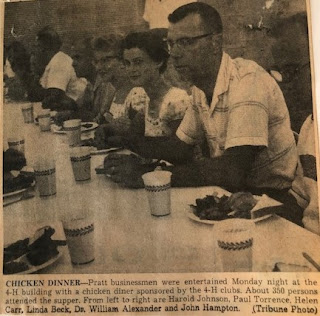
The clipping at the beginning of this post appeared in the "Pratt Tribune" showing the chicken dinner hosted by the 4-H clubs for Pratt Businessmen.  Notice the reference to "business men," although there must have been several business women in Pratt at that time.

I did not have livestock.  My projects were cooking, sewing, and home improvement.  I do recall giving a demonstration describing how to select items for a first aid kit, which I carefully packed into a tin lunch pail.  I also remember the emphasis on learning how to conduct a meeting with the proper motions, seconds, and voting.  As an adult sitting through a few meetings, I sometimes wished those adults conducting the meeting had benefitted from the same 4-H training I had received.
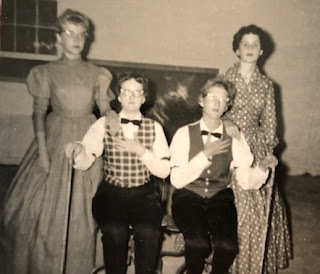
Our club particularly enjoyed music, whether it was square dancing or singing.  The quartette pictured at right consisted of four Byers classmates--Helen, Judy, Cheryl, and Lynda.  Our serious pose was intended to depict a Barbershop Quartette.

I also remember the dances at the fairgrounds, with 4-H members from all the clubs in the county attending.  I think we learned the bunny hop and the schottsche, as well as various square dances, but whatever the dances were, we had fun.

This past Christmas we were surprised by a knock on our door one evening for the delivery of a Christmas ornament decorated by the local 4-H club.  The traditions live on!
  

Thursday, February 16, 2017

Two Hundred Forty Acres

Sign marks the turn 
It is true that the Home on the Range Cabin is a bit in the middle of nowhere, but somewhere isn't far away.  From Smith Center, Kansas, where we had spent the weekend, it was only about a fifteen minute drive on well paved roads except for a very short drive on well-packed dirt.  Department of Tourism signs marked the way until we reached the last turn-off, and an impressive stone sign could be seen well in advance of the turn-off.

Even if there were no particular destination it would be a nice drive through the rolling hills and valleys of northermost Kansas.  A double row of dry corn stalks along both sides of a fence stood like sentries atop a hill as we entered the dirt road.  As we gradually dropped down toward the river valley through which West Beaver Creek wanders, we saw an old bridge, now useful for hikers crossing the creek but once used by vehicles on a now-abandoned county road.

Historic Bridge for pedestrians

One more curve and we pulled into the parking area for Higley's "Home on the Range" Cabin.  If you missed last week's blog post you may want to continue reading the blog post about the cabin which follows below.  The cabin sits above a meadow next to West Beaver Creek.  Mark McClain explained to us when he showed us the grounds that time had change the course of the creek, so it was not exactly where it might have been in Dr. Higley's day, but the feeling of his nearly hidden home along the creek remains.

This special place was saved for future generations by Pete and Ellen Rust, who farmed the land from 1936 until Pete's death in 1986.  After his death, Ellen made plans for preserving this important piece of Kansas history through a trust.  Funds were raise for the restoration of the cabin (See Dr. Higley's Cabin, 2-9-2017 below.), and after the restoration was complete, the property was conveyed to a nonprofit organization.  The cabin and its 240 acres are owned and managed according to the terms of the trust Ellen established.


Plans for bridges, hiking and biking trails, and a natural amphitheater just south of the cabin were underway before Mother Nature caused some interruptions with flooding.  The plans, developed with the guidance of a landscape architect, remain the same, including concerts and other events onsite, as well as activities for young people, such as boy scouts and 4-H groups.

Cabin with bridge
Unlike the Ellen Rust Living Trust initially  established, the transfer to the People's Heartland Foundation as a 501 (c) (3) charity can exist into perpetuity and can also accept tax-deductible contributions from future donors.  This allows planning to extent far into the future, and members of the community and groups wishing to utilize the property are encouraged to participate in the planning with their ideas.  Volunteers willing to help stay ahead of Mother Nature are also welcome.


4-Hers have already contributed to the hiking trail with their Native Grasses Project.

Next week's blog will share more about what one man's dream can become when I blog about Lone Chimney Films, producer of "Home on the Range, The Story of America's Iconic Song."

Cabin at top in photo, creek, meadows, & trees below

Remember, the images can be enlarged by clicking on them!

Thursday, September 19, 2013

Sheep Shearing at the Fair

Judging the sheep at the Ks St Fair 
Kansas is best known for several things--Cowboys and Indians, being the Sunflower State, Dorothy & the Wizard of Oz, "amber waves of grain."  However, most people do not associate sheep with Kansas.  That is unfortunate, for not only are sheep raised in Kansas today, they are also a part of Kansas history.
 
The sheep shearing demonstration


In the early years before there were fields under cultivation, great herds of sheep were driven across Kansas to markets in the east.  Increasing cultivation and the railroads ended that practice.  Few farmers in the area near where Isaac once lived raise sheep today, although I do know of at least one; however, sheep were being raised in this area in Isaac's time.  He mentions in his journal buying mutton from my great grandfather, Aaron Beck, a surprise to me since I had not known of sheep ever being raised by my family.  In the Blizzard of 1886 Isaac recorded in his journal that a neighbor named Blanch lost about 800 sheep and that Neelands Ranch lost a great many too, although he did not know the number.
 
There were sheep raised in Pratt County when I was young, for the Sheep Barn at the Pratt County Fair was a popular place to go when I was in 4-H.  Most of the kids that I knew raised cattle as their 4-H project, however.

 
Students watch the shearing 
A friend who was accompanying a school group that was visiting the fair mentioned that they were on their way to the Sheep Barn to watch the sheep shearing demonstration.  We decided to follow them there, and it may have been my first opportunity to actually watch a sheep being sheared, although I have seen the job done on television.  The children were mesmerized.  The task was finished surprisingly quickly, but the size of the pile of sheared wool from one sheep was an even bigger surprise. 
 

Nearly finished
After the shearing demonstration, the woman who had provided an interesting narrative during the shearing, filled with facts about sheep and wool, moved to a nearby spinning wheel for her own demonstration.  She showed the audience how the wool was spun into yarn, pausing often to answer questions from the interested audience.  Later, when we visited the Oz Gallery where antiques are judged, we saw an antique spinning wheel. 
 

Students learn about spinning wool 


You never know exactly what you might see when you go to the State Fair!