Showing posts with label Pratt (KS). Show all posts

Wednesday, April 20, 2022

Dial Phones Arrive!

 I cannot but wonder how many people are still living who remember the old crank phones and the party lines.  Our ring was 2 longs and a short:  rrrrrring, rrrrrrrrg, ring.  When our phone rang, all of the phones on the party line rang, but only the family whose number had rung was supposed to pick up the receiver.  Sometimes, that was too tempting to lonely neighbors eager for some gossip, and my Great-aunt Abbie was one of those lonely people.  An often told story in my family involved Abbie and her nephew Ray, who lived just a quarter of a mile down the road and who shared the party line with his aunt.  He was on a long distance business call and was having trouble hearing.  When an additional receiver was off the hook, the quality of the transmission was reduced.  Patiently, he said, "Please hang up, Auntie.  I'll call you when we finish and tell you what we said."  My great aunt's loneliness and curiosity often tempted her to eavesdrop on the party line, and her nephew understood.  As the family story was told, Abbie did hang up, and he did call her for a chat when his call was finished.

On the other hand, the party line had a valuable benefit.  The emergency ring could be dialed to bring everyone to the phone without having to dial each one on the line to spread a warning or ask for help.  In the county, that could quickly bring help to put out a fire or help someone who was injured or ill.


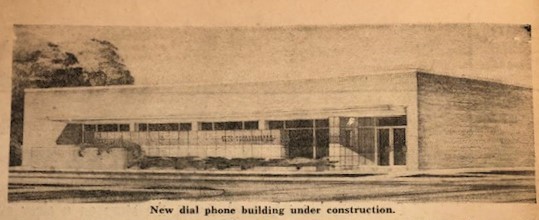
  However, this blog is about the new dial phone building under construction in Pratt, Kansas in 1962, as described in the special Pride publication.  Southwestern Bell had acquired the Pratt exchange in 1953, which at that time handed 3,370 telephones.  Three years later that number had grown to 3,914, an increase of 16%.  With construction of the new dial phone building anticipated for 1957, Pratt center could handle long distance calls for Coldwater, Greensburg, Protection, Coats, Cullison, Haviland, Iuka, Mullinville, Preston, Isabel, Sawyer, Cunningham, Ford and Wilmore.  

Pratt was quite proud of its new dial phone building under construction at 5th and Ninnescah Street!  The total gross expenditure for the building, dial equipment, landscaping, and installation of dial telephone would be about $920,000, according to the construction manager out of Wichita.  The building was to have an air conditioning system, a full basement underneath, and was constructed so that a second story could be added to allow future expansion "if Pratt continues to grow."

Today we pick up our smart phones and give little thought to the wonder that it is.  

Thursday, March 7, 2019

The Ghosts Among Us

Part of my delight in history is learning about our past, and part of my emotion about what I learn is understanding how quickly that past disappears.  The subjects of my manuscript, the Populist Movement and the Peoples' Party it created, were for a brief time a powerful challenge to the two old political parties. Yet, most people today have never heard about them.

Barn on old Saratoga site
In doing the research, I learned about people, famous and influential in that time, which few remember today.  And, I read about places that vied for a long existence but disappeared completely.  One of those places was Saratoga, Kansas.  I have posted blogs about the old cemetery, "Cemetery on the Hill" 2-7-2013, which is nearly impossible to find even when you know where it is, and the beautiful barn built on the site that once was Saratoga, "Disappearing Old Barnes" 1-15-2015, which has since been torn down.  Times move on, people with memories of those places pass away, and eventually those historical roots are forgotten.  Yet, they remain, as the ghosts of our past history.

Two Pratt historians preserved the history of Saratoga, and I am indebted to Lucile Asher and J. Rufus Gray for much of the information I will share in this blog.  I believe that both of their books are available at the Pratt History Museum.

A stone at the Saratoga Cemetery
Three towns battled, literally sometimes, to be chosen as the Pratt County Seat.  When Pratt Center, now simplified to "Pratt," prevailed, Iuka shrank, but Saratoga disappeared completely.  I knew where Saratoga once was, but I had no ideas what a bustling town it had been until I began working on my manuscript.  It could be argued that Saratoga should have prevailed over Pratt.  It existed earlier, a railroad reached it first, and the temporary naming of Iuka as the county seat was more of a governor's whim than an indication that it was a superior choice over Saratoga at that time.

When Pratt Center finally prevailed, many Iuka merchants and residents simply moved there--quite literally moving structures to the new county seat.  Saratoga was determined to continue to exist, but gradually its people began to move to Pratt as well.  Now it is just a forgotten location north of the Forestry, Fish & Game complex.

Images in old photo albums
But, today, as you read this blog, picture the ghosts wandering around the busy town square of Saratoga, unaware that in a few years their homes would be moved or burned down, and the seemingly permanent brick structures would disappear.  Picture the Wichita, Kingman & Western  train (replacing the previous service of the Cannonball Express Stage line).  Add to your imagination the mills on the Ninnescah where Isaac Werner came to sell his corn, and the brick kiln producing the brick for the fine brick buildings in town.

Picture the impressive brick city hall-opera house, the school, livery stable, and hotel, and imagine the bustle of shoppers visiting grocery and general stores, butcher shops, drug stores, restaurants, a dressmaker, a milliner, a jeweler, and most impressive, two book stores.  Churches countered the pool halls, and barber shops kept the men neat.

Now the people who frequented these businesses are the ghosts of past generations, memories passed from generation to generation until they are forgotten, faded images in old photo albums. While some may remember stories about Saratoga, no longer are there first-hand memories of the actual town.  It is the responsibility of historians to preserve these stories, and the responsibility of all of us to care.


Thursday, August 10, 2017

Pratt County Seat Dispute

Early photograph of Pratt Businesses
Gaining the county seat in the westward expansion was extremely important to developing communities.  Often the seed for a town was not much more than a school.  Gradually a nearby home might be designated the community post office, a church might be built, and a few businesses might establish themselves there.  Rather than towns being far apart, there were many of these tiny settlements, almost all of which have now disappeared without a trace remaining today.  Even some of the larger towns have failed to thrive as automobiles and highways allow residents in the surrounding area to travel elsewhere for their shopping.  But for about one hundred years, being the county seat meant the likelihood that the town would prosper.  Naturally, people were willing to fight for that designation, sometimes with marketing, sometimes with trickery, and sometimes with guns.

Pratt County engaged in a bit of all three.  Here is a very brief summary of that history, starting with the designation of the area as a county.  A certain number of residents were necessary, and it is suggested that Pratt County may have counted its population a little generously.

Early photograph of Iuka Businesses
The governor came to investigate, and if it was a legitimate county to determine between Iuka and Saratoga which settlement should be the County Seat.  Clever Iuka promoters met the governor's train with a brass band (so the story goes) and escorted him to their community where he was entertained so 'graciously' that he never made it to Saratoga.

Naturally, Saratoga was not happy.  They contested the temporary designation of Iuka, but when irregularities were found among the necessary signatures, it was decided not to disturb the status quo while the irregularities were investigated.  Iuka retained its title.

Stone in the neglected Saratoga Cemetery 
Iuka's claim was based largely on being the center of the county; however, a legislative attempt to erase Stafford from the map of counties by giving parts of it away to its neighboring counties was defeated, at least partly because two townships had been overlooked in the giveaway.  That allowed Stafford County to survive and demand that its original boundaries be returned.  Once that happened, the reach of Pratt County was reduced, and Iuka was no longer at the center of the county.

A group of businessmen decided to form an investment company to establish a new town called Pratt Center.  Their citizen count involved the same sort of exaggerated numbers that the county itself had used to be recognized.  For a time the accusation was that for Pratt Center to have enough residents to be recognized as a town they must have counted the prairie dogs, which earned it the nickname of Dog City.

Nevertheless, the battle for the county seat now involved three communities.  Perhaps because the investment company used smarter legal tactics than the settlers in the other two communities, Pratt Center was named as the county seat and remains so today.  The small community of Iuka remains, but Saratoga has disappeared.

During those years of disputing claims to the county seat, there was certainly significant marketing, a serious amount of chicanery, and even a bit of gun fire (although most of it was probably aimed into the air rather than at each other).  Once Pratt Center gained the prize it wasn't long before the citizens voted to drop Center from the name of the town.  Today Pratt remains a thriving small city, with museums, a community college, proud citizens, and not a prairie dog to be found!

More stories about these early communities may be found in the blog archives.  Remember, you can click on the images to enlarge them.

(Notice the deceased woman's name on the old grave stone.  Many of these stones may be found in old cemeteries on which neither the woman's given name nor maiden name appears, but rather, the name of the husband at the time of her death is inscribed.  This often makes researching maternal family lines almost impossible.  Even if the given name appears, the maternal family line may still be difficult to ascertain.)

Thursday, July 3, 2014

Arts Thrive on the Prairie


While my blog of 6-18-2014 declared that "Isaac Would Have Been the First One Inside the Door" when the new Vernon Filley Art Museum held its Grand Opening on June 29, 2014, he would have needed to have lined up early to have been the first visitor!  The crowd began to gather well before the 2 p.m. ribbon cutting, and when Mimi Filley arrived, applause filled the air.


Awaiting Mimi were Stan Reimer, who had worked with her for nine years to establish the museum in Pratt, and two members of the Filley Foundation Board, Chris Himmelwright and Lu Sherer, who were waiting with a festive red ribbon.


As the ribbon was cut, the Brass Ensemble announced the moment with their fanfare!  Musicians were Abby Giles, Peter Weinert, Steve and Brittany Novotony, and Blake Lee.  The crowd formed a line to await entry into the museum, eventually adding their names to the guest book, a document that will forever evidence the huge support the community showed their new museum on opening day.


By the end of the day, estimates of the crowd attending the Open House ranged from 500 to 700 visitors.  Not only had they filled the galleries to enjoy their first opportunity to view the Filley Collection, but they were also treated to entertainment by harpist, Julie Rewerts, from the Stafford community, just one of the communities in the surrounding region served by the museum.  A trio of young fans particularly enjoyed the music!

It was overwhelmingly apparent that support for the new museum is strong.  The museum is located at 421 S. Jackson Street in Pratt, KS and will be open from 10 a.m. to 4 p.m. on Tuesday - Friday and from 1 to 4 on Saturdays.  Regular Docent Tours will be available for the public without prior reservations at 1:30 the first Saturday of each month, and arrangements for planned Docent Tours may be made by calling the museum at 620/933-2787 or e-mailing INFO@VERNONFILLEYARTMUSEUM.ORG.  Classes for children and adults are now available, and rental opportunities of the museum are also available by contacting the museum.  Volunteers to help in many capacities have already been of great benefit to the mission of the museum, and more volunteers are welcomed!


In addition to revenue received from memberships and rental of the facility, financial support from individuals and businesses is important.  On Saturday evening a dinner in the museum lobby was held to honor Mimi and to show appreciation to the generosity of early supporters.  A member of the Filley family said that nothing reflected the community support more clearly for her than the willingness of members of the community to loan their fine China for the table settings.  In the background of the image at right can be seen the harpsicord that was used to entertain during the evening.

  At the close of the evening, Mimi Filley and Stan Reimer shared a private conversation, undoubtedly relishing the occasion marking the fulfillment of Mimi's childhood dream and the years of hard work it had taken to make her dream come true.  You may read more about the museum at www.vernonfilleyartmuseum.org.

(Remember, to enlarge the images, you may click on them.)

Thursday, September 26, 2013

Forestry, Fish & Game at the Fair

Forestry, Fish & Game in Eisenhower Bldg
I previously shared Isaac Werner's affection for wild birds.  (Isaac & his "Pet" Game Birds, 8-8-2013)  Early settlers failed to recognize the need for conservation of game birds, and although laws were passed to protect against unlimited hunting of game and song birds in the late 1800s, it was too late for some.  I'm sure that if Isaac could have joined me for a stroll around the fairgrounds, he would have enjoyed the display in the Eisenhower Building pictured at left. 
 
However, this blog is not really about Isaac.  In about 1940, my father went to work at the Forestry, Fish & Game headquarters near Pratt, Kansas.  At that time, most people called it The Fish Hatchery, and many people still do.  My parents had married in 1934, and when they moved to Pratt about 1940 for my father's new job, my older brother was about three years old. 

Early photograph of the Fish Hatchery

Soon, they were able to move into one of the cottages on the Hatchery grounds, and it was a happy time for them, with other young couples living there.  When the men were at work, the wives finished their household chores and gathered for coffee breaks and card games, while their children played together. 
 
One of my father's responsibilities was driving a fish display truck to fairs and other public events.  The back of the truck was outfitted with tanks displaying fish found in Kansas rivers and lakes.  Naturally, when I saw the mobile fish tanks on display at the state fair I thought of my father and one particular trip he made with the fish display truck.
 
Mobile fish display at KS state fair 
In over forty years of marriage, my parents spent only four nights apart (excluding a couple of short hospital stays), but as the employee who drove the fish display truck, my father was required to travel to a destination where he remained overnight.  Apparently, my mother had raised quite a fuss about being left at home.
 
Here's the romantic part of my story--At the end of a long day watching over the fish display and answering visitors' question, my father returned to his hotel room, exhausted.  Those were the days of overnight delivery of letters, and he knew he had better write a letter to my mother or he would be in even worse trouble when he got home.  He had brought no stationery, and there was no complimentary writing paper in the hotel room.  All that he could find was a can of Dutch Maid scouring powder under the bathroom sink.  Carefully, he tore along the overlapping edges of the Dutch Maid label, and as he had hoped, the back of label was white.  He took out his pencil and wrote my mother a love letter, explaining how sorry he was that she couldn't come with him, telling her how much he missed and loved her, and asking "Corky" to take good care of his mother.  I don't know how he managed to find an envelope and get the letter mailed to my mother.  What I do know is that when Mother went to the nursing home over sixty years later, I found that love letter in the top drawer of my mother's bureau.

Thursday, February 7, 2013

Cemetery on the Hill

View of cemetery from road
I was certain we were on the right road, having been told that the old Saratoga Cemetery, also known as Summit Hill Cemetery, was just south of the Kansas Forestry Fish & Game campus, but after the road curved off to the east we were confused.  We could not believe we had missed it, but we turned around for a last attempt to find the old cemetery.  At last, I saw something in a vast grassy field and asked my husband to stop so I could go check it out, but even then my husband wasn't convinced by the lone stone marker I had seen.  "I don't know what it is, but it doesn't look like a cemetery to me," he said. 
 
Marker of Edward R. Gillmore
In fact, what I had seen was the grave marker of Edward R. Gillmore, partially buried in dirt and grass that had filled in around its base over the years so that only part of the stone extended out of the ground.  Edward's parents, George and Elisabeth, originally from Kentucky and Tennessee, had lived in Missouri when Edward and his younger siblings, William and Rosa, were born.  They had paused in Miami County, Kansas for a time before arriving in Saratoga.  Young Edward lacked 14 days of reaching his 16th birthday.
 
It is no wonder that we missed seeing the cemetery as we drove by the first time.  In 1976 Russell Miracle recorded information from the grave stones and collected what information the sexton had.  (http://www.interment.net/data/us/ks/pratt/summit/saratoga.htm)  At that time he accounted for 30 graves, but our visit did not reveal nearly that many, and those that remain show signs of wear and vandalism.  People my age who lived in the area confessed that the old cemetery had been a favorite parking spot for Pratt couples when they were teenages, and others admitted tipping over stones when they were kids.
 
Marker of Fletcher twins
Several of the existing stones now lie flat on the ground, while others are broken.  Even Edward's, which is in better condition than most, appears to have lost a finial from the top of his stone.  The marker for the Fletcher twin girls, who lived only seven days, is so badly broken that identification was possible only because of the records Mr. Miracle saved in 1976.  The unnamed twins were later joined by a tiny sister, Winnie, but no other family members are buried at Summit Hill.
 
The dates of death chiseled on the stones are from the 1880s and 1890s, during years the town of Saratoga vied with Iuka and Pratt Center for the county seat.  (See blog post "How Investors Created Pratt, posted Sept. 27, 2012, to read more about the battle for the Pratt County Seat and the gradual demise of Saratoga.)  Isaac Werner hauled grain to Saratoga to sell or to be ground, and he was impressed with the bustling town built around a square.  The 1887 Biennial Report of the Kansas State Board of Agriculture recorded two newspapers in Saratoga:  "The Saratoga Sun," a republican paper published by Albaugh & Hupp, and "The Pratt County Democrat," J.M. Gore and E.D. Fry, editors and publishers.  There were also two banks--Wilson, Weaver & Co. and the Bank of Saratoga headed by George A. Lewis & Co., both banks reporting paid up capital of $25,000.
 
Distant Pratt viewed from cemetery
At that time, Pratt Center was already the larger town, wih a combined population in town and the township of 1156 residents, but Saratoga had 419 town residents and 147 more in the township.  Iuka had only 68 town residents, although in the township there were 685 more residents.  When Pratt Center finally won the county seat, Saratoga held on for a while but eventually disappeared.  Today, standing atop Summit Hill Cemetery (Saratoga Cemetery) and looking across the broken grave stones of those former Saratoga residents, Pratt can be seen in the distance.
 
Broken stone of Della Thornton
Stone of M.O. Nichelson
Those buried on Summit Hill nearly all sleep in eternal peace alone, spouses and parents having moved on as the town of Saratoga disappeared.  Young Della C. Thornton, only twenty years old at her death, left her husband Frank to raise their son alone, and today none of her descendants remains in the community to repair the broken stone lying half-hidden in the blowing grass.
 
Old cemeteries leave behind many clues but also unsolved mysteries.  Miles O. Nichelson died September 28, 1887, only 21 years old.  The records from 1976 omit any mention of Miles but do include the death of Miles's mother, Parthenia, on Sept. 15, 1887.   Did both Mr. Miracle and I overlook the faint inscription of a second family member's death inscribed on the same stone?  And, what might have caused the deaths within days of each other?  It is reasonable to guess that an illness might be the explanation.  The whereabouts of John Nichelson, father and husband, and of Cora, Miles's thirteen year old sister at the time of his death, could not be traced.
 
Knowing the history of Saratoga, I understand why Summit Hill Cemetery has so few graves and why there are few signs of visitors.  When the town faded into history, some of its residents moved into Pratt, but others scattered across the growing nation.  The occupants of the graves did not live to see the death of their town, and today their neglected stones are the only evidence of a once thriving community.
 
(Remember, you can enlarge the images by clicking on them.  If anyone knows more about the families mentioned in this post. or about the old Saratoga cemetery, please leave a comment.)