Showing posts with label Kansas State Fair. Show all posts

Thursday, September 5, 2019

A New Location for Art at the Kansas State Fair

(c) Lyn Fenwick,  Title:  Fresh Yellow Squash
This week the 2019 Kansas State Fair opens, and once again I have an entry in the Professional Artists display and competition.  Last year was my first year to participate in that category, and the pastel at the top of this page was my entry.  I didn't bring home a prize but I had fun entering.

In the meantime, my six portraits of characters from Willa Cather's My Antonia were selected for publication in the Willa Cather Review, Vol. 61, No. 2, Spring 2019, together with my essay describing how I searched Cather's novel for descriptions of each character to be sure that my imagined portraits were consistent with Cather's descriptions of each of the six characters.  I have a dislike of illustrations done for books that do not honor the descriptions of the author whose book is being illustrated, and I did not want to commit the same disrespect by straying from Cather's descriptions.  I gifted a copy of the Spring Willa Cather Review titled "After Antonia" to the Filley Art Museum in Pratt, Kansas, and I have been delighted when visitors to the museum have told me they enjoyed my portraits and essay.  I am particularly pleased when they tell me it has encouraged them to read My Antonia, either for the first time or to reread it after several years.  I was especially delighted to learn that Mrs. Filley is a long-time Cather fan and had received her copy of the Spring Cather Review with my portraits inside!

Lyn's "models" at the 2017 Plein Aire
The success of my acceptance for publication in the Cather Review encouraged me to enter the Kansas State Fair Professional Artists Show again.  Many of you who follow this blog are also fans and collectors of  a water color artist with ties to Pratt, and Darren Parker has shared with me his intention to enter the State Fair Professional Artists Show with one, or possibly two, of his watercolors.

I am writing this blog before the judging for the particular purpose of letting readers know that the Professional Artists' works have been moved to a different building.  You will not  find the Professional Artists work nor the Plein Aire art displayed in the Oz Building as it has been in the past.  (This change also moves the photography display.)  

Lyn drawing at the 2018 Plein Aire at the Fair


To view the art, go to Lake Talbot East/West located on 23rd Avenue, between Fort Hays Blvd. and Fort Leavenworth Blvd.  For some of you with 4-Hers,  you may identify the two buildings as being across from the 4-H Centennial Hall, the two buildings formerly the Boy and Girl Scout Buildings.  The Professional Art will be in the former Boy Scout building and the Plein Aire (and photography) will be in the former Girl Scout building.  The announcement of prizes for the Plein Aire will be at 6 p.m. Saturday, Sept. 7, and will remain on display through the remainder of the fair.

The Plein Aire competition requires artists to create their work on the fairgrounds, inspired by subjects they can view at the Fair.  They must do the work only at the Fair and within the hours specified--on Friday noon to 7:30 p.m. and on Saturday 7 a.m. to 3 p.m.  Visitors to the Fair are encouraged to watch for artists at work and to pause for a visit if they wish.  Children in particular seem to enjoy watching and asking questions.  Artists work in a variety of media, from acrylics and watercolor to pencils and pastels to paper mosaics or any other creative medium they wish.  No more than two entries can be submitted for judging by any one artist, although an artist my wish to complete additional work from which to select their two entries.  

Maybe I will see some of you at the Fair, and I hope you visit the new location in the former Boys and Girls Scout buildings to view the art on display.

Remember, the images can be enlarged by clicking on them.  Look closely for the cat and mouse in my "Fresh Yellow Squash" pastel painting.

Thursday, October 18, 2018

Fun at the Kansas State Fair


For the second year I went to the Kansas State Fair to participate for two days in the Plein Aire event.  No, I didn't place, but I had a great time!  The weather threatened rain both days, so my selection of where I wanted to set my easel was influenced by that threat.

The second day I found a cozy spot as out-of-the-way as possible for a crowded Saturday.  However, I arrived early to sketch the butter cow near the front door, because I knew that once the crowds arrived it would be impossible to see what I was trying to draw.

The fun is visiting with people curious about what I am drawing.  People kept peeking around to see how I was drawing the scene in front of me.  Instead, I was working from my sketch of the butter cow scene and some children I added, and they were confused or disappointed by what they saw.  So, with a little time left before entries had to be submitted, I quickly drew the scarecrow with his head made from a gourd so people could see what they expected to see.  Look closely and you can see that scarecrow in the back corner of the photograph above left.

When I sketched the butter cow, the sculpting was in the early stage, and the legs and head were not really shaped.  The tail was skinny, and the human figure was just a 'stick man.'  My sketch looked like what I had seen that morning before the sculptor arrived but nothing like a finished sculpture.  I worried that people might not understand that I had depicted a work in progress. At the last minute I added the butter bucket to indicate that the sculpture was unfinished, but the bucket just looked like a big black square in the center of the picture.  Oh well, I still had fun, but I wish now that I had cropped the picture like I did at left.  I might have even added the sculptor's feet near the bucket to show that the work wasn't finished.

The first day, I took shelter in the gazebo near the train station for a little protection if I needed to pack up quickly in case of rain.  That was a really fun place, since lots of children passed through the gazebo on their way to and from the train, and they loved seeing my train take shape.

I definitely need to improve my plein aire skills, and I need to select subjects more like a still life setup.  With limited time and subjects that don't stand still, I need less ambitious subjects!  The details of the train, drawn in colored pencil, were too time consuming.

However, the primary objective for having plein aire artists working at numerous locations around the fair grounds is not really about creating your best work.  It is about enjoying being interrupted to talk with people who stop by to watch and ask questions.  It is also about encouraging children to never be afraid to draw, even if they think they can't draw well enough to try.  And, the same thing goes for adults.

I wish I could show you the outstanding work of those plein aire artists that did receive awards for their depictions of the fair, but photographs are not permitted.  When you go to the fair next year, be sure to visit the Oz Building to see all the plein aire entries.  And, if you are a 'Saturday Painter,' consider joining the fun.  You don't have to be a professional to produce your own fair masterpiece and have fun participating.


Remember, you can click on the images to enlarge them.
  

Thursday, September 21, 2017

Sunflowers Everywhere!

Photo credit:  Larry D. Fenwick
In a recent blog by a friend, she commented on the amazingly abundant native sunflowers this year, contrasting them with the poor dry-land corn.  We have become accustomed to fields of commercial sun flowers in recent years, but that was not what she meant.  On roadsides, in ditches, along pastures and cultivated fields, anywhere they can find a space, large or small, native sun flowers have grown.

You may remember two very early blogs I posted in 2013 about Sunflowers.  Although the sunflower is the Kansas State Flower, and is beloved for that reason, farmers--including Isaac B. Werner--are not always so enthusiastic.  There are several journal entries in which Isaac complains about the hard work of hoeing sunflowers and sand burrs from around his trees, as well as complaints about sunflowers in his corn and potato fields.

Photo credit:  Larry D. Fenwick
Yet, they are beautiful, and on our way to the Kansas State Fair recently, we paused to take photographs, which my husband added to on a recent trip into Pratt.  Much of this week's blog will be sharing photographs.  A few other wild flowers are included.

Those of you who have followed this blog for a long time may remember the pair of posts titled Isaac and the Sunflowers--Part 1, and the following week, Part 2, from 2013.  You may want to return to them to read more about sunflowers, but in particular I want to remind you about what is called the Vogel Model describing the pattern of seeds in the center of a sunflower.  As a reminder I will republish the illustration, but what I want to include in this blog are photographs of the many different kinds of sunflowers that were shown at the Kansas State Fair, all of which show Vogel's pattern in their seeds.
Photo credit:  Larry Fenwick

I will add that the "holes" you see in the patterns are not the result of poor seed growth.  I followed an adult woman looking at the sunflowers I photographed, and she thought she was being very quick and unobserved as she picked seeds from the sunflowers on display.  Some of the sunflowers had been seriously disfigured by other seed collectors, but you can still see the Vogel pattern.


Queen Anne's Lace


Keep your face to the sunshine and you cannot see the shadow. 
It's what the sunflowers do.  --Helen Keller


Those who bring sunshine into the lives of others cannot keep it from themselves.  --J.M. Barrie
Look closely for the Monarch butterfly I captured


Normality is a paved road:  It's comfortable to walk, but no flowers grow.  --Vincent van Gogh


Tomorrow may rain, so I'll follow the sun.  --The Beatles
Goldenrod

Wednesday, September 13, 2017

Kansas State Fair 2017

Bottle washing machine
Prior blogs have mentioned my connection with Isaac Werner through our mutual love of books.  This week's blog shares our mutual enjoyment of drawing.  Many pages of Isaac's journal contain drawings in the margins, including his invention at right.

At the 2017 Kansas State Fair I participated in the Plein Air at the Fair event, during which artists produce art depicting exhibits and events.  Both Friday and Saturday artists working with oils, acrylics, paper, water colors, and pastels set up working sites throughout the fair grounds.  Canvases and papers had to be marked each day, with that day's work turned in at the close of the day, to prove that the art had been created entirely during the day's event.

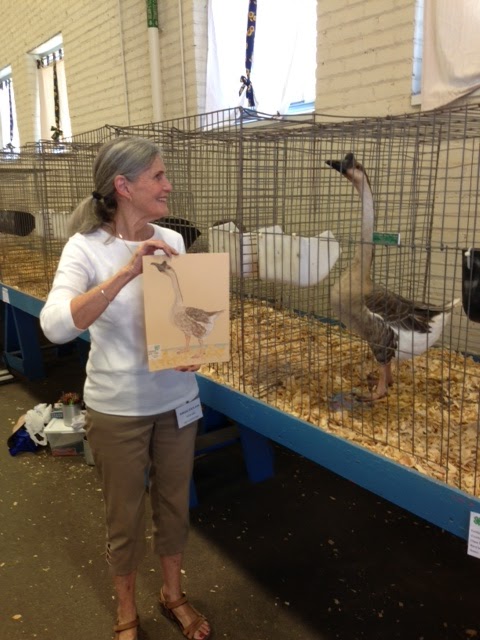
Lyn with "Brownie"
Each artist was limited to two entries, which were judged by a former university art professor who is currently the head of a college art department in Kansas.  Four entries were selected for ribbons--three paintings and one paper mosaic.  Photographs of the displayed art are not permitted, so I cannot show you the four pieces that were selected.  Instead, I will share my adventures and efforts.  Although neither of my two pieces was chosen, I had a wonderful time and hope to participate again.

Having seen entries from past Plein Air events, I decided to participate, along with more than twenty other artists.  Signing up gave me the perfect excuse for purchasing a portable easel.  Having never done Plein Air, I set up my easel on our porch when it arrived to experience the sunlight and breezes of working outside.  It also gave me a chance to see if I had assembled all of the supplies I needed.

I still have a carrier I used to transport files to the courthouse for trials, and I put it to work carrying my new easel and other supplies, assembled in a plastic tub which served as my table when I worked. Many of the artists made do with less to transport, using a simple clip board and sitting on the ground or a park bench.  If artists reading this blog are tempted to participate next year, your supplies need not be elaborate--just whatever works for you!  I do encourage more artist to join the fun.
State Fair Friends

I am normally a portrait artist, so the first day I chose to do portraits--of chickens, ducks, and geese.  After all, a portrait is a portrait.  My first subject, whom I named "Brownie" because he was a Chinese Brown Goose, was great fun.  I was fascinated with his long neck, and while he did not always extend his neck, he was very obliging whenever I asked.  Brownie was a bit vain and seemed to enjoy posing.

My next subject I called "Pilgrim," since his breed was identified as Pilgrim-Sex Linked.  After getting set up, I waited for Pilgrim to become calm, but he was an active duck, back and forth from feeder to water and round and round the cage.  Since it seemed he was unlikely to ever be stationary for long, I decided to only draw his head, which was usually visible above the water and feed tubs.

My last subjects Friday were two colorful bantam roosters caged side by side.  The one named "Henry" (according to his owner) was also active, but because he was small I could keep all of him in sight as he moved about.  He apparently had an artistic nature, as he seemed to enjoy adding his own water splashes to his portrait.    His neighbor was more of a sleepy head, napping often despite the constant noise of the poultry barn.

Lyn with Pilgrim
In the cages behind were two beautiful black and white chickens, the Rooster named Bud and the hen named Rose.  Their pretty young owner obviously loved them like pets, and shyly pointed out that their clever, combined names were Rosebud.  I was tempted to try drawing their complicated black and white feathers, but I had been working about 6 hours at that point and was too tired for another 2-hour portrait.  

Saturday entries had to be turned in by 3 p.m., so I arrived early to get started.  Unfortunately, the exhibits  where I intended to work were not open that early.  I headed to the dairy cattle barn to start my day until my intended subjects were available, but after sketching a particular cow, her owner took her for a bath and I had to stop.  I moved on, intending to return later but in search of a subject to do in the meantime.  I never returned to the cow nor made it to the things I had planned to draw. 

Photo credit Gauman, Hutch News
I chose one of those souvenir photo stands with an oval cut out for children to put their faces through for a photograph to take home from the fair.    With the fair ground pavilion as a background and a tree to balance the triangular composition, I thought it would be a nice, not too complicated image.  I was wrong.  All of the angles and details of the pavilion took most of the morning, and by then the Saturday crowds had arrived.  The photo stand was popular, and families would line up between me and my subject to watch their children pose.  In addition, the miniature train tracks were between me and my subject and passed by regularly.  In fact, they were so busy there were two trains running.  

Since I was working in the park, many people stopped by to watch and to visit, which I loved.  Even Lindsey Gauman with the Hutchinson News took my photo for the Sunday Paper and stopped by to get my name.  What wasn't so nice was that  as the breeze came up I realized that my position blew fairground grit right into my eyes.  I was having a true Plein Air painting experience!

Lyn's turn to pose in the souvenir photo board
On Friday I had finished 3 drawings in six hours, but on Saturday I struggled to finish 1 drawing in 6 1/2 hours, rushing to finish the tree before time ran out.  I wasn't satisfied with Saturday's work, but I chose to enter it as one of my 2 entries, along with the double chicken portraits.

I did not win any prize, but I was pleased when the judge took the time to comment specifically on my entry from Saturday when he finished speaking about the 4 winners.  He said how much he appreciated my theme of contrasting the permanence of the pavilion and the tree against the bright colors and temporary excitement of the fair, represented by the souvenir photo display.  I had been so disappointed with that work, but he had seen what I set out to depict, and I was both embarrassed by being singled out and pleased by his comments.  

The 2017 Kansas State Fair continues through Sunday, September 17, so if you have not attended this year and you are curious to see the Plein Air exhibit, it can be found in the OZ Building.  I hope some of you who may have considered participating will be encouraged to enter next year.  I had a blast!

Remember, you can click on the images to enlarge.


Thursday, September 11, 2014

Isaac's Bad Luck with Hogs

Isaac B. Werner was not lucky when it came to raising hogs.  For several years he had no livestock on his claims.  Eventually he bought a horse, the mare's purchase price and some extra for implements being his first indebtedness.  (See "Isaac's Dolly Varden," 2-28-2012 in the blog archives.)  He also began keeping chickens, (See "Isaac Builds an Incubator," 8-22-2013, and "Isaac Raises Chicks with a Broody Hen," 8-29-2013), and at last he traded some of the grain he raised with neighbors for hogs.  It was the beginning of his bad luck with hogs. 

On April 2, 1888, he wrote in his journal:  "Dix sow died from pigging.  Fed [her] since 12th of December about 6 bushels of corn.  'Yellow Jersey' about same amount of corn & still lean.  Vosburg brood sow now about a year on hand.  Eat about 17 bushels of corn.  Time to be pigging (112 days [according to] Garvin), about up & no signs."

Not only did his own hogs give him trouble but his neighbors hogs got out and ate his crops.  A few days later he wrote in his journal:  "H. Bentley helped me stretch 5 wire around & by eve W. Goodwin hogs inside eating corn again."  Isaac became so annoyed by how often his neighbors' livestock got out and ate his crops that he suggested it might be more efficient if he stopped trying to fence the livestock out of his fields and instead just went to his neighbors' farms and repaired their pen and pasture fences!

By the 11th of April he had given up on the sow he traded grain for with Vosburgh, and he asked Will Goodwin to help him butcher the sow.  He was concerned that the weather was getting too warm for butchering, and he had never killed a hog before.  Will loaned him a barrel and helped him butcher the sow, and they found no signs of piglets inside her.  He asked his neighbor, Mrs. Ross, to render the lard for him while he "cut up the swine and salted same in cellar."

Hedrick's Racing Pigs leave the gate!
Although he continued feeding the 'Jersey' hog, by August it was still lean and he decided to butcher it, despite the warm weather.  Again, he asked Mrs. Ross the try out the lard, but he decided to salt the pickled meat himself.  Unfortunately, the packed meat started going bad, although he "dipped out brine, cut bones out of those hams & salted into a jar by themselves, other meat back into barrel with heated pickle repacked & salted." The hams had to be discarded and the fermented, repacked meat had to be rendered for lard to get any use from it.

An article in the Sept/Oct 2012 issue of "Capper's" with the subtitle "Revisit the virtues of your grandmother's secret ingredient and get cooking,"  included directions for "Dry Rendering" lard and praised the benefits of fats from both animal and vegetable sources.  Citing lard, tallow, duck and goose fat, as well as vegetable fats from olives, coconut and flax, the article claimed the fatty acids "keep our bones healthy (adding calcium absorption), and they enhance the immune system," contrasting the absence of these benefits in engineered fats.
Pig 3 takes the lead at the corner, cheered by the crowd!

The article acknowledged that "The amount of omega-6 and omega-3 fatty acids varies in lard according to what the pigs have eaten, making fat from pastured or grass fed hogs the best choice."  Of course, it was all the corn that Isaac had fed his hogs that made him most resentful of their failure to thrive and produce neither meat nor piglets!

The article warned that "Most of the lard you find stocked on the grocery store shelves has been harvested from 'factory farmed' animals; it's been hydrogenated, bleached and deodorized, and emulsifiers and other chemicals have been added.  Stay away from it!" the article declared.

A new leader in the straight-away excites cheers!
The year of 1888 was not the last time Isaac tried to raise hogs, but he was never very successful.  He was not much of a pig farmer, and he had to admit that he would have been better off hiring out his labor and selling his corn than getting into the hog business!

The photographs accompanying this blog were taken at the 2014 Kansas State Fair.  You may wish to visit blogs posted during Sept. & Oct. 2013 featuring the exhibits at the Kansas State Fair that year.  A special thank you to the Hedrick Exotic Animal Farm (and Bed & Breakfast) located near Nickerson, Kansas for the photographs of the pig races.  The announcer, her helper, the 'volunteers' drafted from the crowd as cheerleaders, and especially the clever little pigs made for great entertainment!
We have a winner and a triumphant cheerleader!

As you can tell if you look more closely, there were actually three races, so the apparent lead changes were really different little pigs among the twelve racers.  The final group slipped through the gate as they were being assembled before their race, and perhaps the fact that they had already had a taste of the trophy plate filled with piggy treats made them slow down a little in the straight-away.

The fair continues through this weekend, so you could still catch the Hedrick's Racing Pigs at the 2014 Kansas State Fair if you check for starting times!  Maybe Isaac's pigs that refused to fatten for butchering really saw themselves as Racing Pigs and were 'staying in shape!'

Thursday, October 17, 2013

Isaac's Antiques


You might not be surprised to find a building at the Kansas State Fair called "The Oz Gallery," but what sort of exhibits would you expect it to contain?  The word "gallery" might be a clue, and if you guessed drawings, paintings, sculpture, jewelry, and photography, you would be right.  However, the original art is not to be photographed, so I cannot share images of those exhibits, although we spent a great deal of time enjoying all of those things.


The Oz building is an interesting building to explore because of all the things you might not expect to see.  For example, have you ever seen a Wheel Ring Sizer?  If you answered "no," look to the picture above.  The person who entered the wheel ring sizer in the antique category was kind enough to include a sign explaining its use, describing how the steel rings around a wooden wheel would be heated in a forge before locking it into the sizer to make it smaller.
 
Of course, when I see antiques from the homesteading era, I always wonder if Isaac might have owned or used that particular object. 


Have you ever seen ox yokes carved from wood?  In 1884 Isaac Werner's neighbor, Gus Gereke, paid $175 for a pair of oxen, and many early settlers used oxen to plow through the thick prairie sod.  Perhaps Gereke's oxen wore yokes like these.


Here is a quiz for you.  Can you identify what this wooden, barrel-like contraption is?  Your grandmother or great-grandmother would have known, and she would probably have had a specific day of the week for using it.  (The answer is at the bottom of this blog.)
 
There were many different kinds of exhibits in the Oz building.  It was the location of Leonard the Bull, featured in last week's blog, and there was a display of chainsaw carved sculptures available for purchase.  However, one display brought tears to many eyes as they walked around all the sides, studying the faces of those who had given their lives or bodies in service.  Decorated in red, white, and blue, the display honored yet another generation of patriots who have fought for their country.
 
Were you surprised by the variety of things to be found in the Oz Gallery?  Beautiful art, antiques from our past, photographs of our heroes.  As Dorothy told us, "There's no place like home," and the Oz building shared many things from the hearts and homes of Kansans this year.
 
(Answer to the quiz:  It is an antique wooden washtub for laundry day.)


Thursday, October 10, 2013

Cattle at the Fair

Isaac B. Werner never kept cattle, although one day in 1886 when the drought was drying up the prairie grass and times were too hard to afford to buy feed, he had two different neighbors in the same day call on him, offering to sell him one or more cows.  One of those neighbors owed Isaac money for carpentry work and offered a cow in settlement of his debt, but Isaac declined.  At various times he tried hogs (unsuccessfully), and he kept chickens eventually, and after going into debt to buy his first horse, he always had horses until his death.  But never cattle!


Cattle are definitely pampered creatures at the Kansas State Fair!  While the poultry had panted in their barn, (See Poultry Barn at the Fair, 10-3-2013.) the cattle seemed quite comfortable beneath the fans stirring the air in their well-lighted, clean barn.  The little cowgirl pictured at right was checking their family's contented cows as we entered the barn. 


There were cattle of all colors and breeds, with the entry catalogue listing Angus, Charolais, Gelbvieh, Herefords, Limousin, Shorthorn, Simmental, and Watusi, and all of them were groomed to look their best.  I watched one rancher using a blower that his wife described to me as being like a giant hair dryer to blow bits of straw off the ebony coat of one of his entries.  She explained that when the cattle lie down they pick up pieces of straw, and even though judging was not taking place, her husband wanted to keep his cattle looking their best.


Ironically, the bull drawing the biggest crowd was not at the cattle barn!  His name was Leonard, and he was attracting all the attention at the Oz Building.  Constructed of every sort of object that a welder's torch could affix to his frame, Leonard was intriguing to examine.  There were nuts, bolts, springs, tools, gears--even an old stove door to access Leonard's interior.  Click on the photographs to enlarge the images and have fun identifying all the clever parts welded to form Leonard!
 

Thursday, September 26, 2013

Forestry, Fish & Game at the Fair

Forestry, Fish & Game in Eisenhower Bldg
I previously shared Isaac Werner's affection for wild birds.  (Isaac & his "Pet" Game Birds, 8-8-2013)  Early settlers failed to recognize the need for conservation of game birds, and although laws were passed to protect against unlimited hunting of game and song birds in the late 1800s, it was too late for some.  I'm sure that if Isaac could have joined me for a stroll around the fairgrounds, he would have enjoyed the display in the Eisenhower Building pictured at left. 
 
However, this blog is not really about Isaac.  In about 1940, my father went to work at the Forestry, Fish & Game headquarters near Pratt, Kansas.  At that time, most people called it The Fish Hatchery, and many people still do.  My parents had married in 1934, and when they moved to Pratt about 1940 for my father's new job, my older brother was about three years old. 

Early photograph of the Fish Hatchery

Soon, they were able to move into one of the cottages on the Hatchery grounds, and it was a happy time for them, with other young couples living there.  When the men were at work, the wives finished their household chores and gathered for coffee breaks and card games, while their children played together. 
 
One of my father's responsibilities was driving a fish display truck to fairs and other public events.  The back of the truck was outfitted with tanks displaying fish found in Kansas rivers and lakes.  Naturally, when I saw the mobile fish tanks on display at the state fair I thought of my father and one particular trip he made with the fish display truck.
 
Mobile fish display at KS state fair 
In over forty years of marriage, my parents spent only four nights apart (excluding a couple of short hospital stays), but as the employee who drove the fish display truck, my father was required to travel to a destination where he remained overnight.  Apparently, my mother had raised quite a fuss about being left at home.
 
Here's the romantic part of my story--At the end of a long day watching over the fish display and answering visitors' question, my father returned to his hotel room, exhausted.  Those were the days of overnight delivery of letters, and he knew he had better write a letter to my mother or he would be in even worse trouble when he got home.  He had brought no stationery, and there was no complimentary writing paper in the hotel room.  All that he could find was a can of Dutch Maid scouring powder under the bathroom sink.  Carefully, he tore along the overlapping edges of the Dutch Maid label, and as he had hoped, the back of label was white.  He took out his pencil and wrote my mother a love letter, explaining how sorry he was that she couldn't come with him, telling her how much he missed and loved her, and asking "Corky" to take good care of his mother.  I don't know how he managed to find an envelope and get the letter mailed to my mother.  What I do know is that when Mother went to the nursing home over sixty years later, I found that love letter in the top drawer of my mother's bureau.

Thursday, September 12, 2013

A Day at the Fair

In 1888 times worsened for farmers like Isaac Werner, and he wrote in his journal that farmers needed to use their heads as well as their backs if they were to survive.  One of the ideas that came from using his head was the plan to form a Stafford County Agricultural Society, and he went to the county seat in St. John to speak with businessmen, as well as fellow farmers, promoting the idea.  Eventually he succeeded in getting enough men interested to form the Stafford County Agricultural Society, for which he was elected Secretary.  One of their plans was to have local gatherings at which prizes were awarded for the best produce and livestock.  Other communities were doing the same thing at about this time, and as my blog of last week, "Time for the Fair!" explained, the roots of the Kansas State Fair reach back to the first Agricultural Society fair held in Hutchinson.
Something to crow about
 
 
This week my husband and I went to the 100th Anniversary celebration of the Kansas State Fair, and the entire day I thought of Isaac and wondered if he would be surprised by the continued popularity of agricultural fairs.  I took my camera, and I will be posting a series of photo-filled blogs about the fair in coming weeks.  This week I invite you to come along with my husband and me to spend a day at the fair.

Shelves of farmers' best
One of our first stops was at the Pride of Kansas Building, and just inside the door was the butter carving, an elaborate statue entirely carved from butter of a mule looking at the tractor that was displacing him in pulling machinery.  The glass-walled, refrigerated display was popular with young and old fair goers.
A school group enjoys the carving
Boys and their toys!
No doubt Isaac would have enjoyed this pavilion in which the farm crops were displayed.  The produce had already been judged, so ribbons of purple, blue, red and white intermingled with the rich colors of orange pumpkins, red potatoes and apples, green beans and watermelon, golden corn and wheat, and rust-colored milo.  There were also brightly-colored farm grown flowers and honey from farm hives.
 
No state fair could be complete without all of the implements on display.  My husband paused for a photograph beside an old John Deere tractor, and I strolled with him through several implement displays.  Eventually, I left him alone to study the fascinating characteristics (to him!) of rows and rows of machinery, while I enjoyed the delightful qualities (to me!) of rows and rows of quilts.
Silver-haired sweethearts
 
Nearly every Kansan who went to the fair as a teenager remembers riding through the dark canals of the Old Mill with their sweetheart.  There were enough scary surprises during the ride to make a girl cuddle closer for protection, and the ride was long enough for even a shy boy to work up the courage to put his arm around his girlfriend.  The braver boys found opportunities to steal a kiss or two.  As the photograph shows, some of those Kansas sweethearts are still holding hands and remembering rides together through the Old Mill long ago.
 
A patch of shade for one


The fair is about meeting friends, old ones and new.  Comfortable shoes and cool clothing can only help so much on fair days when the temperatures reach triple digits, so finding a shaded bench to visit with friends, or a spot away from the crowds to check your e-mails or send a text are appreciated.  We arrived mid-morning with temperatures at 87 degrees and the sun climbing in a clear blue sky, but later in the day the clouds drifted in, and it was a pleasant afternoon, with a slight breeze.
Relaxing with friends  
Of course, we had to wander through the carnival rides and the games of chance--although we boarded no rides nor took any chances!  In my youth, I confess that a day at the state fair was all about carnival rides and food, unless I wanted to impress some boy with livestock at the fair by visiting his animal.  Now, I visit the amusement section of the fair grounds only to enjoy the bright colors and the excited laughter and screams of children and teenagers enjoying the rides I once loved. 
Watch my stuff, Dad!
 

As we strolled through the carnival rides we were amused by the sight of a father, sitting on a bench waiting for his children as they enjoyed the rides.  He was nearly hidden by a collection of stuffed animals, apparently entrusted to his care by his children.  We could just imagine their departing voices calling out as they rushed off to another ride, "Watch my stuff, Dad!"
 
No fair would be complete without the commercial vendors demonstrating their products, and I could not resist snapping a quick action shot of this man.  I didn't pause long enough to risk being caught in his sales pitch, but one lady looked like she might be a prospective customer.
 
 
Our day would not have been nearly as much fun if we had not arrived just in time to watch the last heat of the 4 o-clock pig races.  Young pigs, barely more than piglets, squirmed eagerly as the announcer warmed up the crowd with his clever pre-race introductions of the contestants.  Suddenly, they were off and racing--not for the roses but rather for a pile of pig feed just past the finish line.  Pigs can run faster than you might guess! 
 
As our day wound down, we found the perfect way to relax.  A six member New Orleans style jazz band, led by the jazz band instructor from Hutchinson Community College, was entertaining in the pavilion by Lake Talbott.  We lingered to tap our toes to several numbers played by this outstanding group of musicians, but I guess their audience was too weary from a day strolling the fair grounds to let the music tempt them into dancing.
 
As the sun sunk toward the western horizon, we followed it toward our car, sweaty and foot sore, having had a wonderful day at the fair.  On our way out, we encountered two young brothers, far luckier than we in their rolling sleeping quarters. 
Be sure to return to my blog in coming weeks to read and view more of the things we saw at the fair, for I have only shared a sampling of the fun we had.  Remember, you can enlarge the images by clicking on them.