Showing posts with label librarians. Show all posts

Thursday, January 20, 2022

Why Should I Read? New Year's Resolution Part 2


Remember when reading was fun!  Your New Year's Resolution should be about rediscovering the fun of reading.  And, there is no reason why your reading resolution could not be a family project.  Reading with children reinforces the idea that reading is fun and important.

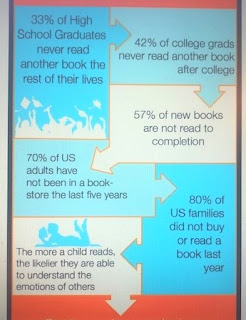
33% of H.S. Graduates never read another book the rest of their lives.

However, assuming your resolution to read more books is going to be solitary reading, there are many good reasons for you to make a New Year's reading pledge.  I will share just a few of those reasons.

42% of college grads never read another book after college.

Last week's blog described two friends who read to relax at bedtime in one case and to just pass the time without any particular reason in another case.  There is nothing wrong with reading to reduce stress.  Personally, even if I am reading to relax, I still prefer to read something of value to me, so  I keep a book of poetry beside my bed which serves that purpose well.  The rhythm of poetry and the shorter length, which makes it easier to find a stopping place, are both reasons why poetry is especially restful and relaxing.  Often the substance of the poems offer content for reflection as I fall asleep.  In a similar category, reading can be inspiring, whether read at bedtime or any other time.  Reading about the achievements or courage or good deeds of others can be an inspirational reason for reading.

The more a child reads, the better they are able to understand the emotions of others.
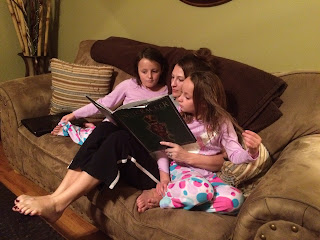

Photo Credit:  Lyn Fenwick

Three hundred years ago, Joseph Addison described another important reason for reading:  "Reading is to the mind what exercise is to the body."  Studies have shown that reading really does increase the blood flow and improves connectivity in the brain.  It is not just what you learn by reading but also an actual physical impact.

80% of U.S. families did not buy or read a book last year.

Obviously, reading can provide information that can alter your thinking.  Right now, with health issues limiting travel, we can still learn about other people and other places through books.  Books can even take us back in history.  Mark Twain wrote that history may not repeat itself, but it does rhyme.  Instead of every generation needing to learn hard lessons for themselves, reading can spare the mistakes and build on the achievements.

70% of U.S. families have not been inside a bookstore in the past 5 years.

Children are not alone in benefitting from reading books that challenge their imaginations.  Fiction authors of the 1800s are believed to have inspired and challenged inventors and scientists who read their books and made fantasy into reality.  How many young boys credit reading a book about an athlete as what made them believe they too could run faster, jump higher, or enter a sport that they believed had been closed to them because of a disability or their color or financial limits.  How many people have built something or written something or baked something or explored something because they were inspired by a book they read, and age need not be a barrier to readers inspired by a book. 

I do not know the source of the statistics I quoted.  Frankly, I hope they are wrong, because I cannot imagine not wanting to continue reading for a lifetime.  But, I do know that other sources support the severe reduction in reading, and I know too many bookstores closed because people stopped buying books.

Whether you read to relax, to be inspired, to be educated, to learn, to improve something about yourself, to gain confidence--and I am not referring to "self-help" books but rather well written books that appeal to you for many reasons, I hope you believe that reading is worth making time to read.


Thank you to Kansas for recognizing Kansas authors & books about Kansas.

And thank you to Libraries and librarians for all they do to encourage reading!


Thursday, December 8, 2016

Literacy Then & Now

Journeys Through Bookland
Isaac Beckley Werner loved his books.  One of the most popular blog post series that I have done is the request for readers of the blog to share their favorite childhood books.  Recently I finished a book by British writer, Neil Gaiman titled "The View from the Cheap Seats."  This week's blog post has grown out of a lecture Gaiman gave to a British organization created to encourage literacy in children.  The lecture is titled, "Why Our Future Depends on Libraries, Reading and Daydreaming," and I hope the many of you who shared your favorite books and who have told me that the blogs about books and libraries are among your favorites will particularly enjoy this post and will share it with teachers, librarians, and readers who might also enjoy the wisdom of Neil Gaiman.

I have often regretted that I was not guided to some of the children's classics when I was growing up, nor encouraged to explore the stories inside the covers of "Journeys Through Bookland" on the family bookcase.  However, Gaiman would not have agreed with me about the need for guidance.  "They [children] can find the stories they need to, and they bring themselves to stories," he believes.  "Well-meaning adults can easily destroy a child's love of reading:  stop them reading what they enjoy, or give them worthy-but-dull books that you like,  ...You'll wind up with a generation convinced that reading is uncool and, worse, unpleasant."

Gentleman Don
One of the books that I found for myself belonged to my older brother, a gift to him from our Great Aunt Anna Marie that was already seriously old-fashioned when he received it.  Yet, I loved it so much that long after I was grown I inquired to see if my brother still had the copy I had read.  Apparently he no longer knew its whereabouts, so I found a copy online and bought it.  When I reread it as an adult, it had lost its magic, but I still love the memory of reading that special book.  Gaiman would understand my feelings, for he writes:  "A hackneyed, worn-out idea isn't hackneyed and worn out to someone encountering it for the first time.  You don't discourage children from reading because you feel they are reading the wrong thing.  Fiction you do not like is the gateway drug to other books you may prefer them to read."  Certainly I would not hand Gentleman Don to a young girl today, expecting her to fall in love with it as I did, but perhaps it was a "gateway" for me to tackle other 'grown-up' books with thick pages about other times in history.

There is a huge difference between imposing what a child should read and guiding children to things they might otherwise miss, and Gaiman emphasizes the importance of librarians in today's world of overwhelming information.  "For all of human history, we have lived in a time of information scarcity, and having the needed information was always important, and always worth something.  ...Information was a valuable thing..."  Today, however, "we've moved from an information-scarce economy to one driven by an information glut."  The role of librarians has become increasingly important, as is the support for libraries.

Neil Gaiman, photo credit: 
Gaiman writes:  "Literacy is more important than ever it was, in this world of text and e-mail, a world of written information.  We need to read and write, we need global citizens who can read comfortably, comprehend what they are reading, understand nuance, and make themselves understood."  Gaiman sees libraries as "the gates to the future."  

Relying on media and technology to produce these global citizens of tomorrow is not going to work.  Gaiman distinguishes the experience of watching TV or film with reading prose fiction.  "When you watch TV or see a film, you are looking at things happening to other people."  In contrast, when you read prose fiction "...you, and you alone, using your imagination, create a world, and people it and look out through other eyes.  You get to feel things, visit places and worlds you would never otherwise know.  You learn that everyone else out there is a me, as well.  You're being someone else, and when you return to our own world, you're going to be slightly changed."

Because our children have mastered hooking up satellite TV, texting, tweeting, navigating Windows 10, googling, and all the other things adults struggle to learn, we tend to see them as smarter than older folks.  Yet, by knowing how to find answers our children are not learning how to reason through ideas to discover answers for themselves.  Gaimin writes, "...our children and our grandchildren are less literate and less numerate than we are.  They are less able to navigate the world, to understand it to solve problems.  They can be more easily lied to and misled, will be less able to change the world in which they find themselves, be less employable."  It is primarily for this reason that Gaimin sees the need for libraries and reading.

"Books are the way that the dead communicate with us.  The way that we learn lessons from those who are no longer with us, the way that humanity has built on itself, progressed, made knowledge incremental rather than something that has to be relearned, over and over."

Lyn searching through County Capital newspapers
Using my own experience as an example, I recall the hours I spent in the Stafford County History & Genealogy Museum turning the brittle, yellowed pages of old newspapers, thinking I was looking for some specific information but finding instead many other things that enriched my understanding of the period.  I did not just learn the single specific thing which had brought me to the museum.  I learned many things I didn't realize that I needed to know.

Using a key word to access information from a phone or a computer is handy, but it does not enrich our understanding, deepen our empathy, develop our reasoning skills in the same way that reading does.  

I will conclude this post by hinting about next week's blog, still inspired by Neil Gaiman's book, The View From the Cheap Seats.  He writes:  "[W]e have responsibilities to the future.  Responsibilities and obligations to children, to the adults those children will become, to the world they will find themselves inhabiting."  Next week's blog will share some of those responsibilities he suggests!

(If you enjoyed this post, you may want to go back through the archives to read other posts about books and reading.)


Thursday, September 22, 2016

Libraries Make the Difference!

Reading Oz in Macksville Grade School Library
Whatever the cost of our libraries the price is cheap compared to that of an ignorant nation.  --Walter Cronkite


Isaac B. Werner left family behind to build a new life in the West, and as a young druggist he prioritized the acquisition of a fine library at the top of his list for spending saved cash.  When he decided to move further west to claim a homestead and timber claim in Kansas, he managed to find a way to ship his impressive library to his prairie home. 


His collection of books included a wide range of subjects, including law, penmanship, history, art, literature, biography, travel, politics, elocution, grammar, medicine, and other topics.  (See "Isaac's Library," 2/2/2012; "Who Reads Shakespeare," 5/30/2013; and "Art in Isaac's Life," 1/22/2014, in the blog archives.)  Isaac was a serious reader.  As I have indicated in other blogs, I attempted to purchase some of the titles Isaac had owned, buying the oldest editions I could find to better represent the editions he owned.  The scholarly content of most of the books he collected stand as evidence that he was a sincere autodidact.  See "Isaac, the Autodidact," 11-13-2014 in the Blog Archives.
Summer program in Macksville City Library

"...[W]hen a library is open, no matter its size or shape, democracy is open too."  --Bill Moyers

One of Isaac's ideas was to establish a library in the County Seat of St. John, where farmers and populists could go to study.  His local Farmer's Alliance did establish a library in the Emerson School where they met.  Isaac built the book cupboard, and members, strapped for cash as they were, voted an assessment to purchase books.  Much of the library was gifted by Isaac from his own collection, however.

Today we are fortunate to have access to books, whether we are rich or poor.  Schools have libraries, and in Isaac's old community there are fine public libraries in St. John, Pratt, Stafford, and even the small town of Macksville.

"The Public Library is...at once an ode to the glory of our most democratic institutions and a culturally necessary prompt to defend them like we would defend our freedom to live, learn, and be--a freedom to which the library is our highest celebration."  --Maria Popova

Used book store in Philadelphia
Today we are also fortunate to have easy access to books through the internet, whether we are ordering books for our own libraries or reading e-books or excerpts available online.  What is less available online, however, is the guidance of librarians.  

"I see them as healers and magicians.  Librarians can tease out of inarticulate individuals enough information about what they are after to lead them onto the path of connection.  They are trail guides through the forest of shelves and aisles--you turn a person loose who has limited skills, and he'll be walloped by the branches.  But librarians match up readers with the right books."  --Anne Lamott

Statistics show that fewer people read books today, finding their entertainment and information elsewhere, and libraries are trying to adapt.  Not only are computers a part of modern libraries but also objects (like cake pans) may be checked out.  DVD rentals seemed to be an important part of one local library's service to the community during a recent visit that I made.

"The truth is libraries are raucous clubhouses for free speech, controversy and community."  --Paula Poundstone

The ability to check out unconventional things at the local library may not seem to serve the ideals expressed in the foregoing quotes, but a library containing the most incredible books ever written serves no purpose unless people come to the library to read those books.  When Laura Bush said, "I have found the most valuable thing in my wallet is my library card," I doubt that she was referring to the ability to check out things other than books.  Yet, perhaps the visitor that comes for a cake pan will leave with an armload of cookbooks, or the child that checks out a movie will discover books about that historic period or movie theme--especially if the librarian is a good "trail guide" with time to direct the visitor to appealing books.

Take a book/Leave a book in Pratt, KS
For Norman Cousins, "A library is the delivery room for the birth of ideas, a place where history comes to life."  Sadly, no ideas will be born if the library does not attract readers.  Imagine the excitement of children attending the country schools of Isaac's community in the late 1800s if they entered any one of the public libraries today's residents enjoy.

Libba Bray expresses the potential that many of us have come to take for granted:  "The library card is a passport to wonders and miracles, glimpses into other lives, religions, experiences, the hopes and dreams and striving of ALL human beings, and it is this passport that opens our eyes and hearts to the world beyond our front doors, that is one of our best hopes against tyranny, xenophobia, hopelessness, despair, anarchy, and ignorance..."

Isaac and his neighbors who settled the Kansas prairie knew that.

(P.S. for Pratt area residents:  After several months of renovations the Pratt Library is planning to reopen for adult and teen sections on October 24th.  The library will be closed Oct. 17-22 to move the book collection into the new locations. That will accomplish Phase I and II, with Phase III scheduled for the end of the year.)