Thursday, November 2, 2017

Farewell, Old Friend

Photo Credit:  Lyn Fenwick
This past weekend we said farewell to a dear old friend who has been a part of the farm since before I was born.  The 1941 Farmall M  was purchased by my Grandfather prior to Pearl Harbor.  When he suffered a stroke a few years later,  my father came back to the farm and purchased the tractor from his dad.   He farmed with it until his death in 1976, after which my mother sold it at the farm sale.  For  13 years the Old Red tractor saw hard use and neglect, until a cousin spotted it on a sale lot and called my husband to tell him it was for sale.

Old Red 13 years after being sold


We were "City-Folks" at that time, living in Atlanta, Georgia, but my husband bought it for me, sight unseen.  His step-father enjoyed restoring old machinery--with a preference for John Deere tractors.  Just this once he took on the task of restoring something RED!  It was a challenge, but when we came home for Christmas one year he surprised us with the completed job.  Larry's mother had acquired a Santa suit and enlisted me to create a face for Santa, and the old Farmall M with Santa at the wheel decorated their yard for the holidays.
My husband sees what he bought!


Because we continued to live in distant cities for several years, the Farmall M made its home with its restorer, and later, in the repair shop of my husband's brother--a rather awkward insertion of red, since his brother managed a John Deere dealership!  Eventually we returned to the farm and built a barn, and the Farmall M was finally home again.  The Old Red Tractor celebrated its first Halloween back home with Jack Pumpkinhead (a character from Baum's Wizard of Oz series) sitting in the driver's seat to welcome guests to our Harvest Moon Barn Dance.

Old Red and Santa
Although the crop land the Farmall M had once farmed with my father, my brother, my husband, and an assortment of male cousins occupying the driver's seat, our land was now leased and farmed by much larger tractors.  However, the Farmall M resumed its responsibilities by dragging a mower  around our farmstead.  Old Red was back at work!

Farmall M with Jack Pumpkinhead
Eventually green equipment began to invade the farm, and Old Red began spending more time alone in the barn, out of the weather.  If tractors have feelings--and it seems as if the Farmall M would have after being a part of this family for so many years--it must have been sad for Old Red.  At the family reunion held at the farm in 2004 soon after its return, the red tractor was the star of the show.  The nephews, now with gray in their hair but who had come to the farm to help their Uncle Ralph during summers when they were teenagers, just had to take the Farmall M for a spin, and it occupied the center of the family group portrait.  Now it sat unused and alone.


I once thought about using the Farmall M as the central character of a children's book, and I had written an outline and imagined the illustrations I would draw of the old tractor.  However, one of my favorite children's book illustrators, Loren Long, beat me to it!  His brave red tractor named Otis is the central character in a series of children's books, but Otis looks a lot like our old Farmall M!
Loren Long's Otis
Our old Farmall M


I didn't realize how much the tractor I rode with my father when I was just a little girl resembled Otis until I got out my most recently purchased Loren Long Otis book.  I have a variety of Loren Long's books in my collection, in addition to the Otis series, and I have given his books to children, which they love.

I had just come into the house after saying good-bye to our old tractor when I decided to tell the story of Old Red on my blog instead of in a children's book.  After all, Otis seemed to be a great stand-in hero for our Farmall M. I took one of Loren Long's books, Otis and the Kittens, off the bookshelf, and I couldn't believe how many of the photographs I had taken of our old tractor were similar to Loren Long's portraits of Otis.  I believe they must be close relatives!

Loren Long's Otis
My father's view
Feeling quite sentimental about saying good- bye to our old tractor, I had sat in the seat to photograph the view through the steering wheel that my father must have seen for uncountable hours.  I could hardly believe it when I found a similar illustration drawn by Loren Long!

I was not one of those farmer's daughters who learned to drive a tractor and helped out in the field.  My contributions were more traditional, cooking meals for hungry harvest hands.  However, I often took cookies and a cold drink to the field and rode a few rounds with my father or my older brother, and after I was married and my husband occasionally helped at the farm, I sometimes rode with him.

My last photo on the Farmall M
I had been surprised and a little confused when my husband bought our old tractor.  Yet, I confess, I loved seeing it back on the old home place when we returned to the farm.  Even after we stopped using it and the effort of getting it out of the barn to sit by the gate on special occasions were reduced to a rarity, it was hard to think about ever allowing the tractor to leave the farm.

Yet, finally, that decision was reached.  I thought I was being very reasonable about it, but when the time came I shed a few tears, although I am very happy to see it go to a special cousin--one of those who drove it when he was a young man.  We are confident that his affection for the old Farmall M is nearly as great as ours.


Our last farewell at the farm
I have tears in my eyes as I type this--silly to some of you I am sure, but not to everyone.  Even in this time when farmers trade tractors frequently, you can still hear a touch of nostalgia when they speak of the first tractor they drove or the tractor with which they began farming.  It is not unusual for retired farmers to begin restoring old models, just as my husband's step-father did.  

I know I will miss the old Farmall M, but I am confident we did the right thing.  My cousin just sent me a text with a picture of the old tractor, delivered safe and sound.  It looks right at home!

Cropped images from Loren Long's Otis and the Kittens are copyrighted and must not be forwarded or printed.  They were inserted in this blog solely for educational, non-commercial purposes and to personally promote my recommendation of Loren Long's books for children.

Remember, my photographs were shown in a small size to allow more images to be included, and you can enlarge them by clicking on the image.

Thursday, October 26, 2017

Cat People vs. Dog People

Isaac Beckley Werner was definitely a Cat Person.  He mentions being given a puppy by a neighbor once, but after the entry about the gift the puppy was never mentioned again.  I assume it was returned.

However, he loved his cats.  This was rather unusual, because he also had a great fondness for birds.  He trusted the predictions of seasonal changes from migrating ducks and geese flying south in autumn and returning to the north in the spring, and he knew the predictable time that his favorite song birds would return in the spring.  

He also liked chickens and had a favorite among his flock.  Unfortunately, when a skunk got into the hen house, it was his favorite that was killed.

But his favorites were his cats.  Before giving away a kitten, he made sure the neighbor taking it had some sort of shelter available for the cat.

Just for fun, this blog is about the distinction between Dog People vs. Cat People.  Studies have found that there are personality differences! Mark Twain was among the authors in Isaac's library collection of books, and Twain is known for being a Cat Person!

Portrait by Lyn Fenwick (c)
Of course, some people love both cats and dogs.  However, if people have a specific favorite, more are dog lovers than cat lovers.

Researcher Denise Guastello, an associate professor of psychology at Carroll University in Waukesha, Wisconsin concluded that such preferences may be related to the types of environments cat or dog people prefer.  Quoted by Rachael Rettner in her article, Guastello said: "It makes sense that a dog person is going to be more lively, because they're going to want to be out there, outside, talking to people, bringing their dog.  Whereas, if you're more introverted, and sensitive, maybe you're more at home reading a book, and your cat doesn't need to go outside for a walk."

The studies do seem to confirm that Dog People are more likely to be extroverts, while Cat People are more likely to be introverts.  In addition to being more likely to be introverts, cat owners are more likely to live alone, to be more timid, modest, obliging, and fairly trusting. Dog People, on the other hand, are generally described as being forceful, assertive, persistent, self-assured, and self-confident.

Dog a descendant of Rin-Tin-Tin
Those who identify themselves as Cat People are unlikely to want to have a dog in their household.  When asked if they were given a dog would they keep it, Cat People tended to say "no," while if Dog People were given a cat, they were more likely to say they would keep it.  That seems to have been true of Isaac, when his friend gave him a puppy.

I tend to identify myself as a Dog Person, but we have had both cats and dogs and we've loved them all.  The photograph at right is of me with a breeder of German Shepherds whose line is descended from Rin-Tin-Tin.  He was a gorgeous dog!

Because cat lovers tend to be introverts, and often book lovers, that would certainly apply to Isaac.  In our family, it may be our cat who is the book lover!

Emerson the Cat


Isaac Werner was a single man who lived alone, enjoying his reading.  He was willing to work hard for the things he supported, but he often did his work in a solitary way, for example, going to the school house to make repairs when he saw that they were needed.  He was modest and obliging, for although he initiated the formation of the County Agricultural Society and the local group of Progressive neighbors, he was content to serve as the Secretary of the groups, rather than feeling snubbed because he wasn't chosen as the President of the groups he formed.  In fact, he was elected Secretary of nearly every organization of which he was a part.  He definitely met many of the common characteristics of a Cat Person.

I thought you might have some fun with some of the generalizations about common traits.  Cat people are more intelligent than dog people.  Cat people are more neurotic than dog people.  Dog people tend to be more conservative than cat people.  Dog people are more obedient--just like dogs.  Cat people are more open-minded that dog people.  Dog people are more masculine than cat people.  Dog people and cat people have a different sense of humor.  (These Basic Differences Between Dog People and Cat People are taken from a list by Lorenzo Jensen III.)

Frankly, I agree with some of the generalizations, but many do not seem to fit my friends and their pets.  The generalizations are based on studies and are simply a measure of what is more likely to be the case.  They certainly aren't absolutes! 

Thursday, October 19, 2017

Roads Across Kansas

Oregon Trail near Kansas City
The earliest settlers arriving in Kansas probably found more ruts than roads, as covered wagons followed the depressions in the prairie sod left by earlier travelers.  However, in 1855 the territorial legislature had recognized the importance of wagon roads and a basis for highway construction was defined, making counties responsible for road-making.

A township road in 2014 a mile from Isaac's claim
In 1857 township road-making was organized.  Isaac B. Werner came to Kansas in 1878, as did many of his neighbors, and by 1884 when he resumed writing in his journal, he described his township road tax which was owed by every man 45 and younger.  Each year the men had a duty to work a certain number of days on the roads and bridges of their township.  Although Isaac did not have a horse for several years, he worked alongside his neighbors to satisfy the road tax.  The township was initially 6 miles from north to south and 12 miles from east to west, and he mentioned working on the bridge in the western part of Clear Creek Township.  Later, that township was divided into two separate townships 6 miles by 6 miles, and Isaac continued working in the new eastern Albano Township where his claims were located until his 45th birthday passed.  Once he had a horse, he used it, if the work they were doing called for a horse.


When railroads reached Kansas in the 1870s and 1880s, trains were available for distant travel.  By the 1930s there were nearly 10,000 miles of railroad in Kansas, most belonging to the Atchison, Topeka & Santa Fe, the Missouri Pacific, the Union Pacific, and the Chicago, Rock Island & Pacific.  However, local roads were still needed.  Until 1917 counties and townships worked independently to provide roads for their communities, although in 1909 the office of county engineer was created and in 1911 a state engineer was provided.  Federal aid for road-making was passed in 1916 but approved in Kansas in 1917, and that resulted in significant progress.  By 1930 Kansas had almost 4,000 miles of surfaced highway.  However, only about 1,000 of that number was hard surfacing, such as concrete or brick.  The remainder was sand, gravel, or chat surfacing.


The next big leap in road improvements occurred with the Federal-Aid Highway Act of 1956, popularly known as the National Interstate and Defense Highways Act.  Initially, $25-Billion was designated to construct 41,000 miles of Interstate Highway over a 10-year period.  

A Network of Interstates
President Dwight D. Eisenhower's support for the project was key and explains part of the reason for the inclusion of "Defense Highways" in the title of the Act.  As a young army officer, Eisenhower had participated in the Army's first transcontinental motor convoy across the United States.  Even then it was intended to show the need for better highways.  Eisenhower still remembered the cracked bridges, the nearly impassable muddy roads, and the broken equipment damaged while traveling.  In addition, Eisenhower had seen the German autobahn network during World War II, which convinced him of the need for a highway network in the United States.  The President's support was expressed as a national defense issue, rather than merely highways for convenience, comfort, and progressive business.  When the new interstate highway was completed, it took only 5 days to transverse the distance that had taken the Army convoy 2 months to travel in 1919!

Today, many of us have become so accustomed to the convenience of our well-paved state and national highways that we forget to explore some of the lessor roadways and the discoveries that await us.  One purpose of this blog is sharing some of the sights to be found by pulling off the major highways to explore.  Some of you have told me that this blog has encouraged you do just that!  But, of course, when we are in a hurry those well-paved roads are appreciated!!

When we first returned to the farm our sandy roads leading to the house had been neglected for years, with little traffic past an old vacant house to justify serious road work.  I want to use this opportunity to say "Thank You" to the township board and our road grader for working so hard since we have returned to the farm to give us a good way to the nearest paved road when it rains and for remembering to open a way for us to get out when it snows.  Our sandy loam soil is a challenge, but it is so much better now.  Isaac would be impressed!

Remember, images can be enlarged by clicking on them.

Wednesday, October 11, 2017

Goldilyn and the Three Bears

Illustration by John Batten, 1890
Once upon a time there was a not-so-little girl named Goldilyn.  One evening she was on her way through the not-really woods when her Prince Charming called out to her.  "Come here!"  He pointed to the crest of a low hill and said, "What do you think those are?"  Goldilyn couldn't believe her eyes, and she ran through all the things they weren't--not coyotes, not wild hogs, not deer...  Finally she turned to her Prince and said, "I think they are bears."  "So do I," he replied.

Photo credit:  Lyn Fenwick
OK, I'll stop with the nursery rhyme, because that evening what my husband and I saw were three bears running across our field, and they were no fairy tale.  We suspected that people might think we had lived in cities so long that we didn't know what wild animals in Kansas looked like.  We avoided mentioning the bears, although we did notify the Forestry, Fish, and Game.  We also alerted our neighbors who might be out in the fields or tree belts, especially those with children.

A few days later I went out to water my trees.  It was still daylight and I had been there not long before and had noticed nothing.  However, as I walked to the hydrant behind the barn there they were--a series of bear tracks between the hydrant and the barn.

We took photographs, laid a ruler beside the tracks to document size, and put flags beside each print from where they began to where the soil became too hard for tracks to show.
Photo credit:  Lyn Fenwick

About two days before we first saw the bears there was a large pile of scat on our lawn, perhaps ten feet from our back door.  There was a smaller pile about twelve feet from our garage door.  We both commented that they didn't really look like the raccoon scat we occasionally see, but we dismissed the scat by assuming the raccoons had eaten something unusual.  My husband had mowed over both piles before we saw the bears, but what we saw definitely looked like the bear scat pictures we found online later.  

Photo credit:  Lyn Fenwick
People are sometimes reluctant to tell anyone when they see something likely to be dismissed by others as being misidentified or imagined.  We certainly experienced that.  However, once news spread about our having seen the three bears, other local people began telling their own stories about  recent sightings.  One man said he had seen "three black animals" run across the road in front of him, too far away to identify.  Another man said something had frightened his horse badly enough to run it through the fence.  Still someone else said their custom cutters during wheat harvest reported having startled a bear in the wheat field with their combine.

We are confident we saw three bears, but we have seen nothing for several weeks.

Photo credit:  Lyn Fenwick 
One of the things I was very diligent about while writing my manuscript about this area of Kansas in the late 1800s was not to describe plants or animals in the community where Isaac Werner homesteaded unless he mentioned them in his journal or I could otherwise document that they were present in his locale during the years he homesteaded.  So, if anyone is writing a story about central Kansas during the summer of 2017,  here's your documentation that there were bears in the vicinity.  Isaac, however, never mentioned seeing a bear! 

Thursday, October 5, 2017

One Very Special Book

Isaac Werner's Journal
Certainly I could not title a blog as I have without including a picture of Isaac Beckley Werner's journal.  That journal is what started everything, including my weekly blog!

However, this week's blog is not about Isaac's journal.  

Some of the titles Isaac owned


Those of you who follow this blog regularly might have thought I was going to write again about having bought books, in the oldest editions I could find, that Isaac's own library contained.

However, this week's blog is not about the incredible number of books in Isaac's library on an amazing range of subjects.  


Some of the research material for Isaac

Some of you might have wondered if I was going to write about a specific book that had been particularly helpful during my research on Isaac.  The picture at right shows some of the books I have purchased for researching Isaac, his community, and the Populist Movement--and a few I already owned.  The file drawers beside the bookcase contain more research, and the 3-ring notebooks on the top of the bookcase contain research on specific subjects.  The handmade cardboard file on top of the 2-drawer file contains copies of newspaper pages from my research.  As you can see, the research overflows the space.  What you cannot see are the 3 tall stacks of research on the top of my desk waiting for me to organize them when I finish writing this blog.

However, this blog is not about my research.

One of Isaac's own books with his signature
 The very special book that inspired this blog is from Isaac Werner's own library!  Isaac's journal was given to the Lucille M. Hall Museum in St. John, KS at the time of Lucille's death.  They have been very generous to allow my use of the journal during the time I have researched and drafted my manuscript about Isaac, his community, and the Populist Movement of the late 1800s.  But eventually it will be returned to the museum.

However, I own the very special book that this blog is about!

When the Pratt Library de-accquisioned many of its older books during the recent renovation of the library, a very  thoughtful person spotted this book and knew how much it would mean to me.  She bought it and gave it to me as a gift.  

Isaac's signature inside the book
The signature of I. B. Werner is clearly visible inside the book, along with the date of its receipt and the place where he was living.  In 1870 Isaac was the proprietor of a drug store in Rossville, Illinois.  He was prosperous, and he ordered a great many books from dealers in cities such as Boston, Chicago, and New York.   He suspected he might be ridiculed for spending so much money on his library, so if someone happened to be in his store when the books he had ordered were delivered, and they inquired what the crates and boxes contained, he told them "supplies for the drug store."

This book also contains the bookplate of Dr. I.H. "Doc" Dix, Isaac's neighbor and close friend who moved to Saratoga to resume his practice of medicine, and later moved into Pratt where he was very active in civic organizations.  Marsha Brown, the kind person who gifted this book to me, also gave me two other books with Doc's bookplate, although they did not contain Isaac Werner's signature.

What I believe is very likely, however, is that Doc bought a great many of Isaac's books at the estate sale, as did William Fisher Brown and other neighbors.  The other two books with Doc's bookplates may very well also have been Isaac's.  

But, it is certain that my own personal copy of James Russell Lowell's book titled Among My Books, belonged to Isaac!  One of the book's chapters is titled "Shakespeare Once More," and that alone would have made Isaac wish to own the book.  He loved Shakespeare.  

Thursday, September 28, 2017

Was Jerry Simpson really sockless?

We Kansans know about Dodge City and the cattle drives.  We know about homesteaders, and some of us are descended from those courageous settlers.  We know about the cowboys and Indians, even if much of what we think we know comes from the movies.  But how much do we know about the late 1800s, when the progressive movement swept across the heartland.

I have shared in this blog that after the Civil War many Union soldiers came to Kansas to claim a homestead, and the legacy of those men who fought in Lincoln's army in defense of the Union partially explains why Kansas remains such a dependable Republican state.  But what is less known about Kansas history is the importance of Kansas during the populist movement.  Because Isaac B. Werner kept his journal during this period of Kansas history, I have learned a great deal.

Many of the leaders of that movement were Kansans, and several lived in or visited the communities in our region.  The Kansan I am going to share with you this week lived in Barber County, and he was a very colorful fellow.  Some even thought he might have been President had he not been born in Canada, although he came to America with his parents when he was six.  During the Civil War he served with the Illinois Volunteer Infantry, and after moving to Indiana he signed on as a deckhand on a Great Lakes steamship and rose to the position of Captain.  It was after his marriage in 1870 that he and his wife came to Kansas, eventually settling in Barber County on a ranch.  The deadly winter of 1884 killed his entire herd, and he first dipped his toe into politics, serving as sheriff in Medicine Lodge.

Like many populists, Simpson first joined the Greenback Party, then Union Labor, then through activity in the Farmers' Alliance he found his way to the People's Party.  His career as a member of the U.S. House of Representatives from Kansas included service from March of 1891 to March of 1895, and after a two year interruption, from March of 1897 to March of 1899.  He liked to portray himself as a country bumpkin, catching political opponents off guard because they had underestimated his intelligent ability.

When his service in elective office ended, he and his wife moved to New Mexico, but when he suffered a brain aneurysm he asked his wife to return to Kansas, realizing he didn't have much more time and wishing to die in Kansas.  He died in 1905 and is buried in Maple Grove Cemetery in Wichita.

But, the question asked in the title of this blog is whether he was really sockless, so I will answer that question, although the explanations for how he got the name "Sockless Jerry Simpson" vary.  Some say that Jerry mocked his well-to-do political opponent by describing his feet as 'encased in fine silk hosiery,' to which the man fired back, silk socks were better than wearing none at all.  Instead of taking offense, Jerry used the name to contrast his down-home common sense and honesty with his opponent's fancy talk and empty promises.

Another version has Jerry giving himself the name by directly pointing out that his opponent wore silk socks while he didn't wear any.  A third version claims that a newsman accused Jerry of wearing no socks and Jerry didn't deny the charge, turning the remark on his opponent by referring to his silk hose.

Exactly how he got the nickname may be uncertain, but the fact that he used it to appeal to his audiences of debt-burdened farmers to establish their common economic struggles is clearly agreed.  As a candidate, he was a good story teller with a ready wit, and if he played up his rural background by sometimes whittling in the doorways of Congress, opponents were foolish if they assumed this canny, well-read Kansan was the fool.

The answer to the title's question is "probably not," but if having you think he was sockless helped him win your vote or pass a populist bill in congress,  he didn't care a bit if you called him "Sockless Jerry."   

Thursday, September 21, 2017

Sunflowers Everywhere!

Photo credit:  Larry D. Fenwick
In a recent blog by a friend, she commented on the amazingly abundant native sunflowers this year, contrasting them with the poor dry-land corn.  We have become accustomed to fields of commercial sun flowers in recent years, but that was not what she meant.  On roadsides, in ditches, along pastures and cultivated fields, anywhere they can find a space, large or small, native sun flowers have grown.

You may remember two very early blogs I posted in 2013 about Sunflowers.  Although the sunflower is the Kansas State Flower, and is beloved for that reason, farmers--including Isaac B. Werner--are not always so enthusiastic.  There are several journal entries in which Isaac complains about the hard work of hoeing sunflowers and sand burrs from around his trees, as well as complaints about sunflowers in his corn and potato fields.

Photo credit:  Larry D. Fenwick
Yet, they are beautiful, and on our way to the Kansas State Fair recently, we paused to take photographs, which my husband added to on a recent trip into Pratt.  Much of this week's blog will be sharing photographs.  A few other wild flowers are included.

Those of you who have followed this blog for a long time may remember the pair of posts titled Isaac and the Sunflowers--Part 1, and the following week, Part 2, from 2013.  You may want to return to them to read more about sunflowers, but in particular I want to remind you about what is called the Vogel Model describing the pattern of seeds in the center of a sunflower.  As a reminder I will republish the illustration, but what I want to include in this blog are photographs of the many different kinds of sunflowers that were shown at the Kansas State Fair, all of which show Vogel's pattern in their seeds.
Photo credit:  Larry Fenwick

I will add that the "holes" you see in the patterns are not the result of poor seed growth.  I followed an adult woman looking at the sunflowers I photographed, and she thought she was being very quick and unobserved as she picked seeds from the sunflowers on display.  Some of the sunflowers had been seriously disfigured by other seed collectors, but you can still see the Vogel pattern.


Queen Anne's Lace


Keep your face to the sunshine and you cannot see the shadow. 
It's what the sunflowers do.  --Helen Keller


Those who bring sunshine into the lives of others cannot keep it from themselves.  --J.M. Barrie
Look closely for the Monarch butterfly I captured


Normality is a paved road:  It's comfortable to walk, but no flowers grow.  --Vincent van Gogh


Tomorrow may rain, so I'll follow the sun.  --The Beatles
Goldenrod

Wednesday, September 13, 2017

Kansas State Fair 2017

Bottle washing machine
Prior blogs have mentioned my connection with Isaac Werner through our mutual love of books.  This week's blog shares our mutual enjoyment of drawing.  Many pages of Isaac's journal contain drawings in the margins, including his invention at right.

At the 2017 Kansas State Fair I participated in the Plein Air at the Fair event, during which artists produce art depicting exhibits and events.  Both Friday and Saturday artists working with oils, acrylics, paper, water colors, and pastels set up working sites throughout the fair grounds.  Canvases and papers had to be marked each day, with that day's work turned in at the close of the day, to prove that the art had been created entirely during the day's event.

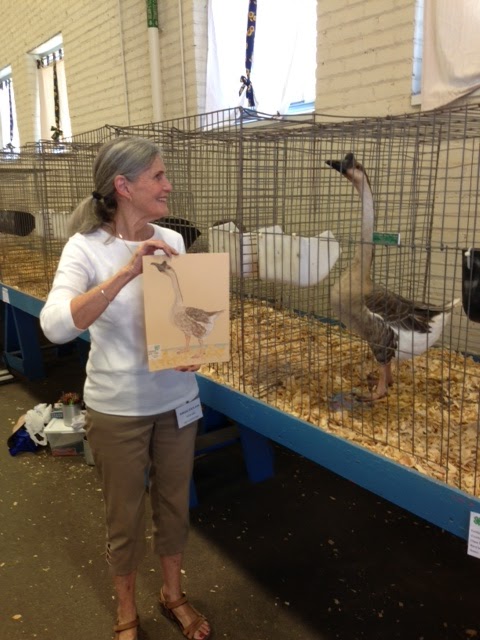
Lyn with "Brownie"
Each artist was limited to two entries, which were judged by a former university art professor who is currently the head of a college art department in Kansas.  Four entries were selected for ribbons--three paintings and one paper mosaic.  Photographs of the displayed art are not permitted, so I cannot show you the four pieces that were selected.  Instead, I will share my adventures and efforts.  Although neither of my two pieces was chosen, I had a wonderful time and hope to participate again.

Having seen entries from past Plein Air events, I decided to participate, along with more than twenty other artists.  Signing up gave me the perfect excuse for purchasing a portable easel.  Having never done Plein Air, I set up my easel on our porch when it arrived to experience the sunlight and breezes of working outside.  It also gave me a chance to see if I had assembled all of the supplies I needed.

I still have a carrier I used to transport files to the courthouse for trials, and I put it to work carrying my new easel and other supplies, assembled in a plastic tub which served as my table when I worked. Many of the artists made do with less to transport, using a simple clip board and sitting on the ground or a park bench.  If artists reading this blog are tempted to participate next year, your supplies need not be elaborate--just whatever works for you!  I do encourage more artist to join the fun.
State Fair Friends

I am normally a portrait artist, so the first day I chose to do portraits--of chickens, ducks, and geese.  After all, a portrait is a portrait.  My first subject, whom I named "Brownie" because he was a Chinese Brown Goose, was great fun.  I was fascinated with his long neck, and while he did not always extend his neck, he was very obliging whenever I asked.  Brownie was a bit vain and seemed to enjoy posing.

My next subject I called "Pilgrim," since his breed was identified as Pilgrim-Sex Linked.  After getting set up, I waited for Pilgrim to become calm, but he was an active duck, back and forth from feeder to water and round and round the cage.  Since it seemed he was unlikely to ever be stationary for long, I decided to only draw his head, which was usually visible above the water and feed tubs.

My last subjects Friday were two colorful bantam roosters caged side by side.  The one named "Henry" (according to his owner) was also active, but because he was small I could keep all of him in sight as he moved about.  He apparently had an artistic nature, as he seemed to enjoy adding his own water splashes to his portrait.    His neighbor was more of a sleepy head, napping often despite the constant noise of the poultry barn.

Lyn with Pilgrim
In the cages behind were two beautiful black and white chickens, the Rooster named Bud and the hen named Rose.  Their pretty young owner obviously loved them like pets, and shyly pointed out that their clever, combined names were Rosebud.  I was tempted to try drawing their complicated black and white feathers, but I had been working about 6 hours at that point and was too tired for another 2-hour portrait.  

Saturday entries had to be turned in by 3 p.m., so I arrived early to get started.  Unfortunately, the exhibits  where I intended to work were not open that early.  I headed to the dairy cattle barn to start my day until my intended subjects were available, but after sketching a particular cow, her owner took her for a bath and I had to stop.  I moved on, intending to return later but in search of a subject to do in the meantime.  I never returned to the cow nor made it to the things I had planned to draw. 

Photo credit Gauman, Hutch News
I chose one of those souvenir photo stands with an oval cut out for children to put their faces through for a photograph to take home from the fair.    With the fair ground pavilion as a background and a tree to balance the triangular composition, I thought it would be a nice, not too complicated image.  I was wrong.  All of the angles and details of the pavilion took most of the morning, and by then the Saturday crowds had arrived.  The photo stand was popular, and families would line up between me and my subject to watch their children pose.  In addition, the miniature train tracks were between me and my subject and passed by regularly.  In fact, they were so busy there were two trains running.  

Since I was working in the park, many people stopped by to watch and to visit, which I loved.  Even Lindsey Gauman with the Hutchinson News took my photo for the Sunday Paper and stopped by to get my name.  What wasn't so nice was that  as the breeze came up I realized that my position blew fairground grit right into my eyes.  I was having a true Plein Air painting experience!

Lyn's turn to pose in the souvenir photo board
On Friday I had finished 3 drawings in six hours, but on Saturday I struggled to finish 1 drawing in 6 1/2 hours, rushing to finish the tree before time ran out.  I wasn't satisfied with Saturday's work, but I chose to enter it as one of my 2 entries, along with the double chicken portraits.

I did not win any prize, but I was pleased when the judge took the time to comment specifically on my entry from Saturday when he finished speaking about the 4 winners.  He said how much he appreciated my theme of contrasting the permanence of the pavilion and the tree against the bright colors and temporary excitement of the fair, represented by the souvenir photo display.  I had been so disappointed with that work, but he had seen what I set out to depict, and I was both embarrassed by being singled out and pleased by his comments.  

The 2017 Kansas State Fair continues through Sunday, September 17, so if you have not attended this year and you are curious to see the Plein Air exhibit, it can be found in the OZ Building.  I hope some of you who may have considered participating will be encouraged to enter next year.  I had a blast!

Remember, you can click on the images to enlarge.


Thursday, September 7, 2017

The Detective Work of an Artist

Clues from old newspapers
Recently I read an article about a performance artist who found a wire recording made in the 1950s in which a family undertakes that awkward effort of acting natural as they record themselves.  Using that recording, the artist created "Say Something Bunny," which she performs in a small Off Off Broadway theater.  When she listened to this unusual wire recording, a technology that predates tape recorders, she became intrigued by the self-conscious conversations of the family, and she set out to discover who they were.  Amazingly, she traced their identities.

Clues from books Isaac Werner read
Having created her performance piece, she wanted to locate a family member to acquire permission to use the recording.  She found the only surviving family member, now seventy-eight years old.  He gave his permission and expressed his amazement in the artist's ability to track down the identities of those on the recording and to find him, saying:  "Allison should really be working for the FBI."

Clues from courthouses
The artist's partner described her efforts in this way:  "A journalist would have started with 'I'm going to find who this person is and get the story from them, but Allison got the story from everything else she could find and put it together."

You have probably realized by now why this newspaper story caught my attention.  I found Isaac Werner's journal, written in 1870-71 and resumed from 1884-1891.  No one is living from that time that I could "get the story from."  I had to be a detective and 'get the story from everything else I could find and put it together.'  Whether you are a writer or a playwright or a narrative poet or some other artist, basing your work on actual historic events, you must be a thorough detective.

Clues from public memorials
There are places to discover the secrets of the past, even when those people about whom you are writing are no longer living and were never famous.  Of course libraries are an obvious place to begin.  In my case, I knew the titles of books in Isaac's own library from the inventory of his estate sale and comments in his journal, and by reading what he read, I learned much about him and the times in which he lived.  Certainly I read books about the period--histories about the Populist Movement, biographies and autobiographies of key figures of that period, books about prohibition and specific historic events.  But, I also interviewed descendants, visited sites relevant to Isaac and the period, walked cemeteries where people mentioned in the book are buried, read old newspapers, and used the valuable information in the local courthouses from deed records and court documents.  

Isaac's journal is an amazing document in itself.  I came to know his community very well, and one of the most difficult challenges in writing my manuscript has been limiting what I can include.  As an editor told me, "Does it advance the story?  If it doesn't, take it out."  

Clues from cemeteries
My manuscript is not a diary or simply Isaac's journal.  Rather it is, as the title suggests, Isaac's story as it reveals the historic Populist Movement, its leaders, and its impact on America both at that time and to the present.  I was unable to include the scandalous story of the runaway elopement or the tragic story of a 15-year-old girl's murder and the lynching of her killer, exciting as both were.  They were both historical to the period and the region, but they did not advance the story of the populist movement that I had chosen to tell.  A detective must follow the clues that will solve the case he is handling, and an artist must advance the story she is telling.


You can enlarge the images by clicking on them.  To read more about "Say Something Bunny" you may go to the June 26, 2017 issue of the New York Times and read the article "The Detective was a Performance Artist" by Elizabeth Vincentelli.