|
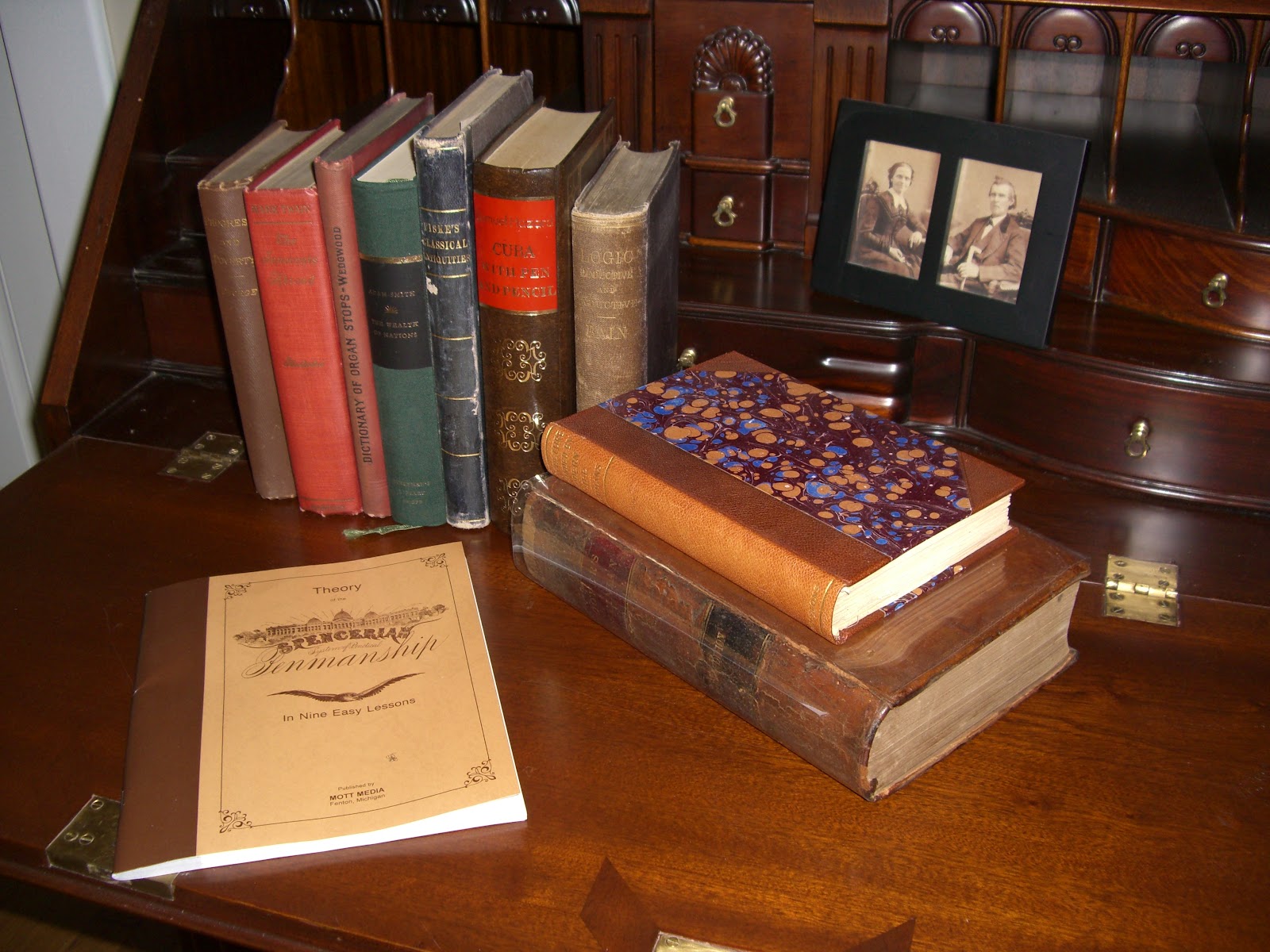
| Books whose titles were in Isaac's Library |
Most days the craft of writing is incredibly satisfying, but one night I experienced a serious bout of writer's angst, lying in bed awake, with thoughts jabbing at me. I announced with satisfaction several weeks ago that my manuscript was finished, but I continued to tighten and polish it, each edit making it better.
Not that the story need be long, but it will take a long while to make it short. Henry David Thoreau
I have been living with Isaac for about two and a half years. The transcribing of his journal was a sort of courtship. The research was a matter of meeting his friends and family, getting acquainted with his neighborhood, and familiarizing myself with the books, ideas, and goals that were important in his life. There was no point in considering an engagement to Isaac until I had done these things.
Next to doing things that deserve to be written, nothing gets a man more credit, or gives him more pleasure than to write things that deserve to be read. Lord Chesterfield
I knew very quickly after the discovery of Isaac's journal that his was a story that should be told. However, it was not until I reached the point in his journal when he began to write about farmers organizing to confront their problems politically that I saw the arc to his story. What had been a struggling homesteader's diary became a history of the populist movement with Isaac at its center.
Close the door. Write with no one looking over your shoulder. Don't try to figure out what other people want to hear from you; figure out what you have to say. It's the one and only thing you have to offer. Barbara Kingsolver
I begin every day reading aloud what I wrote the previous day before writing anything new. I edit with a more objective eye and I fall back into the rhythm of my writing, and only then can I start a new writing day.
An essential element for good writing is a good ear. One must listen to the sound of one's own prose. Barbara Tuchman
 |
| Isaac's journal |
There is nothing like reading my work aloud to show me awkward passages or if I am being verbose or dull. As I told someone once, if it bores you to read it aloud, why would you expect a stranger to find it worth reading?
...an author is one who can judge his own stuff's worth, without pity, and destroy most of it. Colette
By the time I finish a chapter, I have read it aloud to myself, deleting, rewriting, tweaking it in countless ways many times. I then put it aside for several weeks to allow me to edit with a more objective eye.
Books aren't written, they're rewritten. Including your own. It is one of the hardest things to accept, especially after the seventh rewrite hasn't quite done it... Michael Crichton
Eventually, all the chapters were written, and the process of polishing and editing the manuscript as a whole began--was the tone consistent, were characters properly introduced when they appeared and identified as they reappeared, were recurring events threaded through the manuscript in such a way that a reader could recognize the sequence as it advanced the story, were there enough clues to orient a reader without being redundant?
Every sentence has a truth waiting at the end of it and the writer learns how to know it when he finally gets there. Don DeLillo
I write at the computer, so when I edit, the old version disappears. After completing a careful rewrite, which I see at that time as the best I can do, I print it. I use colored paper clips to hold each chapter. My first saved version of the manuscript was clipped with white paper clips. My second version used red. I have now gone through blue, green, pink and yellow. The version I announced as finished used the yellow clips, the last color option in my box of paper clips. The subsequent rewrites were not printed...not because I am out of colors but because I knew when I finished that they were not my last revisions.
The most valuable of all talents is that of never using two words when one will do. Thomas Jefferson
I have realized that my night of angst was the result of knowing that, while I had been successful at tightening the manuscript, doing what Jefferson advocated, the manuscript was still too long.
I believe more in the scissors than I do in the pencil. Truman Capote
My sleeplessness just may have been the ghost of Truman Capote poking me with scissors. Writers know to ask themselves, does this advance the story? If it does not, it must be eliminated, regardless of how interesting or beautifully written it is. Doing all of the research that I have, I discovered so many interesting things, but taking Truman Capote's advice, I have cut wonderful sections from the manuscript that did not seem necessary to advance the story. In short, I may miss them, but I don't think an editor will. Perhaps I will share those deleted stories in future blogs!
My therapist told me the way to achieve true inner peace is to finish what I start. So far today, I have finished 2 bags of M&M's and a chocolate cake. I feel better already. Dave Barry
This time the manuscript really is "finished" and ready to be shown to others. Isaac is about to make his debut--edited, polished, tweaked and slimmed down to make a good impression. I'm not sure what color paper clip he will be wearing.