Showing posts with label writer's angst. Show all posts

Thursday, December 5, 2013

A Publishing Dilemma


Reading the County Capital
Recently, visiting the online newsletter Biographile, Discover the World Through Biography and Memoir, I spotted an intriguing article titled, "No Such Thing as Objective History."  As you know from reading my earlier blog, "What is History, An Update on my Manuscript," posted 5/23/13, one of the issues I have faced in writing my manuscript about Isaac Werner has been--"When documentary material is inadequate to supply every detail, can an author write legitimate history or biography?"  Writers of history and biography who are researching famous people often have a great deal of documentary material available.  With Isaac, I was fortunate to have his journal, his newspaper articles, and his probate documents, but I did not have personal letters, interviews, news reports, speeches, and other documentary material of the sort someone writing about Thomas Jefferson or Marilyn Monroe might have.

Visiting Rossville, IL
I have not read Reza Aslan's best-selling book about the "life and times of Jesus," but the Biographile article questioning "Objective History" was based on an interview of that author, who discussed his approach to writing about the life of Jesus.  Aslan's method for writing about more than the Biblical account was, "[to] rely on the world in which Jesus lived, a world that--thanks to the Romans--we know a great deal about.  By placing Jesus firmly within his time and place, we can fill in the holes of his life and create a picture of him..."  What I found so relevant from the interview of Aslan was how he used the information that was available from that historic period in his book.

Transcribing & Annotating Isaac's Journal
My  manuscript about Isaac Werner also uses what Aslan called research about my subject's "time and place" to "fill in the holes of his life and create a picture" of him.  In addition, I benefitted from getting to know Isaac from the emotions and opinions expressed in his journal.  (Thank goodness he did not always follow the advice of Henry Ward Beecher to keep personal feelings out of his journal.  Blog of 12-7-2012.)


Marketing my manuscript, I am asked to define it.  Biography?...history?...narrative nonfiction?...historic fiction?  That definition is difficult, and it has created a publishing dilemma for me.  Am I prohibited from imagining dialogue if I know from Isaac's journal when, where, and with whom Isaac had a conversation and the likely subjects they discussed?  Does it make a difference that I document in a footnote what I have done, distinguishing the sourced information from the imagined?

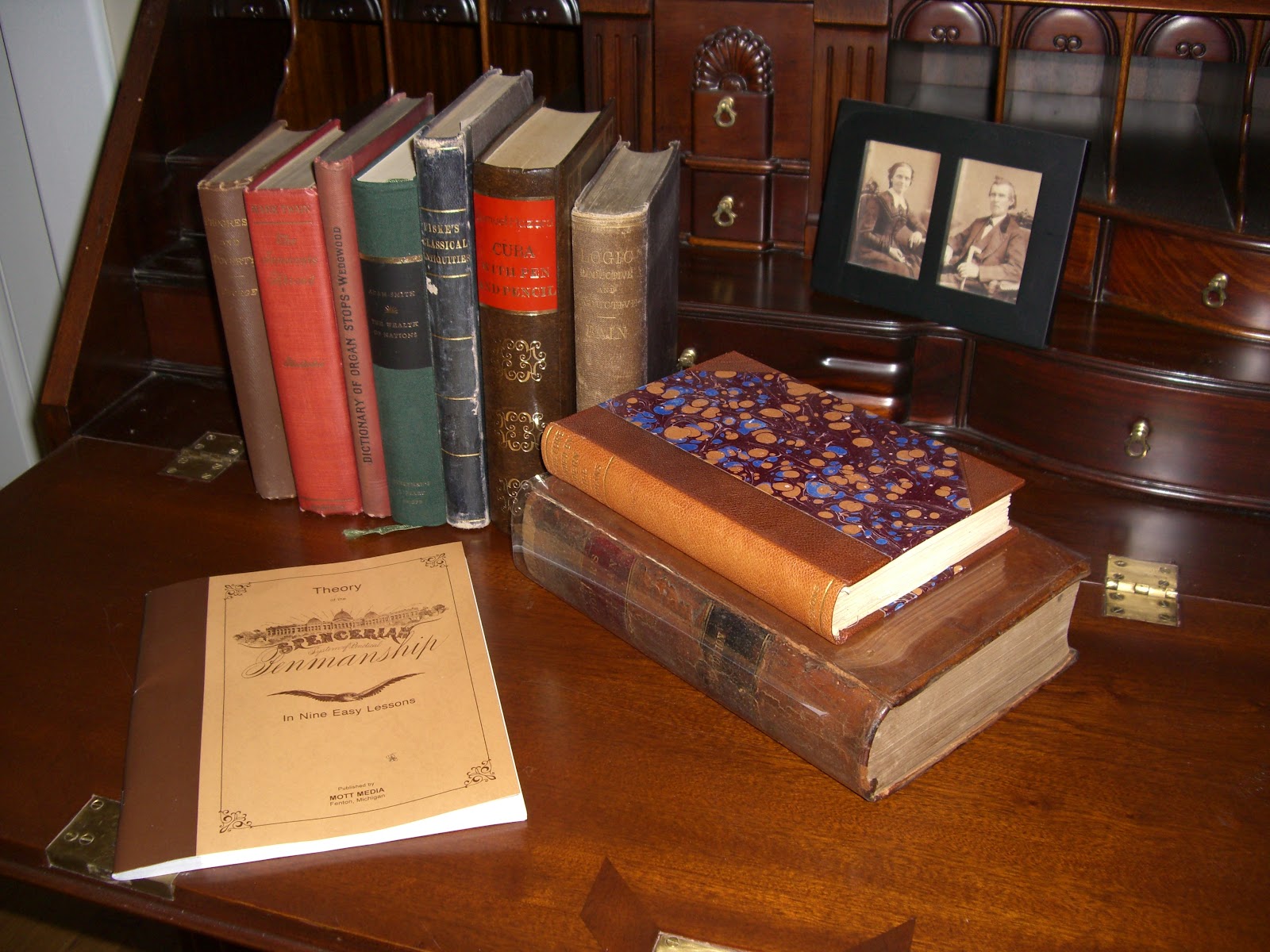
Reading books Isaac read
In his interview, Aslan insists, "There's no such thing as objective history:  a scholar cannot help but bring his own impressions and perceptions into his study, no matter how hard he tries."  Aslan argues that his approach in describing Jesus by "immers[ing] readers in the social, political, and religious context of the first century" allows a reader to "figure out for yourself the larger implication of what he [Jesus] was saying or doing."

Here is what I have done:  I have studied Isaac from his daily journal, (Blog of 10-23-11), his published writings, newspaper and other accounts of events he attended and organizations he joined (Blog of 4-12-12 & 4-17-12).  I have traveled to the town his father founded where Isaac was born and raised, (Blog of 2-16-12 & 2-23-12), visited the town where he was a young druggist, (Blog of 1-20-12 & 1-27-12), walked the land he homesteaded (Blog of 5-16-13), and found his forgotten grave (Blog of 1-13-12).  I have read specific books he read, as well as books by speakers and performers he saw in person and with whom he corresponded (Blog of 2-2-12, 5-30-13, & 4-11-13).  I have done genealogy research of his ancestry and descendants of his siblings, as well as searching the ancestry of each of his neighbors, also learning from interviews with descendants and public documents as much about Isaac's neighbors as I could.  I have immersed myself in the history of the period, reading original documents and scholarly books (Blogs of 8-30-12, 9-13-12, & 10-18-12).  I often felt I knew those people and their lives better than I know the people living in Isaac's community today.

Researching Isaac's Neighbors (Doc Dix)
What is important to me is not writing another scholarly book but rather bringing Isaac, his community, and the Populist movement of the Gilded Age alive to readers, whether they are reading for pleasure or for academic information.  Isaac's journal and the other research I have done is valuable to scholars, but it is also incredibly interesting for general readers.  Is there not some way I can present Isaac's story that is accessible to both?

In the interview with Biographile, Aslan addresses this issue:  "The biggest criticism I have of my [academic] colleagues is that they spend all their time talking to each other, that they rarely bother to synthesize their ideas and their research to make it accessible and appealing to a wider audience.  ... There is a culture in academia that tends to look down on those who try to reach a wider audience--we're immediately tagged as not serious."


Interviewing Isaac's cousin in Wernersville
I have successfully published two non-fiction books, Should the Children Pray?  A Historical, Political, and Judicial Examination of School Prayer, published by Baylor University Press, and Private Choices, Public Consequences, Reproductive Technology and the New Ethics of Conception, Pregnancy, and Family, published by Dutton, a division of Penguin.  You can learn more about those books at my author's website, www.lynfenwick.com.  I sought with both of those books to bridge the gap between writing for general readers and academics, or as Aslan said, to reach a wider audience, although both books were carefully researched and documented.  I was chosen the Georgia Non-fiction Author of the Year for Should the Children Pray?

Visit to town founded by his father
In telling Isaac's story, with a bachelor homesteader at the center of the Populist Movement in his community and events throughout the nation impacting Isaac and other laborers, I am again seeking to bridge the gap between general readers and academics.  By footnoting imagined conversations and describing events based on research and newspaper accounts, I feel that general readers will find the story more involving and accessible while academics will be warned to consult the references provided in the footnote without assuming that the conversation or description is an accurate account of that particular conversation or that the description of the event was exactly as Isaac experienced it, although Isaac's journal does reference the meeting or event.  I may not have an easy label for what I have chosen to do, but as Katherine Hepburn said, "If you obey all of the rules, you miss all of the fun."  I believe trying to fit my manuscript into either an academic mold or reducing it to historical fiction would make it less than what it is as I have written it.  The challenge is to find a publisher that agrees!


Thursday, August 23, 2012

Writer's Angst

Books whose titles were in Isaac's Library
Most days the craft of writing is incredibly satisfying, but one night I experienced a serious bout of writer's angst, lying in bed awake, with thoughts jabbing at me.  I announced with satisfaction several weeks ago that my manuscript was finished, but I continued to tighten and polish it, each edit making it better.
 
 
Not that the story need be long, but it will take a long while to make it short.  Henry David Thoreau 
 
 
I have been living with Isaac for about two and a half years.  The transcribing of his journal was a sort of courtship.  The research was a matter of meeting his friends and family, getting acquainted with his neighborhood, and familiarizing myself with the books, ideas, and goals that were important in his life.  There was no point in considering an engagement to Isaac until I had done these things.
 
 
Next to doing things that deserve to be written, nothing gets a man more credit, or gives him more pleasure than to write things that deserve to be read.  Lord Chesterfield 
 
 
I knew very quickly after the discovery of Isaac's journal that his was a story that should be told.  However, it was not until I reached the point in his journal when he began to write about farmers organizing to confront their problems politically that I saw the arc to his story.  What had been a struggling homesteader's diary became a history of the populist movement with Isaac at its center.
 
 
Close the door.  Write with no one looking over your shoulder.  Don't try to figure out what other people want to hear from you; figure out what you have to say.  It's the one and only thing you have to offer.  Barbara Kingsolver 
 
 
I begin every day reading aloud what I wrote the previous day before writing anything new.  I edit with a more objective eye and I fall back into the rhythm of my writing, and only then can I start a new writing day.
 
 
An essential element for good writing is a good ear.  One must listen to the sound of one's own prose.  Barbara Tuchman 


Isaac's journal
There is nothing like reading my work aloud to show me awkward passages or if I am being verbose or dull.  As I told someone once, if it bores you to read it aloud, why would you expect a stranger to find it worth reading?
 
...an author is one who can judge his own stuff's worth, without pity, and destroy most of it.  Colette 
 
By the time I finish a chapter, I have read it aloud to myself, deleting, rewriting, tweaking it in countless ways many times.  I then put it aside for several weeks to allow me to edit with a more objective eye.
 
Books aren't written, they're rewritten.  Including your own.  It is one of the hardest things to accept, especially after the seventh rewrite hasn't quite done it...  Michael Crichton 
 
Eventually, all the chapters were written, and the process of polishing and editing the manuscript as a whole began--was the tone consistent, were characters properly introduced when they appeared and identified as they reappeared, were recurring events threaded through the manuscript in such a way that a reader could recognize the sequence as it advanced the story, were there enough clues to orient a reader without being redundant?
 
Every sentence has a truth waiting at the end of it and the writer learns how to know it when he finally gets there.  Don DeLillo
 
I write at the computer, so when I edit, the old version disappears.  After completing a careful rewrite, which I see at that time as the best I can do, I print it.  I use colored paper clips to hold each chapter.  My first saved version of the manuscript was clipped with white paper clips.  My second version used red.  I have now gone through blue, green, pink and yellow.  The version I announced as finished used the yellow clips, the last color option in my box of paper clips.  The subsequent rewrites were not printed...not because I am out of colors but because I knew when I finished that they were not my last revisions.
 
The most valuable of all talents is that of never using two words when one will do.  Thomas Jefferson
 
I have realized that my night of angst was the result of knowing that, while I had been successful at tightening the manuscript, doing what Jefferson advocated, the manuscript was still too long.
 
I believe more in the scissors than I do in the pencil.  Truman Capote 
 
My sleeplessness just may have been the ghost of Truman Capote poking me with scissors.  Writers know to ask themselves, does this advance the story?  If it does not, it must be eliminated, regardless of how interesting or beautifully written it is.  Doing all of the research that I have, I discovered so many interesting things, but taking Truman Capote's advice, I have cut wonderful sections from the manuscript that did not seem necessary to advance the story.  In short, I may miss them, but I don't think an editor will.  Perhaps I will share those deleted stories in future blogs!

My therapist told me the way to achieve true inner peace is to finish what I start.  So far today, I have finished 2 bags of M&M's and a chocolate cake.  I feel better already.  Dave Barry

This time the manuscript really is "finished" and ready to be shown to others.  Isaac is about to make his debut--edited, polished, tweaked and slimmed down to make a good impression.  I'm not sure what color paper clip he will be wearing.