Showing posts with label Thomas Jefferson. Show all posts

Wednesday, June 18, 2025

The Concerns of Thomas Jefferson

Thomas Jefferson was only 14 when his father died, and he inherited the responsibility of the family estate.  In his youth he had studied Latin, French, and Greek, Math, and History.  He was well prepared for entering the College of William & Mary, where he studied law.  Later, he married a well to do widow, and fathered 6 children, only two of whom survived into adulthood.  His wife was frail, and soon after the death of her last child, she died.  There was help for raising his children, but only 2 of them reached adulthood.

What history knows best about Jefferson are his political roles.  He is largely credited with writing the Constitution, although John Adams played an important role in its drafting.  Nearly unknown today is that in the first draft of the Declaration of Independence there was a passage blaming the slave trade on George III.  That clause was quickly                                                                                     deleted.  

In 1782 Jefferson served as a delegate to the Continental Congress in Paris.  When he returned in 1789, he served as George Washington's Secretary of State, assisting with matters of foreign policy.  All of this had occurred before the serious rift between Jefferson and Adams. 

Politics were very ugly during this time.  Washington had warned against the trouble political parties could cause, and this period represented an example of just how ugly opposing parties could get.  Adams had served one term, and he planned to follow Washington's example by running for a second term.  Jefferson decided to run for the presidency, in opposition to his friend, and opposing parties became personal.  Adams was displaced, and Jefferson became President.  The false and hateful tactics during the political campaigns severed their friendship.  Jefferson served two terms as President, the Louisiana Purchase generally regarded as his greatest achievement.  

The ultimate part of his legend, however, may be the reconciliation of their friendship.  John Adams reached out first, and their back-and-forth correspondence continued for the remainder of their lives.  The letters of both men were preserved for history, a total of 158 letters between 1812 and 1826.  Their deaths could not have been written better as a Hollywood script.  The two friends died on the same day of the same year, slow correspondence of that era causing both of them to die without awareness of the death of their friend.  Even more remarkable was the fact that the day of their deaths was the 4th of July. 

The example of the political ugliness engineered by political parties between two men who had been friends is an example of what concerned President Washington.   Washington realized that political parties could do great harm if they cared more about their candidates winning than they cared about the things for which our constitution stood.  It remains a good example.      

Jefferson also had concern about threat to the system of government that our founding fathers devised, if the original purpose of the three branches ignored the original purpose.  During his two terms in office, he expressed his warning that "Our government is now taking so steady a course as to show what road it will pass to destruction..."  His fear was that the loss of the original purpose of the three branches of government was being ignored.  He warned:  "The great object of my fear is the federal judiciary.  That body, like gravity, ever acting with noiseless foot and alarming advance, gaining ground step by step and holding what it gains, is engulfing insidiously the [state] governments into the jaws of that [federal government] which feeds them." 

And here we are...with similar problems existing today. 


Wednesday, September 9, 2020

Agrarianism--What is It?


 There is an odd thing about time.  When we look at a clock, time seems to be a very definite thing.  Yet, I remember when I was a child and was told something I eagerly looked forward to would happen in an hour, it took forever!  If it was a special occasion several days away, I thought it would never arrive!!  Yet, today when I recall a special event in the past, it seems like only yesterday, and days on my calendar fly by.

Time has the same impact on words.  Agrarianism in its time referred to a philosophy or political philosophy that placed a superior value on rural society and the independent farmer as a way of living, than was placed on urban society and paid workers.  The imagined simplicity of a rural life was romanticized as more ideal than the complexities of city living.  In America, Thomas Jefferson idealized farmers as "the most valuable citizens," and in Europe John Locke and others reinforced the idea of the Romantic Era depicted in the bucolic paintings of that time.  China also had a philosophy of a utopian society of farmers.   

In Isaac Werner's time immigrants fled crowded European cities and places where their lowly station in life seemed inescapable, to seek a new life in America, as uncertain as that life may actually have been.  Once here, many of them  were confronted by the same urban, crowded tenements and wages reduced by the availability of desperate men willing to work for even less.

The opportunity to travel West and stake a claim had great appeal, but society was changing, spurred on by the industrial changes during and after the Civil War.  It was this era in flux during which Isaac Werner came to Kansas to stake a homestead and a timber claim.  The image of the "landed gentry" may have motivated many families to stake their claims in anticipation of building a farming dynasty for their children.  Instead, it  became a struggle for survival.  America had transformed into three classes--the Wealthy, whose lifestyles gave us the term "The Golden Age," the new Middle Class in towns and cities who lived comfortably 'in the middle' between great wealth and a struggle for survival, and the Working Classes of farmers, miners, small ranchers, and laborers.

As a result of that economic shift, "Agrarianism" took on the meaning of political theories involving land redistribution.  Some governments around the world seized land from the rich and distributed it to the working poor.  In America during Isaac's time a popular author, Henry George, advocated abolishing land ownership altogether and instead having land rent.  Land could not be bought and held as an investment, but it could be rented, and improvements to the land and what was produced on the land would not be taxed, with the land rent replacing taxes.

Today agrarianism is a word with a small "a," used primarily as a way to describe farm life in a positive, somewhat idealized way.  It tends more toward a philosophical or literary theme, with a hint of political thought from the past.

So why did I choose grain elevators from four different eras to illustrate this blog?  My point is, time is relative.  Some of you who follow my blog remember the small grain bens or wooden granaries at every farm.  Later, successful farmers with more land might have their own grain elevator and towns had small elevators like the one in the second image.  By the mid-century the huge concrete elevators towered over the plains, glowing in the sunlight in pristine white.  What had once seemed irreplaceable was not, and the concrete elevators are graying and cracking as huge metal bins replace them, both commercially and on farms whose own production requires massive storage.

Things that once seemed eternal disappear and often, as it happens, we hardly notice.  Time moves on, and to the young it moves more slowly than it moves for the elderly.  Perhaps that is because the young have less to remember and more years ahead to expect. 


Thursday, May 18, 2017

The Books in Our Lives

Jefferson:  "I cannot live without books."
When I did the series on favorite children's books and ask readers of the blog to share the favorites from their childhoods, I was inundated with so many replies that it took several blogs to share all of your favorites.  Last week, I invited readers to share their favorite adult book titles, and only a few of you replied.  Since I know that so many of you were eager readers as children, and because educators believe forming the habit of reading in childhood will develop active adult readers, I expected to be inundated with adult book titles.  I'm disappointed, but I did receive some great replies!  

One of my foreign followers  loves reading history, so he began by admitting that he doesn't read much fiction.  However, he does like John le Carre (1931-    ) spy novels and named The Night Manager as his favorite.  He also enjoys Westerns, naming Ernest Haycox  (1899-1950) and, especially, Jack Schaefer (1907-1991) as favorites.  He warned against trying to take the easy way out by seeing movies based their books--pale imitations, in his opinion!

Edward Bellamy
I have another friend who enjoys mysteries and travel books, neither of which appeal to me.  She has shared some wonderful suggestions outside those genres that I have loved.   Our friendship really took root when we discovered we both had read The House by Otowi Bridge by Peggy Pond Church (1903-1987).

Two people responded to my call for favorite adult books by telling me we share a favorite.  LS chose To Kill a Mockingbird by Harper Lee (1926-2016), which I think every aspiring lawyer should read.

SGR agrees with me about East of Eden being our favorite among John Steinbeck's novels.  She is a voracious reader and declined naming a specific favorite among all the books she loves.  However, she did share a favorite from  among books recently read, and her recommendation came with three reviews and an interview of the author as attachments.  Yes, she has tempted me to read A Gentleman in Moscow by Amor Towles (1964-    ).

Life is too short to read all of the books I'd like to read, so I enjoy recommendations from friends who are readers.  Recently, JD recommended The Sympathizer, which I mentioned in last week's blog.  I would never have read it without his recommendation, and I'm so glad that I did.  In turn, I recommended All the Light We Cannot See, and he tells me he enjoyed it.

I do believe what we read shapes who we are, and for that reason I find no pleasure reading books that are no more than a way to pass the time.  Researching my manuscript about Isaac Werner, I felt that I came to know him from the books he chose to read.  He also led me to books being read during the populist movement, so that I came to understand what inspired and shaped working class people of that time.  Edward Bellamy's Looking Backward (1850-1898) was so popular that Bellamy Clubs, whose members sought to implement some of his futuristic ideas, were formed around the world.  Mark Twain (1835-1910) is still popular today.  Other books that he owned are no longer read, but I appreciated the immersion into that era that reading those books gave me.

Thanks to those of you who shared "the books in your lives!"

Thursday, January 16, 2014

Wisdom for the New Year from Isaac and Others

My early connection with Isaac B. Werner grew from our mutual passion for reading and our common belief in the benefits to each generation from reading the wisdom of their forefathers that can be found in books.  (See "Isaac's Library," Blog Archives 2-2-2012.)


On the last day of 1870 Isaac recorded in his journal recent purchases of books, including legal maxims, history, poetry, and art, expressing his wish for the financial resources to have purchased more.  He wrote:  "But there is nothing like patience to conquer great many things & undertakings.  Whether I really increased the value of my real estate & chattles [sic] during this last year or not, I confidently feel that I enriched my mind, satisfactory to my desire--beyond my any expectations--and in my eye that looks a fortune worth possessing--'O learn thou young man...'"


At FDR's Museum and Library
When my husband and I visited Franklin Delano Roosevelt's Museum and Library, we paused to read the words he had spoken at the dedication: "...the dedication of a library is in itself an act of faith.  To bring together the records of the past and to house them in buildings where they will be preserved for the use of men and women in the future, a Nation must believe in three things.  It must believe in the past.  It must believe in the future.  It must, above all, believe in the capacity of its own people so to learn from the past that they can gain in judgment in creating their own future."


As a reader and a writer, I am always saving quotes about books and writing.  For many years, Salmon Rushdie lived in hiding, constantly guarded by a police team devoted to protecting him from the fatwa issued against him because of words he had written.  Rushdie was required to give himself a new name to protect his identity, and even the policemen guarding him in the privacy of his various hiding places called him by that name, training themselves never to call out his real name in a moment of carelessness.  He chose as his pseudonym a combination of the names of two of his favorite authors--Joseph Conrad and Anton Chekov.  His recent book, Joseph Anton, A Memoir, describes those years of isolation, when he questioned whether his words were worthy of the sacrifices it cost not only him but also his friends and family.  For a time, he questioned whether he should have censored himself, whether he should have written fiction about a subject some found offensive, whether the writing he believed truly important actually made a difference in the greater world.  For a time he thought he had lost the ability to write anything, so crippled was he by the isolation and emotional stress.  Eventually, he found his answers and wrote these words:  "This is what literature knew, had always known.  Literature tried to open the universe, to increase, even if only slightly, the sum total of what it was possible for human beings to perceive, understand, and so, finally, to be.  Great literature went to the edges of the known and pushed against the boundaries of language, form, and possibility, to make the world feel larger, wider, than before."  Rushdie could not stop writing about things he believed to be important, nor could he apologize for what he had written because his story offended some--not ever, and especially, not now, in "an age in which men and women were being pushed toward ever narrower definitions of themselves."         


Milton's Areopagitica
In reaching his answer, Rushdie found a quote from Milton's Areopagitica that reaffirmed his decision.  "He who destroys a good book, kills reason itself...Give me the liberty to know, to utter, and to argue freely according to conscience, above all liberties."


Thomas Jefferson is famous for his love of books, having said, "I cannot live without books."  In fact, he loved books so much that he nearly bankrupted himself buying them!  After the British burned the Capitol in the War of 1812, it was the purchase of books from Thomas Jefferson's library that formed the core of our Library of Congress.  Jefferson's belief in the necessity for American citizens to read and study in order for the nation to prosper is expressed in these words:  "If a nation expects to be ignorant and free, in a state of civilization, it expects what never was and never will be." 


Katherine Hepburn, never one to waste words in her pithy comments stated it more simply.  "What in the world would we do without our libraries?" 


Thomas Jefferson
As Isaac Werner regarded with satisfaction the books he had studied during the previous months, he reflected on the months ahead.  "These last hours of 1870, who may see the last of 1871, only 365 days, but what changes may take place in that very short time to come.  How many a now warm beating pulse may rest motionless till then, and what [future] Shakespeare may take his life in the meantime to shine some future day, an ornament to the period.  Very nearly can I say that I enter the New Year--at least--without pressing debts, about $40.00 near at hand to liquidate, while I have also just the cost in pocket to meet same, any amount square.  While that would leave me about square and strapped--but how many would feel rich at that..."  Isaac continued by enumerating books on painting, Shakespeare, history, the Bible, Don Quixote, and Gibbon's Roman Empire that he wished to buy, including in the enumeration their prices.  He concluded by admitting that "I can't hardly spare so much money at once...but will have to take it cooly and get them by degrees."  He prioritized his wish list, writing, "The following works I long to possess, but not quite as much in a hurry as some above named, but I expect in due course of time to possess them all, and arranged in my library." 


Isaac concluded his New Year's Eve ruminations with this maxim:  "God hath provided wisdom the reward of study," words reflected a century later in FDR's belief that Americans must "learn from the past that they can gain in judgment in creating their own future."


With 2014 just begun, the words of these wise people, reminding us of the importance of reading, seem particularly important!


Thursday, August 23, 2012

Writer's Angst

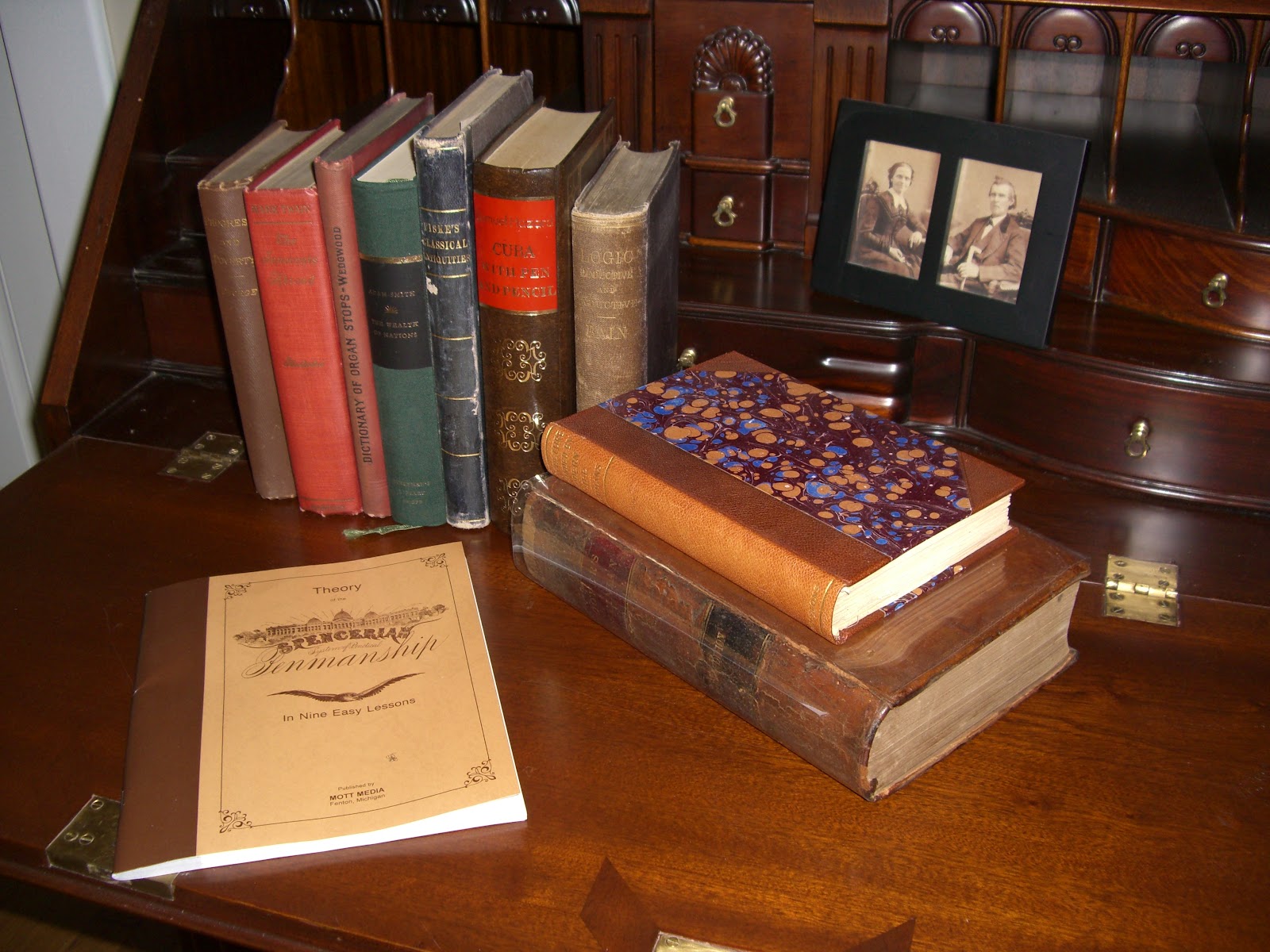
Books whose titles were in Isaac's Library
Most days the craft of writing is incredibly satisfying, but one night I experienced a serious bout of writer's angst, lying in bed awake, with thoughts jabbing at me.  I announced with satisfaction several weeks ago that my manuscript was finished, but I continued to tighten and polish it, each edit making it better.
 
 
Not that the story need be long, but it will take a long while to make it short.  Henry David Thoreau 
 
 
I have been living with Isaac for about two and a half years.  The transcribing of his journal was a sort of courtship.  The research was a matter of meeting his friends and family, getting acquainted with his neighborhood, and familiarizing myself with the books, ideas, and goals that were important in his life.  There was no point in considering an engagement to Isaac until I had done these things.
 
 
Next to doing things that deserve to be written, nothing gets a man more credit, or gives him more pleasure than to write things that deserve to be read.  Lord Chesterfield 
 
 
I knew very quickly after the discovery of Isaac's journal that his was a story that should be told.  However, it was not until I reached the point in his journal when he began to write about farmers organizing to confront their problems politically that I saw the arc to his story.  What had been a struggling homesteader's diary became a history of the populist movement with Isaac at its center.
 
 
Close the door.  Write with no one looking over your shoulder.  Don't try to figure out what other people want to hear from you; figure out what you have to say.  It's the one and only thing you have to offer.  Barbara Kingsolver 
 
 
I begin every day reading aloud what I wrote the previous day before writing anything new.  I edit with a more objective eye and I fall back into the rhythm of my writing, and only then can I start a new writing day.
 
 
An essential element for good writing is a good ear.  One must listen to the sound of one's own prose.  Barbara Tuchman 


Isaac's journal
There is nothing like reading my work aloud to show me awkward passages or if I am being verbose or dull.  As I told someone once, if it bores you to read it aloud, why would you expect a stranger to find it worth reading?
 
...an author is one who can judge his own stuff's worth, without pity, and destroy most of it.  Colette 
 
By the time I finish a chapter, I have read it aloud to myself, deleting, rewriting, tweaking it in countless ways many times.  I then put it aside for several weeks to allow me to edit with a more objective eye.
 
Books aren't written, they're rewritten.  Including your own.  It is one of the hardest things to accept, especially after the seventh rewrite hasn't quite done it...  Michael Crichton 
 
Eventually, all the chapters were written, and the process of polishing and editing the manuscript as a whole began--was the tone consistent, were characters properly introduced when they appeared and identified as they reappeared, were recurring events threaded through the manuscript in such a way that a reader could recognize the sequence as it advanced the story, were there enough clues to orient a reader without being redundant?
 
Every sentence has a truth waiting at the end of it and the writer learns how to know it when he finally gets there.  Don DeLillo
 
I write at the computer, so when I edit, the old version disappears.  After completing a careful rewrite, which I see at that time as the best I can do, I print it.  I use colored paper clips to hold each chapter.  My first saved version of the manuscript was clipped with white paper clips.  My second version used red.  I have now gone through blue, green, pink and yellow.  The version I announced as finished used the yellow clips, the last color option in my box of paper clips.  The subsequent rewrites were not printed...not because I am out of colors but because I knew when I finished that they were not my last revisions.
 
The most valuable of all talents is that of never using two words when one will do.  Thomas Jefferson
 
I have realized that my night of angst was the result of knowing that, while I had been successful at tightening the manuscript, doing what Jefferson advocated, the manuscript was still too long.
 
I believe more in the scissors than I do in the pencil.  Truman Capote 
 
My sleeplessness just may have been the ghost of Truman Capote poking me with scissors.  Writers know to ask themselves, does this advance the story?  If it does not, it must be eliminated, regardless of how interesting or beautifully written it is.  Doing all of the research that I have, I discovered so many interesting things, but taking Truman Capote's advice, I have cut wonderful sections from the manuscript that did not seem necessary to advance the story.  In short, I may miss them, but I don't think an editor will.  Perhaps I will share those deleted stories in future blogs!

My therapist told me the way to achieve true inner peace is to finish what I start.  So far today, I have finished 2 bags of M&M's and a chocolate cake.  I feel better already.  Dave Barry

This time the manuscript really is "finished" and ready to be shown to others.  Isaac is about to make his debut--edited, polished, tweaked and slimmed down to make a good impression.  I'm not sure what color paper clip he will be wearing.


Thursday, July 12, 2012

A One-room Schoolhouse Surprise

Isaac Beckley Werner was an accomplished carpenter, and he helped build the wood frame school house that served his prairie community.  He believed in education, not only for children but also for adults to continue reading and studying.  So, this post about a country school house is particularly apt.

Our last stop at the Homestead National Monument was the brick Freeman School.  White curtains waved at the windows as I crossed the boardwalk from the parking area, admiring the neatly painted privy behind the school and the American flag high atop its pole at the front.  This was certainly a handsome school for homesteaders' children to attend.  Later, I learned that the Freeman School did not close until 1967, earning the distinction of being the oldest operating 1-room school in Nebraska.

A park ranger greeted me inside the school.  I looked at the interior, so similar to other 1-room schools I had visited--with pictures of Washington and Lincoln at the front, wooden and iron desks in neat rows, and a stove in the center of the room.  The ranger described the history of the school and ended his talk with these words:  "This is where separation of church and state began."

What a surprise those words were.  As the author of the book, Should the Children Pray?, I had spent a great deal of time researching the historical, legal, and political issues surrounding public school prayer, and now I found myself standing in a school house with its own connection to that issue.  Of course, I knew it was the First Amendment to America's Constitution that established the relationship between our national government and religious beliefs, and it was Thomas Jefferson in his letter to the Danbury Baptist Association that used the description of "building a wall of separation between Church and State."  However, the ranger explained the role of the Freeman School to the issue. 
Several of the Freeman children attended the school, and when their father learned that the teacher was reading passages from the Bible to the children during the day, he asked that she stop.  When she refused, he took the matter to the school board, who supported the teacher's view that her readings "were for the best interest of the pupils."  Having exhausted his appeals to the school authorities, Freeman filed suit in the Gage County District Court, but the court ruled in favor of the school board.

Daniel Freeman was not a man to be easily dissuaded, and he appealed all the way to the Nebraska Supreme Court.  At last, on October 9, 1902, the case of Daniel Freeman v. John Scheve, et al,  was decided in favor of Plaintiff Freeman.  The court relied on the Nebraska Constitution rather than the United States Constitution for its ruling.  Citing Article 8, Section 11 of the state constitution, which provides:  "No sectarian instruction shall be allowed in any school or institution supported in whole or in part by the public funds set apart for education purposes," the opinion of the court was that readings from the Bible and prayer, even if no comments were made by the teacher, were prohibited.  Ironically, the named defendant in the suit, John Scheve, was not only an officer of the school board but also an organizer of the First Trinity Lutheran Church.  The feelings within the community during the long period over which this litigation extended (and probably for some time after) must have been intense.  Whether Daniel Freeman was a courageous defender of religious liberty or a meddlesome troublemaker depends on your point of view.  Unexpectedly, I had discovered another way in which Isaac's times are similar to our own.


Thursday, April 5, 2012

Isaac & the Plutocrats

America has not always been a nation with great disparity between the wealth of its richest and poorest citizens. In his famous book, Democracy in America published in 1835, Alexis de Tocqueville opened with this observation: "Amongst the novel objects that attracted my attention during my stay in the United States, nothing struck me more forcibly than the general equality of conditions," a statement that obviously ignored American slaves who certainly did not share in such "general equality."

As for the rest of the American population, most were farmers. Writing in 1781, Thomas Jefferson said: "While we have land to labor then, let us never wish to see our citizens occupied at a workbench, or twirling a distaff. Carpenters, masons, smiths, are wanting in husbandry: but, for the general operations of manufacture, let our work-shops remain in Europe." To assure that America continued to have land for the agrarian republic he regarded as the ideal, Jefferson acquired the Louisiana Territory in 1803, providing room for further expansion.

By 1850, farmers still represented 64% of the labor force, although Jefferson's idea of leaving "the general operations of manufacture" in Europe had begun to change. At the beginning of the Civil War there were only a few hundred American millionaires.* By 1890 the number had risen to about 4,000, among them such familiar names as J.P. Morgan, Andrew Carnegie, John D. Rockefeller, and Jay Gould. The number of farmers, however, had dropped to 42% of the labor force. During the time these incredibly wealthy men were creating their fortunes in railroads, steel, and oil, farmers were confronting higher interest rates and foreclosures, lower prices for their crops, and drought, blizzards, and other hardships caused by Mother Nature. It is no wonder that the great disparity in wealth between farmers and laborers, in comparison to the wealthy and politically powerful men of the Gilded Age, created resentment and distrust.

As Isaac Werner wrote in his journal in 1889, "...disgraceful low ruling prices ruining near everybody but 'skimmers' with money. Things getting daily into worse shape and more discontent among the producing class causing oceans of thinking among the commonest people." In a speech delivered in 1890 by Mary Elizabeth Lease, a leading Populist speaker, she said, "Wall Street owns the country. It is no longer a government of the people, by the people, and for the people, but a government of Wall Street, by Wall Street, and for Wall Street. The great common people of this country are slaves, and monopoly is the master. The West and South are bound and prostrate before the manufacturing East. Money rules..."

It is startling how the language of the Populist activists of Isaac's time and the Occupy Wall Street protesters of today is so similar, and the political cartoons of the late 1800s are almost capable of appearing today without modification. Compare some of the goals expressed by the 99ers today with the concerns of Isaac's time--jobs, more equal distribution of income, and a reduction of the influence of corporations on politics. Both then and now, activists sought economic justice and directed much of their anger toward corporate abuses. In their 1880s newspaper The Nonconformist, the Vincent brothers of Winfield, Kansas blamed "corporate greed, that breeds anarchism and everything else that is hideous, in the proportion that it deepens its grip upon the industrial masses."

In Isaac's time the wealth of the few soared during and after the Civil War. Recent statistics from the Congressional Budget Office show that between 1979 and 2007, the incomes of the top 1% of Americans grew by an average of 275%. As for the country's total wealth, in 2007 the richest 1% of Americans owned 34.6% and the next 19% of Americans owned 50.5%. By combining these numbers, it can be seen that the top 20% of Americans owned 85% of the country's wealth, leaving 15% of the wealth in the hands of the bottom 80% of the population.

In the 1800s there were no federal social programs like those we have today to help the aged and the poor. Therefore, the economic extremes between the needy laborers and the very rich were especially severe. When the steel workers in the Carnegie Homestead Steel Mill attempted to negotiate a wage increase because the price of steel had increased during the three years since their prior union contract had been negotiated, they were told that management would instead reduce their wages in the new contract by 22%. When farmers were losing their farms to foreclosure and feeding their children a mixture of ground wheat and water to keep them from starving, the wealthy were building mansions fit for royalty.

The agrarian society upon which Thomas Jefferson placed his faith, believing that farmers possessed a "peculiar deposit for substantial and genuine virtue...[which] keeps alive that sacred fire, which otherwise might escape from the face of the earth" is a mere sliver of the American population today. In the century and a quarter since Isaac joined with other farmers and laborers to form the People's Party to confront the political power of Wall Street, corporations, and trusts, the American population has changed. Data from the 2010 census shows the total U.S. population as 308,745,538, with only 613,000 farmers, with those farmers representing about 2.5% of the nation's working force and only about 0.5% of all employed Americans. As for the present workers in manufacturing and industry, many of them have seen their jobs given to foreign laborers. Yes, America's work force has changed; yet, the issues of economic inequality are being debated as vigorously today as they were in Isaac's time.

*A million dollars in 1890 would be equivalent to about $24,400,250 in 2011.
Plutocracy is defined as government by the wealthy; also, a controlling class of rich men.