Showing posts with label Barbara Kingsolver. Show all posts

Thursday, May 11, 2017

What and How We Read

Steinbeck Home and Restaurant
Recently a friend we met on the John Steinbeck Retreat forwarded news that Steinbeck's childhood home, which had been operated as a lunch-time restaurant by volunteers (with a professional chef and helper in the kitchen) was closing because of inadequate funds to sustain its operation.   The day our group ate there, all of the tables were filled; however, that included 24 of us.  My husband and I ate there when we visited Steinbeck Country several years ago.  It is a wonderful part of the Steinbeck experience, and it would be a shame for it to close.

Mural across from Steinbeck Center
I suppose I am not a typical reader.  I have mentioned my Millennium Reading List, which I compiled at the turn of the century, consulting the lists of great books several publications printed at that time, supplemented with titles from other sources.  My intention to select 100 Great Books quickly expanded beyond the 1900s and grew to more that twice the intended number, and it continues to grow faster than I can keep up, encompassing both fiction and nonfiction.  My attitude is that life is too short to read everything, so why waste time reading junk!

Not all my favorite authors are dead.  I have a shelf of David McCullough histories, and I am a fan of Barbara Kingsolver.  I do read Best Sellers, but usually months after they were on the Best Seller lists, and only if reviewers (professional and friends) that I respect have recommended them.  It sometimes seems that each book I read leads me to more--by the same author, on the same subject, or to learn more about the history of the period described in the book.

Steinbeck Center
Those of you who regularly follow this blog know that I love Willa Cather, and now you know that John Steinbeck is one of my favorites.  I am a great believer in the importance of a literate citizenry necessary to support a great country.  I have shared a favorite quote from Einstein:  "If you want intelligent children, read them fairy tales.  If you want more intelligent children, read them more fairy tales."  Several of my past blogs have dealt with encouraging the habit of reading in our children.  Most adults who are regular readers of books learned that habit as children.

I fear that reading is a habit on the decline.  Even in her home state of Nebraska, the great Willa Cather is no longer on the required reading list of public high schools.  Harper Lee's "To Kill a Mockingbird" is still read in many schools, but it is often relegated to younger readers who may not fully appreciate it.  Too few readers get past Steinbeck's "Grapes of Wrath," a great book but not the only one worth reading.  Despite the huge popularity of "Downton Abbey" on PBS, few readers explore the great English novels written in the 1800s, of which my favorite, "Pride and Prejudice," is only one.

Enjoying access to archived material
But I will continue to be a cheerleader for reading, and sharing time with others who love to read is a special treat for me.  The photographs in this week's blog were taken when our retreat group visited Salinas, California, Steinbeck's childhood home.  We toured the Steinbeck Center and enjoyed a special opportunity to view items from the museum archives not usually seen by visitors.  We had lunch in Steinbeck's childhood home, and we ended our day with a visit to the graves of Steinbeck and other family members.

My favorite Steinbeck book is "East of Eden," a challenging book that I first read about fifteen years ago.  I will close by sharing a conversation from that novel between Samuel Hamilton, who visited his younger friend Adam, to help select a name for the twin boys whose mother had deserted them soon after they were born. In his grief at having been abandoned by his wife, Adam neglected his sons, imposing fears about their mother's evil having been inherited by the boys.  Samuel tells him:  "I don't very much believe in blood.  I think when a man finds good or bad in his children he is seeing only what he planted in them after they cleared the womb."  Adam:  "You can't make a race horse of a pig."  Samuel:  "No, but you can make a very fast pig."    

Graves of Samuel & other family members
Just as Samuel believed in bringing out the best that was possible in Adam's sons, I admit that I believe that reading quality literature and learning from reading history can bring out the best in all of us.  I would love it if you took the time to share the titles of your favorite books with me.  The long-time readers of this blog will remember what a popular series of blogs resulted from your sharing of favorite childhood books, so sharing titles of favorite books you have read as adults should be fun too. 

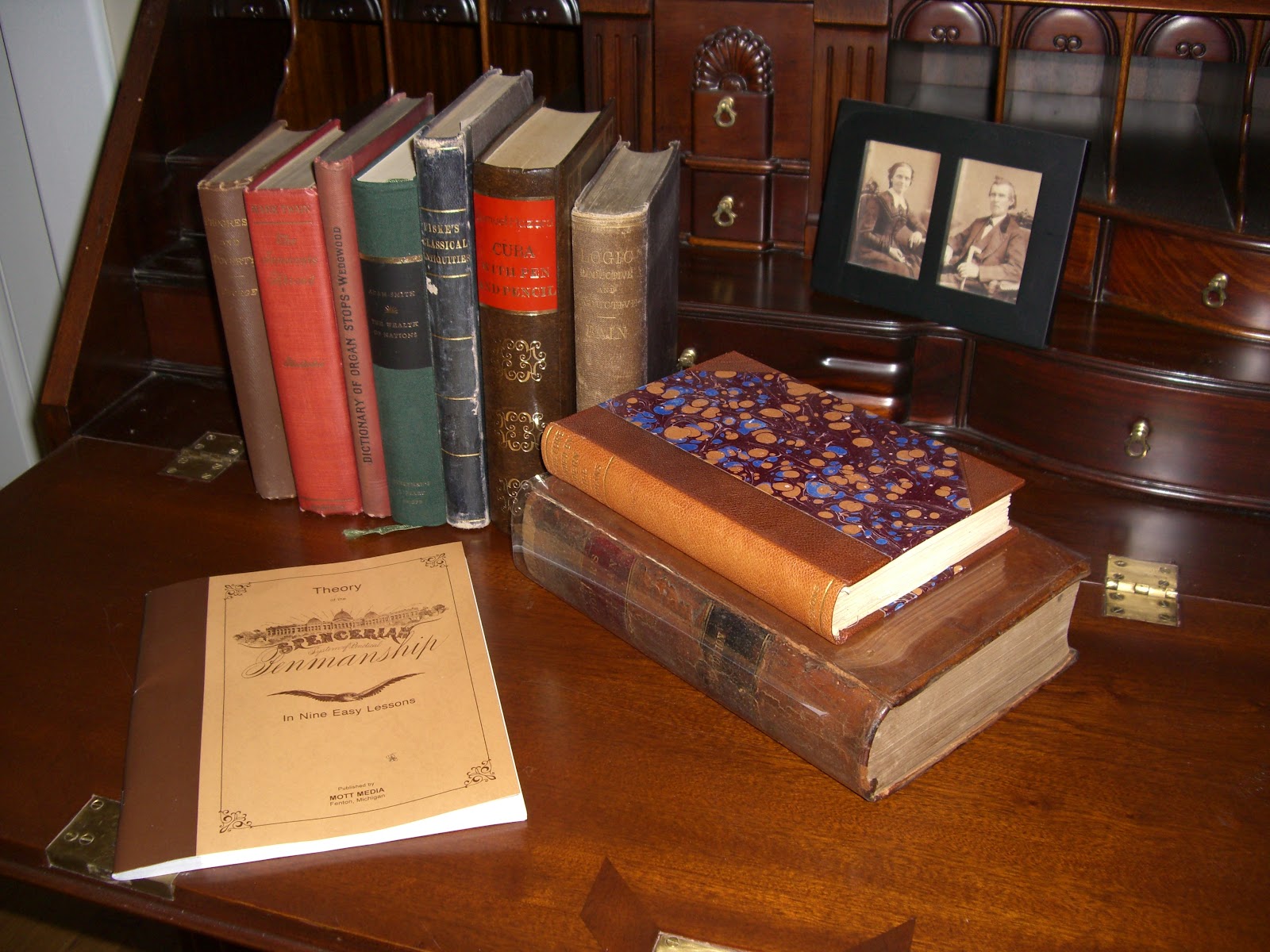
It was Isaac Werner's love for books, and his amazing personal library, that drew me to him, after all!


(Remember, you can click on images to enlarge.)

Thursday, October 3, 2013

Poultry Barn at the Fair


Breed:  Chinese Brown
As we entered the Poultry Barn at the Kansas State Fair, we were greeted with a cacophony of crowing, which seemed to be an ongoing competition among all the roosters in the barn, punctuated regularly with the honking of geese.  Once inside the barn, my husband's autumn allergies were immediately aggravated, so he found a chair outside, anticipating (erroneously) that my interest in the poultry would be brief.  When he called my cell phone to see if I wasn't about ready to end my visit, the noise in the barn was louder than the ringing of my phone, so I enjoyed a long, guilt-free exploration of the exhibits.   
 

Figure 1

The official greeter at the door was a beautiful goose, separated from his like on the other side of the barn.  I wasn't sure whether he was flattered to be displayed independently or disappointed by having none of his own kind nearby to impress.  (Figure 1)
 
A rooster caught my attention with his crowing, and I stood there with my camera, waiting to catch a picture of his cock-a-doodle-doing.  At last I gave up, but I back-tracked as I left the barn, in hopes I might catch him crowing again.  This photograph was the result.  (Figure 2)  I am particularly fond of this breed and wish I had carried pad and paper with me to write down the names of the breeds I admired.  Unfortunately, I had my hands full with purse and camera.  So, I am numbering the pictures I post, and if you know any of the breeds pictured, please supply them in a comment identified with the image number(s).
 
Figure 2 
The lovely couple below (Figure 3) was my favorite pair.  I took one shot of them, but they seemed disappointed by my failure to give them the opportunity to pose properly.  They took it upon themselves to arrange this far superior composition.  Someday, I may have to get out my pastels to draw this pair, but I will use my imagination to place them in a happier setting than a cage!  The second couple (Figure 4) is equally beautiful, but they were less obliging about positioning themselves artistically. 
Figure 4 


Figure 3
 
Figure 5
When I downloaded the photographs from the Poultry Barn, my bias toward black and white feather combinations was apparent, but this "cock-of-the-walk" was too colorful to ignore.  (Figure 5)
 
Nearby was another beautiful but less colorful feather combination.  I hope you take the time to click on this photograph to enlarge the image and enjoy the intricate patterns of this subtle beauty.  (Figure 6) 
Figure 6
 
Chickens ruled the Poultry Barn, but this goose won my heart.  (Figure 7)  Because I still love Nursery Rhymes and Fairy Tales, I naturally thought of these lines, with a slight alteration:  "Goosey, goosey gander, Whither shall I wander, Down a dozen aisles or two, 'Till at last I spotted you."  My apologies to Mother Goose!


Figure 7
Beside the goose by the entrance, this lonely turkey was also displayed.  (Figure 8)  One of my favorite authors is Barbara Kingsolver, and among her wonderful books is Animal, Vegetable, Miracle, in which she describes spending a year attempting to feed her family only with food they had grown themselves or that they had purchased locally.  I recommend the book, but the passage I recalled while photographing this turkey, whom only another turkey could think handsome, was Kingsolver's description of breeding her own flock.  Apparently there was no old turkey in her flock for the young Tom turkeys to observe and learn what the hens expected from them, and Kingsolver's description of handling that teaching experience had me laughing out loud!  Not many writers could turn turkey breeding into a multi-page comedy. 

Figure 8

As those of you who follow my blog regularly know, Isaac Werner raised chickens.  (See "Isaac Builds an Incubator," 8-22-2013 and "Isaac Raises Chicks with a Broody Hen," 8-29-2013.)  Doing research to determine which breed of chicken he might have been most likely to raise, I decided that the Barred Plymouth Rock was most likely.  I love the look of this breed, developed in New England in the 19th Century and very popular for small farms because it is cold tolerant and is both a good producer of eggs and meat.  It comes in several colors, but the barred black and white is the most popular, and this is the breed I assumed that Isaac would have had running around his farm. 
 
Barred Black & White
Don't forget to add a comment if you wish to help me identify the various breeds pictured in this blog, and if you are curious to learn more about the amazing variety among chicken breeds, there are many wonderful websites you might want to visit.  I posted the images small because I used so many, so you may want to click on the photographs to enlarge the images to see them better.

Thursday, August 23, 2012

Writer's Angst

Books whose titles were in Isaac's Library
Most days the craft of writing is incredibly satisfying, but one night I experienced a serious bout of writer's angst, lying in bed awake, with thoughts jabbing at me.  I announced with satisfaction several weeks ago that my manuscript was finished, but I continued to tighten and polish it, each edit making it better.
 
 
Not that the story need be long, but it will take a long while to make it short.  Henry David Thoreau 
 
 
I have been living with Isaac for about two and a half years.  The transcribing of his journal was a sort of courtship.  The research was a matter of meeting his friends and family, getting acquainted with his neighborhood, and familiarizing myself with the books, ideas, and goals that were important in his life.  There was no point in considering an engagement to Isaac until I had done these things.
 
 
Next to doing things that deserve to be written, nothing gets a man more credit, or gives him more pleasure than to write things that deserve to be read.  Lord Chesterfield 
 
 
I knew very quickly after the discovery of Isaac's journal that his was a story that should be told.  However, it was not until I reached the point in his journal when he began to write about farmers organizing to confront their problems politically that I saw the arc to his story.  What had been a struggling homesteader's diary became a history of the populist movement with Isaac at its center.
 
 
Close the door.  Write with no one looking over your shoulder.  Don't try to figure out what other people want to hear from you; figure out what you have to say.  It's the one and only thing you have to offer.  Barbara Kingsolver 
 
 
I begin every day reading aloud what I wrote the previous day before writing anything new.  I edit with a more objective eye and I fall back into the rhythm of my writing, and only then can I start a new writing day.
 
 
An essential element for good writing is a good ear.  One must listen to the sound of one's own prose.  Barbara Tuchman 


Isaac's journal
There is nothing like reading my work aloud to show me awkward passages or if I am being verbose or dull.  As I told someone once, if it bores you to read it aloud, why would you expect a stranger to find it worth reading?
 
...an author is one who can judge his own stuff's worth, without pity, and destroy most of it.  Colette 
 
By the time I finish a chapter, I have read it aloud to myself, deleting, rewriting, tweaking it in countless ways many times.  I then put it aside for several weeks to allow me to edit with a more objective eye.
 
Books aren't written, they're rewritten.  Including your own.  It is one of the hardest things to accept, especially after the seventh rewrite hasn't quite done it...  Michael Crichton 
 
Eventually, all the chapters were written, and the process of polishing and editing the manuscript as a whole began--was the tone consistent, were characters properly introduced when they appeared and identified as they reappeared, were recurring events threaded through the manuscript in such a way that a reader could recognize the sequence as it advanced the story, were there enough clues to orient a reader without being redundant?
 
Every sentence has a truth waiting at the end of it and the writer learns how to know it when he finally gets there.  Don DeLillo
 
I write at the computer, so when I edit, the old version disappears.  After completing a careful rewrite, which I see at that time as the best I can do, I print it.  I use colored paper clips to hold each chapter.  My first saved version of the manuscript was clipped with white paper clips.  My second version used red.  I have now gone through blue, green, pink and yellow.  The version I announced as finished used the yellow clips, the last color option in my box of paper clips.  The subsequent rewrites were not printed...not because I am out of colors but because I knew when I finished that they were not my last revisions.
 
The most valuable of all talents is that of never using two words when one will do.  Thomas Jefferson
 
I have realized that my night of angst was the result of knowing that, while I had been successful at tightening the manuscript, doing what Jefferson advocated, the manuscript was still too long.
 
I believe more in the scissors than I do in the pencil.  Truman Capote 
 
My sleeplessness just may have been the ghost of Truman Capote poking me with scissors.  Writers know to ask themselves, does this advance the story?  If it does not, it must be eliminated, regardless of how interesting or beautifully written it is.  Doing all of the research that I have, I discovered so many interesting things, but taking Truman Capote's advice, I have cut wonderful sections from the manuscript that did not seem necessary to advance the story.  In short, I may miss them, but I don't think an editor will.  Perhaps I will share those deleted stories in future blogs!

My therapist told me the way to achieve true inner peace is to finish what I start.  So far today, I have finished 2 bags of M&M's and a chocolate cake.  I feel better already.  Dave Barry

This time the manuscript really is "finished" and ready to be shown to others.  Isaac is about to make his debut--edited, polished, tweaked and slimmed down to make a good impression.  I'm not sure what color paper clip he will be wearing.