Showing posts with label dugout. Show all posts

Thursday, March 13, 2014

Isaac Claims a Homestead

"He could not breathe in a crowded place--
He wanted his air and his open space--
He watched while civilization neared on the path
through the wilderness..."
William B. Ruggles, "The Pioneer"

The pull westward for Isaac B. Werner had begun while he was still a teenager, and soon after his father died in 1865, Isaac left his father's rich Berks County, PA fields in the Lebanon Valley.  Leaving behind the picturesque Pennsylvania-Dutch community, Isaac and his older cousin Henry traveled first to Indiana, but the promise of the western frontier pulled Isaac onward to Illinois.  In Rossville, IL Isaac established a prosperous business as a druggist and later a milling partnership, but after a few years the gradual civilizing of Illinois reawakened a longing for "his air and his open space," and in 1878 he claimed his homestead and a timber claim on the Great Plains of Kansas.
Posters enticed settlers

Isaac was not some dandified small town druggist without calluses on his hands nor lacking farming experience in his background.  Experience in the milling business had added some agricultural knowledge to his youthful experience on his father's farm.  Yet, not even the Illinois prairie years had prepared Isaac for farming in Kansas.  Foremost was the limited rainfall, which caused crops that were lush and promising in the spring to wither and die in summer's heat and drought.  Next was the fierce wind, which propelled the blast-furnace heat into tender crops.  Fields of corn that had managed to receive the necessary rain and escape grasshoppers and chinch bugs often succumbed to the wind's gritty sand that shredded leaves and blew the essential pollen away before it could fertilize the waiting kernel, ruining the crop for both fodder and the development of the corn.  Add to that the sandy loam soil, and nature's trick of hiding patches of gumbo in unexpected places, and Isaac and other settlers faced unanticipated agricultural challenges.

Original 1933 Cover
 Isaac was not alone in his decision to leave the more settled parts of America and start fresh on the vast prairie lands which had previously been the domain of Native Americans and a few trappers and hunters.  Many American children have been introduced to the saga of Western expansionism through the "Little House" books of Laura Ingalls Wilder.  In Little House on the Prairie, Laura's family built their log house near what is now Independence, KS, having moved into Indian Territory in anticipation of the land being opened for settlement in the near future.  In Little House in the Woods the family returned to Wisconsin to settle on a pre-emption claim.  In Little Town on the Prairie, the Ingalls family moved to South Dakota where Laura's father finally claimed a homestead and they remained, participating in the growth of the town of DeSmet.

Replica homestead
Each of the Wilder's attempts to claim land relied on a different means.  Briefly, these are the three situations.  The Homestead Act of 1862 was signed by Abraham Lincoln, but it did not open all of the Western land for homesteading.  Some eager settlers moved onto land that was not yet opened and attempted to fulfill the requirements for homesteading--building a structure in which to live, making improvements to their property, and physically remaining on the property the required amount of time to mature their claim as if it were homestead.  If that land were subsequently opened for homesteading, they had a head start on other claimants, usually having claimed the most desirable, more fertile land by pre-emption, and they could remain.  Pre-emption could also apply to buying a claim and finishing the requirements started by someone else.  In the case of Indian Territory, those settlers were not always rewarded by their early settlement, as the case of the Oklahoma Land Rush and the term "Sooners" shows.  When the government made a new agreement with the Indians in Oklahoma, and that land was opened for homesteading, early settlers were not allowed to prove up the land they had settled and improved.  Instead, they had to return to the boundary and participate in the Land Rush with everyone else.  Those who hid and pretended to have "rushed" for the land they staked were called Sooners, (whether they were new settlers or preemption settlers trying to secure the land they had developed), given that name because they jumped the starters' guns the morning of the rush, taking advantage of getting to their claim sooner than those who began the rush at the designated starting places and time.

Stafford Co. Map 1885
Isaac came to southernmost Stafford County to stake his homestead in 1878 on land officially open for homesteading.  He built his residence, initially a dugout, and began making improvements by planting trees and breaking sod, and he remained on the land for the requisite 5 years necessary to prove up his claim.  In order to secure his patent, he took two neighbors before a local judge to swear with him that he had lived on the land for the required time and had made improvements.

According to the US Department of the Interior statistics, more than 270 million acres of public land, or about 10% of the land that made up the 48 contiguous states, was transferred to private ownership under the Homestead Acts.  Isaac claimed 160 acres, the maximum allowed under the Homestead law, and received his patent from the government, signed by President Grover Cleveland.

(Remember, you can enlarge the images by clicking on them.) 


Thursday, August 16, 2012

Earthen Prairie Homes

Isaac described the sandy loam soil of his claims as "light blow-sand," a description that would seem to indicate soil incapable of holding together in the rectangles of sod used to build homes or of supporting cave-like dugout walls and roof, yet these structures are well documented in his community.  It was obviously the mat of prairie grasses with their strong, dense roots that held the soil together for use in construction of the rude homes built by settlers.  The sod having been stripped from the soil long ago, we find it hard today to imagine the sturdy earthen structures of our ancestors.
 
 
When Isaac resumed writing in his diary in 1884, he had lived on the Kansas prairie for six years.  By then he had built a wooden house of two stories with a basement room and a cellar for storing his potatoes, grains, and garden produce like melons, turnips, and peanuts.  However, in his early years on the prairie he lived in dugouts.  His journal mentions two different dugouts, abandoned by 1884.
 
 
His wooden house was atypical among his nearest neighbors.  Brothers Will and Felix Goodwin living just to the south of him across the Stafford-Pratt County line lived in a dugout.  Will had a small dugout, and when Felix joined him in 1884, Isaac "staked off Will Goodwin's new residence" and commenced fitting on Will Goodwin's side boards...hanging door, making table..." and finally "set roof on Will Goodwin's new dugout," completing the larger dugout to accomodate both brothers.  In 1885 when Jesse Green's family moved to the claim just to the east of Isaac, they built a soddy, and Isaac went to Larned with Jesse to buy the Iron Board Roofing Paper to finish the soddy's roof.  That same year Isabel Ross staked her claim just east of Isaac's timber claim.  Isaac met with her to discuss building her soddy, but "so much advising and different architecture about, I glad to escape the job."  Tousley became her contractor, but Isaac worked on building her soddy, from top to bottom--staking the dimensions, making the door and window frames, shingling the roof, and digging her well.  George and Nancy Henn lived in a soddy just to the north of Isaac's timber claim, and Persis Vosburgh, another single woman whose homestead was just to the west of Isaac's claim, lived in a dugout. 
There were wooden houses in the community, but Isaac's closest neighbors, as well as many other early homesteaders who arrived on the treeless prairie, took advantage of the materials at hand to build their earthen homes. 

The images used in this post are from the collection of Old Stafford County Pictures at the Stafford County Historical and Genealogy Society, available on CD at the museum.

The Santa Fe Trail Center near Larned, Kansas, has recreated both a dugout and a sod house for visitors to experience what living in these prairie homes was like.  Visit the Santa Fe Trail Center on facebook or see http://www.santafetrailcenter.org/. 

Remember to click on the images for larger viewing.


Thursday, June 21, 2012

Isaac's Farm Implements

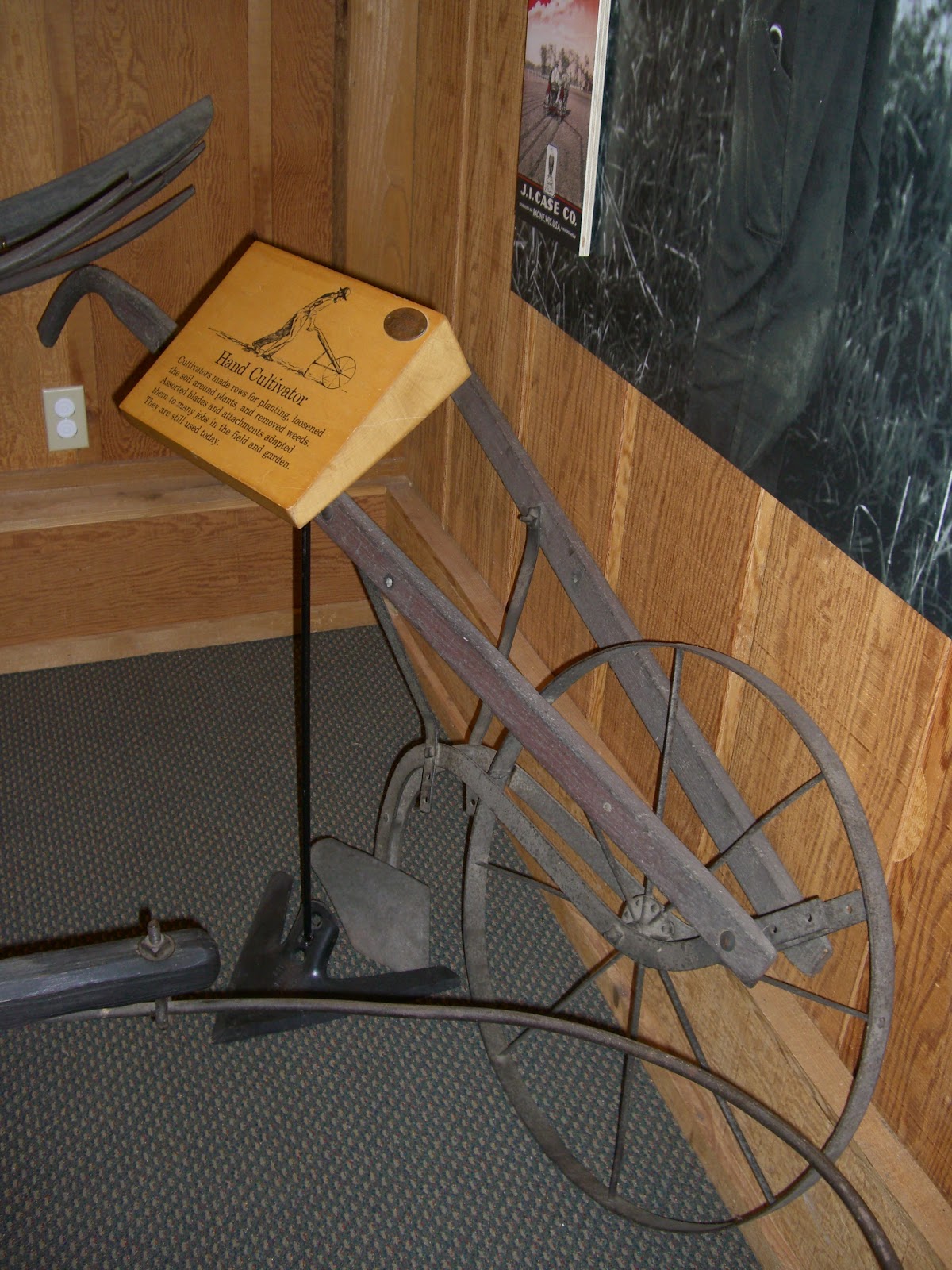
Our visit to the Homestead National Monument near Beatrice, Nebraska, allowed me to see some of the implements Isaac may have used, particularly those he used in the early years after his arrival in 1878 before he had a horse.  A walking cultivator is displayed at the Palmer-Epard Cabin which was moved from a nearby homestead.  The homes in Stafford County, Kansas, were not so grand, for there were no trees for wood and little adequate clay for bricks or chinking between timbers, so they made their early homes from sod.

Because the original settler had cleared the land for crops, when the National Park Service acquired the land on which the first homestead had been claimed under the Homestead Act, they had to recreate the vegetation of the original prairie.  Isaac probably did not find the same grasses on his prairie homestead in Kansas, the tall grasses less prevalent further south.  Even so, imagine trying to break the sod without a horse or oxen to help.  To maintain the healthy prairie environment, the Rangers burn one-third of the park acreage each year, emulating Nature's prairie fires.


Among the implements on exhibit is a hand cultivator with a plow blade, rather than the forked tongs in the picture at the top of this post.  When Isaac traded his own labor in order to have a neighbor break sod for him with their horses, mules or oxen pulling the plow, even the turned sod with ancient roots imbedded in the soil would have been extremely difficult for Isaac to cultivate by hand.  Yet, hand tools were all that Isaac and many settlers had available to use without horses of their own. 

Once the ground was prepared for planting, these farmers who were dependent on their own manual labor, like Isaac, used hand planters, the one pictured being a hand corn planter.  Isaac's journal is filled with detailed records of his experiments regarding how many kernels to plant in each hill, the best date for planting, how far apart to make the hills, the spacing for rows, and the importance of making straight rows to facilitate cultivation of the growing corn.

Not all of the corn was planted in plowed soil.  In the early years, Isaac and many others planted "sod corn," planting hills in the midst of the prairie grasses.  The yield was not particularly good, but they managed to raise enough to supply their own needs.  Today's combines not only cut the stalks but also separate the ears from the stalks and the kernals from the cobs.  Isaac did that by hand, making use of the stalks for fodder or using the dried stalks for fuel in his stove, along with twisted husks and the cobs, once the corn was removed.


These photographs offer some understanding of the hard, physical labor required to create farms on unbroken land, the stubborn grass roots resisting the plow.  Only 40% of the settlers staking their claims endured the hardships and labor required to prove up their land and receive a patent from the government.  It is easy to understand why so many did not survive the difficult task, some giving up their lives in trying, others just giving up.


http://www.nps.gov/home/planyourvisit/150th-anniversary-of-the-homestead-act.htm