Showing posts with label prairie fires. Show all posts

Thursday, November 5, 2015

Mowing on the Prairie

Recently I purchased a reproduction of the Asher & Adams Pictorial Album of American Industry, published originally in 1876 and reproduced in 1976.  Since Isaac B. Werner came to Kansas to stake his claims in 1878, the illustrations of "American Industry" in this book represent the state of equipment near the time of his arrival.

Two differences seem apparent to me.  First, the images in this book show state-of-the-art, top-of-the-line equipment.  Second, the publisher in 1876 was a New York state business, and the images depict buildings, equipment, and decorations more common in the settled eastern parts of America.

Isaac B. Werner was in no financial position to buy state-of-the-art, top-of-the-line equipment.  In fact, the images of mowers shown in this blog were far different from what Isaac used in 1878 when he began mowing the tough prairie hay.  He did not own a horse for eight years, and a 2-horse mower would have been quite a luxury.  He did his mowing by hand with a sythe.

Mowing was very important in those early years of settlement, not only for harvesting crops but also for defending against prairie fires.  Plowing fire breaks was very difficult because of the deep, stubborn roots, so instead, settlers mowed the prairie grass to reduce the risk of fire racing across the land, fueled by the tall, dry grass.

Until Isaac acquired his horse, Dolly Varden, he was dependent on neighbors keeping the grass mowed along the boundary of his claims.  The importance of having his own horse to mow for greater safety was as significant to Isaac as having a horse to use in his fields.  Raising crops was dependent on protecting them from fire just as it was on the weather, and while Isaac could do little about the weather, he could mow to minimize the risk of fires.

He wrote in his journal about mowing a path from his homestead to the Emerson school to avoid wet feet and legs when walking to the school through the grass to attend meetings.  He was not the only settler to do this, as a friend, Bob Moore, told me that his family oral history includes the story of his ancestor, who was a contemporary of Isaac, mowing from his claim all the way to Iuka to clear a path for more pleasant walking.

Let me know if you enjoy these images, and I will share more in the future.

Thursday, November 21, 2013

Prairie Fires

I will never forget the night my husband and I were driving back to my parents' farm from an evening in Macksville when we noticed a strange orange glow on the southern horizon.  My father knew at once what it was.  "Someone's place is on fire," he said, as he headed the car in the direction of the orange glow.  Although he drove as fast as possible on the dirt roads, by the time we arrived, others were there ahead of us.  Some were stretching hoses toward the burning barn of Leroy and Dutch, while others filled every container they could find with water from stock tanks and hydrants, slopping half of it out as they ran toward the blaze to throw what was left on the fire before running back for more.  It was quickly obvious that garden hoses and pails of water could not put out the roaring fire that had summoned everyone with flames reaching into the night sky.  Attention was turned to stopping the spread of the fire to other outbuildings and the house, and neighbors succeeded in doing that.  As I recall, the owners were away from home on vacation, and had neighbors not arrived to fight the fire, far more could have been lost.
 
Prairie Fire East of Isaac Werner's Land! 
The idea of neighbors joining together to fight a fire on someone else's property is as old as the settlement of the prairie.  Isaac wrote in his journal:  "Green & I helped fight fire on old George Henn's 1/4 section, got it finally subdued.  Some 18 men out and several teams, fire originating somewhere from new school house site, through some carelessness."  On the prairie there was no fire department to call.  Instead, neighbors depended on each other.  "Another reckless fire hot to drift down from N. of creek through Vosburghs pasture & burning over Persis two claims.  We--Harry [Bentley], F. Curtis, W. Goodwin & Gus [Gereke] over there plowing and back firing on W. side of Persis timber strip & finally got things safe."
Burned field in Background 
 
Isaac seemed to feel that both of those fires were the result of human carelessness.  In the early years, migrating settlers passing through and leaving embers from their campfires were a particular problem.  Occasionally the cause was a household source, as Isaac described of a close neighbor's fire:  "Yesterday [Jesse] Green's stable yard & roof of stable burned up, caught from stove pipe during noon."  Isaac was particularly critical of those who burned off pastures when conditions were too dry, or who thought a single rainfall had soaked dry grass adequately to allow safe burning nearby.  The arrival of railroads on the prairie was another source of fires caused by man, as sparks from the engines often ignited dry grass along the tracks.
 
Tracks through the Burned Field
However, prairie fires had occurred before the land was settled.  Lightning was the natural cause of those fires, and the population of the plains did not decrease that possibility, especially with so much unbroken prairie sod providing dry grass to ignite.  The reason there were no trees on the prairie when the settlers arrived was not because the land would not support the growth of trees, but rather because of fires that raced across the prairie, burning every sprouting tree whose seed had germinated in the prairie soil.   
 
Today there are local fire stations in rural communities and small towns to help put out fires, if they arrive in time and if the strong prairie winds aren't driving the flames along too rapidly to control.  Many farmers now burn stubble intentionally, a practice that frightens me just as the prairie fires frightened Isaac.  Most of the time the farmers only burn when the air is calm and equipment is standing by to control the spread of the flames, and the real danger often occurs when the fire appears to be out but hidden embers come alive later as winds pick up speed.  Fields left idle for conservation are also burned to minimize weeds and encourage new growth.
 
One evening my husband and I were returning home just after sunset, and a controlled burn lit the nearby horizon, a row of trees between us and the flames.  The dark silhouette of the trees in front of the orange and purple flames twisting and dancing skyward became the image for my manuscript's description of the real prairie fire Isaac watched as it traveled just to the west of my great grandfather Aaron Beck's homestead and timber claim

Thursday, June 21, 2012

Isaac's Farm Implements

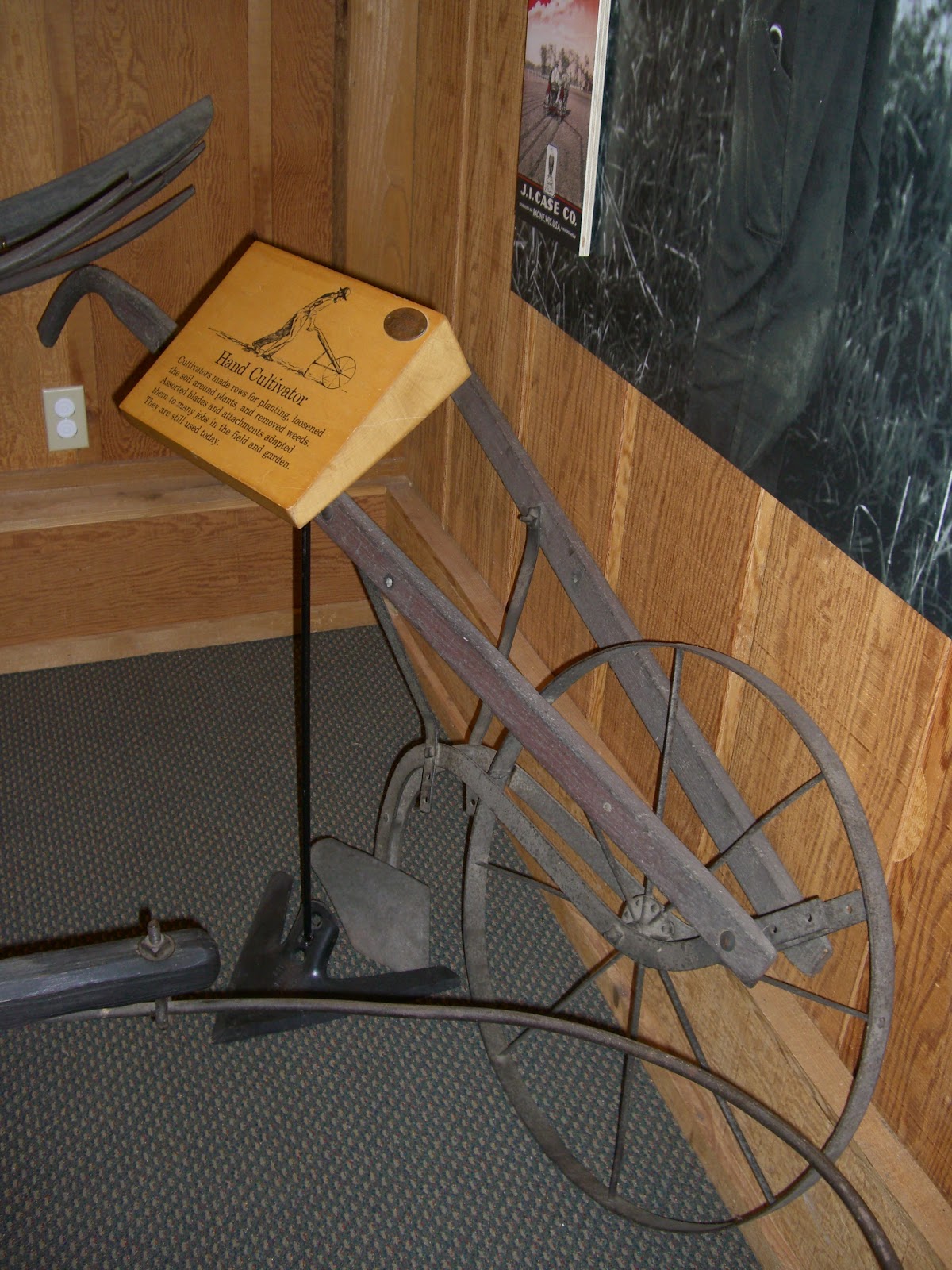
Our visit to the Homestead National Monument near Beatrice, Nebraska, allowed me to see some of the implements Isaac may have used, particularly those he used in the early years after his arrival in 1878 before he had a horse.  A walking cultivator is displayed at the Palmer-Epard Cabin which was moved from a nearby homestead.  The homes in Stafford County, Kansas, were not so grand, for there were no trees for wood and little adequate clay for bricks or chinking between timbers, so they made their early homes from sod.

Because the original settler had cleared the land for crops, when the National Park Service acquired the land on which the first homestead had been claimed under the Homestead Act, they had to recreate the vegetation of the original prairie.  Isaac probably did not find the same grasses on his prairie homestead in Kansas, the tall grasses less prevalent further south.  Even so, imagine trying to break the sod without a horse or oxen to help.  To maintain the healthy prairie environment, the Rangers burn one-third of the park acreage each year, emulating Nature's prairie fires.


Among the implements on exhibit is a hand cultivator with a plow blade, rather than the forked tongs in the picture at the top of this post.  When Isaac traded his own labor in order to have a neighbor break sod for him with their horses, mules or oxen pulling the plow, even the turned sod with ancient roots imbedded in the soil would have been extremely difficult for Isaac to cultivate by hand.  Yet, hand tools were all that Isaac and many settlers had available to use without horses of their own. 

Once the ground was prepared for planting, these farmers who were dependent on their own manual labor, like Isaac, used hand planters, the one pictured being a hand corn planter.  Isaac's journal is filled with detailed records of his experiments regarding how many kernels to plant in each hill, the best date for planting, how far apart to make the hills, the spacing for rows, and the importance of making straight rows to facilitate cultivation of the growing corn.

Not all of the corn was planted in plowed soil.  In the early years, Isaac and many others planted "sod corn," planting hills in the midst of the prairie grasses.  The yield was not particularly good, but they managed to raise enough to supply their own needs.  Today's combines not only cut the stalks but also separate the ears from the stalks and the kernals from the cobs.  Isaac did that by hand, making use of the stalks for fodder or using the dried stalks for fuel in his stove, along with twisted husks and the cobs, once the corn was removed.


These photographs offer some understanding of the hard, physical labor required to create farms on unbroken land, the stubborn grass roots resisting the plow.  Only 40% of the settlers staking their claims endured the hardships and labor required to prove up their land and receive a patent from the government.  It is easy to understand why so many did not survive the difficult task, some giving up their lives in trying, others just giving up.


http://www.nps.gov/home/planyourvisit/150th-anniversary-of-the-homestead-act.htm

Thursday, March 1, 2012

Sandhill Plums

When Isaac arrived on the Kansas prairie in 1878 the land was waving grass from horizon to horizon, with little else left to accentuate the scene because of the prairie fires that swept the land so often. There were exceptions. In the spring, wild flowers, whose tubers and seeds lay waiting, burst into bloom adding splashes of color amidst the swaying grass. At the same time, thickets of sand hill plum bushes opened their delicate white blossoms, offering hope to the settlers of fresh fruit to come, for somehow, enought of the thickets survived the flames to reproduce.

Today's plains dwellers cannot appreciate what a welcome sight those blooming bushes were to the early settlers, who longed for the taste of fresh fruit. Sand hill plums are hardly bigger than cranberries, and unlike cranberries, the fruit has a central seed nearly half the size of the plum itself, leaving very little edible fruit between the seed and the outer skin. Regardless, the settlers enjoyed the beauty and slight fragrance of the blossoms and crossed their fingers that frost would not return to freeze the blossoms and deprive them of that season's tart little plums.

Isaac had a thicket on his "Timber Hill" but he had also saved seeds from some of the best plums to plant plum bushes near his house, finding that it took the seeds two or three seasons to germinate. They were also difficult to transplant because the bushes colonize from one bush with a deep root to form shallow-rooted bushes around it. These shallow-rooted bushes are unlikely to survive if transplanted, and it is difficult to tell without digging which among the bushes is the one with the deep root. Isaac explained in his Journal: "I took up some select Plum bushes on timber hill and set them in rows N. of house patch, 2 rows E. & W. Transplanting Plums generally failures by many. I determined to experiment at least, then also transplant some in the spring."

Because of the effort he had expended in both planting seeds and transplanting the deep-rooted bushes, he was annoyed when one of his neighbors raided his plums. "Lady Frack yesterday out on a plum raid through my door yard of nicest plums, vengeance mine, by calling nearest neighbors in to strip every bush." Today, with farmers having cleared fields for crops, few plum thickets remain. On Isaac's old homestead only some scraggly bushes have managed to survive in the fence row.

As a bachelor, Isaac had learned to cook for himself, but he never mentions attempting to preserve fruit. It would be nice to imagine that one of the neighbors who stripped the plum bushes to spite Mrs. Frack might have made a jar of plum jelly for Isaac, but he only describes the annual pleasure of gorging on whatever fruit was in season.

For my family, enough jars of sand hill plum jelly were canned every summer to last through the year. They were stored with the canned tomatoes, green beans, and two kinds of pickles on rows of shelves in the basement, the walls a kaleidoscope of tomato red, green beans, mossy green dills, noxiously-tinted (with green cake coloring) 3-day lime pickles, and the glow of the scarlet plum jelly. I do not continue the tradition of canning vegetables, except rare years when I can the 3-day lime pickles, but I do make plum jelly. Last year's late frost and summer drought left only a lonesome plum here and there, and we are down to the last jar of the previous year's jelly. One day, I set that jar with one that we received as a wedding favor in the window to admire the beauty of sunlight through the jelly.

Plum jelly is delicious, but it is impossible for me to separate the flavor of childhood memories from the taste of the jelly. Plum bushes have thorns, and picking the plums is a prickly business. They ripen at the hottest time of year, and filling a pail of the small plums is an exercise in endurance of heat, sweat, gnats, and often, mosquitoes. Once in the kitchen, with the jars and the lids sterilized, and the plums rinsed clean with all the stems removed, the process of cooking, mashing the last bit of juice from the pulp and skins, straining through cheese cloth to assure the jewel-like appearance, adding the sugar and a bit of lemon with Sure-gel to give you a little more insurance that the jelly will set, pouring the hot, sticky liquid jelly into the jars, sealing the lids and listening for the "pop" to know the seal is good, and finally cleaning the stickiness off the jars before putting the jelly on the shelves--all of this is the stuff of my memories, and when you add to that the memories of sitting around so many breakfast tables with loved ones it is impossible for any store-bought, expensive gourmet jelly to ever taste as good!

When we finish that last jar of jelly, we, like Isaac, will be forced to await another season's crop from the tough and prickly sand hill plum bushes with their sweet-tart little plums.