Showing posts with label prairie. Show all posts

Thursday, May 16, 2013

Walking in Isaac's Steps

Pond from which I began my walk
Last spring one of the writers' websites I visit challenged readers to an Immersion Writing Contest, described as using a "participatory experience to write about yourself completing a reenactment."  I decided it would be fun to reenact Isaac's footsteps as he walked from his homestead to the home of Doc Dix, where the Emerson Post Office was maintained. 
 
Isaac's homestead was located in the southwest quarter of section 33, and as nearly as I can locate his house, it was near the center of the quarter.  Doc Dix owned the north half of section 31, his timber claim being in the east quarter and his homestead in the west quarter.  When I was a child, my father spoke of "the old Dix's place" as we drove past what appeared to be the remains of a home site located along the north side between the two Dix's claims.  The distance from the center of Isaac's homestead claim to the point on the north side between Doc Dix's two claims would have been about two miles.  I did not carry a camera during my reenactment, so the photographs accompaning this blog were taken in 2013; however, the description of my walk is my experience from 2012.
 
My husband dropped me off at the retention pond in the northeast corner of Isaac's homestead.  (Isaac makes no mention of any permanent pond on his claims, although he does mention ponds after rainfalls.)  My husband paused by the pond with me long enough to flip a turtle struggling on its back at the edge of the pond before leaving me to begin my reenactment of Isaac's walk to get his mail.  As I lingered to watch the wild ducks that Isaac had loved, a splash caught my attention too late to see its cause.  Soon, a bug-eyed frog surfaced to stare at me--the apparent cause of the splash.  A few of his buddies gradually emerged in the pond, reminding me of the "frog choruses" Isaac described in his journal.
 
Racoon tracks
As I turned to begin my walk, the smell of crushed rye along the path my husband had driven filled the air, alive with tiny yellow and white butterflies performing their aerial dance over growing wheat on one side and alfalfa on the other.  Bird songs from the trees near the pond were replaced by the buzz of insects, and  I wondered what birds serenaded Isaac on the treeless prairie before the cottonwoods, catalpa, and peach trees he planted began to grow.  Studying the raccoon tracks beside my own foot prints, I nearly missed the moment I had come to find, the feeling of Isaac tapping me on the shoulder to say, "Look around.  See why you are here."
 
I stood between Isaac's homestead and timber claims and slowly turned in a circle to see the land around me.  How proud Isaac must have felt to be master of the 360 acres he had claimed.  I saw the land through Isaac's eyes and understood his pride.
 
The 1/2 section line
But, I was on my way to Doc Dix's soddie after the mail, and I could not linger.  Soon I reached the black top road and left Isaac's land.  A farmer's daughter born and bred, I refused to cut across a neighboring field and trample knee-high wheat, although Isaac probably walked the diagonal route.  Instead, I walked the half-section line between two fields, straddling a wheat row to avoid bending the slender green stalks, perhaps not so different from walking across the tall prairie grass.  Midway across the field, the noise of a pickup on the backtop road behind me sounded alien, out of place, so immersed was I in Isaac's walk.  A large, deep badger hole beside my path made me hope my reenactment would not awaken the fierce nocturnal animal. 
 
Neglected tree row
 
I passed a mudhole, dried down to the mossy bottom and pocked-marked with deer tracks, while at my feet little red pyramids of anthills dotted the ground.  I paused to listen to the rustling sound of the wind as it ruffled the wheat that surrounded me. 
 
As I neared the center of the section, a tree belt planted in the 'Dirty Thirties,' decades after Isaac's death, obstructed my path.  The wind made a different sound--stronger and full of mystery, and dying branches bent to the ground, a tangled barricade.  The interruption broke the spell of my reenactment and chased Isaac from my imagination. 
 
My walk continued, but the destination changed toward my family home located in the south half of the section in which the Dix family had once resided to the north.  The changed world of abandoned claims, blacktop roads, irrigated fields, and neglected trees brought me back to the present, but for a while I had walked in Isaac's steps.
 
(Remember, you can enlarge the photographs by clicking on them.)


Thursday, June 21, 2012

Isaac's Farm Implements

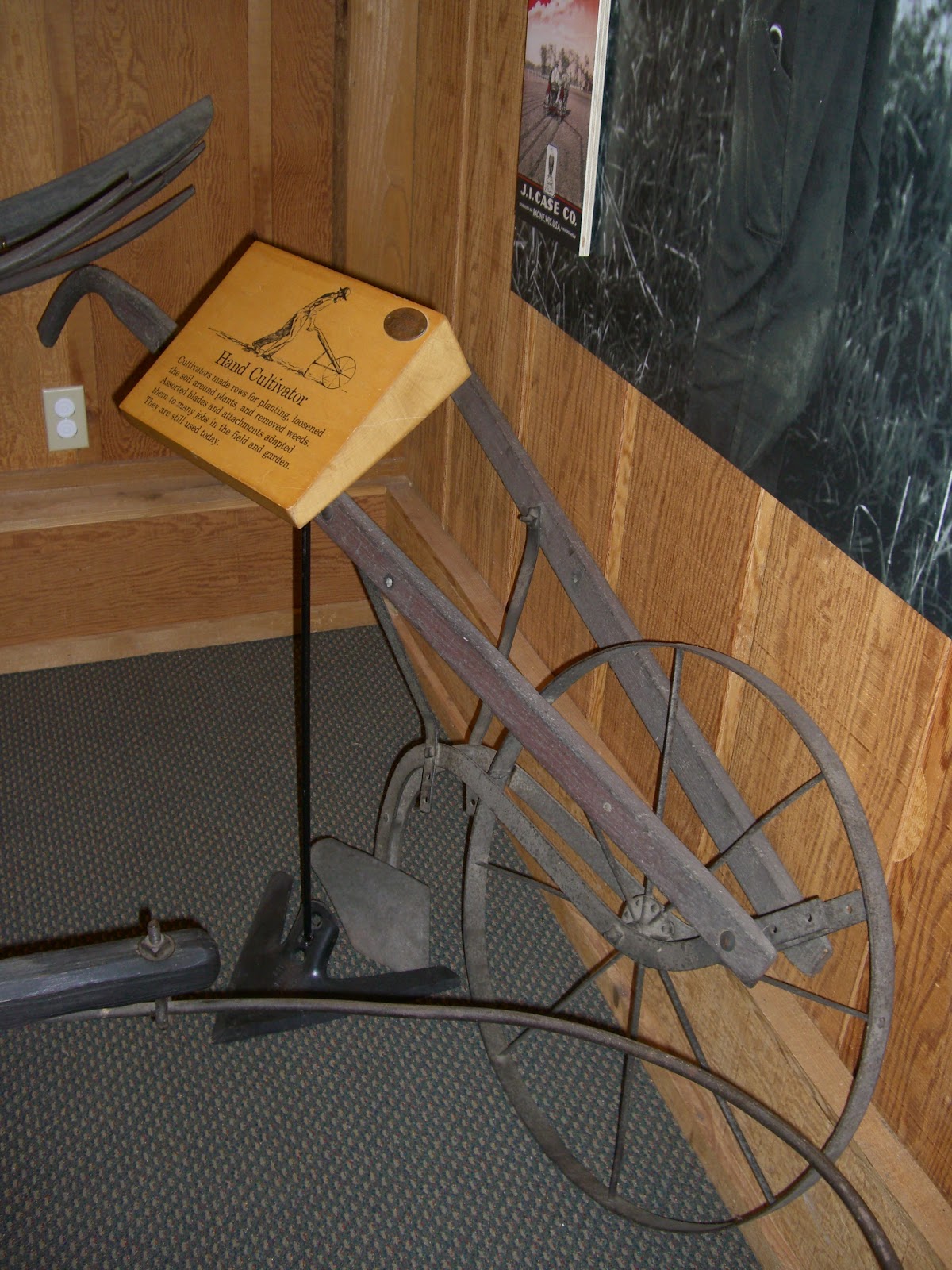
Our visit to the Homestead National Monument near Beatrice, Nebraska, allowed me to see some of the implements Isaac may have used, particularly those he used in the early years after his arrival in 1878 before he had a horse.  A walking cultivator is displayed at the Palmer-Epard Cabin which was moved from a nearby homestead.  The homes in Stafford County, Kansas, were not so grand, for there were no trees for wood and little adequate clay for bricks or chinking between timbers, so they made their early homes from sod.

Because the original settler had cleared the land for crops, when the National Park Service acquired the land on which the first homestead had been claimed under the Homestead Act, they had to recreate the vegetation of the original prairie.  Isaac probably did not find the same grasses on his prairie homestead in Kansas, the tall grasses less prevalent further south.  Even so, imagine trying to break the sod without a horse or oxen to help.  To maintain the healthy prairie environment, the Rangers burn one-third of the park acreage each year, emulating Nature's prairie fires.


Among the implements on exhibit is a hand cultivator with a plow blade, rather than the forked tongs in the picture at the top of this post.  When Isaac traded his own labor in order to have a neighbor break sod for him with their horses, mules or oxen pulling the plow, even the turned sod with ancient roots imbedded in the soil would have been extremely difficult for Isaac to cultivate by hand.  Yet, hand tools were all that Isaac and many settlers had available to use without horses of their own. 

Once the ground was prepared for planting, these farmers who were dependent on their own manual labor, like Isaac, used hand planters, the one pictured being a hand corn planter.  Isaac's journal is filled with detailed records of his experiments regarding how many kernels to plant in each hill, the best date for planting, how far apart to make the hills, the spacing for rows, and the importance of making straight rows to facilitate cultivation of the growing corn.

Not all of the corn was planted in plowed soil.  In the early years, Isaac and many others planted "sod corn," planting hills in the midst of the prairie grasses.  The yield was not particularly good, but they managed to raise enough to supply their own needs.  Today's combines not only cut the stalks but also separate the ears from the stalks and the kernals from the cobs.  Isaac did that by hand, making use of the stalks for fodder or using the dried stalks for fuel in his stove, along with twisted husks and the cobs, once the corn was removed.


These photographs offer some understanding of the hard, physical labor required to create farms on unbroken land, the stubborn grass roots resisting the plow.  Only 40% of the settlers staking their claims endured the hardships and labor required to prove up their land and receive a patent from the government.  It is easy to understand why so many did not survive the difficult task, some giving up their lives in trying, others just giving up.


http://www.nps.gov/home/planyourvisit/150th-anniversary-of-the-homestead-act.htm

Thursday, March 1, 2012

Sandhill Plums

When Isaac arrived on the Kansas prairie in 1878 the land was waving grass from horizon to horizon, with little else left to accentuate the scene because of the prairie fires that swept the land so often. There were exceptions. In the spring, wild flowers, whose tubers and seeds lay waiting, burst into bloom adding splashes of color amidst the swaying grass. At the same time, thickets of sand hill plum bushes opened their delicate white blossoms, offering hope to the settlers of fresh fruit to come, for somehow, enought of the thickets survived the flames to reproduce.

Today's plains dwellers cannot appreciate what a welcome sight those blooming bushes were to the early settlers, who longed for the taste of fresh fruit. Sand hill plums are hardly bigger than cranberries, and unlike cranberries, the fruit has a central seed nearly half the size of the plum itself, leaving very little edible fruit between the seed and the outer skin. Regardless, the settlers enjoyed the beauty and slight fragrance of the blossoms and crossed their fingers that frost would not return to freeze the blossoms and deprive them of that season's tart little plums.

Isaac had a thicket on his "Timber Hill" but he had also saved seeds from some of the best plums to plant plum bushes near his house, finding that it took the seeds two or three seasons to germinate. They were also difficult to transplant because the bushes colonize from one bush with a deep root to form shallow-rooted bushes around it. These shallow-rooted bushes are unlikely to survive if transplanted, and it is difficult to tell without digging which among the bushes is the one with the deep root. Isaac explained in his Journal: "I took up some select Plum bushes on timber hill and set them in rows N. of house patch, 2 rows E. & W. Transplanting Plums generally failures by many. I determined to experiment at least, then also transplant some in the spring."

Because of the effort he had expended in both planting seeds and transplanting the deep-rooted bushes, he was annoyed when one of his neighbors raided his plums. "Lady Frack yesterday out on a plum raid through my door yard of nicest plums, vengeance mine, by calling nearest neighbors in to strip every bush." Today, with farmers having cleared fields for crops, few plum thickets remain. On Isaac's old homestead only some scraggly bushes have managed to survive in the fence row.

As a bachelor, Isaac had learned to cook for himself, but he never mentions attempting to preserve fruit. It would be nice to imagine that one of the neighbors who stripped the plum bushes to spite Mrs. Frack might have made a jar of plum jelly for Isaac, but he only describes the annual pleasure of gorging on whatever fruit was in season.

For my family, enough jars of sand hill plum jelly were canned every summer to last through the year. They were stored with the canned tomatoes, green beans, and two kinds of pickles on rows of shelves in the basement, the walls a kaleidoscope of tomato red, green beans, mossy green dills, noxiously-tinted (with green cake coloring) 3-day lime pickles, and the glow of the scarlet plum jelly. I do not continue the tradition of canning vegetables, except rare years when I can the 3-day lime pickles, but I do make plum jelly. Last year's late frost and summer drought left only a lonesome plum here and there, and we are down to the last jar of the previous year's jelly. One day, I set that jar with one that we received as a wedding favor in the window to admire the beauty of sunlight through the jelly.

Plum jelly is delicious, but it is impossible for me to separate the flavor of childhood memories from the taste of the jelly. Plum bushes have thorns, and picking the plums is a prickly business. They ripen at the hottest time of year, and filling a pail of the small plums is an exercise in endurance of heat, sweat, gnats, and often, mosquitoes. Once in the kitchen, with the jars and the lids sterilized, and the plums rinsed clean with all the stems removed, the process of cooking, mashing the last bit of juice from the pulp and skins, straining through cheese cloth to assure the jewel-like appearance, adding the sugar and a bit of lemon with Sure-gel to give you a little more insurance that the jelly will set, pouring the hot, sticky liquid jelly into the jars, sealing the lids and listening for the "pop" to know the seal is good, and finally cleaning the stickiness off the jars before putting the jelly on the shelves--all of this is the stuff of my memories, and when you add to that the memories of sitting around so many breakfast tables with loved ones it is impossible for any store-bought, expensive gourmet jelly to ever taste as good!

When we finish that last jar of jelly, we, like Isaac, will be forced to await another season's crop from the tough and prickly sand hill plum bushes with their sweet-tart little plums.