Showing posts with label grain storage. Show all posts

Thursday, July 20, 2017

Sedimentary Formations


Natural Bridge near Sun City before demolition
Some of you who are long-time followers of this blog may remember the blogs about the Natural Bridge near Sun City, KS, and you may also remember the blogs about Isaac Werner's potato-selling trips to Sun City, during which he ruminated about the unusual terrain and rock formations.

The photograph at right clearly shows the layering of sedimentary rock in the Natural Bridge near Sun City taken prior to its destruction.  It also shows how water gradually cut an opening in the rock to create the bridge.

Photo credit:  Moondigger
Many beautiful formations can be found in the United States.  The picture at left, taken from below with the camera aimed skyward "Inside Lower Antelope Canyon" by Moondigger, shows the effect of erosion by wind and water that has exposed the elegant sculpturing of layers of sandstone.

In Southwestern Utah a more rugged example of Sedimentary Formations consisting of siltstones and limestones from the Middle Triassic Period illustrates another means of layering in sedimentary Formations.

Viewed by us but not my photograph
Others of you who follow the blog regularly will also remember my posting of photographs taken of Castle Rock and surrounding outcroppings in that area of northwestern Kansas.

My fascination with sedimentary formations caused me to see one particular circumstance in a geological manner, rather than observing it for what is actually was.

Castle Rock in Kansas
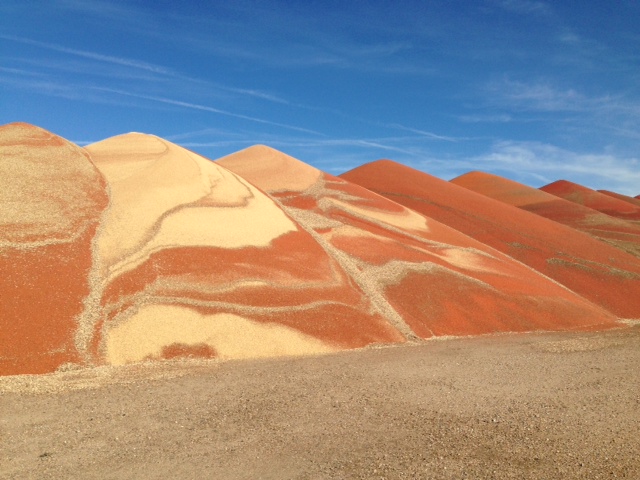
A Kansas "mountain range"
Use your imagination to picture the "mountain range" at right as a sedimentary formation, laid down layer by layer.  That is exactly what I did for a split second as we drove by a Kansas field.  Of course, what I saw was not a mountain range built up layer by layer over eons but rather piles of grain unloaded side-by-side by a Kansas farmer who must have found himself lacking granary storage space.

While it may not have been a mountain range, it was beautiful and offered an interesting comparison of how different materials deposited on top of each other over many eons created the sedimentary rock formations we see today in such places as those pictured above.

The photograph at right shows the grain auger used to transfer the grain from the truck that brought it to the site onto the cleared area on which the grain is being temporarily stored.

The last image shows more closely the layering resulting as the auger deposits the grain on the pile, truck load by truck load.

Beauty is all around us, and with a little imagination, what we see can transport us to imagined places--a wind-shaped canyon, a far-away desert, a distant planet!

Remember, you can enlarge the images by clicking on them.


Thursday, January 9, 2014

What do I do with my crop? (Storing Grain, Part II)


If you missed last week's blog, you may want to go to Part I of this story about grain storage on the prairie.  Otherwise, it may seem as if I am starting in the middle of the story!

This week I will continue with later structures for storing grains, starting with the wooden granaries sheathed in metal, like the structure pictured at the right.  Like my family granary pictured at the start of last week's blog, these old granaries usually had a cupola atop the ridge beam of the main structure to provide venting of the stored grain.  Heat can build up in the grain and ignite the dust and powdery chaff, and fires can start without proper venting.  Some of the larger cupolas, more like little houses, may contain lifts and a means to view the grain bins below.


In response to last week's blog, Jim Coburn posted a comment on face book, an excerpt from which he has given me permission to share on my blog.  He wrote, "I was working for the Preston [KS] Co-op at this time, and the wheat harvest was complete.  Steve Lewis instructed me to go to the...old tin elevator located between Highway 61 and the Rock Island railroad tracks.  I was to check the transfer of wheat from one bin to another.  This required my use of the weighted lift to get to the top.  Steve gave me an explicit warning to be sure and latch the lift before exiting at the bottom."

"...I momentarily forgot to set the latch on the lift.  That moment was just long enough that when I turned back to set the latch, the lift was just beginning its disastrous accent.  It gained speed as it hurtled toward the top.  And, of course, the offsetting weights were gaining speed as they hurtled toward the bottom.  The final outcome was a spectacle to behold.  The weights went crashing through the flooring into the basement compartment, leaving a gaping hole in the floor.  The lift hit the top, broke many things and then, it too came plunging down, leaving another even larger hole in the floor."

"The only thing that prevented Steve from killing me was relief that I hadn't ended up in the basement of the elevator with the lift and the weights.  ...  Actually, Steve Lewis was relieved that I was not injured."

Thank you, Jim, for sharing that exciting account of your dangerous misadventure.

There are still a few of these old metal-clad elevators left, and these two photographs are among my favorites.

More familiar are the mammoth concrete elevators with their white-painted surfaces visible for miles across the flat Kansas landscape.  The movie "Picnic," starring Kim Novak and William Holden, was filmed in Hutchinson, the location of the elevator pictured above right. 
In the mid-1900s the co-operatives that operated most of these elevators kept them sparkling white, usually with the name of the town written near the top of the elevator and often with a wheat or corn decoration painted on the side.  From a distance these sentinel towers loomed above the rooftops of small towns and larger cities, dominating the horizons.

Today, the white paint is graying and the images of grain decorating the sides of the elevators are fading.  The concrete monoliths are being replaced by more industrial-looking metal elevators--stocky silver turrets reflecting the sun.  At many Co-ops, the old and the new stand side-by-side.  As farms have grown larger, many farmers have built their own metal bins to avoid transporting grain to the elevators during the busy harvest season and to avoid paying rent for storage as they hold the grain awaiting a favorable market for their crops. 

In prosperous years, the abundance of grain harvested may exceed the storage capacity of the elevators and bins.  In that case, it becomes necessary to store the grain on the ground.
 
According to his estate inventory, at the time of Isaac Werner's death in 1895 he had 245 bushels of wheat stored in the wooden granary at his farm, which the administrator of Isaac's estate sold for $124.63, less the fee paid a neighbor to haul the grain to town.  In comparison, a grain truck today might easily carry 48,000 pounds or 900 bushels in one load.  Isaac would be impressed!

Thursday, January 2, 2014

What do I do with my crop? (Storing Grain, Part I)

Ask the typical city dweller to define elevator and he or she will probably say it is a conveyance to lift passengers to the top of tall buildings.  Ask a farmer, and he or she will explain it is a place to store grain.  However, granaries and elevators have changed a great deal since Isaac's time.

Isaac stored grain many different ways.  For example, he partitioned his hennery to use one side to store corn. You can see Isaac's design for a new hennery at "Isaac Raises Chicks with a Broody  Hen," 8-29-2013.  At one point, when all his other storage was full, he used the bed of his wagon for several days.  He also built a small wooden granary to hold his wheat and corn, but he definitely resorted to storing grains and other produce in his house as well.  On February 4, 1891, he wrote in his journal:  "...found it necessary for safety sake to place extra prop under 2d floor of my basement to avoid maybe an unexpected 2d rate funeral, too much seed corn & trash overhead."  I love his little joke with himself about the risk of his house falling in on top of him from the weight of too many barrels and sacks of grain.

Sacks and barrels were the common means of transporting and storing grain in early times, and the slow and labor intensive job of loading wagons and boats took days and weeks, not to mention much sweat and many aching backs.

The photograph at the top of this blog was taken in the early 1920s at my Grandfather Beck's farm.  My father is the boy on the horse, riding with his sister Merle and pulling his brother Arthur.  In the background is the granary.  Notice the cupola on the roof.  That granary, minus the cupola, remained on the farm until my father's death.

Although wooden granaries continued to be used, round metal grain bins gradually replaced them, offering more protection against rodents and weather.  When I paused to photograph the aging wooden and metal structures at right, standing side-by-side in a field, I found that the wooden building had a partition in the middle with no door between the two sides.  I concluded that it was used as a granary, especially because of the door in the gable end.  The two structures are an interesting example of a wooden granary standing side-by-side with the metal bin that replaced it.

Next week's blog will continue to share ways grain has been stored over the years.