Wednesday, July 20, 2022

The Legacy of the Neeland's Family


Neelands Cemetery has frequently been referenced in my blogs, so most readers are familiar with the story of how a worker at the Neelands Ranch was buried in a pasture, and the Neelands family donated the surrounding three acres to be used as a cemetery.  Those of you who have read "Prairie Bachelor" are familiar with the description of the cemetery that appeared not only in the opening pages related to Isaac's funeral, but also as the location of other funerals mentioned in the book.

In a time when air conditioning was unimagined, Neelands Grove was the closest thing to a cool place for gatherings.  Near the end of the book, I describe the Grove for two reunions, held on consecutive days--first a reunion of early settlers to the area, and the following a reunion of old soldiers.  As I have shared before, there were many Civil War soldiers who took advantage of applying their years of service during the War toward the years required to prove up a homestead claim.  I have used my great-grandfather, Aaron Beck, who served the Union for three years, as one of those settlers who applied those three years toward the five years required to prove up his homestead claim, reducing his time before applying for his land title to only two years.  In "Prairie Bachelor" I describe the "nearly eighty veterans attending the reunion" including Will Campbell, George Henn, and several other men who wore the Union Blue.

Recently, however, a friend shared a copy of a newspaper article describing the founding of Neelands Chapel located in Neeland's Grove on land donated by James Neeland.  The article was filled with names of many early settlers, including the Charles N. Waters family, who had been friends of the Neelands family in Missouri and had come to Kansas in the fall of 1877 after an invitation from James Neeland to join him in Kansas.  They had a mutual interest in building a church, and the first location considered was near the Livingston School, with a second option of Neeland's grove, which was offered without cost.  The Neeland's grove location was accepted and fundraising for the structure began.

Neeland's grove was an old timber claim, and as the trees grew, so did the popularity of the grove for gatherings, including revivals before the church had been built.  The fast-growing cottonwoods made a welcome shady location for large gatherings, recorded as being from 2,000 to 6,000 people.  Revivals, picnics, reunions, and political rallies are some of the events eager for gathering places during that time.

On November 18, 1904, the speaker was chosen to dedicate the church, upon its completion, and the choice was "Elder Beck."  None of my research reflects membership of my grandfather Royal D. Beck in that church, although he was a Methodist and in later years the family was active in the Byers Methodist Church, which was originally the Naron Church.  The actual dedication of the church in Neeland's Grove took place on December 13, 1904.

The church prospered until 1950, and it was first given to the Methodist Conference, after which the church was torn down for its lumber used in building the Iuka Methodist Church when their new brick building was framed.

Some of the ancient cotton wood trees survive, and Neelands Cemetery continues in use today.

Neeland's Stone surrounded by many of his friends
Photo credit:  Lyn Fenwick


Wednesday, July 13, 2022

Memories & Discoveries

When I was a little girl, there was a particular couple that became a part of my childhood memories.  They lived just across the section from my home, our house being on the Southeast Quarter of the Section, and their home being in the Southwest Quarter.  The land they farmed belonged to a family named Kennedy, and my father and Lester Kennedy had been best buddies growing up, but the Kennedys had moved to Western Kansas, leaving the farming of their old home to a tenant farmer named Glen DeGarmo and his wife Oma.  The couple were significantly older than my parents, but our families were very close.  In fact, they are the only "babysitters" I remember from my childhood.

Looking West toward Glen & Oma's home, Credit Lyn Fenwick

I have many memories of Glen and Oma--the Thanksgiving our families spent together when a snowstorm blocked the roads and their guests could not reach their farm as planned and my family could not go to my aunt's house for the holiday as intended.  My father used the tractor and feed wagon to get us across the fields to the DeGarmo's house where we pooled what we had to make a Thanksgiving feast.  I also remember the evening Glen scooped up sand from the driveway into a box that he brought into the house so I could continue playing with my toy cars and trucks inside when it became dark outside.  There was also their upstairs mirrored wardrobe that actually held a bed.  Once, when their grandkids visited and the hinged bed had been lowered like a Murphy bed for their guests, we kids discovered that by crawling under the bed we could make faces in the mirror above us.   Another special memory is that my childhood playhouse was a repurposed henhouse moved from the Kennedy place after my father bought that land.  The only bad memory I have of visiting Glen and Oma is of the outhouse.  They had water into the kitchen, but they had no indoor bathroom, and I hatted having to use the outdoor "John."

One Sunday morning when I was ten years old, my father and I went to church alone, my brother being away at college for his first year and my mother staying home for some reason I have forgotten.  As we turned on the county line road, which Glen and Oma would also have driven to go to church, my father commented:  "Glen and Oma are late getting off to church this morning too."  There had been a light sprinkle during the night, and my father had seen that there were no tire tracks which Glen's vehicle should have made by now.  I was sitting in Bible class later that morning  when someone came in to get me, saying,  "Your father asked me to take you home today," and although it was confusing to me, I did as I was told.  In fact, news had reached the church that Glen had died, and my father had left immediately to see how he could help.    

Photo credit:  Lyn Fenwick
Isaac's stone in foreground; DeGarmo stone far right edge of picture

My father ended up buying that land from the Kennedys and he farmed it for the rest of his life.  My last memory of Oma was a visit in Western Kansas, where she had lived after Glen's death.  That visit  must have been not too long before she died in 1970.

Decades later, when I was doing the research for Prairie Bachelor, The Story of a Kansas Homesteader and the Populist Movement, I was researching the settlement of Isaac's estate.  Imagine how surprised I was to discover that Isaac's farm had been purchased by a man named Jacob DeGarmo.  Jacob and his wife Adeline had a large family, and it included a son named Archie Glen DeGarmo, who was born in 1886 before the family had come to the Macksville community.  However, by May 29, 1895, I documented that Glen was 8 years old, living with his family in Albano Township, and he was still there at the turn of the century.  He married Oma in St. John, where her family lived, on January 14, 1914.  In summary, my childhood friend lived in Isaac Werner's home most of his childhood and adolescence.  

Gravestone of Glen & Oma, Photo credit:  Lyn Fenwick

Recently, while doing some research about Neelands Cemetery, where Isaac is buried, I discovered that Glen and Oma are also buried there.  My husband and I made a visit, and I was surprised to discover that Glen and Oma are buried only a few steps away from Isaac.  Somehow, I find that comforting.    


Wednesday, July 6, 2022

Pausing to Remember the Past

Photo credit Lyn Fenwick

 When we received the message from David Werner explaining that he and his wife were hoping to drive from Wernersville, PA to South Central Kansas to visit Isaac Werner's grave and to see the Journal, as well as anything else of interest in relation to Isaac, I was pleased...and then worried.  The two things he mentioned were certainly available, but what else was there to show them?  Nearly all of the structures from Isaac's time are gone, and even the land Isaac claimed has changed.  What is there to see?

As it turned out, there was a lot to see, and this blog is not only about our visit from Isaac's cousins but is really about the things around us that we no longer give our attention--that we fail to share with our children and grandchildren.  While the things available to share are not exactly like they were when our ancestors lived, there are still things to see and stories to share.  That is what this week's blog is about.

Photo credit Larry Fenwick


The picture above of David  Werner, Isaac's 1st cousin 3 times removed, having slipped back to take one more picture of Isaac's grave, particularly touched me.  As did the light touch on the corners of Isaac's stone by each of the cousins--LaRita, David, and Cynthia--as the group gathered around for a photograph.  (Also in the picture is Deann Werner.)  The emotions for this once forgotten bachelor cousin were real.  

I walked them around the quiet country cemetery, pointing out the graves of friends of Isaac, many of whom are mentioned in Prairie Bachelor, and I directed their attention to the number of settlers whose stones displayed their military service in the Civil War.  Particularly emotional were the many stones of infants and young children.

We drove around Isaac's timber claim and homestead, although both are changed by cultivation for more than a century.  The second day we returned, first for a farewell to Isaac and then for a tour of his community.  As we drove through the community, I read brief excerpts from Prairie Bachelor, connected with the particular locations where we paused, such as the land where Isaac stayed with neighbors in his final days, the locations of the country post offices, the location of the home of the young man who visited Isaac every day until Isaac could no longer remain in his home--sharing details at each pause related to each of his neighbors in some way.  They couldn't believe how far he walked in his community for visits, jobs, and other reasons.

They discovered their own surprises--how sandy the soil was, how pretty the wild flowers were, how many animals they saw on the country roads, how the cottonwood trees had looked like a snowfall had covered the bark, and because of the blackened trees from a recent fire in our community that burned many acres, how frightening prairie fires must have been in Isaac's time.

Lyn, Dave & LaRita: Photo credit Larry Fenwick
We visited both the Lucille Hall Museum in St. John and the County Museum in Stafford, which Michael Hathaway generously interrupted his weekend to share with us.  It was a particular treat to see both where Isaac's Journal was found and to see the actual "County Capital" newspapers where I did so much of my research for Prairie Bachelor.

Although I had worried that there would be too little to show them, that was never the case.  Of course, I have written this blog to share their visit with you, but I hope that it may encourage you to consider your own family tour, whether to see sights specifically relevant to your family or just to explore the community that we sometimes take for granted.

I will close with a final photograph that perhaps best displays the joy of connection with roots from the past.  I had covered the dining room table with examples of my research, and added to the display was an incredible research collection compiled by Cynthia McClanahan Cruz, tracing the Direct Descendants of Henry and Magdalena Meyer Werner, (Isaac's grandparents), genealogy that stretched back to the generation that connected all of the guests to one another.  Among these items placed on the table to be explored was Isaac's Journal.  I will close with the picture that seems to say it all. 


Photo credit Larry Fenwick

Without Isaac Werner's daily entries in this 480 page oversized journal, there would never have been a Prairie Bachelor, The Story of a Kansas Homesteader and the Populist Movement.  Many of you who had never heard of the Populist Movement in which Kansas and other states played such a significant  role, might never have known about it, its influence today, and the roots of Populism and Progressivism.  For many readers of the book, they now understand the challenges their own ancestors faced during that time.  Today, Kansas is sometimes referred to as a "flyover state," but those who know its full history know better!


Wednesday, June 29, 2022

Isaac meets his cousins

James Werner, Photo credit:  Larry Fenwick
When my husband and I packed for a Willa Cather Conference at Smith College in Massachusetts, we had no intention of doing any more than attending the conference and visiting some of the places we remembered from the time my husband was stationed at the air base nearby.  However, rather than returning straight home, we began to travel down the east coast, making spontaneous stops at historic locations.  Our wandering took us as far as Gettysburg, and that was probably when I began to suggest that we travel to Wernersville, Pennsylvania.  

I had already transcribed Isaac Werner's journal and had done quite a bit of  my research, but we had left for the Cather Conference with no intention of its being anything other than a holiday.  The spontaneous side trips had not taken us too far out of our way, but they had delayed our return home.  My suggestion to visit Wernersville would add both miles and more days away from home to our trip.  Yet, it seemed a shame to be so close to the town Isaac's father had founded and not visit it.  I had brought none of my research with me, but at least I could see the present-day town and perhaps visit the cemetery where members of Isaac's family were buried.  I convinced my husband to go out of our way to visit Wernersville. 

My lack of professional preparation for doing research was embarrassing when we reached Wernersville with only the research I had in my memory, but I was rewarded with far more information than I deserved, and one of those rewards was meeting James Werner, to whom I was introduced because we wandered into Hains Church after visiting the church cemetery.  I had asked if any Werners were members of the church, and that is how I was introduced to James, who interrupted his day to come to the church to share much of his family history as a descendant of Isaac Werner's favorite uncle.

In my files I have a letter dated July 5, 2012, in which I tell James "The manuscript is completed, and I am at the point of preparing submissions to publishers."  My expectations for quickly finding a publisher were overly optimistic!  My previous books had been published quickly, but as most of you reading this blog know, Prairie Bachelor was finally released in late December of 2020, twelve years after I first saw the journal and began my work toward telling Isaac's story!  I was determined to write history accurately but in a style that would read like a novel.  Academics already know about the Populist Movement, but most Americans do not know about the most successful Third Party in our history, and I wanted to share that important past with general readers through Isaac Werner and his community.  Finding a publisher willing to do that proved challenging.  I am proud that Prairie Bachelor, The Story of a Kansas Homesteader & the Populist Movement was honored as a 2021 Kansas Notable Book.      

I stayed in touch with James off and on during those years, and when FHSU hosted a virtual book launch in December 2020, the James Werner family was well represented among the many supporters who attended. Many of those who attended the book launch had never attempted virtual gatherings, although many of us learned during the covid pandemic.  Yet, people across America, and even from as far as Ukraine, learned the technology in order to attend.  The picture at left is of James and his wife Emily gifting Prairie Bachelor to the Hains Church.  They also gifted the book to the town library, the school library, and the Heidelberg Heritage Society.  Tentative invitations for me to speak have been postponed by covid.

James and Emily do not look their age, but they have begun to limit distant travel, and it is a long drive  from Pennsylvania to Kansas.  However, for younger members of the family, such a trip was not out of the question.  This past weekend we hosted David & his wife Deann Werner, as well as Cynthia Cruz and LaRita McNeely, whose ancestors were brothers of Isaac's father, making them first cousins to Isaac, three times removed.

The truth is that Isaac Werner was a forgotten man, but he is forgotten no more.  It was surprisingly emotional for all of us to visit Isaac's grave in Neelands Cemetery, not only to see Isaac's stone but also many of the other early settlers buried there, several of whom are mentioned in Prairie Bachelor.  I open Prairie Bachelor by quoting Walt Whitman's poem and close the book with a reference back to that poem, asking,  "Will someone when I am dead and gone write my life?" I conclude by answering Whitman's question with, "Someone has."  

By using Isaac's life to tell the true story of the Populist Movement--the struggles that led farmers, ranchers, miners, and small town merchants to form a political party, the successful achievements of the People's Party, and the eventual decline of the party--a pattern very much like Isaac's own life--my book has brought awareness of this historic movement to so many people, a political movement that changed the two older parties and continues to influence politics today. Now, not only Isaac's relatives know who he is, but also people across the nation--and even beyond.  Isaac's story attracted readers who would never have read a scholarly book about political history, but today they recognize the significance of Populists and Progressives that began with farmers like Isaac and that continues to impact politics today. 

Gifting "Prairie Bachelor" to Heidelberg Heritage Society


Wednesday, June 22, 2022

It's a Small World

 When I was a young girl, I thought my father must know more people than anyone in the world.  I would meet someone from another school and mention my new acquaintance to my father, and he would proceed to tell me who my new friend's parents were, and sometimes who the grandparents were.  Of course, his wide acquaintances were primarily in the half-a-dozen counties where he had been raised.

This blog is really about those serendipitous meetings where you are someplace far from home and you meet someone you know, or you meet someone new and discover you have a very close connection.  For example, when we attended the Montreal World's Fair of 1967, we ran into a man my husband had played basketball against in high school.

During my husband's tour of duty in South East Asia, he was playing pool in the officers club and heard someone call out his name, using his high school nick name.  It was an acquaintance from a neighboring Kansas town whom, my husband discovered, was also an Air Force Officer.  Although they hadn't seen each other for several years, they had a nice visit half way around the world.


In the early 2000s we took our mothers to England for a holiday, and while having lunch in an English castle my husband spotted the parents of one of our best friends having lunch in the same castle dining room, and we stopped by to say hello..

This story, however, is a little different, since the person I met was a stranger.  We were attending an art exibition in Oklahoma, and I wandered into an ongoing conversation with one of the artists exhibiting her work.  The Filley Art Museum in Pratt, Kansas was mentioned, and the artist acknowledged having some familiarity with that area.  As I joined the conversation, the artist asked if I grew up in Pratt, and I replied that I had grown up in the small community of Byers, adding "which you have probably never heard of."  She replied, "Oh, yes, I know Byers.  My Aunt Gloria went to school there."  "Gloria Martin?" I asked, never imagining it might be someone I knew.  "Yes," she replied excitedly.  "That's my Aunt!"

Painting by Sonya Terpening

As a result of pure serendipity I had a delightful conversation with Sonya Terpening, an artist who began studying with professional artists in junior high school, who received her degree in art from Oklahoma State University, and who was awarded the Distinguished Alumni Award from that university in 2020.  However, her recognition as an artist goes well beyond Oklahoma, and even well beyond Texas, where she now lives.  She and her work have been featured in such important magazines as Art of the West, Western Art Collector, and Southwest Art.  Her deep feeling for the West, which is the frequent subject of her paintings, is beautifully expressed in her own words:  "Living in Oklahoma or Texas is living with the fable of the West, both states are so rich in history." (More of her work can be seen online.)

What a treat for me it was to meet Sonya Terpening, and what proof that "It's a Small World" that I wandered into a conversation, mentioned my small childhood community, and unexpectedly had a pleasant chat with an artist whose work we had admired as we wandered through the exhibit earlier.  Serendipity can shrink the world and produce delightful surprises!   

Wednesday, June 15, 2022

What Else May You Be Missing in Kingman?

In previous blogs I have mentioned outdoor mural art and indoor post office art, from both of which history can be learned.  Kingman, Kansas offers both examples.  In a previous blog I featured the two murals by Stan Herd on the north outside wall of the Main Street Kingman County Historical Museum.

Just across the street from the Museum is the Kingman Post Office.  Kingman is one of those lucky towns whose post office contains art commissioned by the U.S. Treasury Department Section of Painting and Sculpture.  Kingman's painting, "In the Days of the Cattlemen's Picnic," was done in tempera by Jessie S. Wilbur.

Because I have already posted a blog about the commissioning by the U.S. Treasury Department Section of Painting and Sculpture during the 1940s, I will mention that only to date Jessie Wilbur's painting as being done in 1942.  At that time, she would have been 30 years old and would have completed her study of art at Colorado State Teachers College.

Initially, she became interested in cubism, which held her interest for many years, but later she became interested in impressionism.  However, it was as a printmaker that she became best known.  None of these styles dominate her painting in the Kingman Post Office, but her inclination toward a more modern style of painting can be seen.

She did not rely entirely on her paintings for income but rather taught at Colorada State for a few years before going to Montana State College in Bozeman, Montana, where she also taught courses at the Archie Bray Foundation in Helena, Montana.  

Many examples of her public art may still be seen. Some of her art is on permanent display in the Jessie Willber Gallery at the Beall Park Art Center in Bozeman.

The next time you travel through Kingman, Kansas, you just may want to visit the Post Office.


Wednesday, June 8, 2022

More Praying Mantids to Share

Credit: Lyn Fewick  Praying mantid turns to greet me!


I was so excited to see an article in the newspaper from the K-State entomologist about Praying mantids.  Those of you who follow my blog know that I am fascinated by them.  The article described how to ensure a garden has a few praying mantid guardians by carefully removing a discovered egg case and putting it in a glass jar with a lid that has at least 10 small air holes.  The instructions said to keep the egg case in the house with warm temperatures and wait 4-6 weeks for eggs to hatch.  The instructions included the alternative of keeping the jar in the refrigerator to delay hatching and then removing it when you want it to hatch, which will take 1 or 2 months after removing it from the refrigerator.

Credit:  Lyn Fenwick     Admiring his shadow


Frankly, I have much more confidence in Mother Nature to help with the hatching than in myself getting involved.  If I got something wrong, I would feel very guilty.  The need to make sure the nymphs were not released to freezing temperatures, which would be fatal, convinced me that I needed to stay out of the praying mantis mothering and leave it up to nature.

Of course, if a building to which the mantid mother had attached her eggs was being torn down, or I spotted a branch or stem in the burn pile about to be set ablaze, that would be different.  In such emergency rescue cases, even I might be willing to take the chance of hatching the nymphs, whose eggs case appears like a hardened piece of Styrofoam stuck on branches, walls, fences and sides of houses.  Perhaps a school science class might be entrusted with the responsibility, and more specific instructions could be obtained from Kansas State Department of Horticulture and Natural Resources.

Credit:  Lyn Fenwick   Discarded shell


As for myself, I will continue to keep my eyes open for praying mantid hiding in leaf rubble, where I once spotted one, or hatching on the side of our house.  I watched in amazement as it slowly escaped from the case it had outgrown.  Several weeks later that year, my husband and I were sitting on the porch when a praying mantid joined us.  He showed no signs of fright and lingered with us to enjoy the afternoon before finally disappearing.  It didn't take too much imagination for me to believe it might have been the praying mantid I watched shedding his case earlier in the spring. 

Credit:  Lyn Fenwick     Escaping outgrown case 


They are beneficial in gardens, eating "anything they can grab onto with their raptorial front legs," according to K-State entomologist Raymond Cloyd.  That includes flies, of which we had so many last spring and summer, and crickets, months, wasps, and caterpillars.  Unfortunately, it also includes butterflies, but if they are on their toes, those butterflies can escape into the sky!

Be on the lookout for these interesting insects, which are described as "a beneficial to a home garden."  

Wednesday, June 1, 2022

Buffalo Bill Cody and Hays

William F. (Buffalo Bill) Cody
Photo Credit:  Lyn Fenwick


The picture above shows the image of William F. Cody, also known as 'Buffalo Bill,' outside the Hays Library.  Buffalo Bill is nearly legendary in Hays, Kansas, his exploits familiar to local people.

Photo Credit:  Lyn Fenwick
Beneath the bust of Cody his importance to the city of Hays is described, explaining how he co-founded the town that was the predecessor of Hays, with a man named William Rose in 1867.

Cody was in the area because in 1867 he was employed by the Kansas Pacific Railroad, his job being to hunt buffalo to feed the railroad work crews.  The following year, 1868, Cody served as a scout and guide in the U.S. Army.  These assignments were often dangerous, and he was awarded a Medal of Honor.  His celebrity made him well-known, and he was featured in the popular dime novels of that era.

In his time, he was seen as a hero--brave, handsome, charismatic.  Yet today we often judge our heroes with hindsight.  His reputation was gained by the displacement, if not actual slaughter, of indigenous people and animals.  Indians saw the arrival of trains, and the people inside those trains, as a threat to their way of life--and they were correct.  While Cody killed the buffalo to feed railroad workers, he also killed for sport, killing far more than was needed to feed work crews, and he sometimes led hunting groups.  It is believed that Cody himself killed 4,000 buffaloes.  

Photo: Lyn Fenwick
Indians also killed the buffalo, but almost no part of the animal was wasted, from their wooly coats and their meat, all the way down to their sinews.  In contrast, wealthy sportsmen shot from trains, leaving the buffalo to rot on the prairie.  Sometimes they would compete to see who could kill the most buffalo in a single day.  It has been estimated that for every buffalo killed, as many as four wandered off to die, suffering from their wounds. 

The irony is that part of the thrill was the fact that these prairie bemouths were regarded as a great prize to kill.  As they were slaughtered to near extinction, they were also considered the Monarchs of the Plains.  The plaque at left reads:  "Herds of 60 million Buffalo once roamed the Prairie until reduced to 300 and near extinction.  They were the basis for the Indian Economy, Food for the Emigrant, Railroad Worker and Soldier." 

Photo Credit:  Lyn Fenwick

The reverence for the Monarch of the Plains is sculpted from the native limestone of the region, depicting the buffalo looking out across the fort once occupied by soldiers and now visited by tourists.  And so, Hays, Kansas honors both the marksman who used his frontier reputation to create his own Wild West Show and profit from the reputation he built killing buffalo, while on a hilltop outside of Hays a buffalo carved from the native stone looks over the city of Hays.

Cody's Wild West Show became internationally famous, but in the end, his show went bankrupt and closed in 1913, although he performed in other shows until his death in 1917.  Near extinction, a small herd of Buffalo was used to breed back the Monarch of the Plains, avoiding extinction.

Photo credit:  Lyn Fenwick


Wednesday, May 25, 2022

The Oldest Boot Hill West of the Mississippi


Photo Credit:  Lyn Fenwick


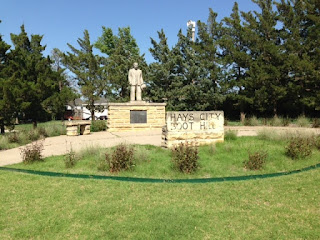
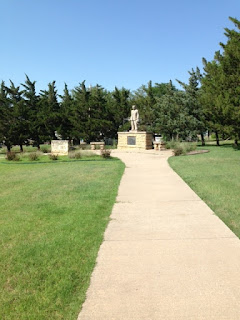
So, you think you know the location of the Oldest Boot Hill West of the Mississippi...but you may be in for a surprise!  Did you think it was Dodge City?  No, that came 5 years later.  Maybe you thought it was Tombstone, Arizona, or Dead Wood, South Dakota, but neither of them is older than the Boot Hill pictured above.  The oldest Boot Hill west of the Mississippi is in Hays, Kansas, located on the northeast corner of  Fort and 18th Streets.  When that location was chosen in 1867, it was about half a mile north of town, but by 1874, when the last recorded burial took place, the town had expanded to reach the burial grounds.  Some of the graves were relocated to the new Mount Allen Cemetery, but others remained.

Photo Credit:  Lyn Fenwick


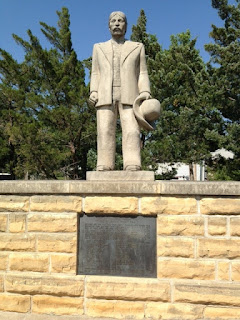
The statue, called "The Homesteader" was created by Pete Felten, but despite the name, many of the men buried there were not exactly our idea of a homesteader.  The name of these early cemeteries--Boot Hill--was derived from the fact that many buried there died with their boots on in shootouts, from suicides and racial disputes, and from alcoholism.  However, that was not always the case, and the  first man buried in the Hays Boot Hill was a teamster, kicked in the head by a mule.

An early burial in the Hays Boot Hill

The last known burial was in 1874.  Many, if not most, of the burials were done without ceremony, and records of the men buried there are incomplete.  The number is believed to be between 37 to 100, and most likely to be 79.  There are no grave markers, but it is a peaceful spot for those who are buried there.


This post is unlike my usual Memorial Day posts, yet the men and women who expanded settlement across the nation in its early years are worth remembering.  Today we are also becoming more aware of those we displaced in settling America, the Native Americans who lived on this continent before most of our ancestors arrived.  We are also becoming more respectful of those who arrived unwillingly but who also deserve our respect for settling this nation.  Certainly,  Memorial Day is intended to honor those who fought and those who died for this Nation.  However, perhaps we might also pause to  reflect beyond those who served our nation, and our own families.  Perhaps we could also take the time to reflect on some of those men and women we too often forget when we honor the dead who came before us. 

Wednesday, May 18, 2022

Heroes We Should Not Forget


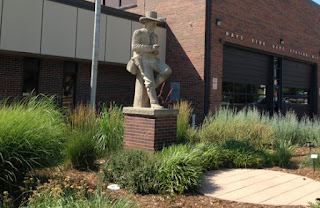
Hays, Kansas Fire Station
Photo Credit:  Lyn Fenwick

Always on the lookout for Kansas history, I spotted this statue at the Hays, Kansas Fire Station.  As I wandered back into the corner of the station, I noticed a Plaque.  

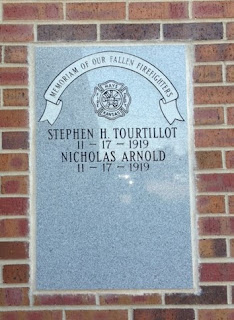
Photo Credit:  Lyn Fenwick


The plaque  was a "Memoriam of Our Fallen Firefighters," and the two names on the plaque--Stephen H. Tourtillot and Nicholas Arnold--shared a common date.  After doing some research, I learned that the date was the day they died in the line of duty as firefighters for the city of Hays.
In searching to learn more about the two men, I discovered that they are honored at the Kansas Firefighters Museum, a museum of which I was unaware.  

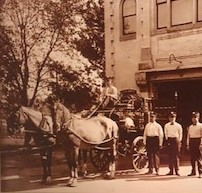
I learned that the last horse drawn fire station built in Wichita, Fire Station #6 was completed in 1909, and had 2 horses, Tom and Dick, and four fire fighters.  When Wichita became an all motorized fire department, it was the first such fully motorized fire department in the U.S. and the second in the world.  With no longer a need for a horse drawn Fire Station, #6 was used for other purposes, and in the 1980s it became a storage facility.  


Faced with the possibility of abandonment, Station #6 was rescued in 1993 when the Historic Preservation Alliance of Wichita and Sedgwick County formed the "Friends of Engine House No. 6" with the idea of restoring it as the Kansas Firefighters' Museum.  In 1994 it was placed on both the Registers of the Kansas and the National Historic Places.  Both Stephen H. Tourtillot and Nicholas Arnold are recognized in those places.
 
Both of these men died while fighting a fire at Ninth & Oak streets in Hays.  According to the Fire Fighters' Museum, they were killed when 3 Standard Oil gas lines exploded.  Also killed were six bystanders, and 150 others were injured.

I will close by quoting from the obituary for Stephen H. Tourtillott, published in The Hays Free Press.  "Monday morning he left home for work and with his usual energy at the call of duty entered into the work of trying to save the property around the burning tanks.  He was one of the victims of the explosion.  He was carried to the hospital where all was done that love and skill could do but he left this world of sorrow at 11:15 that afternoon.  He is survived by his wife, four children, his father and four brothers and their families."

Everyday, somewhere, firefighters face danger, trying to save us and our property.  I chose to do the research and share the story of these two men as a way to thank so many firefighters who have faced danger to protect us, sometimes at the cost of their lives. 

Wednesday, May 11, 2022

Bravo for the New Kansas State Fruit


Copyright by artist, Lyn Fenwick


Did you know that in April of 2022 Kansas Governor Laura Kelly signed House Bill 2644 making the Sandhill Plum our Official State Fruit!  Those of you who follow my blog already know that I am a great fan of the humble sandhill plum.  Past blogs have shared my jelly making, and in 2019 I entered my pastel painting titled "State Fair Jelly" at the Kansas State Fair.  It didn't win a ribbon but it garnered many comments from fellow sandhill plum lovers!

Naturally, as a sandhill plum enthusiast, I was thrilled by the Governor's choice.  But I was also surprised that Kansas had not already selected the Kansas State Fruit.  We have young Kansas students to thank for bringing that omission to the Governor's attention.  Apparently there were a few other nominees for the honor, but the sandhill plum won by a landslide.

I began to wonder what other fruits might have been chosen, and the one that quickly came to mind was the mulberry,  We had mulberries at the farm when I was a child, and because I ran around everywhere in bare feet, the soles of my feet were always stained with the purple mulberry juice that carpeted the ground under the trees.  I learned why mulberry trees spread so easily.  Mulberries are wind pollinated, they are not particular about poor soil, buds develop in later spring and are rarely affected by spring frosts, and they tolerate drought. 


My 2021 jelly making


There were other nominees, but some of those were eliminated because they were not native to Kansas.  I am certain that the early homesteaders found sandhill plums on the prairie when they arrived, because Isaac Werner, my prairie bachelor, wrote about them in his journal.  Isaac also had a peach orchard, but he planted it.  He tried to plant apples, but that was not successful, although there is a mention of one apple tree in his journal, so one tree among the dozen he ordered may have survived.  His garden also contained melons, but they were cultivated from seeds he bought.

Other native fruits existed in Kansas, but many of those are native only to a certain part of the state.  Some are very difficult to raise, particularly the PawPaw tree.  After doing the research about the few other fruits native to Kansas, I agree that the sandhill plum was the best choice--although I admit that I am prejudiced.  

This year there are absolutely no sandhill plums in our pasture.  I have seen some blooming bushes along roadsides, so I have no explanation for the absence of plums in our pasture.  We did have late snows, and I also wonder if the extremely strong winds might have interfered with pollination.  Fortunately, we still have jelly from last year's canning! 

Congratulations to local school children in our area who were part of the selection of our new state fruit!  
  

Wednesday, May 4, 2022

An Air Base Becomes a Municipal Airport


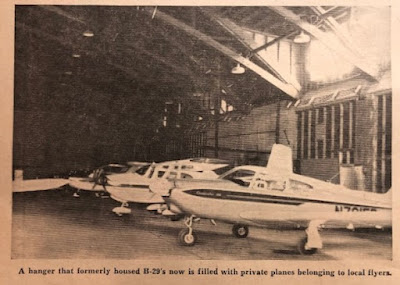
As a child, I remember driving far to the east of what is now Highway 281 in order not to pass through the military base a few miles north of Pratt.  However, by 1962 the former B-29 training base had become Pratt's Municipal Airport, and the special edition Pride Magazine proudly declared "While its airport is not as fancy as some in larger cities, Pratt is proud to claim one of the best- equipped small-town airports in the Midwest...[with] two long runways, both hard surfaces, plenty of hangar space (even for overnight transient aircraft) and complete facilities for major engine and airframe overhaul."  The article added, "In addition there is a lighted runway, beacon, courtesy car and a certified radio repair station."

Jim Newhouse managed the airport at that time, and also operated Pratt Air Service.  The article admitted that "air traffic is never very heavy" but touted the unicom radio and the two long runways of 6,000 and 4,000 feet.

Ted Turner's plane on the Pratt Runway

Today the airport remains a valuable asset for Pratt.  The 1962 article mentioned that "some 20 aircraft owners make use of the facility, and local pilots continue to utilize the airport and house their planes there."  That continues to be true today, and in addition, planes from across the nation land there.  During hunting season, another growing business in the region, hunters often fly in to hunt.

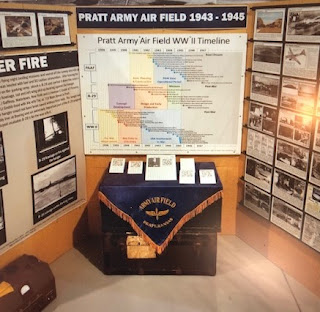
The history of the Air Base and the men and women who served there are honored today at the airport,  which includes not only the museum housed in the former parachute building but also descriptive signs around the airport identifying locations and the structures and purposes of those places during war time.

An exhibit at the Pratt Airbase Museum

Part of the mission of the museum is to record interviews of people who served at the base during World War II.  Although the museum is operated by volunteers, there are very professional and educational exhibits to be seen.

The Pratt Airport remains something of which the community can be proud, convenient for local pilots and those passing through. From the original purpose as a military base to  its present use, the air port remains an asset for Pratt and surrounding communities.  Today the fixed base operator is Randy Huitt, following in the footsteps of his father, Mr. Curt Huitt.


Wednesday, April 27, 2022

Irene's College Cup--A Mother's Day Tribute


I have reached the age of accumulated things.  My husband and I are both collectors, but we were never ones to buy things just because they were currently popular.  We bought things we wanted to live with for a long time.  However, if you live long enough, it is inevitable that you will collect much more than you need.  We have reached that age and need to decide what should be gifted or discarded.  Like many of our friends, we are finding that difficult, because the value of so many of our things is a matter of memories.

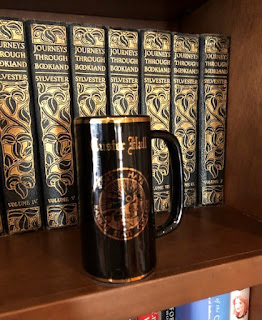
One of those things is the decorative Custer Hall mug that belonged to my mother-in-law.  She had already been widowed twice when my husband and I married, the first time having been left to raise two little boys alone, and the second time having thought she had found a husband to enjoy the rest of a long life together, only to be widowed again after a few happy months. 

Of course, we realized her sadness, but perhaps we were too young to fully understand her courage.  At the time of her second marriage, she had given up her job to move to a new town.  With the sudden death of her husband, she had to turn away from the plans they had made together to make new plans for herself.  That decorative Custer Hall mug is a symbol of her courage.  She decided to go to college.

To be honest, today I see it as courageous, but as a young bride having my mother-in-law join us at college wasn't quite what I had in mind.  Today, I see it differently, and that is why I struggle to know what to do with her mug.

It had been a long time since high school for her, and stepping back into a classroom was challenging.  Her grades weren't great, but she persevered.  Then, she discovered a way to make it all work.  She continued to take a few hours, but she became a dorm mother at Custer Hall.  The transition from a coed with gray in her hair to a dorm mother was a better fit.  

Today, each year hundreds of people over the age of 50 go back to school.  Some get degrees to change careers and others choose to explore long-held passions that had to be deferred until retirement.  That was not common when my mother-in-law began her college career.  She had been a working mother when that was less common--although mothers at that time certainly had important responsibilities that did not include a pay check.  My mother-in-law had the responsibility of parenting alone and being the sole bread winner. 

The idea of senior citizens continuing their studies is fairly common today, and if not directed toward a degree then for other reasons.  Some places offer senior citizen tuition waivers.  Other seniors return primarily to enjoy campus amenities.  In fact, in some places, retirement communities are planned nearby the university.  Some schools offer classes just for seniors, and there are also opportunities for online courses.  I have now taught two virtual Osher classes, a program designed for continued learning for people 50 and older.

But in my mother-in-law's era, what she did was unusual and brave.  For me, her Custer Hall mug is like a trophy, awarded for her courage and determination to push sadness and disappointment out of her way and get on with life.  

With Mothers' Day not far away, being on May 8th, this seemed like a good time to share my mother-in-law's story and the symbol of her courage that I see when I look at the Custer Hall Mug. 

Wednesday, April 20, 2022

Dial Phones Arrive!

 I cannot but wonder how many people are still living who remember the old crank phones and the party lines.  Our ring was 2 longs and a short:  rrrrrring, rrrrrrrrg, ring.  When our phone rang, all of the phones on the party line rang, but only the family whose number had rung was supposed to pick up the receiver.  Sometimes, that was too tempting to lonely neighbors eager for some gossip, and my Great-aunt Abbie was one of those lonely people.  An often told story in my family involved Abbie and her nephew Ray, who lived just a quarter of a mile down the road and who shared the party line with his aunt.  He was on a long distance business call and was having trouble hearing.  When an additional receiver was off the hook, the quality of the transmission was reduced.  Patiently, he said, "Please hang up, Auntie.  I'll call you when we finish and tell you what we said."  My great aunt's loneliness and curiosity often tempted her to eavesdrop on the party line, and her nephew understood.  As the family story was told, Abbie did hang up, and he did call her for a chat when his call was finished.

On the other hand, the party line had a valuable benefit.  The emergency ring could be dialed to bring everyone to the phone without having to dial each one on the line to spread a warning or ask for help.  In the county, that could quickly bring help to put out a fire or help someone who was injured or ill.


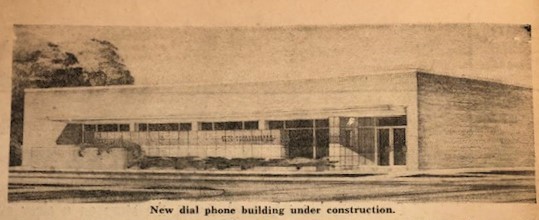
  However, this blog is about the new dial phone building under construction in Pratt, Kansas in 1962, as described in the special Pride publication.  Southwestern Bell had acquired the Pratt exchange in 1953, which at that time handed 3,370 telephones.  Three years later that number had grown to 3,914, an increase of 16%.  With construction of the new dial phone building anticipated for 1957, Pratt center could handle long distance calls for Coldwater, Greensburg, Protection, Coats, Cullison, Haviland, Iuka, Mullinville, Preston, Isabel, Sawyer, Cunningham, Ford and Wilmore.  

Pratt was quite proud of its new dial phone building under construction at 5th and Ninnescah Street!  The total gross expenditure for the building, dial equipment, landscaping, and installation of dial telephone would be about $920,000, according to the construction manager out of Wichita.  The building was to have an air conditioning system, a full basement underneath, and was constructed so that a second story could be added to allow future expansion "if Pratt continues to grow."

Today we pick up our smart phones and give little thought to the wonder that it is.  

Wednesday, April 13, 2022

Long Distance Phone Calls


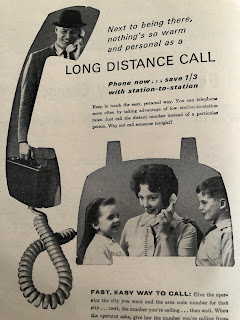
As I was exploring the 1962 Pratt Pride magazine I noticed this ad for long distance phone call service.  I could not help but smile.

In my family, long distance phone calls were reserved for very specific purposes--good news and bad news.  You could expect a phone call on your birthday or to share the excitement of a new birth in the family or to deliver a compliment for a special achievement.

On the other hand, if a long distance voice was heard on the other end of the line and there was no known good news explanation for the call, your heart skipped a beat.  Had someone been hurt?  Was someone in trouble?  Were they sick?

Unless you are of a certain age, these responses to a ringing phone will make no sense, and perhaps my family was more thrifty about spending unnecessary money, but those memories were called back to mind by the 1962 add.

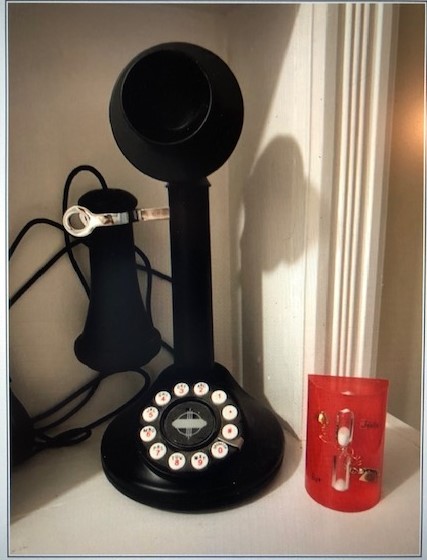
To complete the story I must include the small hour glass filled with sand that always sat on the desk beside the phone.  I think it took about 3 minutes for the sand to go from one side to the other in the hourglass, and good news or bad, in my family 3 minutes were regarded as sufficient to deliver either one!  The little red hour glass in the photograph is the one that my family always set by the phone.


When my husband and I returned to the farm about two decades ago, we were in a dead zone for wireless phone service, so we connected the long unused rural phone line.  With no one living in the farm house for many years, reconnecting wasn't simple.  It was discovered that the buried line to our house had been cut by deep plowing by a neighboring farmer .  Once that was repaired, we were back online.  We added a phone upstairs, something my parents had never had, and the contractor build a recessed alcove in the wall to hold the new phone.  I found a modern phone that was designed to look like an old fashioned 'candle stick' phone that fit snugly in the alcove.  A young visitor, who had only used a cell phone, noticed the replica phone and exclaimed, "Oh look, an old fashioned phone."

At the time, I laughed to myself, since she had overlooked the 'modern' dial in the base of the phone.  However, the joke was really on me, since dial or no dial, the phone really was 'old fashioned' to her, since she had never used a dial, and it would soon be obsolete to us, when cell phone service was eventually available at the farm. How quickly the world changes from one generation to the next!  My memory even goes back to the old-fashioned crank phone party line of my childhood!!

Wednesday, April 6, 2022

Tons of Ice!

Lynda & Jerry

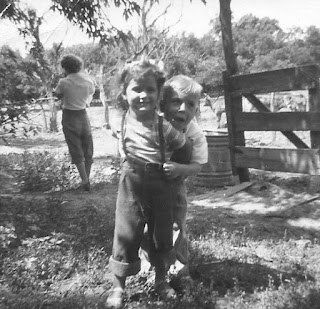
It isn't as if we no longer stop for a bag of ice at the convenience store.  We still do.  It is just less frequently that we stop to get enough to keep our cooler cold for a long afternoon at a picnic, with enough extra to keep the huge container of ice tea cold too.  Air conditioning seems to have practically eliminated the wonderful picnics I remember from my youth.  

I'm not sure the exact occasion pictured above, but I suspect it might have been a 4-H tour from farm to farm to see the livestock raised by 4-Hers for the County Fair, judging from the water tank and gate in the background.  Church picnics, Mothers' Club picnics, family picnics, picnics between baseball games...summer was filled with excuses to get out of the sultry house and find a shady park for a picnic.

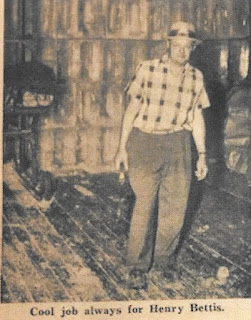
Our family often headed for the Pratt Lake, hoping to stake out a claim on a nice shady place below the dam.  But, on the way into Pratt, we would stop first at Bettis Ice Company Plant on North Main.


 I don't really remember much about the plant itself, because I was much more excited about getting to the picnic, but the gentleman who helped my father get the ice could have been Henry Bettis.  According to the article in the 1962 special Pratt edition, 60 tons of ice were produced daily at the Bettis company.  They shipped to many nearby towns and their ice was used to ice freight and passenger trains of the Rock Island Railroad.

In his interview, Mr. Bettis, owner and manager of the ice plant, said that their plant was one of the first in Kansas to push the packaged ice business fifteen years before his interview, meaning sometime about 1947.

Air conditioning is wonderful, and I would not want to give it up, but I can still recall fondly those picnics at the Pratt Lake, when you needed to get there early if you wanted a good spot below the dam.  Above the dam, cars came and went, pausing to watch the water skiing on the lake, and we kids would certainly have gone up there to watch the skiers too.  It was a busy place, both above and below the dam.