Tuesday, February 12, 2013

Romance on the Prairie

From the County Capital
Touring a personal library is a lot like going through someone's family photo album.  Quote from "The Man Who Loved Books Too Much" by Allison Hoover Bartlett
 
Isaac B. Werner captured my heart when I discovered his passion for books.  Having spent nearly three years studying the lists of books in his journal and in the inventory from his probate records, and having acquired many of those books to read, I feel that I have toured Isaac's personal library and know a great deal about him. 
 
At Isaac's estate sale there were so many books to sell that not all of them could be auctioned individually, and some were boxed to be sold together.  Among the books sold was one titled "Marriage & Family," and knowing that, I am sure that Isaac never intended to spend his entire life as a bachelor.  Why else, when money was dear and he took such pains to select the books he could afford to buy, would his library have included a book about marriage?! 
 
With Valentine's Day at hand, I find myself thinking of the ladies in Isaac's life after he came to Kansas, trying to imagine someone to whom he might have wished to send a Valentine.  He did leave some clues, and one of the most intriguing involves a lady named Ellen.  His journal mentions receiving letters from Ellen or Elle Green, and he was obviously pleased to receive them and prompt to reply.  One day, however, there was a cryptic entry in his journal, "second refusal," and after that day there were no more mentions of Ellen.
 
Another possible candidate was neighbor Isabel Ross, to whom he referred in his journal as Mrs. Ross, using her given name only once.  Mrs. Ross had divorced her husband on the grounds that he was abusive to her and their four children, and following the divorce, she staked a homestead claim as a single woman on land adjacent to Isaac's timber claim.  Gradually, a friendship developed between them, and Isaac was especially kind to share corn husks for fuel and make sure her soddy was readied for cold weather.  If they came to care for each other romantically, Isaac never mentioned such feelings in his journal.
 
The most obvious infatuation he revealed was toward a young woman who came to St. John to deliver temperance lectures.  The first evening he heard her speak, he wrote in his journal:  "...heard Miss Hazelett deliver a first class prohibition speech with magic lantern views, a splendid political speech from a quite young lady probably 23 years of age a nice & good sensible talker."  A few days later he heard her speak again, this time a political speech when she ran as the Republican candidate for County Superintendent of Schools.  It may have been the only time he had something positive to say in his journal about a Republican candidate!  The following month he visited Dr. & Mrs. McCann, the couple with whom Miss Hazelett resided.  Isaac wrote:  "...paid a visit or made a call on Miss Blanche B. Hazelett at Dr. McCann's residence.  Some pleasant surroundings and agreeable company to talk to."  Unfortunately, Miss Hazelett lost the election and resumed traveling on the temperance lecture circuit, and a few weeks later the McCanns left St. John for a different city.
 
From the County Capital
Isaac was regarded as a "good catch" for the ladies.  After a visit to Isaac's farm, newspaper editor John Hilmes praised Isaac's farm as one of the finest in the area.  In that same issue of the paper, the local reporter described the abundant trees Isaac had cultivated and added:  "We think the rooster of the sand hills ought to take some fair damsel under his wings." 
 
The most outright teasing Isaac received followed his lecture at a Farmers' Alliance meeting about ideas from Edward Bellamy's book, "Looking Backward."  That book, still read today, was very popular with Populists who admired some of the social changes Bellamy described in his future world.  Perhaps Isaac mentioned one change--that it was socially proper in that future time for a woman to propose marriage to a man.  In the County Capital newspaper the week after Isaac's lecture, the local reporter teased that the eligible women of Isaac's community had discussed taking him up on that idea, and if he wasn't willing to agree to the propriety of a woman extending the marriage proposal to a man, they didn't want to hear any more talk from Isaac about Edward Bellamy and his future society!
 
Isaac lived and died a bachelor, never having need to use the information contained in his own copy of "Marriage & Family."  Yet, I believe he had not meant to live his life alone.  To read about Isaac's flirtations and marriage plans as a younger man, visit my Feb. 9, 2012 blog, "A Young Man's Fancy." 

Thursday, February 7, 2013

Cemetery on the Hill

View of cemetery from road
I was certain we were on the right road, having been told that the old Saratoga Cemetery, also known as Summit Hill Cemetery, was just south of the Kansas Forestry Fish & Game campus, but after the road curved off to the east we were confused.  We could not believe we had missed it, but we turned around for a last attempt to find the old cemetery.  At last, I saw something in a vast grassy field and asked my husband to stop so I could go check it out, but even then my husband wasn't convinced by the lone stone marker I had seen.  "I don't know what it is, but it doesn't look like a cemetery to me," he said. 
 
Marker of Edward R. Gillmore
In fact, what I had seen was the grave marker of Edward R. Gillmore, partially buried in dirt and grass that had filled in around its base over the years so that only part of the stone extended out of the ground.  Edward's parents, George and Elisabeth, originally from Kentucky and Tennessee, had lived in Missouri when Edward and his younger siblings, William and Rosa, were born.  They had paused in Miami County, Kansas for a time before arriving in Saratoga.  Young Edward lacked 14 days of reaching his 16th birthday.
 
It is no wonder that we missed seeing the cemetery as we drove by the first time.  In 1976 Russell Miracle recorded information from the grave stones and collected what information the sexton had.  (http://www.interment.net/data/us/ks/pratt/summit/saratoga.htm)  At that time he accounted for 30 graves, but our visit did not reveal nearly that many, and those that remain show signs of wear and vandalism.  People my age who lived in the area confessed that the old cemetery had been a favorite parking spot for Pratt couples when they were teenages, and others admitted tipping over stones when they were kids.
 
Marker of Fletcher twins
Several of the existing stones now lie flat on the ground, while others are broken.  Even Edward's, which is in better condition than most, appears to have lost a finial from the top of his stone.  The marker for the Fletcher twin girls, who lived only seven days, is so badly broken that identification was possible only because of the records Mr. Miracle saved in 1976.  The unnamed twins were later joined by a tiny sister, Winnie, but no other family members are buried at Summit Hill.
 
The dates of death chiseled on the stones are from the 1880s and 1890s, during years the town of Saratoga vied with Iuka and Pratt Center for the county seat.  (See blog post "How Investors Created Pratt, posted Sept. 27, 2012, to read more about the battle for the Pratt County Seat and the gradual demise of Saratoga.)  Isaac Werner hauled grain to Saratoga to sell or to be ground, and he was impressed with the bustling town built around a square.  The 1887 Biennial Report of the Kansas State Board of Agriculture recorded two newspapers in Saratoga:  "The Saratoga Sun," a republican paper published by Albaugh & Hupp, and "The Pratt County Democrat," J.M. Gore and E.D. Fry, editors and publishers.  There were also two banks--Wilson, Weaver & Co. and the Bank of Saratoga headed by George A. Lewis & Co., both banks reporting paid up capital of $25,000.
 
Distant Pratt viewed from cemetery
At that time, Pratt Center was already the larger town, wih a combined population in town and the township of 1156 residents, but Saratoga had 419 town residents and 147 more in the township.  Iuka had only 68 town residents, although in the township there were 685 more residents.  When Pratt Center finally won the county seat, Saratoga held on for a while but eventually disappeared.  Today, standing atop Summit Hill Cemetery (Saratoga Cemetery) and looking across the broken grave stones of those former Saratoga residents, Pratt can be seen in the distance.
 
Broken stone of Della Thornton
Stone of M.O. Nichelson
Those buried on Summit Hill nearly all sleep in eternal peace alone, spouses and parents having moved on as the town of Saratoga disappeared.  Young Della C. Thornton, only twenty years old at her death, left her husband Frank to raise their son alone, and today none of her descendants remains in the community to repair the broken stone lying half-hidden in the blowing grass.
 
Old cemeteries leave behind many clues but also unsolved mysteries.  Miles O. Nichelson died September 28, 1887, only 21 years old.  The records from 1976 omit any mention of Miles but do include the death of Miles's mother, Parthenia, on Sept. 15, 1887.   Did both Mr. Miracle and I overlook the faint inscription of a second family member's death inscribed on the same stone?  And, what might have caused the deaths within days of each other?  It is reasonable to guess that an illness might be the explanation.  The whereabouts of John Nichelson, father and husband, and of Cora, Miles's thirteen year old sister at the time of his death, could not be traced.
 
Knowing the history of Saratoga, I understand why Summit Hill Cemetery has so few graves and why there are few signs of visitors.  When the town faded into history, some of its residents moved into Pratt, but others scattered across the growing nation.  The occupants of the graves did not live to see the death of their town, and today their neglected stones are the only evidence of a once thriving community.
 
(Remember, you can enlarge the images by clicking on them.  If anyone knows more about the families mentioned in this post. or about the old Saratoga cemetery, please leave a comment.) 


Saturday, February 2, 2013

Shared Orphan Train Stories


Sculptures at Orphan Train Museum
People are sharing Orphan Train Stories directly with me by e-mail and on facebook, so I thought I would share a few to add to this week's post below.

Shirley Jorns Fast wrote:  My grandparents, John and Dovie Jorns, wrote a letter to the Kansas Foundling Society saying they were interested in possible placement of a little girl age 2 to 4, as they had a natural daughter age 8.  They never received a reply, but two months later, much to their surprise, early one morning the Depot Agent delivered my father to them with a note saying, 'we know you requested a girl but we hope this little boy will fulfill your needs.'  My grandmother always said, "And fit our needs he did!"  Apparently the train arrived in Preston [KS] shortly after midnight, and as the depot was closed, they just left him on the bench outside with a note that said to deliver him to the John Jorns farm.  The agent found him at 6 a.m. and delivered him.
 
Wendy Sloan of Norton, KS wrote:  I actually knew a gentleman that made his home here in Norton that was on the orphan train.  He was born in Arkansas and traveled on the train here and was adopted.  He had some interesting stories.
 
Lillian Kateman wrote:  Christine Murphy was a lady in the Slater [MO] Christian Church.  She and her husband were school teachers and moved back to the Slater area after retirement...  He was a former "Orphan Train Kid, and while he was alive they attended "Orphan Train Reunions."  Christine attended the reunions after his death as long as she could before her death.
 
Others have written to share movie titles that include stories of the Orphan Trains, and Alice McMillan Lockridge shared a wonderful link for those of you who would like to read more at http://www.pbs.org/wgbh/amex/orphan.  I hope you enjoy these stories received from visitors to the blog, and don't miss the story and photographs below.

Thursday, January 31, 2013

Orphan Trains

                Orphan Train Museum, Concordia, KS
Between 1841 and 1860, America became home to 4,311,465 immigrants in search of a better life.  Some of them found exactly what they had hoped, but others found disease, over-crowding, unsafe working conditions, and lack of sanitation, especially in the cities where many of the immigrants remained.
 
The result was that many died or faced extreme poverty.  Older parents and siblings had not always immigrated with them, so when immigrants with children faced difficulties, there were no family members to help.  Children were orphaned or were placed in orphanages by desperate parents who could pay weekly or monthly for their children's care.  When the parents failed to make payments, the children became wards of the state.  Other children were left with no adult to care for them, and they roamed the streets, begging, stealing, and surviving however they could.  Some of the boys survived by selling newspapers. 
 
Donated Clock at Museum
After the Civil War many infants were abandoned along streets and in tenement hallways.  Mothers hoping to entrust their infants to others able to care for them often left their babies on the door steps of the wealthy and of churches.  Because of the need, foundling hospitals were created.
 
As cities became overwhelmed with the number of these abandoned and orphaned children, the idea of sending them West, to towns and farms with fresh air, was coupled with the expansion of railroads.  The Orphan Train movement began.  Between 1854 and 1929, it is estimated that 250,000 orphaned, abandoned and homeless children were placed throughout the United States and Canada.  Research indicates that 1 in every 25 Americans is somehow connected to an Orphan Train rider.
The research building at the Orphan Train Museum

In doing my research about Isaac Werner and his community, I never found a mention of an Orphan Train arriving in any of the nearby towns, nor did I find any mention of an adoption; however, there were many such children placed in Kansas.
 
Imagine being a child, perhaps as young as three or as old as sixteen.  You joined a group of from ten to forty other children of all ages, entrusted to an adult you probably did not know, called a "western agent," responsible for transporting you and the other children to a location in the West where you would know no one.
 
Partial view of plaque beneath clock
If you were such a child, you would eventually reach a town where you and some of the other children would be lined up in a row on the platform of the train depot.  Flyers would have been sent to the towns along the way of the planned stops of the train.  A screening committee would have been formed to assist the western agent in selecting who among the people gathered to obtain a child were suitable prospective guardians.  The screening committee was probably composed entirely of men, typically the town doctor, a clergyman, the newspaper editor, a store owner or a teacher.  You might be too young to remember many details about yourself, so your name and age might be embroidered in your dress, if you were a girl, or your jacket, if you were a boy.  If your birthdate were known, it might be included.
 
The prospective guardians might be a loving couple unable to have children, or they might be a couple needing a helper for their farm work.  You would have no say in the selection process.  If you were chosen, your parent guardians were required to sign a contract regarding your schooling and your care, and if you were one of the older children, your guardian would be required to provide certain clothing and cash to give you a start when you reached the age to be on your own.  Whether the requirements of the contracts were fully kept was difficult to insure, since the western agent would continue on his or her journey with those children not selected.
 

Some of these children were ill treated, chosen primarily for their labor, but even those were taken from the hard lives they were living in the cities.  Many of these children were adopted, formally or informally, and became a part of loving families.
 
You may visit the museum website to read more about the history, as well as letters of some of the children and newspaper articles from the period at http://orphantraindepot.org/
You may also request research if you think you might have a family member who was one of the riders.  Consider a visit to Concordia to see the museum and other local sites.  The 2013 Annual Orphan Train Riders' Celebration & Depot Days will be held June 7, 8 & 9.
 
Remember, you can enlarge the images by clicking on them.  If you have a family story about the Orphan Trains, please share it in a comment.


Thursday, January 24, 2013

Music on the Prairie

St. John Band
Isaac Werner loved music.  When he was a young druggist in Rossville, Illinois, the only day of the week that his store was closed was Sunday.  His younger cousin, Ezra Werner, had come to Rossville following Isaac's arrival, bringing with him an accordion.  During the week on winter evenings, Isaac loved to sit by the fire and listen to Ezra play the accordion, but what he especially enjoyed were outdoor concerts.  Isaac, Ezra, and another friend named Frederick often enjoyed their Sundays with a walk to a shady grove to sit on a log or a soft patch of grass to be entertained by Ezra.  When the birds joined in with their singing, Isaac was convinced that no concert hall in the city could have provided finer music.
 
When he came to Kansas, Isaac treasured opportunities to hear music.  A few evenings he enjoyed visiting the Eggleston family, who had brought musical instruments with them when they homesteaded.  There were also some fine singers in Isaac's community, and in the Clear Creek community, William Wilson was known for his beautiful singing voice.  In fact, Wilson offered a singing school during the winter evenings when he was not busy in the fields.
 
Isaac described an evening at the Emerson School House when Wilson and some other men visited a Farmers' Alliance meeting.  The Albano membership attendance was small that night, so the meeting was quickly adjourned, and the men enjoyed singing until midnight.
 
About his own musical talent Isaac never commented, although his personal library included a book on organ stops.
 
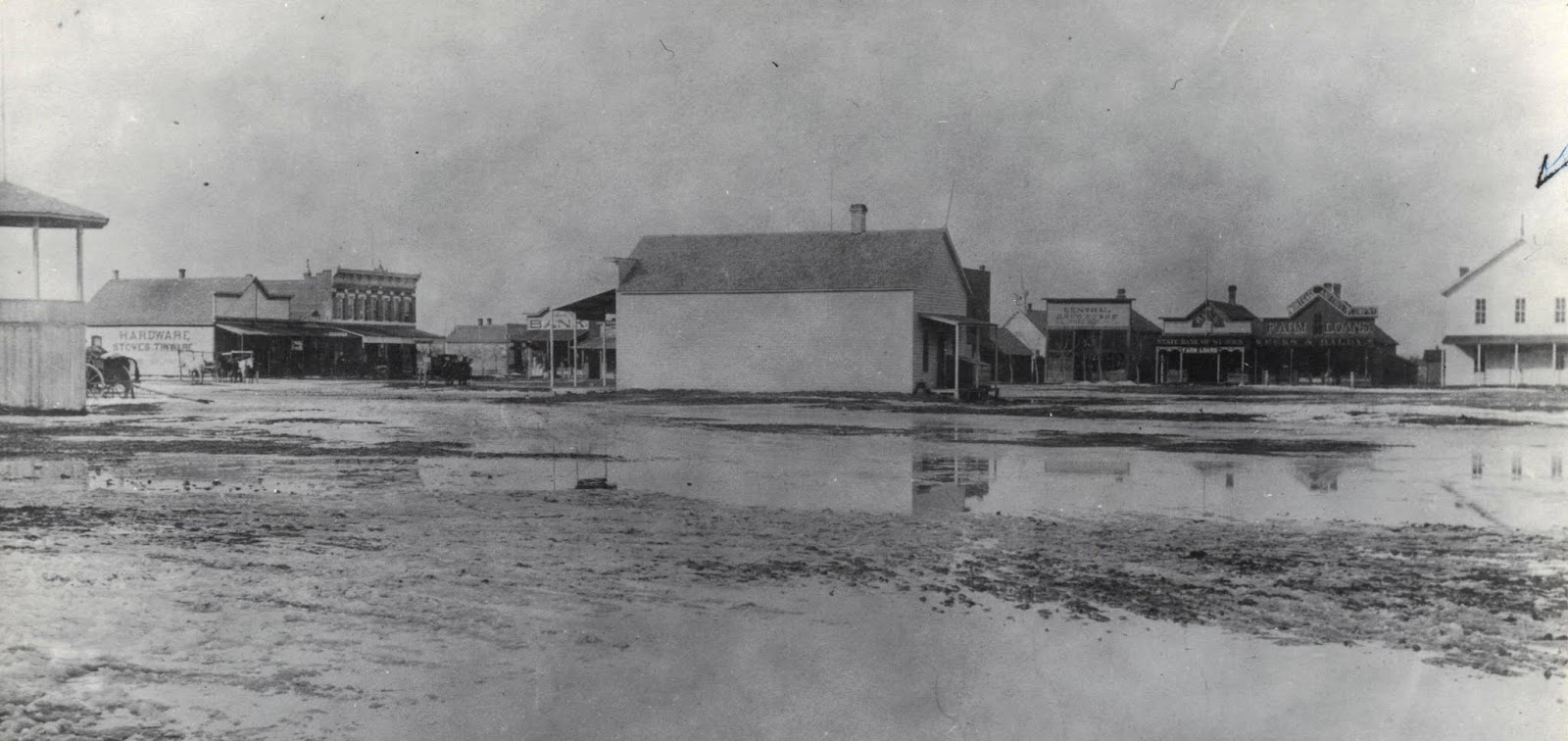
       St. John Town Square with Band Shell at far left
The reputation of the St. John Town Band was so impressive that they were often called upon to play in other towns.  When the Pratt County People's Party held it first political rally parading down Main Street, it was the St. John band that furnished the music for the parade.  The band was often asked to play for political events, organizers knowing that the band would draw a larger crowd.
 
So highly regarded were these musicians that a band shelter was built in the St. John Square, although the rest of the town square was nothing more than a muddy eyesore in wet weather and a source of dust blowing through the town when the season was dry.  (The first photograph of the St. John Band was taken in front of the City Stable, where Isaac often slept  with his horses when he needed to stay in St. John overnight.  The second photograph shows the band shell at the far left with the rain soaked bare town square in the foreground.  Remember, the photographs can be viewed larger by clicking on them.)
 
The opportunity to enjoy music with friends was one of Isaac's greatest pleasures!  Those of us living in a time when music is available in our homes, our cars, and while we go for a jog, as well as the many places where we can enjoy live performances, need to be reminded what a special treat hearing music was for those living in earlier times. 


Thursday, January 17, 2013

Females & Finance in the late 1800s

Image from the County Capital, the newspaper to which Isaac subscribed
 
Two of homesteader Isaac Werner's closest neighbors were single women with claims of their own.  He was friendly and supportive of both his unmarried "spinster" neighbor Persis Vosburgh and his divorced mother of four neighbor Isabel Ross.  I will write more about the surprising number of single, female homesteaders in a later post, but this week's post is about Women and Wall street.  While doing research in the actual copies of the County Capital available at the Stafford County Historical Society, I discovered the wonderful image and story shown above.  Isaac would certainly have seen this story, and one of the things about which he was most certain was women's rights, something the Populist Movement supported more than the other political parties of that time, Republican or Democrat. 
 
Ironically, among the individuals Isaac and the People's Party most disliked were speculators and Wall Streeters.  Therefore, while Isaac would have had no problem with the general idea of women being capable of doing whatever they chose to do, because he disliked the entire class of speculators and Wall Streeters, it would have been interesting to have seen his reaction to this story.
 
The story reads in part, "The fever of Wall street speculation has reached the women of New York.  There are at present enough women gamblers in stocks to make it profitable to run a stock broker's office exclusively for women."  (Remember, you can click on the image to enlarge it in order to read more of the story.)  This story, published in a Populist newspaper, used the derogatory term "gamblers" rather than "stock investors."  The image is from an 1890 newspaper.
 
The history of the New York Stock Exchange goes back to May 17, 1792, when 24 stockbrokers gathered under a buttonwood tree and signed an agreement to establish rules for buying and selling bonds and shares of companies.  The name by which it is currently known was shortened from the original name in 1863.  You can read more about the history of the NYSE at http://www.nyx.com/who-we-are/history/new-york.      
 
The exact location of the "cozy room made attractive to the feminine eye and equiped with all the accessories usually found in the downtown broker's office" is not identified in the story.  According to a Bloomberg article by Kristin Aguilera, the first women to own a Wall Street brokerage were sisters, Victoria Woodhull and Tennessee Claflin, whose firm was known as Woodhull, Claflin & Co.  A New York Times story published in 1870 about the opening of their business predicted "a short, speedy winding up of the firm."
 
Aguilera's article cites Bureau of Labor Statistics in 2010 stating that "women held 53.2 % of the financial management positions in the U.S. and 37.7 % of the financial analyst positions."   At the time of writing the article, Kristin Aguilera was the deputy director of the Museum of American Finance and the editor of Financial History magazine.  You can read the full article at http://www.bloomberg.com/news/print/2011-12-28/a-history-of-wall-street-s-women-echoes.html.
 
While it may surprise many that women were active traders on Wall Street so early, full acceptance of women did not come for decades.  The first woman to own a seat on the NYSE was Muriel "Mickie" Siebert who joined 1,365 men at the exchange as the sole woman on December 28, 1967.  Two endorsements are required on the application to become a member, and Siebert was turned down by nine prospective sponsors before finding two men willing to sign for her.
 
The anomosity Isaac felt toward speculators and Wall Streeters was caused largely by his beliefs about two things:  manipulation of commodity prices to keep famers from receiving a fair price for the crops and livestock they raised and political power that enabled the wealthy to control Senators and Congressmen, both state and federal, to enact laws that favored the wealthy.  Today, many farmers use commodity markets to protect themselves from wide price fluctuations for the crops they raise, and agri-business controls powerful lobbying of politicians.  Neither of the present political parties has exculsively attracted the laborers, miners, and farmers that comprised the old People's Party of Isaac's day, but the perception of the wealthy exerting disproportionate political power remains.  We are left to wonder what Isaac would have thought of today's voter alignment and of women on Wall Street.  


Wednesday, January 9, 2013

Isaac Werner's Personality

As I was reading The Forgotten Founding Father, Noah Webster's Obsession and the Creation of an American Culture by Joshua Kendall, I could not help noticing how many of Webster's traits seemed present in Isaac Werner.  Like Webster, Isaac was insistent on doing things right and disgusted with others who seemed content with doing only what was necessary to get by.  Isaac was constantly buying equipment that he modified with improvements before he would be satisfied with its performance.  His journal entry of February 19, 1888 is one example:  "Over-hauled fanning mill mostly all over to get same into working order, never put together right."
 
In addition to striving to make things right for his own farming equipment and methods, Isaac expended ongoing efforts to assist others.  His January 29, 1888 journal entry is a good example of Isaac's desire to reach out to improve things for others:  "While eating my breakfast conceived the idea of some competent man to go through the country and inspect each 1/4 section of land, its Surface Soil & its subsoil and classify them by number or letters according to the predominating elements of soil.  Then implements could be devised to work most satisfactory just those different soils and that would afford a basis to work on and continue improving thereby soon elevate the standard of agriculture and saving large sums of money from being expended in useless tools."
 
Isaac was active in farming organizations, hoping that farmers could share their experiences, successes and failures, to improve farming techniques for everyone.  He became disgusted, however, with meetings that neglected the educational portion of the gathering to become merely social.  He was even more impatient when members failed to study the educational material made available to them.  He observed which farmers seemed willing to implement progressive ideas and invited them to join with him in a separate group.  His December 6, 1889 journal entry described:  "...first meeting, 4 of us, [Wm] Campbell, Frank Stimatze, Ferguson & I organized Albano Reform Club...to afford more privilege to discuss political matter outside Alliance." 
 

Isaac also initiated the formation of a County Reform Club, of which he was chosen President at the first meeting, but so little interest was shown by those attending the initial meeting and by others Isaac attempted to recruit that a second meeting was never held.  Isaac had more success in founding the Stafford County Agricultural Society, of which he served as the secretary.  Inevitably, Isaac was disappointed with the commitment of other members who failed to dependably attend meetings or to diligently work toward the goals of the organizations. 
 
Reading about Noah Webster and his failed newspapers and poorly attended lectures, but also his unflagging efforts to advance his political ideals and to create an American culture through common spelling, pronunciation and grammar could not help but make me think of Isaac.  When I shared my observations about Isaac with author Joshua Kendall through e-mail exchanges, he replied, "Isaac fits the type."  See Kendall's website at http://joshuackendall.com  
 
For a time, Noah Webster favored the idea of adopting phonetic spelling for the new American nation, an idea he later abandoned.  Isaac also flirted with the idea of phonetic spelling for the farmers' movement, believing it would make it easier for immigrants who were just learning English as their second language, as well as for English-speaking farmers who had never learned to read or write, to acquire the ability to read progressive newspapers and educational material.  In Isaac's January 30, 1891 journal entry he wrote:  "I most the day reviewing books and Shakespeare, where several publishers combined in London to issue first complete edition, and what reading that 1623 edition now is to us and our present mode of spelling obominable [sic] to what it may be in the near future with some proper effort."  (See 1-3-2013 blog, "The Spelling Bee" about irregular spelling.)
 
So, paraphrasing author Kendall's book subtitle, I asked myself, "Did Isaac Werner have an Obsession to Create a Superior American Farmer?"
 
A recent article in http://psychnews.psychietryonline.org/newsArticle.aspx?articleid=1555744 includes an interview with Joshua Kendall about not only Noah Webster but also about his new book, American Obsessives:  The Compulsive Energy That Built a Nation, due to be released this summer.  Kendall told the interviewer, "The job of a biographer is to get inside of a subject's head.  I guess what fascinates me about obsessional types is that they are always pretty clear about what is on their minds."  You can read more about Kendall's new book at www.americasobsessives.com.
 
My manuscript is both biography and history, Isaac at the center of the story of his community and the Progressive movement of the late 1800s.  Isaac's daily journal entrys from 1884-1891 certainly helped get me inside his head.
Webster's handwritten drafts of dictionary entries
The article in Psychnews explains that most of us have a mix of personality traits which vary in intensity.  Among those traits, a trait that is moderated can be useful, but if carried to the extreme may be disabling.  The very traits that led some to consider Noah Webster vain, arrogant, and self-promoting are the same traits that allowed him to undertake writing a speller that was used by American school children for nearly a century and produce a dictionary that took three decades to complete.  Webster's personality demanded sacrifices from his family and caused offence among his friends as he devoted his attention to the job at hand, neglecting most other things and the needs of others. 
 
One of the professionals Kendall consulted for his new book was John Oldham, M.D., co-author of The New Personality Self-Portrait: Why You Think, Work, Love and Act the Way You Do, which explores ways traits that can be disabling in extreme cases can also be what makes a person successful when moderated.
 
To answer my own question, "Did Isaac show traits of obsessive-compulsive personality?" as a layman I believe he probably did.  But, more importantly, did he moderate those traits sufficiently to have a successful life?  Absolutely!  While the fact that he never married may have related to his personality, and he spent many days and nights alone with his reading and his projects, he also had some genuinely good friends.  He managed to create one of the most beautiful farms in the area and to free himself from indebtedness in difficult times, and he did a great many good things for his community that no one else would have had the drive to do.  Quoting Joshua Kendall's concluding words from the Psychnews interview, "Biographers are tempted to either slime their subjects or idealize them.  But people are so much more complex."  

Thursday, January 3, 2013

The Spelling Bee

8th Grade Graduates of Stafford County, Kansas, abt. 1915
As I polished this draft before posting it, my first act was to click on "Spell Check."  In a world where entire phrases are reduced to letters, like BFF and LOL, and where the ease of using Spell Check corrects most errors, being the best speller in the class holds less  prestige. 
 
However, in Isaac Werner's day, pride in winning the spelling bee meant something!  When classes were finally conducted in the new Emerson School (#33) that Isaac helped build, a few days after classes began Isaac recorded in his journal:  "Jan. 14, 1886.  Evening was to be 1st spelling bee in new school house."
 
Standardized spelling did not always exist.  Reading old documents with irregular spelling might mislead you to think the author was poorly educated; however, for Americans, it was not until Noah Webster published his book, A Grammatical Institute of the English Language in 1783, later called The American Spelling Book, that American spelling, pronunciation, and grammar gained an effective champion for standardization.  By the year of Webster's death in 1843, nearly 13 million copies of his spelling book in various editions had been sold, (many of which had blue covers for which his speller became known).  Sales following his death continued at a rate of about a million copies per year, remaining the favorite spelling book for nearly a century.  Of course, most of us know him because of his life's labor producing Webster's Dictionary.
 
As a result of spelling standardization, a new entertainment arose.  Spelling bees involved not only school children but also adults.  In his 2012 book The Forgotten Founding Father, Joshua Kendall quoted  an unnamed historian who described an adult spelling bee in which the community watched "a school trustee standing with a blue backed Webster open in his hand while gray-haired men and women, one row being captained by the schoolmaster and the other team by the minister, spelled each other down."  You may visit Joshua Kendall's website at http://joshuackendall.com/ .

Competitive spelling matches continue, including the Scripps National Spelling Bee established in 1925.  Webster's (now Merriam-Webster) remains the dictionary used for the competition.  The 2012 winner was Snigdha Nandipati of San Diego, California, and the winning word was guetepens.  You may visit www.spellingbee.com to read more about this competition.

The Scripps website shows that in 1925 the winning word was gladiolus, in 1935 intelligible, in 1975 incisor, all words familiar to most of us.  The goals of Scripps include not only improving students' spelling but also improving vocabulary, and the winning words beginning in 2001 would certainly increase most of our vocabularies, including such words as succedaneum, autochtonous, and cymotrichous! Competitors must not be beyond 8th graders, and the 2012 national competition included the youngest ever--six year old Lori Anne Madison.  With Snigdha Nandipati's victory, she became the fifth winner of Indian descent in a row and the tenth out of the past fourteen years.

The Scripps National Spelling Bee inspired a popular movie, Akeelah and the Bee.  Teachers wishing to motivate student participation in the local preliminary spelling bees leading to qualification for the national spelling bee are encouraged to show their classes this movie, which is still readily available online and is sometimes shown on television movie channels. 

While most of us rely today on Spell Check to support our atrophied spelling skills, it is still Noah Webster and his intellectual descendants upon whom the programers of the electronic spell checker rely to make sure we spell our words in the American standardized way.

(The girl pictured in the 3rd row, 3rd from the left, among the County Graduates pictured above is my father's oldest sister, Verna Pauline Beck, 1902-1926.  Verna became a teacher and probably contracted tuberculosis from one of her students.  She was only 23 years old when the disease took her life.)


Friday, December 28, 2012

Isaac's Dolly Varden

Isaac Werner arrived on the Kansas prairie without a horse.  While neighbors broke sod with horses, mules, and oxen, Isaac traded his labor in exchange for using his neighbor's stock and equipment.  Between his arrival in 1878 and 1886, he focused on planting and tending trees, doing the weeding by hand with a hoe.  Without a horse of his own, he broke little sod.  However, he also stayed out of debt, raising enough sod corn and garden produce to survive without much cash, but also missing the early years of the 1880s when grain prices were higher. 
 
Fig. 1, Alexander Kastler photo
At last, a neighbor by the name of Gullet, who had run up a stable bill in St. John that he could not pay, offered to sell his mare to Isaac to get the money to pay the bill, preferring to sell her to Isaac over having the stable take her for non-payment.  Isaac borrowed three hundred fifty dollars to buy the mare for one hundred fifteen dollars, needing the balance to buy implements, lumber, and seed now that he had a horse.  It was the beginning of his borrowing, but he believed that with a horse the money would soon be repaid from the crops he could now raise. 
 
He named her Dolly, and only one place in his journal did he leave a clue regarding his choice of name.  Throughout the rest of his journal he calls her Dolly, or Doll, but on that one occasion he uses her full name--Dolly Varden.  It was only natural that Isaac, who loved his books, should have chosen a literary name for the mare he had wanted to buy for so long.

Fig. 2, Frame Overo

Dolly Varden is a character known for her colorful wardrobe in the Dickens' novel Barnaby Rudge.  That character's costume has led to the use of her name for colorful objects and people.  For example, the Dolly Varden trout has greenish sides and a white belly, but there are also pink and yellow spots on its body and red spots on its lower sides.  It is believed the trout was named in reference to the Charles Dickens' character.  Likewise, I presume that Isaac named his mare for the same reason. 
 
There are no photographs of Isaac's Dolly, nor does he describe her appearance, so we are left to imagine what markings and coloration might have inspired Isaac in the choice of her name.  Horses have many coat colors and distinctive markings from which to choose, with a specialized vocabulary that has evolved to describe all of the variations.  In this blog I will share some of the more distinctive ones. 
 
Fig. 3, Anna photo
I will begin with the Gray.  While not as colorful as some of the other varieties, their characteristics are interesting, for they have black skin with white or mixed dark and white hairs, and they generally lighten as they age.  Further, they may be born any color, gradually lightening as they age.  The famous Lipizzaner horses are typically born bay or black, but they will be pure white by the time they are ten years old.  The Dapple Gray is a dark colored horse with lighter rings of graying hairs, called dapples, scattered throughout the coat.  A Flea Bitten Gray is an otherwise white horse with develops flecks of red hairs throughout the coat. The image (Fig. 1) created by Alexander Kastler of a champion Arabian mare with the classic "flea bitten" red speckles is a beautiful example.
 
The Pinto is a multi-colored horse with patches of brown and/or black on white, but there are many specific variations among the pinto horses.  An Overo has sharp, irregular markings, usually more dark than white, and often the eyes are blue.  The Image (Fig. 2) shown is an example of Frame Overo from http://www.horsevet.co.us.  Another type of pinto is the Tovero, characterized by dark pigmentation around the ears (sometimes called "Mexican Hat" or "War Bonnet,") dark pigmentation around the mouth which may extend up the sides of the face and form spots, chest spots that may extend up the neck, as well as flank spots and spots at the base of the tail.  The image (Fig. 3) taken by Anna, http://flickr.com/people/30031388@N00, is of a blue Tovero.  Among other pinto horses are Paint horses with known Quarter Horse and/or Thoroughbred bloodlines, treated as a separate breed.     
Fig. 4, Francois Marchal photo
 
A Roan is a color pattern in which white hairs are evenly intermixed with the other color, and there are Red Roans, Bay Roans, and Blue Roans.  Unlike grays, the roans do not generally change color or lighten.  When Isaac bought a second mare in 1887 that he named Jule, he described his mare as a gray, and he referred to her colt as a "roan colt" without indicating the color.  The image, Fig. 4, taken by Francois Marchal, is of two Blue Roan mares. 
 
Figure 5, taken by Jean-Pol Grandmont, is of a Pinto on the left and an Appaloosa on the right.  Several breeds of horses are represented in a group of coat patterns called Leopard, caused by the leopard gene complex.  Among the leopard patterns are Blanket, so called because of white over the hip that may extend to the base of the neck; Varnish, which is a mix of body and white hairs, and the similar Frost, distinguished by the white hairs only on back, loins, and neck; Snowflake, which is white spots on a dark body; and Leopard, which is dark spots of varying sizes on a white body. 
 
Fig. 5, Grandmont photo
The Appaloosa is known for its leopard-spotted coat patterns, with great variety in body types revealing the history of multiple breeds in its bloodlines.  Of particular interest to me was the discovery that the Nez Perce developed the original American breed.  The tribe lost most of their horses after the Nez Perce War of 1877.  Could Isaac's Dolly Varden have carried some of the leopard spots from interbreeding with the Nez Perce horses?  Since Isaac provided no description of Dolly's coloration, we are left to our imaginations, but I think picturing Dolly as a beautiful Appaloosa mare is my choice.  
 
The lovely images at the beginning and conclusion of this post are of mares with their babies at Decker's Red Eagle Appaloosas stables located twelve miles west of Eugene, Oregon.  You may visit their website at http://www.d-rea.com where you will find more beautiful images of their horses.  For those of you interested in more than pretty pictures, you will enjoy reading about their careful blending of genetics, blood lines, and good old "horse sense" to produce champions.  If you are lucky enough to be near Alvadore, Oregon, the Deckers invite you to visit them.
 

 (Remember, click on the images to enlarge.)


Thursday, December 20, 2012

Trains & Boom Towns

Kay Williams sets up his model town
In 1871 when the trains came to Rossville, Illinois, Isaac was among the group of citizens that opposed the arrival of the railroad to their community.  (See my blog of Jan. 20, 2012) At that time he was a prosperous druggist, dreading the arrival of competing businesses and the riff-raff that the construction and eventual completion of rail lines would bring to his town.
 
In 1886 when the rail lines approached the Stafford County seat of St. John, Isaac's attitude had changed.  Now, he was a farmer with produce to ship, as well as a customer for the merchandise that would be available from the new businesses the railroad would bring to town.
Williams' coach & trailer
On April 19, 1886, Isaac's journal entry expressed his interest in the progress as the railroad lines moved westward:  "Noticed this morning on the streets in St. John a R.R. grading outfit of some 1/2 doz. Wagons, some 12 spans of horses & several 2 wheel scrapers, all loaded on road towards Larned or beyond to do R.R. grading all completely equipped with men, necessary shelter, tools, etc. quite a procession.  At Grading of Hutchinson branch just W. of St. John & on Eastward [sic].  Macksville to rush generally now seeming every body wanting to get to Macksville & Casody, nearly a hundred new buildings put up there now this spring in anticipation of new R.R. every body wild." 


Model town in foreground; Buckhorn entry in background
Recently, I experienced my own eager anticipation as rail lines were laid and a town began to sprout along the tracks.  For the past seven or eight years a gentleman named Kay Williams has arrived at Buckhorn RV Resort in his motor coach, towing a trailer painted to match the coach, filled with the materials for a railroad boom town of his own.  He needs no scrapers or grading equipment, for he lays his tracks on the lawn beneath a magnificent live oak tree.  Like those early railroaders laying tracks across the plains who brought their own tools, Mr. Williams brings his tools in his fancy trailer, and after setting up his motor coach for his stay in the park, he becomes a 1-man railroad crew. 
 
Mr. Williams' boom town
I didn't ask him when he got his first model train set, but because many little boys ask Santa to bring them their first model train, I thought sharing Kay Williams's Christmas display on my blog would be an appropriate Christmas post.  This was our third opportunity to see his display, and each year he has added more buildings to his town.  He patiently answers questions and welcomes photographs of his model railroad town as fellow RVers stroll past his site.
This year his town was on display for about a week, but he was eager to start back home.  He was restoring a 1948 Ford automobile for a lady who wanted it done by Christmas as a gift to her husband--the restoration of their courtship car from back when they were young.  As Mr. Williams shared the story of restoring an object of romantic memory to a couple now in their golden years, he had such a twinkle in his eyes, obviously taking delight in the pleasure his craft would bring to them.  Standing there before me, with the model trains and town behind him, I could almost imagine Santa in his work denims putting the final touches on the model trains he would deliver to children on Christmas Eve.  Perhaps Kay Williams isn't really Santa, but he certainly knows how to bring joy and laughter to many people during the holiday season.   

(Remember, you can enlarge the images by clicking on each picture.)

P.S.  If you missed last week's post about my Victorian "angels and ancestors" Christmas tree, be sure to continuing scrolling down to read about this special tree.


Thursday, December 13, 2012

Christmas Guests


Angels & Ancestors Tree
Every holiday season I invite our relatives for a visit to the Beck family ancestral home that my husband and I have restored.  They all arrived last week, both of our parents, grandparents, and great-grandparents.  Because so many elderly unmarried aunts are forgotten at the holidays, we invite them too, as well as some of our young nieces and nephews.  With all of our pets scattered among them, it is quite a crowd.  I've never actually counted, but there must be fifty or more. 
 
In case you haven't guessed, our holiday guests arrive as photographs, and rather than finding beds for everyone, I find the perfect place on our Christmas tree.  When we restored the Victorian farm house built in 1899 by my great-grandmother Susan and her son Royal, I decided it needed a Victorian Christmas tree.  I was lucky to find some Victorian picture frame ornaments perfect for what I had in mind, and that was the beginning of our "Angels & Ancestors Tree."  The Victorian theme was enhanced by candle lights and cut-glass globes, and I planned a color scheme of crystle, gold and silver.  Then I began collecting beautiful angel ornaments. 
 
Aaron & Susan Beck w/ daughter Anna at upper left


The tree goes up as soon after Thanksgiving as I can convince my husband to help me assemble it, and it remains well into the New Year.  Every ancestor from six generations of whom I have a photograph is on the tree, along with other special relatives and all of our past pets.  Our young nieces and nephews are among the relatives on the tree, in hopes that discovering their pictures will encourage them to ask questions about their own ancestors. 
Royal & Lillian Beck w/ Geo. & Theresa Hall upper left
 Although he is not a relative, I wish I had a picture of Isaac to add to the tree.  I would hang his ornament near my Beck and Hall great-grandparents so these old friends would be nearby.  Someplace not too far away I would hang the pictures of my paternal grandparents, both of whom Isaac knew.  In his journal, Isaac wrote about how efficiently young Royal Beck handled a transaction at the post office when his father, the postmaster, was away the afternoon that  Isaac needed to mail important documents.  The only family to whom Isaac mentions having loaned some of his precious books and stereoscope views was the Aaron Beck family.  Isaac was also close friends with the George Hall family.  In his final illness, Isaac stayed with the Halls for a time and would perhaps have been cared for by my 15-year-old paternal grandmother, Lillian Hall.


Larry & Lyn Fenwick
The farm house is filled with memories--not only my own memories but also the memories shared with me by my parents, my aunts, uncles, and cousins.  My genealogy research sometimes makes it seem as if I knew ancestors who died long before I was born.  Even Isaac added to that store of memories in his journal entries about my ancestors. 
 
I don't really believe in ghosts, but I do like to imagine that the family and friends who shared important events at our farm over the years, both happy and sad, might somehow know that we have rescued the old farm house in which dinners, parties, wakes, holidays, announcements, romances, loud laughter, and shared secrets occurred.  There may not be ghosts in the old farm house, but at Christmas every year, their spirits are remembered. 


Friday, December 7, 2012

Advice from Henry Ward Beecher

Every young man would do well to remember that all successful business stands on the foundation of morality.  Henry Ward Beecher
 
Inside Isaac's journal was a lengthy newspaper clipping which described how to keep a journal.  The author of the article was Henry Ward Beecher, a Congregationalist minister, social reformer, and abolitionist.  Today his sister, Harriet Beecher Stowe, is probably better known, for she is the author of Uncle Tom's Cabin, whom Abraham Lincoln addressed as 'the lady who started this war,' when they met.  However, during his life, Harriet's brother Henry was also widely known.
 
Henry had his own encounter with Lincoln, who heard him preach.  Beecher advanced the Union cause on a speaking tour through England during the Civil War, and when the flag was again raised over Fort Sumter near the end of the Civil War, he was the primary speaker.  Beecher lived in a time when eloquent preachers could become celebrities, drawing crowds to their services and becoming acquainted with other well known people.  After hearing Rev. Beecher preach, Mark Twain described his performance as "sawing his arms in the air, howling sarcasms this way and that, discharging rockets of poetry and exploding mines of eloquence, halting now and then to stamp his foot three times in succession to emphasize a point."  Even if Twain was guilty of his well-known exaggerations, Beecher must have been a forceful speaker.  Using his celebrity to speak out for causes, Beecher supported women's suffrage, temperance, and Darwin's theory of evolution.
 
The pastor of Plymouth Congregational Church in faraway Brooklyn, New York had a significant role in early Kansas.  Before the Civil War, Beecher raised money for the early settlers in Kansas and Nebraska who were willing to oppose slavery, using the money he raised to buy them rifles.  Consequently, the guns acquired the nickname of "Beecher's Bibles."
 
Hold yourself responsible for a higher standard than anybody expects of you.  Never excuse yourself.  Henry Ward Beecher
 
Even the scandal involving accusations of improprieties with a female member of his church, the wife of his friend, did not extinguish Beecher's celebrity.  The Plymouth Church Board of Inquiry exonerated Beecher but excommunicated the woman's husband, and a second Board of Inquiry two years later excommunicated the woman as well.
 
Whether Isaac was aware of the scandal is unknown, but he respected Beecher's opinion well enough to have clipped an article written by Beecher from the newspaper to save in his journal.  Beecher counseled against filling a personal journal with feelings and opinions, recommending that a journal should be a record of specific events--of weather, people seen that day, and how time was spent.  The clipping in Isaac's journal is undated, but Beecher's advice would indicate that the opinions and emotions of a young man shared in Isaac's journal entries of 1870-71 were before he read Beecher's newspaper column, and the entries of 1884-1891 when the journal resumed were influenced by Beecher's advice to stick to facts.
 
Journaling may have been a Werner family tradition.  His twin brother Henry Beckley Werner also kept a diary, which was donated to Albright College in Reading, Pennsylvania by Henry's son, Charles Hain Werner.  The diary entries may be read at http://library.albright.edu/casc.  It was very interesting for me to compare entries from 1871 from both twin brothers' journals, particularly the entries about brother Henry Werner's travels to Virginia.
 
Even after Henry Ward Beecher's death in 1887, his advice was available to people, as can be seen from the advertisement taken from the County Capital newspaper to which Isaac subscribed.  Posthumously, Beecher was still dispensing advice on "courtship, early marriages, church work, choir music, women and housekeeping."  Frankly, I wonder what Rev. Beecher had to say about housekeeping!  The very thought of Henry Ward Beecher delivering his opinion to women readers of the Ladies Home Journal on the subject of housekeeping calls to mind Rev. Beecher's own words. 
 
A person without a sense of humor is like a wagon without springs.  It's jolted by every pebble on the road.  Henry Ward Beecher