Wednesday, March 27, 2013

1st Black Female Lawyer

On October 27th, 1890, Isaac headed to St. John for a People's Party rally, joining the Livingston and East Albano Farmers' Alliance congregations along the way.  He set up a camera to photograph the wagons that paraded around the "E. side of public square round by 5th Avenue house, down to S.W. corner of square and around the square finally double procession..."  After lunch the farmers gathered at the rink for speeches, and among the speakers was "a colored Speaker from Topeka, the 2d orator, short and quite satisfactory."  Although Isaac approved of the man's brief and effective speech, he did not include the man's name in his journal, nor did the newspaper mention the name.
 
In doing my research for writing the manuscript about Isaac and that historical period, I found a clue that suggests to me who the speaker might have been.
 
Image of Lutie Lytle from the County Capital
In about 1882 a man named John R. Lytle joined other African Americans in relocating his family to Kansas as part of the Exoduster movement.  The family moved into a house at 1435 Monroe Street in Topeka, and John became involved in the community.  As the People's Party became active in Kansas, John became a member, running unsuccesssfully for the position of city jailor.  His local prominence allowed him to assist one of his four children, daughter Lutie, to gain an appointment as the Populist Party assistant enrolling clerk for the state legislature.  It seems quite possible to me that John R. Lytle was the man Isaac heard speak to the rally in St. John.
 
Lutie gained prominence in her own right.  She explained to an interviewer that she was working in a printing office when she began to contemplate becoming a lawyer.  She said, "I read the newspaper exchanges a great deal and became impressed with the knowledge of the fact that my own people especially were the victims of legal ignorance.  I resolved to fathom its depths and penetrate its mysteries and intricacies in hopes of being a benefit to my people." 

She carried out her dream of studying law by moving to Tennessee, where she attended Central Tennessee College, having earned tuition money by teaching school.  In September of 1897 she was admitted to the Criminal Court in Memphis after passing an oral examination.  Records indicate that she was the first African American woman to be licensed to practice in Tennessee, the second or third in the United States (records conflict about this), and the first in Kansas when she returned to Topeka. 
 
Lutie Lytle
Lutie was briefly married to a minister, but later she married Alfred C. Cowan, a lawyer.  According to the 1910 Federal Census, Lutie and Alfred lived in Brooklyn, New York, and were both employed in the general practice of law.  Lutie's father John was living with them, employed as a real estate agent, together with her brother Albert, age 26, working as a law clerk, and her sister Corine, age 17.
 
The date of Lutie's death is uncertain, but in 1925 she spoke to a large audience at St. John's A.M.E. Church in Topeka, the church she had attended as a girl.  She opened many doors for women, and during the year she taught domestic relations, evidence, and criminal procedure at her alma mater, she was described as "the only woman law instructor in the world."
 
Her own words describe her feelings for the law:  "My favorite [area of the law] is constitutional law.  I like constitutional law because the anchor of my race is grounded on the Constitution, and whenever our privileges are taken away from us or curtailed, we must point to the Constitution as the Christian does to his Bible.  It is the great source and Magna Carta of our rights..."
 
Lutie and her father are a distinguished and important part of the early history of Kansas, and whether John was the speaker to whom Isaac referred in his journal or not, they are a significant footnote to the story of the People's Party.

(To read more about Lutie Lytle Cowan visit www.kshs.org; www.blackpast.org; and http://edwardianpromenade.com/women)

Thursday, March 21, 2013

Susan's Album

Susan & Anna Beck
My great-grandmother, Susan Beck, taught in one-room country schools  in both Stafford and Pratt Counties.  School terms accommodated the necessity for children to help on the farms, and the fall term usually began in late October.  After a break for the holidays, the spring term resumed until March or early April.  Many of the country school teachers were barely older than their students, young unmarried girls who had been students the previous school year.  Having a mature woman with a high school education as their teacher was considered quite a privilege.
 
Records of the Stafford County country schools are incomplete, but the Stafford County History book indicates that Susan taught in the early sod school house in Albano Township.  Susan has a photo album given in appreciation for her teaching in that community, and she may have taught in the school house Isaac helped build.  Pratt County has more complete documentation of its country schools, and those records confirm that Susan taught in townships located on the far north side of Pratt County several terms in the 1890s.  Her daughter, Anna Marie Beck, not only taught in Stafford County schools but also served as Stafford County Superintendent of Schools.
 
As you may remember from prior posts on this blog, Isaac Werner was friendly with the Beck family, loaning books, stereoscope views, and his albums to Aaron and Susan Beck and their children, Royal and Anna.  Unfortunately, Isaac's books, views, albums, and framed prints were sold in his estate sale, and although I suspect some of them might still be found among family antiques in the surrounding communities, I have not located any of Isaac's collections (other than his wonderful journal).
 
Susan Beck's album from grateful parents
Therefore, I am using the album my great-grandmother received from parents of students she taught as an example of what Isaac's albums might have been like.  I have seen many examples of albums from this period, many with velvet covers and most with some type of decoration.  The pages are thick cardboard, on which a card stock type of paper is glued with framed openings to hold photographs or cards of famous people.  Susan's album has two frames on each page positioned vertically.  Other albums have different arrangements of frames and different sizes of frames.
 
Interior pages of Susan's album with a print
Susan's album from the late 1890s or early 1900s holds primarily photographs of family and friends, but Isaac's albums probably held more images of  prominent people.  Although newspapers published sketches of people in the news, we must remember that without movies, television, and the internet, images of important people, historical or living, were not widely available.  In his ongoing quest to better educate himself, Isaac wanted to be familiar with the images of famous people. His journal entry of December 31, 1870 included among the books and engravings he wished to purchase the following:  "Card Photographs of about 150 Authors & Artists."
 
Another entry on February 27, 1871 read: "Started also a small book or memorandum of transitory or present or future wants, such as photographs of certain noted individuals, painting and certain necessary books etc.  By eve had already recorded 3 columns in my small book of such items."  When he acquired the photograph cards he wanted, they were arranged in albums similar to the album in the above photographs.
 
Although Isaac was eager to acquire a better education with his reading and his collections of engravings, stereoscope views, and photograph cards, he was reluctant to reveal to those who might criticize his efforts just what he was doing.  His entry of March 16, 1871 revealed this modesty: "During A.M. as Mr. Hutcheons run in and out several times, and each time found me busy at my desk at something (he knew not what though, filling my large Album with card photographs of Authors), he remarked, 'Well Mr. W.--.  You astonish the natives someday, the way you are always busy at something.'"      
 
Most of Isaac's books, engravings, views, and photograph cards were acquired during the years when he was a prosperous druggist in Rossville, Illinois, but he always believed the money to acquire his collections was wisely spent, and he continued to enjoy them during the hard times of his later years as a homesteader on the Kansas prairie.

Wednesday, March 20, 2013

Postscript to 5th Avenue Hotel

The 5th Avenue Hotel in later years

As a postscript to the previous blog, I am adding this image of the building taken several years later.  From the cars parked at the hotel, I would guess that the photograph was taken in the 1930s or early 1940s.  Decide for yourself whether you think the modifications to the structure improved its appearance.

Thursday, March 14, 2013

Fifth Avenue Hotel

When the railroad arrived in St. John, Kansas, new buildings sprung up nearly as fast as hen bit is currently doing in Kansas lawns.  Among those buildings was the Fifth Avenue Hotel pictured above.  It is similar in style to the elegant Victorian courthouse written about in my blog of 3/29/2012 (Isaac's Victorian Court House), and it shares similar details with the school built at nearly the same time. 
Early St. John School
Far more elaborate than the St. John Hotel, the wooden structure pictured in my recent blog about Women on the Prairie (2/21/2013), the Fifth Avenue Hotel featured balconies overlooking the square.  It was from one of those balconies that Isaac photographed the wagons in a double row that extended around the square and beyond in a rally parade for the People's Party.
 
The City Stables
 
Unfortunately for Isaac, money was scarce, and when he needed to spend the night in St. John, unless he was invited to stay in the home of a friend, the City Stable served as the overnight accomodations for both Isaac and his horses!


Thursday, March 7, 2013

Snow Storms on the Prairie

Sculpture in Kiowa, Kansas
Last week we arrived at the farm in Kansas between record breaking snow storms.  The sculpture of a prairie couple made me think of Isaac Werner and his neighbors dealing with blizzards in the late 1800s.  Unlike today's prairie residents, they did not have NOWA to warn them of approaching storms nor satellite images shown on television and the internet.  The day before the second snow storm arrived, the sky gave no indication that Mother Nature was not finished dumping snow on Kansas, and I wondered if Isaac would have known of signs we no longer recognize as weather predictions.
 
Drifts fill the road near our farm house
Regardless of our sophisticated methods of predicting approaching weather, we are sometimes left helpless to deal with the conditions.  The picture at the right shows one of the roads drifted full of snow near our farm.
 
Today, many farmers have snow plows they attach to their tractors.  Farmers with cattle raced to protect their herds from the dangers forecast for the second snow storm, risks not from the cold itself but rather from the combination of snow and extreme winds that can cause cattle to breathe in the moisture and literally drown from the moisture in their lungs.  In the blizzard of 1886, thousands of cattle and sheep died on the prairie, but the recent snows caused no such disasters.
 
View of our front yard after the 1st snow storm
Drifts filled the roads, and plows cleared streets and roads from the first snowfall just in time for the second storm to arrive and create new tasks for road crews.  The warmer weather since the storms has melted some of the snow, but the new problem is mud and standing water, and drifts still block many country roads.  Neighbors with tractors have helped us reach the farm, and this morning I learned that our township grader is broken, idle until a new part arrives.  Now I know why no roads to the farm were plowed for us by the township grader!
 
In Isaac's time, homesteaders lacked our sophisticated technology and our powerful equipment, but even with these things, Mother Nature is still capable of showing us that she hasn't been conquered.
 
(The windmill in the picture to the left has the blades that capture the wind removed from the tower.  These wind-powered pumps used to lift water from underground acquifers are a gradually disappearing sight on the prairie.)


Friday, March 1, 2013

Political Symbols on the Prairie

All Americans are familiar with the elephant and the donkey as symbols of our two leading political parties, but do you know the origins of those two animals as party symbols?  Animals were often used in political cartoons to satirize individuals and groups.  One of my favorite cartoons from the County Capital during the 1890s appears at the right.  (Remember, you can click on the images to enlarge them.)  The poor farmers and miners who were suffering such hard times are depicted as hares or rabbits, appealing to the wealthy and powerful for help.  Those well-dressed animals ignoring their pleas are: politician as horse, monopolist as bull, office holder as goat, speculator as sheep, and money lender as cow.  Fierce dogs, labeled famine, want, and other hardships, threaten the defenseless rabbits.

The origin of the donkey as the symbol of democrats is traced back to the 1828 presidential campaign of democrat Andrew Jackson.  His opponents called him a "jackass" for his populist views, but rather than being offended, Jackson adopted the image of a stubborn donkey in his campaign posters.  Cartoonists, especially Thomas Nast, picked up the association of a donkey representing democrats, and the image continues to this day.

It is believed that a cartoon drawn by Nast that appeared in Harper's Weekly in 1874 was the first use of an elephant to represent the republican party.  My favorite from the County Capital depicting the elephant as a political symbol appears at the left.  The People's Party, which the newspaper and Isaac supported, saw republicans as the wealthy and powerful, gobbling up benefits through their influence over politicians in Washington and the state capitols.  This cartoon uses not only an elephant but also adds a greedy pig inside, labeled "Plutocrat" and wearing a blanket labeled "G.O.P." or Grand Old Party, another name for republicans.  The hay the elephant is consuming is labeled "The Public Substance."

The symbol used by the County Capital for the People's Party was the rooster.  The crowing rooster pictured at the right appeared on the front page of the newspaper announcing a near sweep of state and local elective offices, the editor's visual boast covering about half the page!

Although there is no doubt that in Stafford County, Kansas, the rooster represented the People's Party, researchers believe it sometimes was used to represent democrats.  An article appearing in the 1913 Journal of American History traces the origin to 1834 in Indiana when a man named Joseph Chapman ran for office.  Apparently Chapman was quite an orator, and his style of boasting about what he would accomplish if he were elected was described by his opponents as "crowing," giving him the nickname of "Crowing Joe."  http://www.newrivernotes.com/old_nrn/misc/rooster.htm   Another researcher traced the connection of a rooster with democrats in West Virginia.  In that state, voters were urged to "Scratch the Rooster," meaning to put an "x" below the rooster symbol to vote a straight democratic ticket.  http://morganmessenger.com/news/content/story-10302

All of that may be true, but at the St. John, Kansas, County Capital newspaper, the rooster crowed for the People's Party. 

Thursday, February 21, 2013

Women on the Prairie

City Hotel in St. John, Kansas
In searching for images to accompany this blog I observed that often the women photographed in everyday scenes were at the back of the picture, standing behind the men.  You will need to click on the image at the right to enlarge it enough to find the women at the rear door of the City Hotel in St. John, Kansas.  That is an appropriate allegory for how the role of women in homesteading the prairie is often seen--a wife surrounded by children standing behind her husband.  Certainly many of the women on the prairie were wives who came with their husbands to stake a claim, but it must be remembered that those wives, and the children as well, worked side-by-side with their husbands, not necessarily doing the same chores but doing other things that needed to be done if they were to survive and prosper.
 
The requirements for homesteading were that the claimant be the head of the household or be single and at least 21 years of age.  The claimant's gender was not specified.  As a result, many homesteaders were women--single, widowed, or divorced.  The ratio of men to women homesteaders varied from place to place and year to year, but estimates range from five to twenty percent of homesteaders being women.
 
 
Woman gathering buffalo chips for fuel
The women in my family who came to Isaac's community to build a new life on the prairie came with their husbands--Susan Beck, Theresa Hall, and Mary Wilson.  However, two of Isaac's nearest neighbors were women homesteaders.
 
Persis Vosburgh was an unmarried lady, born in New York state in about 1837.  She came to Kansas with her younger brother Jerome and his wife Ann.  After Ann's death, Persis helped raise her brother's children who were still at home--Fay, Leila, and Fannie.  Because of her close connection with her brother, (she was counted in his household in both the 1880 Federal Census and the 1885 Kansas Census), there were those who raised an objection to her claim as a homesteader, believing Persis had not maintained a residence on her claim.  At a vigilance meeting at the Naron School in the spring of 1885 to discuss what to do about claim jumpers, Isaac, William Campbell, and C. W. Shattuc supported Persis against those who said she did not meet the requirement of residing on her land.
 
In 1888 Persis Vosburgh died while on a visit to New York state to see family.  Isaac farmed her land following her death, growing corn and plowing fire guards to protect her trees from prairie fires.  Her heirs eventually conveyed it to G. G. John, the man who cared for Isaac during the final five months Isaac was able to remain in his own home.
 
Isaac's other unmarried neighbor was Isabel Ross, a divorced woman with children still at home.  When Mrs. Ross made the decision to claim her homestead just to the east of Isaac's timber claim, Isaac called on her to make out a lumber list for what would be necessary to build her soddy.  He wrote in his journal that she had so many architectural ideas that he was glad the job of contractor went to Tousley, another neighbor.  However, Isaac worked on the job from the time the soddy was staked until he dug her well after the structure was finished.
 
Although divorce was rather uncommon in those times, the court records on file explain why Isabel Ross filed against her husband.  She claimed he abused her and their children and he claimed she was an unfit mother, but she prevailed in the suit and was given custody of their children.  Over time, Isaac's initial opinion of her changed, and his journal records many kindnesses he showed her--taking corn husks and cobs to her for fuel in storms, helping tie down her stable roof in winds, papering inside her soddy roof to reduce drafts in the winter.  Despite these acts of thoughtfulness, Isaac continued calling her Mrs. Ross, avoiding the more personal use of her first name.
 
Susan Beck & daughter Anna Marie
My great grandmother Susan Beck is a good example of women who remained on the land with their children after misfortune.  Her husband, Aaron, suffered a stroke in about 1891, and Isaac's journal describes a sale at the Beck's about that time. During the 1890s, Susan taught in nearby Pratt County country schools.  Their older child, Royal, was a teenager, old enough to do work on the farm with direction, and by the time of Aaron's death in 1900, Royal and Susan had bought land and had begun building a house.  Daughter Anna Marie was already following her mother's footsteps as a teacher in Stafford County schools, and both mother and daughter spent a year teaching in Colorado before setting up their household in St. John.  Royal remained on the farm and brought his bride, Lillian Hall, to the home he and his mother had built.  Although Susan was not initially widowed, she did become the primary provider for her family as her husband's health failed, and she kept the family together in their prairie home.
 
The roles of women on homesteads, whether as the claimant or the wife, daughter, or unmarried sister or aunt of the male claimant, should not be overlooked or minimized in the settling of the prairie.  You might enjoy Staking Her Claim:  Homesteading the West, by Marcia Meridith Hensley,  http://newwest.net/topic/article/no_husband_no_problem_problem_for_women_staking_her_claim/C39/L39

 P.S.  The woman pictured gathering buffalo chips is Ada McColl, believed to be the first female photographer in Kansas.  She is known for documenting everyday life on the prairie, as well as for portraiture.  Her homestead was in Kearny County, and she began working as a photographer in the late 1800s in Garden City.  The image is taken from an old postcard.  

Tuesday, February 12, 2013

Romance on the Prairie

From the County Capital
Touring a personal library is a lot like going through someone's family photo album.  Quote from "The Man Who Loved Books Too Much" by Allison Hoover Bartlett
 
Isaac B. Werner captured my heart when I discovered his passion for books.  Having spent nearly three years studying the lists of books in his journal and in the inventory from his probate records, and having acquired many of those books to read, I feel that I have toured Isaac's personal library and know a great deal about him. 
 
At Isaac's estate sale there were so many books to sell that not all of them could be auctioned individually, and some were boxed to be sold together.  Among the books sold was one titled "Marriage & Family," and knowing that, I am sure that Isaac never intended to spend his entire life as a bachelor.  Why else, when money was dear and he took such pains to select the books he could afford to buy, would his library have included a book about marriage?! 
 
With Valentine's Day at hand, I find myself thinking of the ladies in Isaac's life after he came to Kansas, trying to imagine someone to whom he might have wished to send a Valentine.  He did leave some clues, and one of the most intriguing involves a lady named Ellen.  His journal mentions receiving letters from Ellen or Elle Green, and he was obviously pleased to receive them and prompt to reply.  One day, however, there was a cryptic entry in his journal, "second refusal," and after that day there were no more mentions of Ellen.
 
Another possible candidate was neighbor Isabel Ross, to whom he referred in his journal as Mrs. Ross, using her given name only once.  Mrs. Ross had divorced her husband on the grounds that he was abusive to her and their four children, and following the divorce, she staked a homestead claim as a single woman on land adjacent to Isaac's timber claim.  Gradually, a friendship developed between them, and Isaac was especially kind to share corn husks for fuel and make sure her soddy was readied for cold weather.  If they came to care for each other romantically, Isaac never mentioned such feelings in his journal.
 
The most obvious infatuation he revealed was toward a young woman who came to St. John to deliver temperance lectures.  The first evening he heard her speak, he wrote in his journal:  "...heard Miss Hazelett deliver a first class prohibition speech with magic lantern views, a splendid political speech from a quite young lady probably 23 years of age a nice & good sensible talker."  A few days later he heard her speak again, this time a political speech when she ran as the Republican candidate for County Superintendent of Schools.  It may have been the only time he had something positive to say in his journal about a Republican candidate!  The following month he visited Dr. & Mrs. McCann, the couple with whom Miss Hazelett resided.  Isaac wrote:  "...paid a visit or made a call on Miss Blanche B. Hazelett at Dr. McCann's residence.  Some pleasant surroundings and agreeable company to talk to."  Unfortunately, Miss Hazelett lost the election and resumed traveling on the temperance lecture circuit, and a few weeks later the McCanns left St. John for a different city.
 
From the County Capital
Isaac was regarded as a "good catch" for the ladies.  After a visit to Isaac's farm, newspaper editor John Hilmes praised Isaac's farm as one of the finest in the area.  In that same issue of the paper, the local reporter described the abundant trees Isaac had cultivated and added:  "We think the rooster of the sand hills ought to take some fair damsel under his wings." 
 
The most outright teasing Isaac received followed his lecture at a Farmers' Alliance meeting about ideas from Edward Bellamy's book, "Looking Backward."  That book, still read today, was very popular with Populists who admired some of the social changes Bellamy described in his future world.  Perhaps Isaac mentioned one change--that it was socially proper in that future time for a woman to propose marriage to a man.  In the County Capital newspaper the week after Isaac's lecture, the local reporter teased that the eligible women of Isaac's community had discussed taking him up on that idea, and if he wasn't willing to agree to the propriety of a woman extending the marriage proposal to a man, they didn't want to hear any more talk from Isaac about Edward Bellamy and his future society!
 
Isaac lived and died a bachelor, never having need to use the information contained in his own copy of "Marriage & Family."  Yet, I believe he had not meant to live his life alone.  To read about Isaac's flirtations and marriage plans as a younger man, visit my Feb. 9, 2012 blog, "A Young Man's Fancy." 

Thursday, February 7, 2013

Cemetery on the Hill

View of cemetery from road
I was certain we were on the right road, having been told that the old Saratoga Cemetery, also known as Summit Hill Cemetery, was just south of the Kansas Forestry Fish & Game campus, but after the road curved off to the east we were confused.  We could not believe we had missed it, but we turned around for a last attempt to find the old cemetery.  At last, I saw something in a vast grassy field and asked my husband to stop so I could go check it out, but even then my husband wasn't convinced by the lone stone marker I had seen.  "I don't know what it is, but it doesn't look like a cemetery to me," he said. 
 
Marker of Edward R. Gillmore
In fact, what I had seen was the grave marker of Edward R. Gillmore, partially buried in dirt and grass that had filled in around its base over the years so that only part of the stone extended out of the ground.  Edward's parents, George and Elisabeth, originally from Kentucky and Tennessee, had lived in Missouri when Edward and his younger siblings, William and Rosa, were born.  They had paused in Miami County, Kansas for a time before arriving in Saratoga.  Young Edward lacked 14 days of reaching his 16th birthday.
 
It is no wonder that we missed seeing the cemetery as we drove by the first time.  In 1976 Russell Miracle recorded information from the grave stones and collected what information the sexton had.  (http://www.interment.net/data/us/ks/pratt/summit/saratoga.htm)  At that time he accounted for 30 graves, but our visit did not reveal nearly that many, and those that remain show signs of wear and vandalism.  People my age who lived in the area confessed that the old cemetery had been a favorite parking spot for Pratt couples when they were teenages, and others admitted tipping over stones when they were kids.
 
Marker of Fletcher twins
Several of the existing stones now lie flat on the ground, while others are broken.  Even Edward's, which is in better condition than most, appears to have lost a finial from the top of his stone.  The marker for the Fletcher twin girls, who lived only seven days, is so badly broken that identification was possible only because of the records Mr. Miracle saved in 1976.  The unnamed twins were later joined by a tiny sister, Winnie, but no other family members are buried at Summit Hill.
 
The dates of death chiseled on the stones are from the 1880s and 1890s, during years the town of Saratoga vied with Iuka and Pratt Center for the county seat.  (See blog post "How Investors Created Pratt, posted Sept. 27, 2012, to read more about the battle for the Pratt County Seat and the gradual demise of Saratoga.)  Isaac Werner hauled grain to Saratoga to sell or to be ground, and he was impressed with the bustling town built around a square.  The 1887 Biennial Report of the Kansas State Board of Agriculture recorded two newspapers in Saratoga:  "The Saratoga Sun," a republican paper published by Albaugh & Hupp, and "The Pratt County Democrat," J.M. Gore and E.D. Fry, editors and publishers.  There were also two banks--Wilson, Weaver & Co. and the Bank of Saratoga headed by George A. Lewis & Co., both banks reporting paid up capital of $25,000.
 
Distant Pratt viewed from cemetery
At that time, Pratt Center was already the larger town, wih a combined population in town and the township of 1156 residents, but Saratoga had 419 town residents and 147 more in the township.  Iuka had only 68 town residents, although in the township there were 685 more residents.  When Pratt Center finally won the county seat, Saratoga held on for a while but eventually disappeared.  Today, standing atop Summit Hill Cemetery (Saratoga Cemetery) and looking across the broken grave stones of those former Saratoga residents, Pratt can be seen in the distance.
 
Broken stone of Della Thornton
Stone of M.O. Nichelson
Those buried on Summit Hill nearly all sleep in eternal peace alone, spouses and parents having moved on as the town of Saratoga disappeared.  Young Della C. Thornton, only twenty years old at her death, left her husband Frank to raise their son alone, and today none of her descendants remains in the community to repair the broken stone lying half-hidden in the blowing grass.
 
Old cemeteries leave behind many clues but also unsolved mysteries.  Miles O. Nichelson died September 28, 1887, only 21 years old.  The records from 1976 omit any mention of Miles but do include the death of Miles's mother, Parthenia, on Sept. 15, 1887.   Did both Mr. Miracle and I overlook the faint inscription of a second family member's death inscribed on the same stone?  And, what might have caused the deaths within days of each other?  It is reasonable to guess that an illness might be the explanation.  The whereabouts of John Nichelson, father and husband, and of Cora, Miles's thirteen year old sister at the time of his death, could not be traced.
 
Knowing the history of Saratoga, I understand why Summit Hill Cemetery has so few graves and why there are few signs of visitors.  When the town faded into history, some of its residents moved into Pratt, but others scattered across the growing nation.  The occupants of the graves did not live to see the death of their town, and today their neglected stones are the only evidence of a once thriving community.
 
(Remember, you can enlarge the images by clicking on them.  If anyone knows more about the families mentioned in this post. or about the old Saratoga cemetery, please leave a comment.) 


Saturday, February 2, 2013

Shared Orphan Train Stories


Sculptures at Orphan Train Museum
People are sharing Orphan Train Stories directly with me by e-mail and on facebook, so I thought I would share a few to add to this week's post below.

Shirley Jorns Fast wrote:  My grandparents, John and Dovie Jorns, wrote a letter to the Kansas Foundling Society saying they were interested in possible placement of a little girl age 2 to 4, as they had a natural daughter age 8.  They never received a reply, but two months later, much to their surprise, early one morning the Depot Agent delivered my father to them with a note saying, 'we know you requested a girl but we hope this little boy will fulfill your needs.'  My grandmother always said, "And fit our needs he did!"  Apparently the train arrived in Preston [KS] shortly after midnight, and as the depot was closed, they just left him on the bench outside with a note that said to deliver him to the John Jorns farm.  The agent found him at 6 a.m. and delivered him.
 
Wendy Sloan of Norton, KS wrote:  I actually knew a gentleman that made his home here in Norton that was on the orphan train.  He was born in Arkansas and traveled on the train here and was adopted.  He had some interesting stories.
 
Lillian Kateman wrote:  Christine Murphy was a lady in the Slater [MO] Christian Church.  She and her husband were school teachers and moved back to the Slater area after retirement...  He was a former "Orphan Train Kid, and while he was alive they attended "Orphan Train Reunions."  Christine attended the reunions after his death as long as she could before her death.
 
Others have written to share movie titles that include stories of the Orphan Trains, and Alice McMillan Lockridge shared a wonderful link for those of you who would like to read more at http://www.pbs.org/wgbh/amex/orphan.  I hope you enjoy these stories received from visitors to the blog, and don't miss the story and photographs below.

Thursday, January 31, 2013

Orphan Trains

                Orphan Train Museum, Concordia, KS
Between 1841 and 1860, America became home to 4,311,465 immigrants in search of a better life.  Some of them found exactly what they had hoped, but others found disease, over-crowding, unsafe working conditions, and lack of sanitation, especially in the cities where many of the immigrants remained.
 
The result was that many died or faced extreme poverty.  Older parents and siblings had not always immigrated with them, so when immigrants with children faced difficulties, there were no family members to help.  Children were orphaned or were placed in orphanages by desperate parents who could pay weekly or monthly for their children's care.  When the parents failed to make payments, the children became wards of the state.  Other children were left with no adult to care for them, and they roamed the streets, begging, stealing, and surviving however they could.  Some of the boys survived by selling newspapers. 
 
Donated Clock at Museum
After the Civil War many infants were abandoned along streets and in tenement hallways.  Mothers hoping to entrust their infants to others able to care for them often left their babies on the door steps of the wealthy and of churches.  Because of the need, foundling hospitals were created.
 
As cities became overwhelmed with the number of these abandoned and orphaned children, the idea of sending them West, to towns and farms with fresh air, was coupled with the expansion of railroads.  The Orphan Train movement began.  Between 1854 and 1929, it is estimated that 250,000 orphaned, abandoned and homeless children were placed throughout the United States and Canada.  Research indicates that 1 in every 25 Americans is somehow connected to an Orphan Train rider.
The research building at the Orphan Train Museum

In doing my research about Isaac Werner and his community, I never found a mention of an Orphan Train arriving in any of the nearby towns, nor did I find any mention of an adoption; however, there were many such children placed in Kansas.
 
Imagine being a child, perhaps as young as three or as old as sixteen.  You joined a group of from ten to forty other children of all ages, entrusted to an adult you probably did not know, called a "western agent," responsible for transporting you and the other children to a location in the West where you would know no one.
 
Partial view of plaque beneath clock
If you were such a child, you would eventually reach a town where you and some of the other children would be lined up in a row on the platform of the train depot.  Flyers would have been sent to the towns along the way of the planned stops of the train.  A screening committee would have been formed to assist the western agent in selecting who among the people gathered to obtain a child were suitable prospective guardians.  The screening committee was probably composed entirely of men, typically the town doctor, a clergyman, the newspaper editor, a store owner or a teacher.  You might be too young to remember many details about yourself, so your name and age might be embroidered in your dress, if you were a girl, or your jacket, if you were a boy.  If your birthdate were known, it might be included.
 
The prospective guardians might be a loving couple unable to have children, or they might be a couple needing a helper for their farm work.  You would have no say in the selection process.  If you were chosen, your parent guardians were required to sign a contract regarding your schooling and your care, and if you were one of the older children, your guardian would be required to provide certain clothing and cash to give you a start when you reached the age to be on your own.  Whether the requirements of the contracts were fully kept was difficult to insure, since the western agent would continue on his or her journey with those children not selected.
 

Some of these children were ill treated, chosen primarily for their labor, but even those were taken from the hard lives they were living in the cities.  Many of these children were adopted, formally or informally, and became a part of loving families.
 
You may visit the museum website to read more about the history, as well as letters of some of the children and newspaper articles from the period at http://orphantraindepot.org/
You may also request research if you think you might have a family member who was one of the riders.  Consider a visit to Concordia to see the museum and other local sites.  The 2013 Annual Orphan Train Riders' Celebration & Depot Days will be held June 7, 8 & 9.
 
Remember, you can enlarge the images by clicking on them.  If you have a family story about the Orphan Trains, please share it in a comment.


Thursday, January 24, 2013

Music on the Prairie

St. John Band
Isaac Werner loved music.  When he was a young druggist in Rossville, Illinois, the only day of the week that his store was closed was Sunday.  His younger cousin, Ezra Werner, had come to Rossville following Isaac's arrival, bringing with him an accordion.  During the week on winter evenings, Isaac loved to sit by the fire and listen to Ezra play the accordion, but what he especially enjoyed were outdoor concerts.  Isaac, Ezra, and another friend named Frederick often enjoyed their Sundays with a walk to a shady grove to sit on a log or a soft patch of grass to be entertained by Ezra.  When the birds joined in with their singing, Isaac was convinced that no concert hall in the city could have provided finer music.
 
When he came to Kansas, Isaac treasured opportunities to hear music.  A few evenings he enjoyed visiting the Eggleston family, who had brought musical instruments with them when they homesteaded.  There were also some fine singers in Isaac's community, and in the Clear Creek community, William Wilson was known for his beautiful singing voice.  In fact, Wilson offered a singing school during the winter evenings when he was not busy in the fields.
 
Isaac described an evening at the Emerson School House when Wilson and some other men visited a Farmers' Alliance meeting.  The Albano membership attendance was small that night, so the meeting was quickly adjourned, and the men enjoyed singing until midnight.
 
About his own musical talent Isaac never commented, although his personal library included a book on organ stops.
 
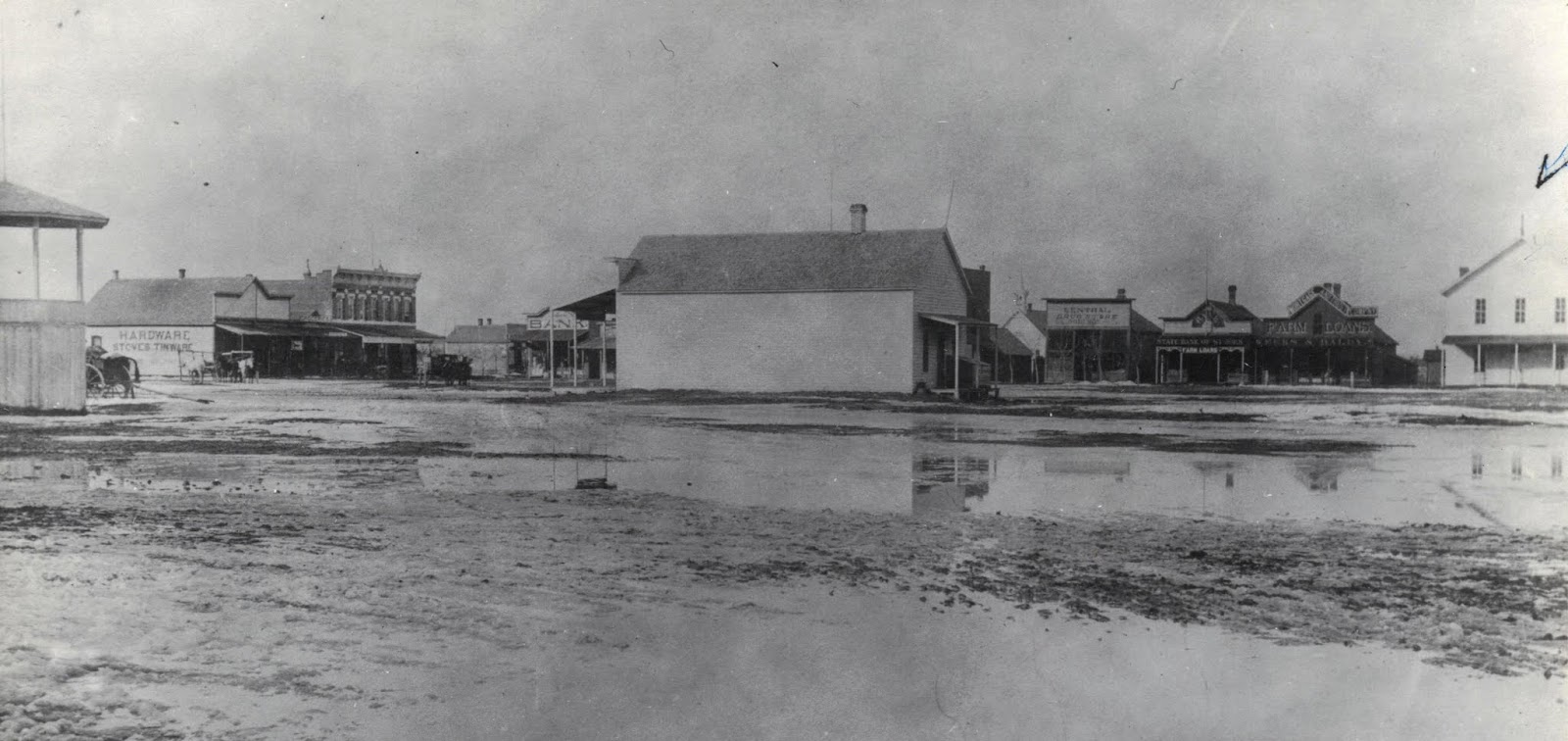
       St. John Town Square with Band Shell at far left
The reputation of the St. John Town Band was so impressive that they were often called upon to play in other towns.  When the Pratt County People's Party held it first political rally parading down Main Street, it was the St. John band that furnished the music for the parade.  The band was often asked to play for political events, organizers knowing that the band would draw a larger crowd.
 
So highly regarded were these musicians that a band shelter was built in the St. John Square, although the rest of the town square was nothing more than a muddy eyesore in wet weather and a source of dust blowing through the town when the season was dry.  (The first photograph of the St. John Band was taken in front of the City Stable, where Isaac often slept  with his horses when he needed to stay in St. John overnight.  The second photograph shows the band shell at the far left with the rain soaked bare town square in the foreground.  Remember, the photographs can be viewed larger by clicking on them.)
 
The opportunity to enjoy music with friends was one of Isaac's greatest pleasures!  Those of us living in a time when music is available in our homes, our cars, and while we go for a jog, as well as the many places where we can enjoy live performances, need to be reminded what a special treat hearing music was for those living in earlier times. 


Thursday, January 17, 2013

Females & Finance in the late 1800s

Image from the County Capital, the newspaper to which Isaac subscribed
 
Two of homesteader Isaac Werner's closest neighbors were single women with claims of their own.  He was friendly and supportive of both his unmarried "spinster" neighbor Persis Vosburgh and his divorced mother of four neighbor Isabel Ross.  I will write more about the surprising number of single, female homesteaders in a later post, but this week's post is about Women and Wall street.  While doing research in the actual copies of the County Capital available at the Stafford County Historical Society, I discovered the wonderful image and story shown above.  Isaac would certainly have seen this story, and one of the things about which he was most certain was women's rights, something the Populist Movement supported more than the other political parties of that time, Republican or Democrat. 
 
Ironically, among the individuals Isaac and the People's Party most disliked were speculators and Wall Streeters.  Therefore, while Isaac would have had no problem with the general idea of women being capable of doing whatever they chose to do, because he disliked the entire class of speculators and Wall Streeters, it would have been interesting to have seen his reaction to this story.
 
The story reads in part, "The fever of Wall street speculation has reached the women of New York.  There are at present enough women gamblers in stocks to make it profitable to run a stock broker's office exclusively for women."  (Remember, you can click on the image to enlarge it in order to read more of the story.)  This story, published in a Populist newspaper, used the derogatory term "gamblers" rather than "stock investors."  The image is from an 1890 newspaper.
 
The history of the New York Stock Exchange goes back to May 17, 1792, when 24 stockbrokers gathered under a buttonwood tree and signed an agreement to establish rules for buying and selling bonds and shares of companies.  The name by which it is currently known was shortened from the original name in 1863.  You can read more about the history of the NYSE at http://www.nyx.com/who-we-are/history/new-york.      
 
The exact location of the "cozy room made attractive to the feminine eye and equiped with all the accessories usually found in the downtown broker's office" is not identified in the story.  According to a Bloomberg article by Kristin Aguilera, the first women to own a Wall Street brokerage were sisters, Victoria Woodhull and Tennessee Claflin, whose firm was known as Woodhull, Claflin & Co.  A New York Times story published in 1870 about the opening of their business predicted "a short, speedy winding up of the firm."
 
Aguilera's article cites Bureau of Labor Statistics in 2010 stating that "women held 53.2 % of the financial management positions in the U.S. and 37.7 % of the financial analyst positions."   At the time of writing the article, Kristin Aguilera was the deputy director of the Museum of American Finance and the editor of Financial History magazine.  You can read the full article at http://www.bloomberg.com/news/print/2011-12-28/a-history-of-wall-street-s-women-echoes.html.
 
While it may surprise many that women were active traders on Wall Street so early, full acceptance of women did not come for decades.  The first woman to own a seat on the NYSE was Muriel "Mickie" Siebert who joined 1,365 men at the exchange as the sole woman on December 28, 1967.  Two endorsements are required on the application to become a member, and Siebert was turned down by nine prospective sponsors before finding two men willing to sign for her.
 
The anomosity Isaac felt toward speculators and Wall Streeters was caused largely by his beliefs about two things:  manipulation of commodity prices to keep famers from receiving a fair price for the crops and livestock they raised and political power that enabled the wealthy to control Senators and Congressmen, both state and federal, to enact laws that favored the wealthy.  Today, many farmers use commodity markets to protect themselves from wide price fluctuations for the crops they raise, and agri-business controls powerful lobbying of politicians.  Neither of the present political parties has exculsively attracted the laborers, miners, and farmers that comprised the old People's Party of Isaac's day, but the perception of the wealthy exerting disproportionate political power remains.  We are left to wonder what Isaac would have thought of today's voter alignment and of women on Wall Street.  


Wednesday, January 9, 2013

Isaac Werner's Personality

As I was reading The Forgotten Founding Father, Noah Webster's Obsession and the Creation of an American Culture by Joshua Kendall, I could not help noticing how many of Webster's traits seemed present in Isaac Werner.  Like Webster, Isaac was insistent on doing things right and disgusted with others who seemed content with doing only what was necessary to get by.  Isaac was constantly buying equipment that he modified with improvements before he would be satisfied with its performance.  His journal entry of February 19, 1888 is one example:  "Over-hauled fanning mill mostly all over to get same into working order, never put together right."
 
In addition to striving to make things right for his own farming equipment and methods, Isaac expended ongoing efforts to assist others.  His January 29, 1888 journal entry is a good example of Isaac's desire to reach out to improve things for others:  "While eating my breakfast conceived the idea of some competent man to go through the country and inspect each 1/4 section of land, its Surface Soil & its subsoil and classify them by number or letters according to the predominating elements of soil.  Then implements could be devised to work most satisfactory just those different soils and that would afford a basis to work on and continue improving thereby soon elevate the standard of agriculture and saving large sums of money from being expended in useless tools."
 
Isaac was active in farming organizations, hoping that farmers could share their experiences, successes and failures, to improve farming techniques for everyone.  He became disgusted, however, with meetings that neglected the educational portion of the gathering to become merely social.  He was even more impatient when members failed to study the educational material made available to them.  He observed which farmers seemed willing to implement progressive ideas and invited them to join with him in a separate group.  His December 6, 1889 journal entry described:  "...first meeting, 4 of us, [Wm] Campbell, Frank Stimatze, Ferguson & I organized Albano Reform Club...to afford more privilege to discuss political matter outside Alliance." 
 

Isaac also initiated the formation of a County Reform Club, of which he was chosen President at the first meeting, but so little interest was shown by those attending the initial meeting and by others Isaac attempted to recruit that a second meeting was never held.  Isaac had more success in founding the Stafford County Agricultural Society, of which he served as the secretary.  Inevitably, Isaac was disappointed with the commitment of other members who failed to dependably attend meetings or to diligently work toward the goals of the organizations. 
 
Reading about Noah Webster and his failed newspapers and poorly attended lectures, but also his unflagging efforts to advance his political ideals and to create an American culture through common spelling, pronunciation and grammar could not help but make me think of Isaac.  When I shared my observations about Isaac with author Joshua Kendall through e-mail exchanges, he replied, "Isaac fits the type."  See Kendall's website at http://joshuackendall.com  
 
For a time, Noah Webster favored the idea of adopting phonetic spelling for the new American nation, an idea he later abandoned.  Isaac also flirted with the idea of phonetic spelling for the farmers' movement, believing it would make it easier for immigrants who were just learning English as their second language, as well as for English-speaking farmers who had never learned to read or write, to acquire the ability to read progressive newspapers and educational material.  In Isaac's January 30, 1891 journal entry he wrote:  "I most the day reviewing books and Shakespeare, where several publishers combined in London to issue first complete edition, and what reading that 1623 edition now is to us and our present mode of spelling obominable [sic] to what it may be in the near future with some proper effort."  (See 1-3-2013 blog, "The Spelling Bee" about irregular spelling.)
 
So, paraphrasing author Kendall's book subtitle, I asked myself, "Did Isaac Werner have an Obsession to Create a Superior American Farmer?"
 
A recent article in http://psychnews.psychietryonline.org/newsArticle.aspx?articleid=1555744 includes an interview with Joshua Kendall about not only Noah Webster but also about his new book, American Obsessives:  The Compulsive Energy That Built a Nation, due to be released this summer.  Kendall told the interviewer, "The job of a biographer is to get inside of a subject's head.  I guess what fascinates me about obsessional types is that they are always pretty clear about what is on their minds."  You can read more about Kendall's new book at www.americasobsessives.com.
 
My manuscript is both biography and history, Isaac at the center of the story of his community and the Progressive movement of the late 1800s.  Isaac's daily journal entrys from 1884-1891 certainly helped get me inside his head.
Webster's handwritten drafts of dictionary entries
The article in Psychnews explains that most of us have a mix of personality traits which vary in intensity.  Among those traits, a trait that is moderated can be useful, but if carried to the extreme may be disabling.  The very traits that led some to consider Noah Webster vain, arrogant, and self-promoting are the same traits that allowed him to undertake writing a speller that was used by American school children for nearly a century and produce a dictionary that took three decades to complete.  Webster's personality demanded sacrifices from his family and caused offence among his friends as he devoted his attention to the job at hand, neglecting most other things and the needs of others. 
 
One of the professionals Kendall consulted for his new book was John Oldham, M.D., co-author of The New Personality Self-Portrait: Why You Think, Work, Love and Act the Way You Do, which explores ways traits that can be disabling in extreme cases can also be what makes a person successful when moderated.
 
To answer my own question, "Did Isaac show traits of obsessive-compulsive personality?" as a layman I believe he probably did.  But, more importantly, did he moderate those traits sufficiently to have a successful life?  Absolutely!  While the fact that he never married may have related to his personality, and he spent many days and nights alone with his reading and his projects, he also had some genuinely good friends.  He managed to create one of the most beautiful farms in the area and to free himself from indebtedness in difficult times, and he did a great many good things for his community that no one else would have had the drive to do.  Quoting Joshua Kendall's concluding words from the Psychnews interview, "Biographers are tempted to either slime their subjects or idealize them.  But people are so much more complex."  

Thursday, January 3, 2013

The Spelling Bee

8th Grade Graduates of Stafford County, Kansas, abt. 1915
As I polished this draft before posting it, my first act was to click on "Spell Check."  In a world where entire phrases are reduced to letters, like BFF and LOL, and where the ease of using Spell Check corrects most errors, being the best speller in the class holds less  prestige. 
 
However, in Isaac Werner's day, pride in winning the spelling bee meant something!  When classes were finally conducted in the new Emerson School (#33) that Isaac helped build, a few days after classes began Isaac recorded in his journal:  "Jan. 14, 1886.  Evening was to be 1st spelling bee in new school house."
 
Standardized spelling did not always exist.  Reading old documents with irregular spelling might mislead you to think the author was poorly educated; however, for Americans, it was not until Noah Webster published his book, A Grammatical Institute of the English Language in 1783, later called The American Spelling Book, that American spelling, pronunciation, and grammar gained an effective champion for standardization.  By the year of Webster's death in 1843, nearly 13 million copies of his spelling book in various editions had been sold, (many of which had blue covers for which his speller became known).  Sales following his death continued at a rate of about a million copies per year, remaining the favorite spelling book for nearly a century.  Of course, most of us know him because of his life's labor producing Webster's Dictionary.
 
As a result of spelling standardization, a new entertainment arose.  Spelling bees involved not only school children but also adults.  In his 2012 book The Forgotten Founding Father, Joshua Kendall quoted  an unnamed historian who described an adult spelling bee in which the community watched "a school trustee standing with a blue backed Webster open in his hand while gray-haired men and women, one row being captained by the schoolmaster and the other team by the minister, spelled each other down."  You may visit Joshua Kendall's website at http://joshuackendall.com/ .

Competitive spelling matches continue, including the Scripps National Spelling Bee established in 1925.  Webster's (now Merriam-Webster) remains the dictionary used for the competition.  The 2012 winner was Snigdha Nandipati of San Diego, California, and the winning word was guetepens.  You may visit www.spellingbee.com to read more about this competition.

The Scripps website shows that in 1925 the winning word was gladiolus, in 1935 intelligible, in 1975 incisor, all words familiar to most of us.  The goals of Scripps include not only improving students' spelling but also improving vocabulary, and the winning words beginning in 2001 would certainly increase most of our vocabularies, including such words as succedaneum, autochtonous, and cymotrichous! Competitors must not be beyond 8th graders, and the 2012 national competition included the youngest ever--six year old Lori Anne Madison.  With Snigdha Nandipati's victory, she became the fifth winner of Indian descent in a row and the tenth out of the past fourteen years.

The Scripps National Spelling Bee inspired a popular movie, Akeelah and the Bee.  Teachers wishing to motivate student participation in the local preliminary spelling bees leading to qualification for the national spelling bee are encouraged to show their classes this movie, which is still readily available online and is sometimes shown on television movie channels. 

While most of us rely today on Spell Check to support our atrophied spelling skills, it is still Noah Webster and his intellectual descendants upon whom the programers of the electronic spell checker rely to make sure we spell our words in the American standardized way.

(The girl pictured in the 3rd row, 3rd from the left, among the County Graduates pictured above is my father's oldest sister, Verna Pauline Beck, 1902-1926.  Verna became a teacher and probably contracted tuberculosis from one of her students.  She was only 23 years old when the disease took her life.)