Thursday, October 18, 2012

Politics and Wealth in Isaac's Day

What That "Wave of Prosperity" Is Doing

 
"We can have democracy in this country, or we can have great wealth concentrated in the hands of a few, but we can't have both."  Louis D. Brandeis, U.S. Supreme Court Justice (b. 1856 - d. 1941)

 
Ask most people about the Gilded Age and they will perhaps mention the mansions along 5th Avenue in NYC or the elaborate summer homes in Newport, Rhode Island, or they may recall names like Vanderbilt, Carnegie, and Gould.  What they are unlikely to mention are the factory workers, miners, steel workers, and farmers struggling to survive during an era better known for its extravagant displays of wealth.  This is the era during which Isaac Werner wrote in his journal about farmers who signed mortgages when rain did seem to follow the plow and prices for crops were high, only to face foreclosure and starvation when drought, low prices, and higher interest rates defeated hope and hard work. 
 
Early America, when industry meant local craftsmen--like blacksmiths, barrel makers, tanners, tinsmiths, and millers, or crafts such as candle making, spinning, weaving, and butchering done at home--changed around the time of the Civil War to a nation of steel mills, factories, and corporations.  The United States male population described by Alexis de Toqueville in 1835 as having "...greater equality in point of fortune and intellect, or, in other words, more equal in their strength, than in any other country of the world..." had been replaced in only a few decades by a nation of great economic inequality among men.  Vast wealth brought disproportionate power and political influence.
 
The Gilded Age was the time during which the populist movement was born.  Farmers like Isaac joined laborers to confront the political influence of the wealthy few with the greater voting strength of the many.  Disproportionate wealth distribution during the Gilded Age is similar to current economic statistics referred to as the 1% vs. the 99%.  However, in Isaac's time government social programs to assist the aged, the disabled, and the unemployed were not available, and people literally starved.  Although the People's Party of Isaac's time failed in its attempt to establish itself as an enduring third party, many of the issues championed by the People's Party were subsequently implemented, including social programs and government regulations upon which Americans now rely. 
 
If you can afford to buy an election you can afford to pay higher taxes!
Today, the political debate about the disappearing middle class and economic inequity sounds very similar to issues debated during the Gilded Age.  The money pouring in to political ads since the Citizens United case was decided by the US Supreme Court has only made the significance of one citizen's vote more doubtful for some Americans, regardless of party affiliation.  (The  sidewalk graffiti posted on facebook garnered "likes" from friends of all political attitudes.)
 
One presidential candidate has declared that "Corporations are people too," although the definition in Black's Legal Dictionary states that a corporation is "an artificial person or legal entity created by or under the authority of the laws of a state or nation."  Since the creation of people still requires egg and sperm, an artificial person created under the authority of laws doesn't really have what it takes to be a person!  When our nation was founded the distrust of corporations in England was brought to the new land, and early laws reflected that distrust.  Gradually the laws changed, but current distrust of wealth and corporate influence shares much in common with early attitudes, making many voters feel insignificant within the political process, just as the working classes felt after the Civil War when corporations, trusts and monopolies gained power.
 
In 1906, Theodore Roosevelt wrote:  "Behind the ostensible government sits enthroned an invisible government owing no allegiance and acknowledging no responsibility to the people.  To destroy this invisible government, to befoul the unholy alliance between corrupt business and corrupt politics is the first task of the statesmanship of the day."  In Isaac's time the enemies of the working classes were Monopolists, Trusts, Wall Street, and Speculators, who were resented not only because of their disproportionate wealth but also because they used their wealth politically to gain advantages.
 
Letting the Little Fellow Think He's Driving--When He Isn't
Maintaining the economic balance to keep the United States a land of opportunity for all of its citizens has been a challenge since its inception, and particularly so after manufacturing and industry expanded beyond small, local producers.  The global marketplace is not new either, although it has certainly changed.  Franklin Roosevelt left a definition for what he believed necessary to a strong and healthy political and economic system:  Equality of opportunity for youth and others; Jobs for those who can work; Security for those who need it; The ending of the special privileges for the few; The preservation of civil liberties for all; and The enjoyment of the fruits of scientific progress in a wider and constantly rising standard of living."  FDR was a Democrat, but the goals he enumerated would seem to meet with the approval of most Americans. 
 
Isaac's generation confronted how to accomplish those goals during the Gilded Age; the often-described Greatest Generation confronted meeting those goals while fighting a world war during the Depression and World War II; and the present generation confronts those same goals today.  The two political cartoons from 1890 seem especially applicable as election day 2012 nears.  Is the "Wave of Prosperity" lifting only some of America's citizens while drowning others, and are some Americans being hoodwinked by the wealthy and powerful to believe they are driving political decisions when they are not?  Are these questions as relevant today as they were in Isaac's time? 

Reading Isaac's journal and researching the era about which he was writing intrigued me with political similiarities to our own.  Then as now, each person's vote mattered.  Political views continue to differ, but everyone still has the same precious right to cast a ballot!
 
Remember, you can click on the images to enlarge them.    

Thursday, October 11, 2012

Isaac Builds a School House

Emerson School House, Dist. 33, Stafford County, Kansas

The earliest school in Isaac's community was a soddy, but on New Year's Eve at the close of 1884, neighbors met prior to the bond election to discuss the style and dimensions of a new wooden school house.  On January 3, 1885, Isaac recorded in his journal:  "Great election day voting $500. Bonds district 33 Stafford Co., Kansas for School bonds."  Although women would not have the vote in general elections for many years to come, the Kansas state constitution had given women the right to vote in school elections, and apparently they exercised that right enthusiastically in support of the new Emerson school.
 
The school board retained contractor David Carnahan to construct the building, and he hired Will Goodwin and Isaac Werner to help him, but it was not until October 13th that Isaac wrote:  "...came round by new school house, Carnahan foundation nearly bricked up, & few loads of lumber on ground, soon all to be got this week & house to go up next week."  During the following days, Isaac recorded his labor at the school house, and on the last day of October, he wrote:  "[E]ve up with wagon to school house got tool chest...," taking some of the leftover building materials in partial payment from Carnahan.  Two weeks later he wrote, "...settled with Carnahan being very near square," and on December 6, 1885, he wrote with satisfaction:  "Yesterday school house building accepted by directors of Carnahan pleased with the job etc.  school to commence to-morrow."  During the remaining years of Isaac's life he attended many community meetings in that building, and he often went there alone to make needed repairs, or as he said, keep it "tidy."  The above picture of the school house Isaac helped build was taken in the early 1900s several years after Isaac's death, showing a neglect of repairs to the siding of which Isaac would have surely disapproved!
 
The stucco-finished Emerson School House, Dist. 33, Stafford, Co. 


A few years after that picture was taken, the wooden structure that Isaac helped build was replaced by a larger, stucco-finished school with a basement.  My father's older siblings may have attended the wooden school, but my father began school in the newer building.  He is the little boy sitting next to the steps with his chin resting on his hands.  The girl sitting next to him is his cousin, Lucille M. Hall, who bequeathed Isaac's journal to the museum bearing her name, and both she and my father are descendants of George Hall, Isaac's friend.  (My father and Lucille were born only a few days apart, and they were great buddies during childhood and remained close as adults.)
 
Public school education was a high priority for early settlers, and when farmers began to organize during the hard years of the 1880s and 1890s, education remained a core issue of the populist movement.  One of the books Isaac read during this time was written by Ignatius L. Donnally, a U.S. Congressman from Minnesota and a leader in the populist movement.  Caesar's Column is a novel set in the future, which depicts class warfare between the extremely wealthy and the workers they have reduced to inhuman conditions.  Donnally's book imagines what could happen if the trends of the Gilded Age, with a growing economic gap between the wealthy capitalists, bankers, and industralists and the factory workers, miners, and farmers of the working classes, were allowed to continue. 
 
In his book, Donnelly depicts the disadvantages of educating the nation's children in separate schools, with children of the wealthy, professional, and managerial classes abandoning public schools.  In the novel, a group of educated survivors escape the cataclysmic class war and establish a utopian community dedicated to avoiding the old world's mistakes.  One of the fictional founders of that utopia describes their education system with these words:
"We abolish all private schools, except the higher institutions and colleges.  We believe it to be essential to the peace and safety of the commonwealth that the children of all the people, rich and poor, should, during the period of growth, associate together.  In this way, race, sectarian and caste prejudices are obliterated, and the whole community grow up together as brethren.  Otherwise, in a generation or two, we shall have the people split up into hostile factions, fenced in by doctrinal bigotries, suspicious of one another, and antogonizing one another in politics, business and everything else." 
Caesar's Column was published in 1890.
 
Ralph center front right, Lucille behind, & Arthur Beck behind her


 Although Isaac was a bachelor without children of his own, be believed in the importance of supporting education.  Even after the school was built, if Isaac noticed something in need of repair, he fixed it.  For Isaac, public school tax dollars were an investment in our nation's future, unrelated to having children in school.  His efforts built a school for many children who attended Emerson District 33 School, including my own father and the ancestors of countless others.  He did not expect reimbursement for his volunteer repair jobs or the books from his own collection that he donated.  He acted from the belief that communities are better served by educated citizens, and he supported the school with his taxes, his private acts of repair, and his donated books.

Remember:  You can enlarge the images by clicking on them.

Thursday, October 4, 2012

Writer of the Prairie

Red Cloud, Nebraska
"Black Hawk, the new world to which we had come to live, was a clean, well-planned little prairie town, with white fences and good green yards, about the dwellings, wide dusty streets, and shapely little trees growing along the wooden sidewalks.  In the centre of the town there were two rows of new brick 'store' buildings, a brick school-house, the court-house, and four white churches.  Our own house looked down over the town, and from our upstairs windows we could see the winding line of the river bluffs, two miles south of us."  Taken from "My Antonia" 
 
For Willa Cather fans like me, a visit to Red Cloud, Nebraska, is like a literary Disneyland.  Cather's fictional town of Black Hawk is a stand-in for Red Cloud, for Cather's novels often involve the use of her hometown and the people she knew there.
 
Red Cloud Opera House
Many of you may remember reading My Antonia in high school.  If you haven't read it, perhaps you should.  If you have, you might consider reading it again.  Just as I often tell Kansas children that they should read L. Frank Baum's Wonderful Wizard of Oz, I believe those of us who love the prairie should read Willa Cather, and My Antonia is a good place to start.
 
If you live close enough, you may want to include a visit to Red Cloud as part of your Cather experience.  There you can see on the west side of the main street, which is Webster Street, the "new brick store buildings" described by Cather in the paragraph that opened this blog.  In the middle of the row is the Red Cloud Opera House, circa 1885, where Cather attended performances.  The Cather Foundation offices, gallery, bookstore, and auditorium now occupy this wonderful space, with exciting plans underway to expand the facilities.
 
Silas Garber's bank
 
 
During your visit you could go inside the Harling (Miner) House, circa 1878, to see the tiny room where the "hired girl" after whom Cather fashioned the character of Antonia slept.  You could drive out into the country to visit the Pavelka Farm where the "real Antonia" lived with her husband and where they raised the family of children described by the fictional Jim Burden when he visited Antonia as an adult.
 
 
You could also see the Farmers' and Merchants' Bank built by Silas Garber, which houses a museum with other memorabilia connected to Antonia.  Garber was the founder of Red Cloud and the 4th governor of Nebraska.  What is significant to Cather fans like me, however, is that Silas and his wife were the prototypes for Captain and Mrs. Forrester in another Cather novel, The Lost Lady.  When I visit Red Cloud, fiction always trumps reality!
 
Red Cloud Train Depot
 
My favorite of Cather's novels is O Pioneers! about a woman who takes over the family farm after her father's death.  Cather writes often about the immigrants who claimed homesteads on the Nebraska high prairie, and many of them arrived by train.  Alexandra Bergson is the Swedish heroine of O Pioneers! with whose love for the family farm I identify.  "She had never known before how much the country meant to her.  The chirping of the insects down in the long grass had been like the sweetest music.  She had felt as if her heart were hiding down there, somewhere, with the quail and the plover and all the little wild things that crooned or buzzed in the sun." Many Swedish immigrants, as well as those from other countries, arrived by train, and when she was a child, Cather enjoyed being at the depot.  During your visit to Red Cloud, you could see the original 2-story building that existed in Cather's day.
Willa Cather's childhood home
 
When young Jim Burden describes the view from the upstairs window in the above quote, Willa Cather was surely thinking of the view from her rented childhood home.  Visitors can now tour her old home, furnished as it would have been when Cather lived there.  The Cather Foundation has recently acquired the home Cather's parents bought in 1903, where Cather spent summers when she came to stay with her family.  It is now possible to stay in the home her parents bought when you visit Red Cloud.
 
There are many other Cather sights to see in Red Cloud and the surrounding countryside.  We visited the grave of her cousin, upon whom her Pulitzer-winning novel, One of Ours, is based.  Cather was the first woman to receive that award.
 
If tackling one of her novels seems a little intimidating, I highly recommend her short stories.  Among my favorites are "The Sculptor's Funeral," "Old Mrs. Harris," "A Wagner Matinee," and "Coming, Aphrodite!"  Cather's writing shares in common with another favorite of mine, Harper Lee, the richness of writing about people and places they knew.  What both women write will stay with you, because when you finish their books you feel like you have come to know their characters and have been present in the places described in their books.  Theirs are book to slow down and savor.
 
Consider going to the library to check out a Cather book, or going online where many of her novels and short stories can be downloaded.  If you find a favorite, or already have one, please leave a comment recommending your favorites to other visitors to this blog.  I hope that at least some of you will join Cather's many fans, including international readers, and soon you will be among those who love to debate which book or short story is her best!
 
For more information, visit www.willacather.org.  

Thursday, September 27, 2012

How Investors Created Pratt

Lyn in Pratt County Museum lobby near books for sale
Pratt County lay alongside the south boundary of Isaac's homestead, and its earliest towns were Iuka and Saratoga, both of which Isaac visited.  Iuka was established in 1878, the year Isaac came to Kansas, and although Saratoga was not incorporated until 1884, the settlement existed earlier.  Pratt Center was also incorporated in 1884; however, the method of its creation differed from the earlier towns.  Rather than evolving naturally from a cluster of settlers at its core, Pratt Center was formed by a syndicate.  In fact, the early town site was mockingly called "Dog Town," because the only genuine residents were the prairie dogs.
 
Briefly, Kansas required all counties to set aside land to be used for schools as the population grew and families with children settled the area.  Frequently, however, families preferred to donate an acre from their own homesteads for building a school nearer their homes.  With these small one-room schools dotting the countryside, one or two in each township, the land reserved for schools was often unusued.  Predictably, settlers chose to run the risk of treating these lands as homesteads, planning to make an official claim when the land was released from the school set aside requirements.  It was just such land that became involved in a legal scandal when Pratt Center was formed.  Leaving the details of that legal dispute for a later post, or to read in my book, for now it is enough to say that Saratoga settlers alleged a fraudulent conspiracy to get their lands, while Pratt investors claimed they had utilized proper legal actions available to businessmen to develop their town.  Ultimately the pre-emptive settlers lost their farms and the businessmen created a town.
 
Having entered the battle for the county seat late, Pratt Center nevertheless gained the prize in 1888.  Many Iuka businesses and residents chose to move into Pratt Center, and the remaining Iuka businesses focused on services for surrounding farmers, becoming a center for marketing and shipping grain.  Saratoga, however, disappeared, having lost its post office in 1895, and so many businesses and residences having been literally moved into Pratt Center by 1900 that few landmarks of the town that Isaac had known remained.  


The North School Building with its basement
 
Part of the problem was the close proximity of Pratt Center and Saratoga, so close that Isaac seemed to use the two names interchangeably in his journal.  After getting the patents to his homestead and timber claim, Isaac's friend Doc Dix decided to move into town to resume his medical practice, and Isaac referred to the location of Doc's new residence by both names.  In December of 1887, Isaac helped the Dix family move, and when he finished helping his friends, he went over to Pratt Center to ride the new street cars which had been operating for only two weeks.  However, there is an old photograph showing the house of Dr. Dix in Pratt.  These and other clues make it seem likely that Dr. Dix did move his family to Saratoga but participated in the subsequent exodus to Pratt Center.

 
Pratt Center thrived.  In his journal entry of April 27, 1887, Isaac wrote:  "Pratt Center laboring under a new boom, outfit at grading Rock Island R. R.  W. of road at town water tank, lots of new buildings going up all round along main street digging out foundations for several brick business blocks." 
 
Many of Isaac's trips to Pratt Center were to Blaine Bros. Implement Dealers.  He bought implements from them and they carried his notes given in partial payment.  When Isaac invented a 3-horse cultivator, he turned to them for advice about patenting his invention.  The 1993 publication by the Pratt County Historical Society, a re-publication of a 1911 book published by the Pratt Commercial Club, contains a picture (at left) of the distinguished D. W. Blaine, who was then engaged in the automobile business.  In 1888, with a population of 3,000, Pratt Center had twenty brick buildings; a city waterworks, electric lights, and a street railway; five churches (Methodist, Christian, Presbyterian, African, and Catholic); four banks, three newspapers, and a 3-story school that included a high school.  The long list of businessmen included proprietors of about every business that could be imagined for a bustling prairie town. 

Lyn beginning the museum tour
The name Pratt Center had been adopted during the county seat battle to refute Iuka's claim that it was the best choice because of its central location.  (A change in the county's boundaries impacted Iuka's claim and allowed Pratt Center to assert its own location advantage, although neither town was actually the geological center of the county.)  After winning the county seat battle, Pratt Center no longer needed to assert the distinction of occupying the center of the county, and "Center" was dropped from the town's name in 1893 after a newspaper poll indicated that citizens favored the simpler name of Pratt.
 
Visit the Pratt County Historical Society Museum online at http://prattcountymuseum.org or at its location at 208 S. Ninnescah, Pratt, Kansas, to enjoy their wonderful displays or do research from their collection.
 
Remember, you can enlarge the images in this blog by clicking on them.


Thursday, September 20, 2012

Isaac's Giant Melon

Garden planted in the old chicken house foundation
When Isaac arrived on the Kansas prairie in 1878 and staked his timber claim and homestead, he did not own a horse.  It was 1886 before he bought his mare Dolly, and without a horse to pull a plow, he was limited in his ability to break sod.  For that reason, he focused upon planting and tending trees on his timber claim.  To meet the requirements for a homesteader, he resided on that claim, first living in two different dugouts before building a wooden house.  His farming consisted primarily of planting sod corn and tending his garden plot to raise his own food.
 
Over the course of keeping his journal, Isaac mentioned several things that he raised--tomatoes, cucumbers, peanuts, black-eyed peas, turnips, radishes, and melons among them.  His August 31, 1884 entry specifically described harvesting a forty-eight pound Cuban Queen watermelon.  As I did with so many references in his journal, I searched for information and at gardenweb.com I found a member comment about a Missouri grower in the late 1800s who had grown Cuban Queen watermelons.
My tidy 2011 garden in early spring
I researched many heirloom plants and animals mentioned by Isaac.  After he acquired horses his primary cash crops were potatoes and corn, and he tested many varieties to determine which grew best in his sandy loam soil.  I attempted to research each of the many varieties that he identified, but I could not find some of them, even after consulting farmers who raise heirloom plants.
 
At local nurseries most plants being sold are hybrid varieties.  Having overcrowded my 2011 garden, I had learned my lesson.  This past spring I was determined to plant no more than five tomato plants.  Unfortunately, something nibbled one plant down to the ground and ate about half of another plant.  It was early in the season, so when my husband went to town I asked him to buy a replacement for the destroyed plant.  Suffering from the same dementia I experience when I enter a plant nursery in the spring, he came home with three plants rather than only one--one to replace the plant nibbled to the roots, one to replace the partially eaten plant (because he didn't believe me when I said I thought it would be all right), and one because the clerk had recommended it so highly.
 
 
Mid-summer the path has disappeared
When I took the new plants to the garden and dug up the roots of the "destroyed" plant, I observed a sprout.  Not one to throw away a plant struggling to survive, I moved it to have a chance at life.  The partially eaten plant was recovering, so instead of my carefully spaced five tomato plants, I had eight crowded plants!
 
Marigolds that had ringed the 2011 garden had left behind seeds, whose descendants I carefully transplanted.  I also noticed tiny seedlings with tomato-like leaves, so I left them to see what they might be.
 
After being away for a long weekend in early June, we returned to find many healthy little tomato plants, especially in the area that I had found difficult to reach in the overcrowded 2011 garden.  Unpicked tomatoes had apparently fallen to the ground and left seeds in the soil.  I transplanted (unsuccessfully) a few of the volunteers to an area too shady for them to thrive and left the rest.  The thick little forest of volunteer tomato plants that I ignored began to sprawl, as the store-bought plants grew in their tall cages, beautiful towers of green.
Sprawling tomato vines escape through the fence
Whether you live in the central region of the United States or not, you know from my blog that this has been the second year of high temperatures and little rain.  Before it got so hot, we got a few tomatoes from three of the eight plants we bought, but I'm sure you can guess where most of our tomatoes were picked--from the ignored, sprawling volunteer plants, of course!
 
They engulfed the green beans, cucumbers, and onions, growing wherever Mother Nature planted them.  They exploded through the fence.  And, they produced tomatoes!
 
Volunteers overtake the herb garden
What do seeds from volunteer hybrid tomatoes produce?  In our case, cherry and Roma tomatoes, probably because in 2011 the large tomatoes did not produce well to leave behind any hidden seeds.  The volunteers seem to be more tolerant of the heat and drought than the fancy hybrids in their cages, some of which produced nothing this year!
 
Tomatoes and marigolds were not our only volunteers.  The zinnas from 2011 overtook the herb garden outside the fence.  Herbs are hardy plants, however, and they refused to give up.  The other thing that spread vigorously was the Bermuda grass, which was determined to fight for space in the jumble of plants intended for herbs.  It was a messy garden in 2012, but it survived the drought.
 
I hope this year's tomatoes hide some seeds beneath their sprawling vines for Mother Nature to tend.  She seems to grow better tomato plants than the nurseries!  However, I must be more hard hearted next spring about which little volunteers I allow to live.  Either that, or I need to clear more garden space in a sunny area!  Maybe then I could grow asparagus and strawberries and melons and...

Thursday, September 13, 2012

Before Carrie Nation--Prohibition in Kansas

Frances Willard
Ask most Kansans to name the woman who led the crusade against liquor, and they will think of Carrie Nation and her hatchet; however, prohibition in Kansas has a much longer history.
 
When Isaac Werner was a young druggist in Rossville, Illinois, selling liquor was part of his business, and one of the reasons he chose to sell his business was concern about the changing liquor laws.  By the time he arrived in Kansas in 1878 to claim his homestead, he was sympathetic to the prohibition cause, although he was never an active member of the Prohibition Party.
 
In 1880 Kansas voters (which would have meant men at that time) approved an amendment to the Kansas Constitution prohibiting all manufacture and sale of "intoxicating liquors."  The statewide ban went into effect January 1, 1881, and Kansas laws remained among the strictest in the nation for nearly seven decades, the statewide prohibition lifting only in 1948.  That year the Constitution was amended by authorizing the legislature to regulate, license and tax the manufacturing and sale, as well as the possession and transportation of intoxicating liquor, but open saloons were "forever prohibited."  Gradually, liquor laws were changed to bring Kansas more in line with other states.  
 
Despite the strict early laws of the state of Kansas, exceptions allowing sales of liquor for medicinal purposes and original container laws that permitted sales in the original containers under interstate commerce allowed liquor into the state.  During these years, a letter to the editor of the County Capital asked just how it was possible in a prohibition state for anyone so inclined to go to St. John or Stafford and get drunk!
 
While Isaac was living in Kansas, the Prohibition Party was a significant political influence, and at the center of the movement was the Women's Christian Temperance Union led by its second national president, Frances Willard.  Elected in 1879, she held that post for nineteen years.  At a time when women did not have the vote, WCTU women nevertheless championed prohibition through lobbying, petitioning, marching, preaching, publishing, and educating. 
 
Advertisement from the County Capital
The Prohibition Party created problems for the Populist movement, for among the People's Party were members who both favored prohibition and those who saw no reason to oppose responsibile consumption of liquor.  Whether Populist candidates supported prohibition or ignored the issue, they were bound to offend some portion of their members. 
 
In 1888 a young lady named Blanche Hazelett arrived in St. John and made her home with dentist Dr. McCann and his wife.  She had come as a WCTU prohibition lecturer, and when Isaac heard her speak at a meeting in Livingston one evening, he wrote in his journal that despite her youth, she was by far the best speaker of the evening.  It was not long before Isaac paid a social call at the McCann residence, and he recorded in his journal the "social time in pleasant surroundings."  Miss Hazelett became the Democratic candidate for County Superintendent of Schools, and her political biography during the campaign included the fact that she had served as secretary to Frances Willard.  When she lost the election, she resumed her travels as a prohibition lecturer, and Isaac enjoyed no further social calls on Miss Hazelett.
 
Frances Willard expanded the activities of the WCTU beyond prohibition, advocating for education, better working conditions for laborers, improved sanitation and health regulation, child protection laws, and work relief for the poor.  But foremost among her goals was what she called "Home Protection," which she felt could be best achieved by securing the vote for women above the age of twenty-one.  For those women who found the suffragists too strident and unladylike, home protection offered a socially acceptable way to work for enfranchisement.  With the vote, women believed they could impact laws concerning the issues important to protect their homes and families, including stricter laws to enforce prohibition.
 
Frances Elizabeth Caroline Willard died in 1898, but the Women's Christian Temperance Union carries forward its mission to this day.


Membership certificate of Ester (Esther) Hoopes
A friend shared this wonderful family document with me after reading this week's post about the WCTU.  The certificate belonged to her great grandmother, and she added the note that her ancestor was buried wearing her Carrie Nation pin.  Anthony, Kansas, where Esther Hoopes lived, is not far from Medicine Lodge, Kansas, home of Carrie Nation.  Thank you, Helen, for this wonderful addition to my post!     

Thursday, September 6, 2012

Confronting the Dalton Gang

One of my problems with history is organizing various historical events in my mind in relation to each other.  When I picture the wealthy women of the Gilded Age arriving for a party at one of the mansions along 5th Avenue wearing their long strands of pearls and exotic feathers artfully arranged in their hair, it is hard for me to place them chronologically alongside prairie women raising their children in a dugout.  Yet, they shared the same period in history.  One of the interesting experiences in researching and writing the book about Isaac B. Werner was putting the events of Isaac's time together like pieces of a puzzle.
 
When I told my husband that I was writing this blog about the Dalton Gang, he asked, "Were they robbing banks in Isaac's time?"  The answer is, "Yes, they were."  The County Capital, to which Isaac subscribed, reported the Coffyville bank robbery on the front page of its October 7, 1892 issue.

The days of the notorious outlaws of the American West had nearly ended by the time the Dalton brothers began robbing trains.  However, they were continuing a sort of family tradition, since the Younger brothers who rode with Jesse James had been their first cousins.  Jesse James was known for robbing banks, and it was said that Bob Dalton decided to cement his outlaw reputation by doing something Jesse James never did--robbing two banks at once in broad daylight.

The bodies of the Dalton Gang
Perhaps they chose their hometown for the site of the dual robbery because of its familiarity to them, but whatever the reason, it was a bad idea.  They had hardly entered Coffeyville the morning of October 5, 1892 when they were recognized, despite the false beards they wore.  The gang consisted of Bob, Grat, and Emmett Dalton, and two other outlaws named Dick Broadwell and Bill Power.  Three of them went to the C. M. Condon Bank and two entered the First National Bank on what proved to be the last day of their lives for all but Emmett.
 
Oldest brother Frank Dalton
However, this is not a post about these bank robbers.  Instead, it is a story of two lawmen.  Ironically, the oldest of the Dalton brothers was a Deputy US Marshal who served honorably and was killed when he attempted to arrest a horse thief in the Oklahoma Territory on November 27, 1888.  His brothers chose to follow in their older brother's footsteps, but their service was not so honorable, and they traded their badges for the outlaw life that killed all but one of them.
 
The rest of this story is about Town Marshal Charles T. Connelly, who rushed to defend  his town when the Dalton Gang rode into Coffeyville.  The members of the gang tried to make their get-away, but getting to their horses that were tied in an alley complicated their escape.  Grat did reach the alley, although he was mortally wounded, and when Marshal Connelly ran into the alley from the south end, Grat let him pass and then shot him in the back at close range. 
 
Charles T. Connelly was only 47 years old, but he had lived an admirable life, beginning when he enlisted in the Ninth Indiana at the age of 17 to serve as a Union soldier in the Civil War.  As a civilian after the war, he had been a teacher, and according to an interview his son gave the Kansas City Star, Marshal Connelly had accepted the position of high school principal and would have left his office as town marshal in a matter of days.  His son told the newspaper that his father had served for about five months, agreeing to accept the position during the summer when school was not in session.  He was approached by citizens who wanted more law and order enforced in their town, and he and the citizens thought he was a man who could get that job done quickly.
 
Grave stone of C. T. Connelly
Charles T. Connelly had two children with his first wife, and after her death he married again and had two more children, only one of those two still living when he was killed.  The memoriam in the Coffeyville newspaper said:  "As city marshal he discharged his duty with great courage, and absolute fidelity to the best interests of the city.  He gave his life freely in defense of the lives and property of our citizens and his faithfulness to duty will ever be held in grateful remembrance by the people of Coffeyville."
 
The public schools were dismissed, and students and teachers marched to the depot to met the train bearing his body, and honor guards from the GAR, the Ancient Order of United Workmen, and the Modern Woodmen marched in front of the hearse.  Charles T. Connelly was a respected man whose life was cut short by the famous Dalton Gang, whose name is remembered, while the name of the honorable marshal they shot in the back is largely forgotten.
 
At www.odmp.org/officer/3343-marshal-charles-t-connelly on the Officer Down Memorial page, Marshal Connelly is honored.  (All of the Dalton brothers were killed except Emmett, who was sentenced to life but pardoned after 14 years.  Three men who had ridden with the gang, Newcomb, Pierce, and Doolin, were not part of the Coffeyville robbery, although rumors persisted that Doolin had been there.  The reference on the Officer Down page to a shootout by the Dalton Gang a year later is unclear, as no Dalton could have been a participant. 
 
For an eye-witness account of the attempted bank robberies, you may visit "The Dalton Gang's Last Raid, 1892," at http://www.eyewitnesstohistory.com .
 
Visit http://skyways.lib.ks.us/genweb/civilwar/Charles%20T.%20Connelly.htm for the newspaper obituary, interview of his son, and funeral accounts (also the source for the image of Connelly's grave stone). 


Thursday, August 30, 2012

Chasing Ghosts

"I see dead people."  Of course, that famous movie line is from the 1999 movie, The Sixth Sense.  However, after 2 1/2 years with Isaac and his Stafford County neighbors, I can identify with Cole Sear, the young man from the movie who lived with dead people as real to him as his flesh-and-blood friends and family. 
 
As I finalize my manuscript, I am making an effort to discover details about a few of Isaac's neighbors, and this week, I experienced the historian's idea of hitting the jackpot!
 
G. G. John is first mentioned in Isaac's journal when Isaac went in search of fertile eggs to use in the incubator he designed and built.  What he found at G. G. John's place instead were hens and chicks, saving him the trouble of hatching his chicks in the incubator.
 
However, my specific interest in G. G. John came from the Probate Records detailing the administration of Isaac's estate.  The last two years of Isaac's life were difficult, ending with Isaac receiving round-the-clock care in the homes of others.  The man who allowed Isaac to spend a few more months in his own home was G. G. John, who checked on Isaac every day, ran necessary errands for him, and built an invalid chair to help him move around his house.  When claims were submitted to the estate, John's claim for five months of attending to his neighbor was ten dollars.  In contrast, the couple who took Isaac into their home later claimed ten dollars a month board, plus $2.50 a day and $2.50 a night for his care!  This was during hard times when one young man was willing to work for thirty-eight cents a day and men in search of work rode the rails and could be arrested as tramps in many cities for simply having no sign of gainful employment.
 
I wanted to know more about the man who asked so little for helping a sick neighbor (in contrast to other neighbors who took advantage of an opportunity to cash in on Isaac's care!)


My first clue about G. G. John came from an undated newspaper clipping in my great aunt's scrapbook with the headline:  "Byers Author Is Remembered / Leaves Own Books in Farm Mansion."  A reviewer of the book was quoted in the article as calling John's book, Whose Son is This?, "socialistic is theme, but scintillatingly brilliant."  His home was described in the article as having 13 rooms, with a large library, an elevated music room, a large cold storage room off the kitchen, and two separate wings, each with its own staircase.  That would have been quite a country home for those times--in fact, for today!

Searching for a man who used initials (without knowing the names for which those initials stood) is challenging, and his last name of John created its own problems.  Search engines insisted upon adding an "s" to the end, or putting "St." at the beginning.  Even knowing the state where he was born and his approximate birth date had not allowed me to find him on ancestry.com. 
 
Then, a friend told me about an 87-year-old man living in St. John who might be related somehow.  Crossing my fingers, I made a phone call.  Jackpot!  I spent a delightful couple of hours talking with Milton John about his Great Uncle George.  He shared wih me that George's parents had named all of their sons with double initials--O. O., E. E., and M. M.  Using G. G.'s newly confirmed given name and the names of his brothers, my search on ancestry.com succeeded, and I learned that George's father had an even more unusual pair of names.  His name was John John, a blacksmith and farmer born in 1831 in Virginia.
 
A few hours later I received an e-mail from Milton's sister sharing the birth, marriage, and death dates of George Griffith John!  I wrapped up my research with a trip to the court house deed records to confirm that G. G. lived on the land just to the west of Isaac's timber claim, making an easy walk for him to reach Isaac's house on his daily visits.
 
Neither his niece nor his nephew had a picture of G. G., nor of his Southern-style mansion embraced in porches.  Regardless, I can picture that house in my imagination, with a distinguished gentleman standing on the porch, holding a book.  How happy the kind, book-loving neighbor must have made Isaac each day when he visited those last five months Isaac lived in his own home.

So now you are wondering why I posted the picture of a group of men standing on the steps of the Stafford County Court House, aren't you?  Could one of those men be George Griffith John?  We can only guess...(unless someone out there discovers the real thing!  And, while you are looking for his picture, see if you can find a copy of one of  the books he wrote!!)

Thursday, August 23, 2012

Writer's Angst

Books whose titles were in Isaac's Library
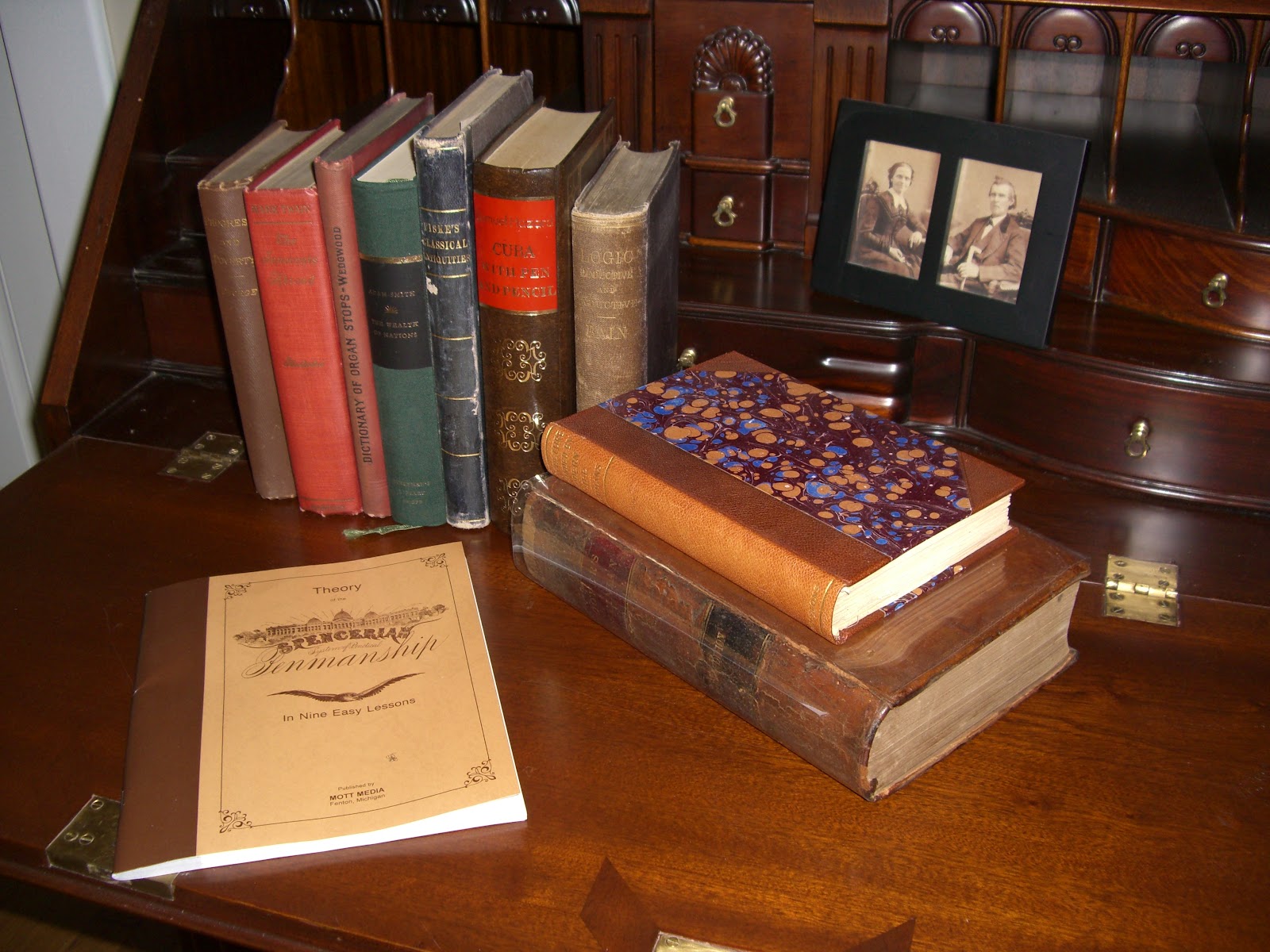
Most days the craft of writing is incredibly satisfying, but one night I experienced a serious bout of writer's angst, lying in bed awake, with thoughts jabbing at me.  I announced with satisfaction several weeks ago that my manuscript was finished, but I continued to tighten and polish it, each edit making it better.
 
 
Not that the story need be long, but it will take a long while to make it short.  Henry David Thoreau 
 
 
I have been living with Isaac for about two and a half years.  The transcribing of his journal was a sort of courtship.  The research was a matter of meeting his friends and family, getting acquainted with his neighborhood, and familiarizing myself with the books, ideas, and goals that were important in his life.  There was no point in considering an engagement to Isaac until I had done these things.
 
 
Next to doing things that deserve to be written, nothing gets a man more credit, or gives him more pleasure than to write things that deserve to be read.  Lord Chesterfield 
 
 
I knew very quickly after the discovery of Isaac's journal that his was a story that should be told.  However, it was not until I reached the point in his journal when he began to write about farmers organizing to confront their problems politically that I saw the arc to his story.  What had been a struggling homesteader's diary became a history of the populist movement with Isaac at its center.
 
 
Close the door.  Write with no one looking over your shoulder.  Don't try to figure out what other people want to hear from you; figure out what you have to say.  It's the one and only thing you have to offer.  Barbara Kingsolver 
 
 
I begin every day reading aloud what I wrote the previous day before writing anything new.  I edit with a more objective eye and I fall back into the rhythm of my writing, and only then can I start a new writing day.
 
 
An essential element for good writing is a good ear.  One must listen to the sound of one's own prose.  Barbara Tuchman 


Isaac's journal
There is nothing like reading my work aloud to show me awkward passages or if I am being verbose or dull.  As I told someone once, if it bores you to read it aloud, why would you expect a stranger to find it worth reading?
 
...an author is one who can judge his own stuff's worth, without pity, and destroy most of it.  Colette 
 
By the time I finish a chapter, I have read it aloud to myself, deleting, rewriting, tweaking it in countless ways many times.  I then put it aside for several weeks to allow me to edit with a more objective eye.
 
Books aren't written, they're rewritten.  Including your own.  It is one of the hardest things to accept, especially after the seventh rewrite hasn't quite done it...  Michael Crichton 
 
Eventually, all the chapters were written, and the process of polishing and editing the manuscript as a whole began--was the tone consistent, were characters properly introduced when they appeared and identified as they reappeared, were recurring events threaded through the manuscript in such a way that a reader could recognize the sequence as it advanced the story, were there enough clues to orient a reader without being redundant?
 
Every sentence has a truth waiting at the end of it and the writer learns how to know it when he finally gets there.  Don DeLillo
 
I write at the computer, so when I edit, the old version disappears.  After completing a careful rewrite, which I see at that time as the best I can do, I print it.  I use colored paper clips to hold each chapter.  My first saved version of the manuscript was clipped with white paper clips.  My second version used red.  I have now gone through blue, green, pink and yellow.  The version I announced as finished used the yellow clips, the last color option in my box of paper clips.  The subsequent rewrites were not printed...not because I am out of colors but because I knew when I finished that they were not my last revisions.
 
The most valuable of all talents is that of never using two words when one will do.  Thomas Jefferson
 
I have realized that my night of angst was the result of knowing that, while I had been successful at tightening the manuscript, doing what Jefferson advocated, the manuscript was still too long.
 
I believe more in the scissors than I do in the pencil.  Truman Capote 
 
My sleeplessness just may have been the ghost of Truman Capote poking me with scissors.  Writers know to ask themselves, does this advance the story?  If it does not, it must be eliminated, regardless of how interesting or beautifully written it is.  Doing all of the research that I have, I discovered so many interesting things, but taking Truman Capote's advice, I have cut wonderful sections from the manuscript that did not seem necessary to advance the story.  In short, I may miss them, but I don't think an editor will.  Perhaps I will share those deleted stories in future blogs!

My therapist told me the way to achieve true inner peace is to finish what I start.  So far today, I have finished 2 bags of M&M's and a chocolate cake.  I feel better already.  Dave Barry

This time the manuscript really is "finished" and ready to be shown to others.  Isaac is about to make his debut--edited, polished, tweaked and slimmed down to make a good impression.  I'm not sure what color paper clip he will be wearing.


Thursday, August 16, 2012

Earthen Prairie Homes

Isaac described the sandy loam soil of his claims as "light blow-sand," a description that would seem to indicate soil incapable of holding together in the rectangles of sod used to build homes or of supporting cave-like dugout walls and roof, yet these structures are well documented in his community.  It was obviously the mat of prairie grasses with their strong, dense roots that held the soil together for use in construction of the rude homes built by settlers.  The sod having been stripped from the soil long ago, we find it hard today to imagine the sturdy earthen structures of our ancestors.
 
 
When Isaac resumed writing in his diary in 1884, he had lived on the Kansas prairie for six years.  By then he had built a wooden house of two stories with a basement room and a cellar for storing his potatoes, grains, and garden produce like melons, turnips, and peanuts.  However, in his early years on the prairie he lived in dugouts.  His journal mentions two different dugouts, abandoned by 1884.
 
 
His wooden house was atypical among his nearest neighbors.  Brothers Will and Felix Goodwin living just to the south of him across the Stafford-Pratt County line lived in a dugout.  Will had a small dugout, and when Felix joined him in 1884, Isaac "staked off Will Goodwin's new residence" and commenced fitting on Will Goodwin's side boards...hanging door, making table..." and finally "set roof on Will Goodwin's new dugout," completing the larger dugout to accomodate both brothers.  In 1885 when Jesse Green's family moved to the claim just to the east of Isaac, they built a soddy, and Isaac went to Larned with Jesse to buy the Iron Board Roofing Paper to finish the soddy's roof.  That same year Isabel Ross staked her claim just east of Isaac's timber claim.  Isaac met with her to discuss building her soddy, but "so much advising and different architecture about, I glad to escape the job."  Tousley became her contractor, but Isaac worked on building her soddy, from top to bottom--staking the dimensions, making the door and window frames, shingling the roof, and digging her well.  George and Nancy Henn lived in a soddy just to the north of Isaac's timber claim, and Persis Vosburgh, another single woman whose homestead was just to the west of Isaac's claim, lived in a dugout. 
There were wooden houses in the community, but Isaac's closest neighbors, as well as many other early homesteaders who arrived on the treeless prairie, took advantage of the materials at hand to build their earthen homes. 

The images used in this post are from the collection of Old Stafford County Pictures at the Stafford County Historical and Genealogy Society, available on CD at the museum.

The Santa Fe Trail Center near Larned, Kansas, has recreated both a dugout and a sod house for visitors to experience what living in these prairie homes was like.  Visit the Santa Fe Trail Center on facebook or see http://www.santafetrailcenter.org/. 

Remember to click on the images for larger viewing.


Thursday, August 9, 2012

Naron--an early settler, a town, and a cemetery


Near Isaac's homestead were two country cemeteries in use in the years before his death.  The nearest one was the Naron Cemetery in Pratt County, about two miles southwest.  The community of Naron took its name from an early settler, and the cluster of buildings included a store, a school, and a church.  In 1914 the town of Byers was founded about half a mile to the south of Naron, and the businesses in the old community literally picked up and moved to the new town.  The old Naron Cemetery continued to be used by the neighborhood, for it sits on a hill about a quarter of a mile northwest of Byers.

My aunt, Wilma Carr Beck, wrote a history of Byers, 1914-1964, in which she describes the celebration day of the new town, using information found in the Pratt Union newspaper.  The death of Naron and its rebirth as the new town of Byers was the result of the decision by the Anthony & Northern Railroad to locate its tracks where they did.  Byers was built along the north side of the tracks and was given the name of the railroad company president, O. P. Byers.  Relying on the promise of the railroad that the tracks would arrive in Byers on October 15, 1914, the town scheduled its celebration for that date.  The tracks did not actually arrive until later, but two political candidates did--the Honorable J. S. Simmons and Senator Jewett Shouse, and the town celebration became a sort of political rally.  There was also a balloon ascension and a barbeque dinner, and the citizens felt that their town was off to a strong start. 

As for the town of Naron that Isaac had known, Byers drew what was left of it like a magnet.  Many houses were moved, but the certain end to Naron was when W. F. Brown moved his store into Byers in March of 1915.  He carried a complete line of dry goods and groceries, and his slogan expressed his disappointment for the demise of Naron, as well as his commitment to Byers.  "We never came here and we don't intend to go away!" the slogan declared.  Using the pen name of 'Old Fisher Brown,' he wrote for the Pratt Union newspaper, and about the time of his commercial move to Byers, he wrote, "Old Naron was almost gone, but not forgotten."  Today, most of the people who remembered the old town of Naron are gone, taking their memories with them.  Even the town of Byers has nearly disappeared but for a few houses and one thriving business.


Isaac did not live to see the founding of Byers, but he certainly knew the settlement of Naron, often mentioning trips to the Naron Store, Farmers' Alliance meetings in the Naron school house, wagons parked around the Naron Church, and funerals held at the Naron Cemetery.  Naron was about a mile and a half south of Isaac's homestead, and the cemetery was about a half mile southwest of the town, so both were an easy trip for Isaac, even before he owned a horse.  Although Isaac chose to be buried in the Neelands Cemetery to the north of his claim, several of his friends and neighbors are buried in the Naron Cemetery, including:  Frank Curtis, whose life Isaac may have saved when he was only a teenager by suggesting changes in the boy's diet after the doctor had told his mother there was no hope; Charles Shattuc, who farmed some of Isaac's land as Isaac's health began to decline; William F. Brown, with whom Isaac shared an interest in books and ancient history, as well as progressive politics; Gus Gereke, who was a nearby neighbor and someone who joined with Isaac and others in planting a cooperative field of potatoes; and neighbors James Lattimore and Wesley Logan, whom Isaac hired to harvest a crop.  A visit to the Naron Cemetery cannot help but evoke sadness to see the several gravestones of infants and young children of Isaac's friends, their lives cut short by the hard times Isaac's Journal describes so vividly.


Reminder:  By moving your cursor over the images or clicking on them, you can enlarge the images to view them better.

International Visitors This Week

So disappointed that only one international visitor clicked on the "surprising" box below this week's post.  For the first time, France topped the list as the country with the most visitors this week, followed by Russia.  There were also visitors from Canada, India, Ukraine, China, Denmark, New Zealand and for perhaps the first time, Panama.  I do not check the listing of international visitors every week, so other countries may have been represented as visitors that I failed to see.  I can see the countries from which visitors come, but I cannot see who the persons are, nor can I tell who clicks boxes...so don't worry about privacy issues.  I don't know where my faithful visitors from Germany, the UK, and Japan were this week, but I missed you!   I just wanted to spend one week letting my international visitors know how much I appreciate their visits.  I will be posting a new message later today.