Thursday, August 30, 2012

Chasing Ghosts

"I see dead people."  Of course, that famous movie line is from the 1999 movie, The Sixth Sense.  However, after 2 1/2 years with Isaac and his Stafford County neighbors, I can identify with Cole Sear, the young man from the movie who lived with dead people as real to him as his flesh-and-blood friends and family. 
 
As I finalize my manuscript, I am making an effort to discover details about a few of Isaac's neighbors, and this week, I experienced the historian's idea of hitting the jackpot!
 
G. G. John is first mentioned in Isaac's journal when Isaac went in search of fertile eggs to use in the incubator he designed and built.  What he found at G. G. John's place instead were hens and chicks, saving him the trouble of hatching his chicks in the incubator.
 
However, my specific interest in G. G. John came from the Probate Records detailing the administration of Isaac's estate.  The last two years of Isaac's life were difficult, ending with Isaac receiving round-the-clock care in the homes of others.  The man who allowed Isaac to spend a few more months in his own home was G. G. John, who checked on Isaac every day, ran necessary errands for him, and built an invalid chair to help him move around his house.  When claims were submitted to the estate, John's claim for five months of attending to his neighbor was ten dollars.  In contrast, the couple who took Isaac into their home later claimed ten dollars a month board, plus $2.50 a day and $2.50 a night for his care!  This was during hard times when one young man was willing to work for thirty-eight cents a day and men in search of work rode the rails and could be arrested as tramps in many cities for simply having no sign of gainful employment.
 
I wanted to know more about the man who asked so little for helping a sick neighbor (in contrast to other neighbors who took advantage of an opportunity to cash in on Isaac's care!)


My first clue about G. G. John came from an undated newspaper clipping in my great aunt's scrapbook with the headline:  "Byers Author Is Remembered / Leaves Own Books in Farm Mansion."  A reviewer of the book was quoted in the article as calling John's book, Whose Son is This?, "socialistic is theme, but scintillatingly brilliant."  His home was described in the article as having 13 rooms, with a large library, an elevated music room, a large cold storage room off the kitchen, and two separate wings, each with its own staircase.  That would have been quite a country home for those times--in fact, for today!

Searching for a man who used initials (without knowing the names for which those initials stood) is challenging, and his last name of John created its own problems.  Search engines insisted upon adding an "s" to the end, or putting "St." at the beginning.  Even knowing the state where he was born and his approximate birth date had not allowed me to find him on ancestry.com. 
 
Then, a friend told me about an 87-year-old man living in St. John who might be related somehow.  Crossing my fingers, I made a phone call.  Jackpot!  I spent a delightful couple of hours talking with Milton John about his Great Uncle George.  He shared wih me that George's parents had named all of their sons with double initials--O. O., E. E., and M. M.  Using G. G.'s newly confirmed given name and the names of his brothers, my search on ancestry.com succeeded, and I learned that George's father had an even more unusual pair of names.  His name was John John, a blacksmith and farmer born in 1831 in Virginia.
 
A few hours later I received an e-mail from Milton's sister sharing the birth, marriage, and death dates of George Griffith John!  I wrapped up my research with a trip to the court house deed records to confirm that G. G. lived on the land just to the west of Isaac's timber claim, making an easy walk for him to reach Isaac's house on his daily visits.
 
Neither his niece nor his nephew had a picture of G. G., nor of his Southern-style mansion embraced in porches.  Regardless, I can picture that house in my imagination, with a distinguished gentleman standing on the porch, holding a book.  How happy the kind, book-loving neighbor must have made Isaac each day when he visited those last five months Isaac lived in his own home.

So now you are wondering why I posted the picture of a group of men standing on the steps of the Stafford County Court House, aren't you?  Could one of those men be George Griffith John?  We can only guess...(unless someone out there discovers the real thing!  And, while you are looking for his picture, see if you can find a copy of one of  the books he wrote!!)

Thursday, August 23, 2012

Writer's Angst

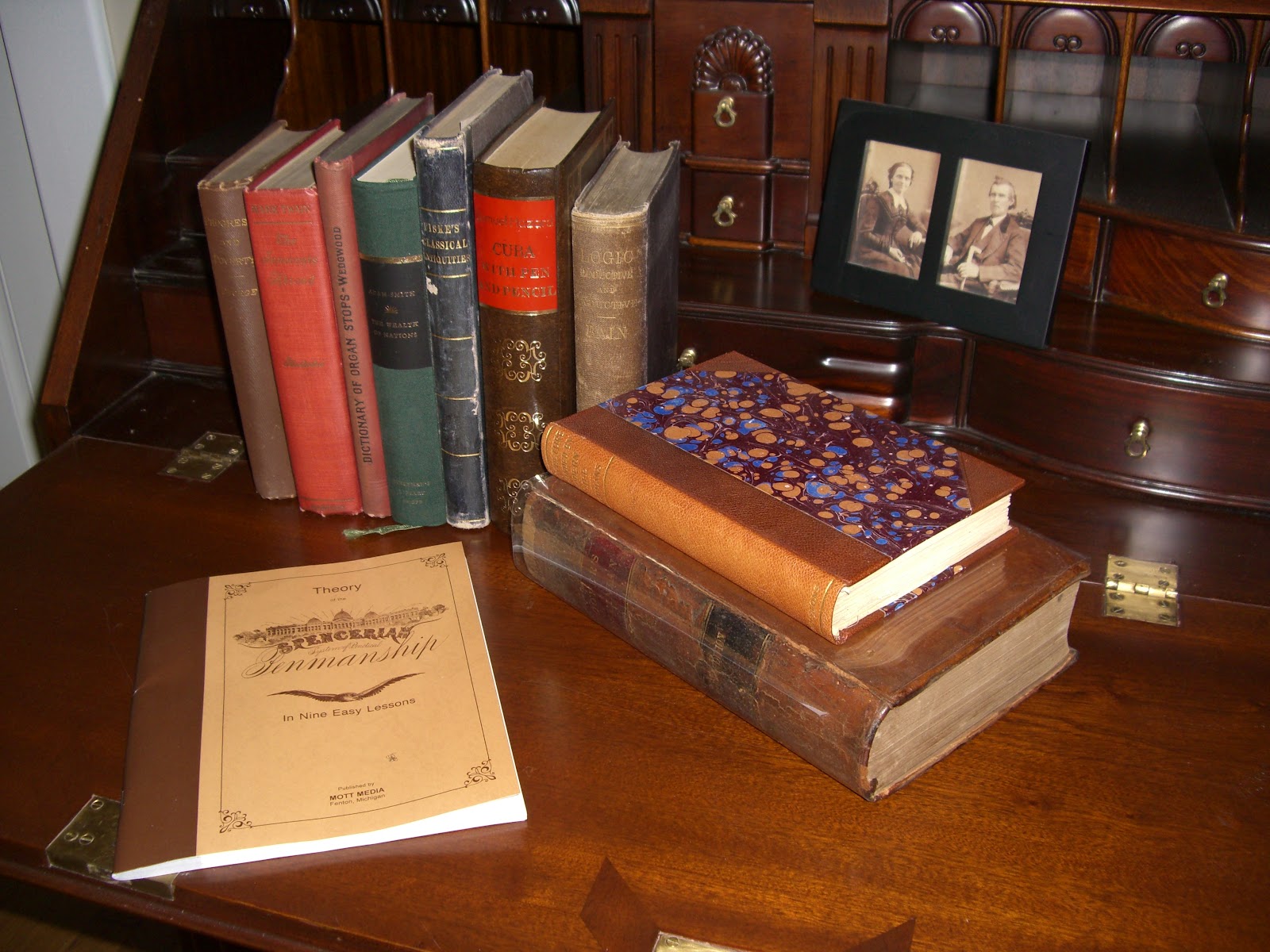
Books whose titles were in Isaac's Library
Most days the craft of writing is incredibly satisfying, but one night I experienced a serious bout of writer's angst, lying in bed awake, with thoughts jabbing at me.  I announced with satisfaction several weeks ago that my manuscript was finished, but I continued to tighten and polish it, each edit making it better.
 
 
Not that the story need be long, but it will take a long while to make it short.  Henry David Thoreau 
 
 
I have been living with Isaac for about two and a half years.  The transcribing of his journal was a sort of courtship.  The research was a matter of meeting his friends and family, getting acquainted with his neighborhood, and familiarizing myself with the books, ideas, and goals that were important in his life.  There was no point in considering an engagement to Isaac until I had done these things.
 
 
Next to doing things that deserve to be written, nothing gets a man more credit, or gives him more pleasure than to write things that deserve to be read.  Lord Chesterfield 
 
 
I knew very quickly after the discovery of Isaac's journal that his was a story that should be told.  However, it was not until I reached the point in his journal when he began to write about farmers organizing to confront their problems politically that I saw the arc to his story.  What had been a struggling homesteader's diary became a history of the populist movement with Isaac at its center.
 
 
Close the door.  Write with no one looking over your shoulder.  Don't try to figure out what other people want to hear from you; figure out what you have to say.  It's the one and only thing you have to offer.  Barbara Kingsolver 
 
 
I begin every day reading aloud what I wrote the previous day before writing anything new.  I edit with a more objective eye and I fall back into the rhythm of my writing, and only then can I start a new writing day.
 
 
An essential element for good writing is a good ear.  One must listen to the sound of one's own prose.  Barbara Tuchman 


Isaac's journal
There is nothing like reading my work aloud to show me awkward passages or if I am being verbose or dull.  As I told someone once, if it bores you to read it aloud, why would you expect a stranger to find it worth reading?
 
...an author is one who can judge his own stuff's worth, without pity, and destroy most of it.  Colette 
 
By the time I finish a chapter, I have read it aloud to myself, deleting, rewriting, tweaking it in countless ways many times.  I then put it aside for several weeks to allow me to edit with a more objective eye.
 
Books aren't written, they're rewritten.  Including your own.  It is one of the hardest things to accept, especially after the seventh rewrite hasn't quite done it...  Michael Crichton 
 
Eventually, all the chapters were written, and the process of polishing and editing the manuscript as a whole began--was the tone consistent, were characters properly introduced when they appeared and identified as they reappeared, were recurring events threaded through the manuscript in such a way that a reader could recognize the sequence as it advanced the story, were there enough clues to orient a reader without being redundant?
 
Every sentence has a truth waiting at the end of it and the writer learns how to know it when he finally gets there.  Don DeLillo
 
I write at the computer, so when I edit, the old version disappears.  After completing a careful rewrite, which I see at that time as the best I can do, I print it.  I use colored paper clips to hold each chapter.  My first saved version of the manuscript was clipped with white paper clips.  My second version used red.  I have now gone through blue, green, pink and yellow.  The version I announced as finished used the yellow clips, the last color option in my box of paper clips.  The subsequent rewrites were not printed...not because I am out of colors but because I knew when I finished that they were not my last revisions.
 
The most valuable of all talents is that of never using two words when one will do.  Thomas Jefferson
 
I have realized that my night of angst was the result of knowing that, while I had been successful at tightening the manuscript, doing what Jefferson advocated, the manuscript was still too long.
 
I believe more in the scissors than I do in the pencil.  Truman Capote 
 
My sleeplessness just may have been the ghost of Truman Capote poking me with scissors.  Writers know to ask themselves, does this advance the story?  If it does not, it must be eliminated, regardless of how interesting or beautifully written it is.  Doing all of the research that I have, I discovered so many interesting things, but taking Truman Capote's advice, I have cut wonderful sections from the manuscript that did not seem necessary to advance the story.  In short, I may miss them, but I don't think an editor will.  Perhaps I will share those deleted stories in future blogs!

My therapist told me the way to achieve true inner peace is to finish what I start.  So far today, I have finished 2 bags of M&M's and a chocolate cake.  I feel better already.  Dave Barry

This time the manuscript really is "finished" and ready to be shown to others.  Isaac is about to make his debut--edited, polished, tweaked and slimmed down to make a good impression.  I'm not sure what color paper clip he will be wearing.


Thursday, August 16, 2012

Earthen Prairie Homes

Isaac described the sandy loam soil of his claims as "light blow-sand," a description that would seem to indicate soil incapable of holding together in the rectangles of sod used to build homes or of supporting cave-like dugout walls and roof, yet these structures are well documented in his community.  It was obviously the mat of prairie grasses with their strong, dense roots that held the soil together for use in construction of the rude homes built by settlers.  The sod having been stripped from the soil long ago, we find it hard today to imagine the sturdy earthen structures of our ancestors.
 
 
When Isaac resumed writing in his diary in 1884, he had lived on the Kansas prairie for six years.  By then he had built a wooden house of two stories with a basement room and a cellar for storing his potatoes, grains, and garden produce like melons, turnips, and peanuts.  However, in his early years on the prairie he lived in dugouts.  His journal mentions two different dugouts, abandoned by 1884.
 
 
His wooden house was atypical among his nearest neighbors.  Brothers Will and Felix Goodwin living just to the south of him across the Stafford-Pratt County line lived in a dugout.  Will had a small dugout, and when Felix joined him in 1884, Isaac "staked off Will Goodwin's new residence" and commenced fitting on Will Goodwin's side boards...hanging door, making table..." and finally "set roof on Will Goodwin's new dugout," completing the larger dugout to accomodate both brothers.  In 1885 when Jesse Green's family moved to the claim just to the east of Isaac, they built a soddy, and Isaac went to Larned with Jesse to buy the Iron Board Roofing Paper to finish the soddy's roof.  That same year Isabel Ross staked her claim just east of Isaac's timber claim.  Isaac met with her to discuss building her soddy, but "so much advising and different architecture about, I glad to escape the job."  Tousley became her contractor, but Isaac worked on building her soddy, from top to bottom--staking the dimensions, making the door and window frames, shingling the roof, and digging her well.  George and Nancy Henn lived in a soddy just to the north of Isaac's timber claim, and Persis Vosburgh, another single woman whose homestead was just to the west of Isaac's claim, lived in a dugout. 
There were wooden houses in the community, but Isaac's closest neighbors, as well as many other early homesteaders who arrived on the treeless prairie, took advantage of the materials at hand to build their earthen homes. 

The images used in this post are from the collection of Old Stafford County Pictures at the Stafford County Historical and Genealogy Society, available on CD at the museum.

The Santa Fe Trail Center near Larned, Kansas, has recreated both a dugout and a sod house for visitors to experience what living in these prairie homes was like.  Visit the Santa Fe Trail Center on facebook or see http://www.santafetrailcenter.org/. 

Remember to click on the images for larger viewing.


Thursday, August 9, 2012

Naron--an early settler, a town, and a cemetery


Near Isaac's homestead were two country cemeteries in use in the years before his death.  The nearest one was the Naron Cemetery in Pratt County, about two miles southwest.  The community of Naron took its name from an early settler, and the cluster of buildings included a store, a school, and a church.  In 1914 the town of Byers was founded about half a mile to the south of Naron, and the businesses in the old community literally picked up and moved to the new town.  The old Naron Cemetery continued to be used by the neighborhood, for it sits on a hill about a quarter of a mile northwest of Byers.

My aunt, Wilma Carr Beck, wrote a history of Byers, 1914-1964, in which she describes the celebration day of the new town, using information found in the Pratt Union newspaper.  The death of Naron and its rebirth as the new town of Byers was the result of the decision by the Anthony & Northern Railroad to locate its tracks where they did.  Byers was built along the north side of the tracks and was given the name of the railroad company president, O. P. Byers.  Relying on the promise of the railroad that the tracks would arrive in Byers on October 15, 1914, the town scheduled its celebration for that date.  The tracks did not actually arrive until later, but two political candidates did--the Honorable J. S. Simmons and Senator Jewett Shouse, and the town celebration became a sort of political rally.  There was also a balloon ascension and a barbeque dinner, and the citizens felt that their town was off to a strong start. 

As for the town of Naron that Isaac had known, Byers drew what was left of it like a magnet.  Many houses were moved, but the certain end to Naron was when W. F. Brown moved his store into Byers in March of 1915.  He carried a complete line of dry goods and groceries, and his slogan expressed his disappointment for the demise of Naron, as well as his commitment to Byers.  "We never came here and we don't intend to go away!" the slogan declared.  Using the pen name of 'Old Fisher Brown,' he wrote for the Pratt Union newspaper, and about the time of his commercial move to Byers, he wrote, "Old Naron was almost gone, but not forgotten."  Today, most of the people who remembered the old town of Naron are gone, taking their memories with them.  Even the town of Byers has nearly disappeared but for a few houses and one thriving business.


Isaac did not live to see the founding of Byers, but he certainly knew the settlement of Naron, often mentioning trips to the Naron Store, Farmers' Alliance meetings in the Naron school house, wagons parked around the Naron Church, and funerals held at the Naron Cemetery.  Naron was about a mile and a half south of Isaac's homestead, and the cemetery was about a half mile southwest of the town, so both were an easy trip for Isaac, even before he owned a horse.  Although Isaac chose to be buried in the Neelands Cemetery to the north of his claim, several of his friends and neighbors are buried in the Naron Cemetery, including:  Frank Curtis, whose life Isaac may have saved when he was only a teenager by suggesting changes in the boy's diet after the doctor had told his mother there was no hope; Charles Shattuc, who farmed some of Isaac's land as Isaac's health began to decline; William F. Brown, with whom Isaac shared an interest in books and ancient history, as well as progressive politics; Gus Gereke, who was a nearby neighbor and someone who joined with Isaac and others in planting a cooperative field of potatoes; and neighbors James Lattimore and Wesley Logan, whom Isaac hired to harvest a crop.  A visit to the Naron Cemetery cannot help but evoke sadness to see the several gravestones of infants and young children of Isaac's friends, their lives cut short by the hard times Isaac's Journal describes so vividly.


Reminder:  By moving your cursor over the images or clicking on them, you can enlarge the images to view them better.

International Visitors This Week

So disappointed that only one international visitor clicked on the "surprising" box below this week's post.  For the first time, France topped the list as the country with the most visitors this week, followed by Russia.  There were also visitors from Canada, India, Ukraine, China, Denmark, New Zealand and for perhaps the first time, Panama.  I do not check the listing of international visitors every week, so other countries may have been represented as visitors that I failed to see.  I can see the countries from which visitors come, but I cannot see who the persons are, nor can I tell who clicks boxes...so don't worry about privacy issues.  I don't know where my faithful visitors from Germany, the UK, and Japan were this week, but I missed you!   I just wanted to spend one week letting my international visitors know how much I appreciate their visits.  I will be posting a new message later today.

Thursday, August 2, 2012

Celebrating America's International Roots

Hola!  Li-ho!  Jum Reap Sour!  Hej!  Salut!  Ciao!  Labdien!  Hallo!  Moi!  Ohayoou!  Hei!  Zdravstvuyte!  Witaj!    


Hello to all the international followers of my blog!  One of the surprises and great pleasures of my blogging has been the number of international followers that read my blog.  That was something I did not anticipate when I began my weekly posts in October of 2011.  The numbers began small and gradually grew.  The week of July 4th, my international visitors exceeded visitors from the USA.  That may have been an exceptional week, but the numbers of foreign guests remain consistently large.


They come from all parts of the world.  Listed alphabetically, they include:  Argentina, Australia, Barbados, Belgium, Cambodia, Canada, China, Columbia, Denmark, Finland, France, Georgia, Germany, Greece, Hong Kong, India, Indonesia, Israel, Italy, Japan, Latvia, Netherlands, New Zealand, Philippines, Poland, Russia, South Africa, Sri Lanka, Spain, Sudan, Sweden, Taiwan, Ukraine, United Arab Emirates, and the United Kingdom. 


Because the United States is a country of immigrants, perhaps I should not be surprised.  A brief history of our nation's immigration patterns reveals that in the colonial era of 1600 to 1795 the largest number of immigrants were British.  Strictly speaking, these early arrivers were not really immigrants, for in the early years we were still part of the British Empire.  A large number of those arrivals were indentured servants, whose passage was paid in return for their commitment to work as a servant for a certain number of years, typically seven, and of those early settlers, 90% became farmers.  In addition to economic reasons, many came for matters of religion.  My book, Should the Children Pray? includes chapters for each of the original thirteen colonies, describing the religious reasons why many colonists made the dangerous ocean crossing.  Along with the British immigrants, a large number of Dutch settlers located along the Hudson River, with people from Spain settling in Florida, Texas and New Mexico, while the French settled along the Mississippi River and the Gulf Coast.


During the period of 1790 to 1849 there was relatively little immigration, but beginning about 1850 a new wave of settlers arrived--Germans who settled primarily in the Midwest, and Italians, Greeks, Humgarians, Poles, others whose language was Slavic, and many Jews--all arriving in significant numbers.  These immigrants tended to fill the need for industrial laborers, and the USA expanded beyond its original agrarian roots to become a world leader in steel, coal, and textiles.


Of course, among the population were the Native Americans, who had made their homes here long before the immigrants arrived, and Africans, who arrived against their will.  The Chinese added to the growing population, as did Scandinavians, who settled primarily in the upper Midwest.  In the late 19th century, settlers from Lebanon and Syria came, many remaining in East Coast cities like New York and Boston.  Unavoidably, this brief summary leaves out other groups who arrived before and during Isaac's years on the prairie and made their own important contributions.


Focusing on the migration of populations in Kansas, it must first be remembered that many Indian tribes were relocated from their native homes in the eastern part of North America to land in Kansas.  In 1854 certain Kansas territory was opened to white settlement, but the population shift really began after the Civil War (1861-1865) and increased with the passage of the Homestead Act of 1862.  That settlement era included Black Americans seeking new homes after the Civil War.

Many of the Kansas homesteaders migrated from other states, their parents and other ancestors having immigrated earlier.  The largest international group coming to Kansas were German speaking, some coming from Germany and others from the Volga region in Russia.  There were also many Swedish immigrants, who arrived because of famine in their old country.  Mexican workers came along with the railroads and large agricultural operations, such as sugar beet production.

George & Theresa Hall with Maria & baby Lillian
Most of the homesteaders in Isaac's community relocated from other states, many from Pennsylvania (Isaac's childhood home), as well as a great many from Midwestern states.  However, there were also those who had not been born in the USA.  Among them were two of Isaac's close neighbors--George Henn and Gustave Gereke, both of whom came from Germany.  Surprisingly, the owner-editor of the County Capital newspaper in St. John, John Hilmes, came from Germany in 1872 and had acquired the proficiency with English to publish the weekly newspaper.  Of particular interest to me are my own great grandparents, George & Theresa Hall, who were close friends of Isaac.  They came from England in 1882, settling in Ohio for a few years before arriving in Kansas.  The baby on her mother's lap is my grandmother Lillian.  The picture was taken shortly before they left England for America.

Immigration to America continues.  In 2010 the countries from which the largest numbers of legal permanent residents came were Mexico, China, India, the Philippines and the Dominican Republic.  During the decade of 1990 to 2000, Kansas ranked 14th among all the states in the percentage of change in its foreign-born population, with a 114.4% increase.  The state with the greatest percentage change was North Carolina with a 273.7% increase.  The state with the least change was Maine with 1.1%

So, here is a tip of my hat to all of my international visitors.  I hope you continue to visit my blog and that you invite others to visit as well.  I thank all of you for the rich contributions your countrymen who have immigrated to the United States of America over the years have made to our national culture. 

To my international visitors, I invite you to "click" on the middle box below labeled surprising if you see your national flag on the map at the beginning of this week's post.  I had fun finding the flags for all the countries to glue on the map.  To my USA visitors, I hope you will open the comment box to leave a message stating the country of origin of your first ancestor who came to America.


Drought Link


The Blog Fodder, an early follower of my blog, has sent this link showing annual drought patterns in the USA back to 1896! Those of you engaged in agriculture will enjoy viewing drought conditions during important years of your families' histories. Thank you to Blog Fodder for this link and the many informative comments he has left to past posts!
http://www.nytimes.com/interactive/2012/07/20/us/drought-footprint.html?ref+earth

Thursday, July 26, 2012

Drought on the Prairie

"July was proving to be unusually hot, and rain was sorely needed.  The leaves on Isaac's potato plants were drying, even the ones in his garden patch that he watered daily.  The corn was suffering too,  drying before  ears had formed or silk was out, and leaves turning white.  The ground was too dry and hard most places to stir the wheat stubble, such droughty conditions being exactly what Professor Hicks had predicted.  According to the current almanac, the drought was to set in after June and continue into the 1891 and 1892 seasons.  Isaac could only hope that this time Professor Hicks was wrong."

The above quote is from Chapter 8, 1890, of my manuscript.  Did you think I might be quoting from this week's newspaper?  The passage certainly sounds familiar to many farmers in Isaac's old Kansas community.

In Isaac's time, he turned to almanacs for long range weather predictions.  The almanac pictured at right was published in 1892 by Dr. J. A. McLean to promote his patent medicines, but the "Storm Calendar and Weather Forecasts" were prepared by Rev. Irl R. Hicks, the "Storm Prophet," whose weather predictions Isaac came to respect.

Today's farmers have more sophisticated forecasting methods available to them.  The United States Seasonal Drought Outlook map shown below was issued by the National Weather Service.

 According to the news report accompanying the map, the current drought is the most widespread since 1956, with 56% of pastures and rangelands in poor to very poor conditions and stream flows at or near record low values across much of the Midwest and parts of the Central Plains, West, Southeast, and even parts of New England.  Sixty-four percent of the contiguous U.S. is in some degree of drought, with another 17% abnormally dry.

Working on my manuscript this week, tweaking and deleting to tighten the text in preparation for submitting to publishers, I read the paragraph quoted above.  Like so many issues from the 1880s and 1890s that relate to what we face today, today's farmers can obviously identify with the challenges faced by Isaac during the drought a century and a quarter ago.  Careful weather records like those kept in Isaac's journal are part of our present consideration of whether such climatic events are only cyclical weather patterns or whether today's weather is becoming more extreme and erratic.  Farming since Isaac's time has obviously become more sophisticated, but like Isaac, today's farmers remain subject to the challenges of unfavorable weather.    

Sunday, July 22, 2012

A Note to my International followers...

Because I have a great many international followers, I had hoped some of you might leave your comments to this week's post.  Whether you come from countries that were America's allies during W.W. II or you do not, sharing your family memories about W.W. II might allow us to see the ways in which people are more similar than different.  I believe history can help our generation avoid repeating the mistakes of the past, and the loss of so many young men in war is sad for every family, regardless of the uniform those soldiers wore.

Thursday, July 19, 2012

Living in the Past

History has overtaken the Fenwick household!  After tolerating about two and a half years of my immersion in newspapers from the 1880s and 1890s, my husband has discovered just how interesting reading old newspapers can be.  Last week, while I went through the old photographs available at the Stafford County Historical Museum in search of images that might be used in my book about Isaac, my husband joined me and began his own research from the Macksville Enterprise during the years of World War II.

Nearly every week's newspaper had a center front page section about the young men from Macksville (and occasionally a young woman) who were serving our country.  That generation is disappearing, and more than once since he began his research he has wished he had done it a few years ago when there were more veterans still living.  I am encouraging him to write about the interesting things he has found.  Maybe you will open my blog one week to discover a guest post from him!

So many Macksville men served in W.W. II, but there were also many who were given deferments to stay home and work the farms.  My father was one of those men, and I believe he always felt uncomfortable about not having served in the military.  He was very proud of my husband when Larry entered the Air Force after college. 

While Larry searched the information about the "Macksville boys in uniform," he found this interesting advertisement of the Community War Fund.

Published in the Macksville Enterprise October 26, 1944

The message reads: "Victory begins with the American farmer, working from long before sunset until long after nightfall.  Upon him falls the burden of feeding the fighting forces...the civilian population...and hungry mouths in war-torn countries."  It continues:  "Despite shortages of help and equipment, they have established records.  They have contributed mightily towards winning the war."


Having acknowledged the necessary role of those men whose military duty was deferred, the appeal for contributions to the War Fund was made.  "Now you are asked to help your fellow-men in another way...to contribute money to give men in the armed forces needed recreation, to give books and sports equipment to prisoners of war, to give nerve-shattered men in the merchant marine a chance to recuperate.  To give unfortunate people abroad and at home a chance to have life, liberty, and happiness."


I don't know whether my father responded to this appeal, although I would hope that he did.  However, I do believe he always felt that others his age gave far more to the war effort than he did, some men he knew having given their lives. 


The first Memorial Day after we had rescued the farm house, we resumed the old tradition of hosting a family Decoration Day Dinner at the farm.  Before the meal we paused to remember those family members who had served in the military.  Three veterans were present, and among the other guests everyone had someone to remember--a husband, brother, son, father, or brother-in-law.  

Many of the original homesteaders in Isaac's community were veterans of the Civil War, and my husband and I can trace family roots back to the American Revolution.  In during the research about Isaac, I verified that some from this community served in the Spanish-American War, and many answered the call for World War I & II, Korea, and Southeast Asia.  Yet there were also those who stayed at home.  In a farming community, I found it very significant to discover that appreciation was shown to the young men who stayed on their farms during W.W. II. 

Thursday, July 12, 2012

A One-room Schoolhouse Surprise

Isaac Beckley Werner was an accomplished carpenter, and he helped build the wood frame school house that served his prairie community.  He believed in education, not only for children but also for adults to continue reading and studying.  So, this post about a country school house is particularly apt.

Our last stop at the Homestead National Monument was the brick Freeman School.  White curtains waved at the windows as I crossed the boardwalk from the parking area, admiring the neatly painted privy behind the school and the American flag high atop its pole at the front.  This was certainly a handsome school for homesteaders' children to attend.  Later, I learned that the Freeman School did not close until 1967, earning the distinction of being the oldest operating 1-room school in Nebraska.

A park ranger greeted me inside the school.  I looked at the interior, so similar to other 1-room schools I had visited--with pictures of Washington and Lincoln at the front, wooden and iron desks in neat rows, and a stove in the center of the room.  The ranger described the history of the school and ended his talk with these words:  "This is where separation of church and state began."

What a surprise those words were.  As the author of the book, Should the Children Pray?, I had spent a great deal of time researching the historical, legal, and political issues surrounding public school prayer, and now I found myself standing in a school house with its own connection to that issue.  Of course, I knew it was the First Amendment to America's Constitution that established the relationship between our national government and religious beliefs, and it was Thomas Jefferson in his letter to the Danbury Baptist Association that used the description of "building a wall of separation between Church and State."  However, the ranger explained the role of the Freeman School to the issue. 
Several of the Freeman children attended the school, and when their father learned that the teacher was reading passages from the Bible to the children during the day, he asked that she stop.  When she refused, he took the matter to the school board, who supported the teacher's view that her readings "were for the best interest of the pupils."  Having exhausted his appeals to the school authorities, Freeman filed suit in the Gage County District Court, but the court ruled in favor of the school board.

Daniel Freeman was not a man to be easily dissuaded, and he appealed all the way to the Nebraska Supreme Court.  At last, on October 9, 1902, the case of Daniel Freeman v. John Scheve, et al,  was decided in favor of Plaintiff Freeman.  The court relied on the Nebraska Constitution rather than the United States Constitution for its ruling.  Citing Article 8, Section 11 of the state constitution, which provides:  "No sectarian instruction shall be allowed in any school or institution supported in whole or in part by the public funds set apart for education purposes," the opinion of the court was that readings from the Bible and prayer, even if no comments were made by the teacher, were prohibited.  Ironically, the named defendant in the suit, John Scheve, was not only an officer of the school board but also an organizer of the First Trinity Lutheran Church.  The feelings within the community during the long period over which this litigation extended (and probably for some time after) must have been intense.  Whether Daniel Freeman was a courageous defender of religious liberty or a meddlesome troublemaker depends on your point of view.  Unexpectedly, I had discovered another way in which Isaac's times are similar to our own.


Thursday, July 5, 2012

Isaac By My Side

Most writers will tell you that their characters, fictional or real, will begin to inhabit their waking lives, even when they are not writing.  Sometimes the characters will invade their dreams.  For the past few days, Isaac has joined me in the Kansas summer heat as I dig goat head stickers!
 
From 1878 when Isaac arrived on the Kansas plains to claim his homestead until 1886 Isaac was without a horse.  His journal is filled with references to his ongoing battle with sun flowers and sand burrs, and most of the time his only weapon was a hoe.  To get the benefit of better tools, he had to trade his own labor to borrow a neighbor's horse and plow.  In August of 1885 he wrote, "...up to Stimatze about getting final 1 horse plowing in 6 acre timber's [timber claim's] sandburrs in exchange for work."  Apparently Isaac was not able to barter his labor with Stimatze, for the next day he wrote, "...about done with tall sun flowers and sand burrs...(each tree is hoed).

I'm not certain whether Isaac was battling what local people call Mexican sand burrs--a small round burr covered with countless stickers--or what we call goat head stickers--a hard seed shaped vaguely like a goat's head with a single, long sharp sticker.  What I am currently battling are the goat head stickers.  That is work enough, so I am presently ignoring the grassy clumps of burrs growing in the same area. 

The challenge for me is digging the entire plant and carefully lifting it into the trash can without knocking any of the stickers off to hide in the dirt and repopulate the area I just dug.  When the trash can is filled, I take the contents to be safely burned.  Otherwise, the plants will dry up but the tough sticker seeds will drop off and germinate wherever they were dumped.

It's hot, dry and windy in Kansas right now, so I was outside this morning before sunrise, an empty trash can beside me and a garden fork in my hands.  The birds were serenading me, and the flies were biting as if I were the morning smorgasbord.  Sandy loam soil can look like a child's sand box, but in dry weather it can also take on the hardness of plaster of Paris, so the previous evening my husband had watered the area where I planned to dig, and it was just right for jabbing the garden fork underneath the central portion of the plant and lifting the root section.


The objective is to reach down below the stems to the actual root and pull the entire plant out of the soil, leaving nothing left to regrow.  Sometimes I find an old mother plant, nothing much left of her but the dry skeleton of her branches radiating like spokes of a wheel in a 3' or 4' span.  Her dry carcass must still be dug and lifted with special care to avoid dropping the dried seeds clinging to the stems.  My spiteful pleasure comes in digging all of her progeny clustered around the span of her reach, destroying everything she spent her life creating.  The truth remains that dig as I will, I know that the soil contains more seeds waiting to germinate as soon as my back is turned.

The plants are actually rather pretty, with delicate, almost fern-like leaves and tiny yellow flowers.  The circular pattern of the stems is highlighted with a peachy-orange color, the plant spreading discretely close to the ground where the mower blade will pass over without harm.  Trying to rid yourself of them by plowing, as Isaac seems to have done, only turns the seeds into the soil, unless the plowing is done before the seeds set.

As the sun climbs on the horizon and the temperature rises, I am glad to take Isaac with me to my computer as I write this post.  Tomorrow morning I will be back outside doing battle with the goat head stickers, and for many mornings to come, I fear.  I know I can defeat them, for our lawn is finally free of them--although I must be vigilant for those that we have planted by tracking the stickers into the grass on the bottoms of our shoes.  The work I am facing now is the result of my own negligence for having ignored that area of the farmyard the past two years while I researched and wrote about Isaac.  It's only fair that I take him with me outside every morning to face the digging and bending and pricks of my fingers and sweat and bites of the flies.  The monotony of the chore is abated by Isaac's company as I reflect on his life on the prairie and all the work he too did by hand.  He used a hoe for his digging, but I think he would have had better success with a garden fork!


Wednesday, June 27, 2012

Isaac as Photographer

Isaac's interest in photography is mentioned in his journal several times during 1871, and when he sold his drug store business, he considered becoming a photographer--if not a professional then at least an amateur.  With the changes occurring as towns sprung up on the prairie and railroad tracks slashed through the landscape, Isaac dreamed of preserving images of the unspoiled country before it was "ruined" by civilization. 

He believed there would be a particular market for stereoscope views, photographing not only the landscape but also public occasions and seasonal images to be enjoyed at other times of the year.  Stereoscope views consist of a pair of images taken by cameras a few feet apart, with the finished photographs mounted side-by-side on a rectangular cardboard.  Inserted in the adjustable rack of the stereoscope, when the pair of images are viewed through the lenses of the stereoscope, the two photographs merge into a 3-dimensional image.  In a world before television, movies and computers, stereoscopes provided both entertainment and the opportunity to view distant places.

Isaac studied the various types of cameras available, of which there were several, and just as today, the prices varied widely.  Although these cameras were expensive, in comparison to the amounts Isaac had spent on his library, a camera seemed affordable.  However, having sold his business, he may no longer have been in the position to purchase such luxuries, and it is uncertain whether Isaac bought his own camera.

A journal entry during the summer of 1890, two decades after the first entries about photography, it became obvious that Isaac's interest had not disappeared, for he wrote:  "...very anxious to have a series of Negatives taken of my home from several points of view."  The following day he added, "I walked over place with small mirror selecting point of views to photo, some time, making some 30 different interesting views I would like to have taken."

As if fate had heard Isaac's wishes, only four days later at a political rally in Pratt Center, Isaac met Seth Blake, a farmer with an amateur photo outfit.  Blake lived only 7 miles south of Isaac, and they struck up a friendship.  In the following months, Isaac accompanied Blake to several political rallies to photograph the events, and Blake began coming to Isaac's farm to photograph his neighbors, using  Isaac's picturesque farm setting as a back drop.

Among the neighbors Isaac recorded as having been photographed at his farm were the William Campbell family, Fracks, Frank Curtis team and women, William Blanch family, Graff and Penrose in buggy, Carr team and wagon, Sadie and children, Mrs. Henn and family, Miss Anna Carr and Miss Balser, Mrs. Ross, McHenry team, and numerous other photographs of boys on horses and groups that were not specifically identified.  The hard times had reduced the farms of many neighbors to abject poverty, and I suspect there are many photographs in family albums with Isaac's prosperous farm and beautiful tree groves in the background, assumed by descendants to be their ancestors' farms.  I have yet to locate any photographs of such family groups, nor the historically valuable images of political rallies and parades that Blake and Isaac took.  Neither have I found the photographs of Isaac's farm, his 3-horse cultivator, nor the co-operative potato patch, all of which are mentioned in his journal.

The cameras of that time were cumbersome and heavy; yet, Isaac describes in his journal the day he climbed into the top of his big cottonwood tree with one of Blake's cameras in an attempt to photograph an elevated view of his farm.  Imagine Isaac, at the age of forty-five, perched high in a cottonwood tree!  He concluded that the wind in the tree caused too much swaying to get a good image, and he climbed down without getting his photograph.

I remain hopeful that some of these photographs still exist for me to find.  Seth Blake did not develop his own dry plate negatives, which were developed by a studio in Pratt (probably Logan's) and by Miss Shira in St. John, so some of Isaac and Blake's photographs may appear on mounting cardboard bearing the logo or address of these or other studios.

I also know that Isaac sat for two different studio portraits of himself in 1890 and 1891, taken at Logan and Shira's studios.  He recorded having sent studio portraits to his siblings, as well as some photographs of his farm, but if they still exist, I have not located them.

I have made the most surprising discoveries in doing research for the book, so I continue to hope that I may yet find one of Isaac's photographs!

Thursday, June 21, 2012

Isaac's Farm Implements

Our visit to the Homestead National Monument near Beatrice, Nebraska, allowed me to see some of the implements Isaac may have used, particularly those he used in the early years after his arrival in 1878 before he had a horse.  A walking cultivator is displayed at the Palmer-Epard Cabin which was moved from a nearby homestead.  The homes in Stafford County, Kansas, were not so grand, for there were no trees for wood and little adequate clay for bricks or chinking between timbers, so they made their early homes from sod.

Because the original settler had cleared the land for crops, when the National Park Service acquired the land on which the first homestead had been claimed under the Homestead Act, they had to recreate the vegetation of the original prairie.  Isaac probably did not find the same grasses on his prairie homestead in Kansas, the tall grasses less prevalent further south.  Even so, imagine trying to break the sod without a horse or oxen to help.  To maintain the healthy prairie environment, the Rangers burn one-third of the park acreage each year, emulating Nature's prairie fires.


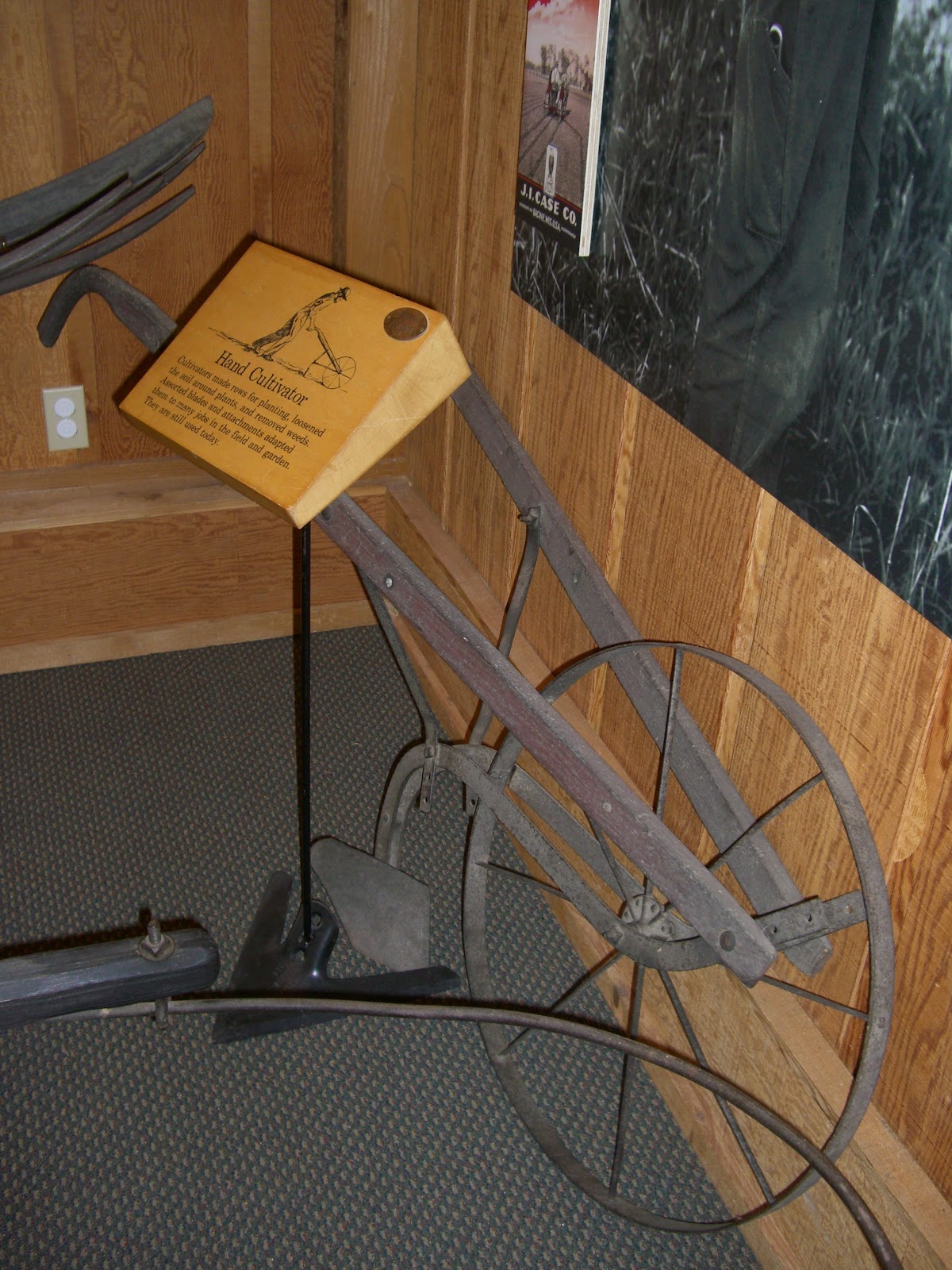
Among the implements on exhibit is a hand cultivator with a plow blade, rather than the forked tongs in the picture at the top of this post.  When Isaac traded his own labor in order to have a neighbor break sod for him with their horses, mules or oxen pulling the plow, even the turned sod with ancient roots imbedded in the soil would have been extremely difficult for Isaac to cultivate by hand.  Yet, hand tools were all that Isaac and many settlers had available to use without horses of their own. 

Once the ground was prepared for planting, these farmers who were dependent on their own manual labor, like Isaac, used hand planters, the one pictured being a hand corn planter.  Isaac's journal is filled with detailed records of his experiments regarding how many kernels to plant in each hill, the best date for planting, how far apart to make the hills, the spacing for rows, and the importance of making straight rows to facilitate cultivation of the growing corn.

Not all of the corn was planted in plowed soil.  In the early years, Isaac and many others planted "sod corn," planting hills in the midst of the prairie grasses.  The yield was not particularly good, but they managed to raise enough to supply their own needs.  Today's combines not only cut the stalks but also separate the ears from the stalks and the kernals from the cobs.  Isaac did that by hand, making use of the stalks for fodder or using the dried stalks for fuel in his stove, along with twisted husks and the cobs, once the corn was removed.


These photographs offer some understanding of the hard, physical labor required to create farms on unbroken land, the stubborn grass roots resisting the plow.  Only 40% of the settlers staking their claims endured the hardships and labor required to prove up their land and receive a patent from the government.  It is easy to understand why so many did not survive the difficult task, some giving up their lives in trying, others just giving up.


http://www.nps.gov/home/planyourvisit/150th-anniversary-of-the-homestead-act.htm

Thursday, June 14, 2012

Plum Harvest

Today's post is about harvesting things long awaited.  First, after more than two years of research and more than a year of writing and re-writing, I am polishing my manuscript in preparation to begin marketing.  Seeing the pages in a neat stack feels like quite a harvest to me!

Second, I have posted about canning plum jelly and have shared photographs of the blooming plum bushes, but for those of you who have never seen a sand hill plum, I have supplied only my verbal description of the plums.  Every year, like Isaac, I await the sand hill plums, hoping that there were no late spring frosts to harm the blossoms and that rains came at the right times so that the bushes will be loaded with plums in summer.  Those of you who follow my blog know that a late frost and too little rain left the plum bushes nearly empty last summer.  You also know that I have hoarded one last jar of the 2010 jelly, refusing to be completely without.  Now I can open that jar.

Hurray!  The 2012 plum crop is here, and the bushes are loaded.  Most are still too green to pick, but this morning I went out with my pail and my camera to pick and photograph the early ripened plums.  I will gather more in coming days before I set aside a day for making jelly, but the first day of harvesting the plums is deserving of celebration.

I believe they are early this year, and I know they are earlier than Isaac picked his plums.  I found one incredible thicket on which the plums are remarkably large.  Perhaps there were plums like these in Isaac's day that gave him so much pleasure eating them right off the bush, but I don't remember ever seeing plums so large.

Although my manuscript is nearly complete after many drafts and much editing, I will continue to post stories about Isaac and his community on my blog.  For those of you on facebook, you may visit my Lynda Beck Fenwick page to follow my progress in seeing Isaac's story published.  Just enter Lynda Beck Fenwick in the search window at the top of your facebook page to visit.

Things long awaited are especially enjoyed, and although finishing the manuscript is only a milestone and not the final goal, thank you for supporting me along the way so far.

Thursday, June 7, 2012

Are you one of 93 million descendants?

Isaac B. Werner had no descendants, but many homesteaders raised families.  Today it is estimated that 93 million people are descendants of homesteaders.  I am among that number, and perhaps many of you following my blog are too. 


This past weekend my husband and I attended the 57th Annual Willa Cather Spring Conference in Red Cloud, Nebraska, and I will be sharing that great American Writer and her hometown with you in future posts.  However, I mention our trip to Nebraska to share some side trips we took after the Conference.


The Homestead National Monument operated by the National Park Service is located near Beatrice, Nebraska, northeast of Red Cloud.  We enjoyed the drive through some of Nebraska's beautiful rural landscape and realized only when we arrived at the national park that it is the 150th Anniversary of the Homestead Act of 1862. 

Those of us who know the Great Plains region tend to think of homesteading as having occurred on the plains, overlooking the extent of America opened for settlement by homesteaders.  Upon arrival at the park site, visitors are immediately presented with the question:  "Do you live near a Homestead?"  A map shows that there were 30 homesteading states, although in 1862 when Abraham Lincoln signed the Homestead Act, not all of the territory had yet achieved statehood.  According to the park ranger who greeted us, Montana is the state with the largest homestead acreage, and Nebraska is the state with the largest percentage of its land having been homestead.  Kansas, where Isaac homesteaded, also has a great homesteading heritage.


As visitors approach the Heritage Center, the sidewalk parallels a wall showing the 30 homesteading states, with a box cut from each state's silhouette representing the proportion of that state's total area that was available for homesteading.  The photograph taken looking down a portion of the wall shows Nebraska at the far left, with Kansas next in the line of state silhouettes on the wall.


After an informative conversation with the ranger, we viewed the film and walked out just in time to see a Junior Ranger being sworn in.  It was great seeing how seriously the young man took the responsibilities he was assuming with his oath to learn about the prairie and help care for it and teach others to respect the land.  Notice particularly the tall Plexiglas tube on the left side of the photograph.  A bunch of prairie grass has been carefully extracted from the soil to show the blades of grass above the surface (above the top band on the tube) but also the length of the roots extending deeply into the soil.  Grass such as this formed the sod that homesteaders plowed to clear the land for cultivation of crops.  I will never again think that the common garden weeds that I pull have deep roots!

Isaac staked his claim in 1878, and it was not until 1886 that he finally bought a horse, having avoided the indebtedness necessary to purchase a horse until that year.  During his early years of farming, he traded his own labor in exchange for help from neighbors with horses and machinery to break the sod. This exchange of labor allowed him to break so little sod that much of his time was spent raising trees rather than planting fields.  Even when the sod was broken, he had to use hand tools for farming the ground.

The implements displayed near the homesteader's cabin on the grounds of the Heritage Center are those pulled by horses, mules, or oxen; however, at the Education Center the exhibit included man-powered implements like Isaac initially used.  When we arrived there, I spotted the sign directing visitors to that exhibit.  "Oh, look!" I exclaimed.  "This is where the farm implements are!"  I noticed two rangers exchanging perplexed expressions, and I said, "I suppose that is not something you usually hear from the women visiting your exhibits."  They laughed and nodded.  They had no idea that it was my time spent with Isaac that had caused my enthusiastic response to the opportunity to see the implements he used on his homestead.  In a future post I will share pictures of some of the implements I photographed.

Not only the Homestead National Monument has wonderful events planned throughout the summer commemorating the 150th Anniversary of the Homestead Act of 1862 but also the Nebraska Humanities Council is celebrating their state's homesteading legacy.  It is a great year to visit Nebraska, and when you do, be sure to include the Willa Cather Memorial Prairie and Willa's hometown of Red Cloud in your planning.  http://willacather.org/; http://nebraskahumanities.org/; and http://www.nps.gov/home/planyourvisit/150th-anniversary-of-the-homestead-act.htm.   


Wednesday, May 30, 2012

Isaac's Catalpa Trees

Perhaps it was the deep shade cast by the large, heart-shaped leaves of the catalpa trees that made Isaac love them as he did.  What he specifically mentioned in his Journal was the sweet perfume of their blossoms.  Blooming in late spring, the flowers resemble miniature orchids--delicate petals of white surrounding an open throat bordered with a tracery of burgundy accented with yellow.  Isaac found the fragrance of the catalpa blossoms sweet, but others find the scent overpoweringly strong, as I learned when a dinner guest once asked me to remove a catalpa bouquet from the room. 

The blossoms are followed by green seed pods 10" or longer, resembling elongated green beans.  These pods darken to brown by autumn, and their appearance gives the tree the common names of cigar tree, Indian cigar, and Indian bean tree.  A friend of mine understood that name literally as a youngster and tried to smoke one of the long brown seed pods.  It didn't work.

The name catalpa has an interesting history.  The Native American name for the tree was Catawba, but the botanist who wrote the first formal scientific description of the genus made a transcription error which resulted in the scientific name being Catalpa.  In some regions of the country, the Native American name of Catawba is still used. 

Catalpa leaves are the only food source for the caterpillars of the catalpa sphinx moth (Ceratomia catalpa).  The popularity of these caterpillars among anglers for use as live fishing bait has encouraged some fishermen to plant small catalpa groves to assure a ready source of what Southern anglers call "Catawba-worms."

One day, with the catalpa trees in full bloom and a new batch of chicks scratching around the chicken yard with the hens, Isaac had visitors.  The ladies who called were from the Antrim community a few miles to the east of Isaac, and like others sometimes did, they came to admire Isaac's farm, and especially, to enjoy his trees.  Isaac wrote in his Journal:  "[Misses] Gibbs & Mrs. Bushel called in buggy to see place & trees, got chick & catalpa bouquette, & well pleased," the bachelor homesteader offering a bit of prairie chivalry.

Thursday, May 24, 2012

A Guest Post by Misty Beck

After posting the blog remembering Memorial Days from the past, I asked my cousin, Misty Beck, if she would share as a comment an amusing story about how my Uncle Arthur taught her the tradition of decorating graves.  I fear that some of you aren't taking time to read the comments that visitors post, which are certainly worth reading.  In case you missed reading Misty's, I asked her if I could share her story for Memorial Weekend.  I've added this picture of me with my parents, decorating my grandparents' grave when I was about the age that Misty describes in her Guest Post.

Misty's Comment:
My grandparents (Arthur and Wilma, in Lyn's photograph posted May 10, 2012, 4th man from left and 4th woman from left) were adamant that when I was a child in the late 70s and early 80s, that I learn about the meaning of Memorial Day.  But, more importantly, my granddad insisted that I know where all of the family graves were located.  I remember every year as a child loading up the boxes of flowers (replaced with the ease of reusable plastic flowers in their later years) and heading to the cemeteries.

Our route included Farmington at Macksville, Byers (Naron), and Iuka.  At the cemetery, I would sit in the back of the pickup, or if we were in the car on the trunk--they didn't worry so much about safety back then. My granddad would drive, and when I found a family grave, I had to knock on the back glass.  He would stop, and then I had to show him where the grave was and tell him who was buried there.  This probably started when I was 3 years old.  My granddad died when I was 8, but I have very vivid memories of our trips to the cemeteries and how important it was to him that I know where those graves were.

While locations were important to my granddad, my grandmother found other things important.  Every year as we finished at the last cemetery (Iuka), she would remind me that we had one more set of flowers to put out.  See, my dad was adopted by my grandparents, because his biological mother died when he was born and his biological father couldn't take care of him.  Her grave was our last stop every year, because my grandmother always said we needed to thank his birth mother because she gave my dad to my grandparents.  And, if she hadn't, they wouldn't have me.  Of course, that was my grandmother's way of making it important to me.

I could probably still find all of the graves but must admit my Memorial Weekend pilgrimage is much shorter.  I just visit one cemetery to decorate our family graves there, but I am thankful that my grandparents took the time and energy to educate me on these great family traditions.  And, as I leave the Iuka cemetery every year, I put a small bunch of flowers on my dad's biological mom's grave...just like Gram always insisted.