Friday, January 27, 2012

Isaac Visits the future Hoopeston

When we left Rossville, Illinois, there was another place I wanted to see. I remembered that in the spring of 1871, Isaac, his friends John and Frederick, and this cousins Ezra and Henry, had borrowed a buggy to take a Sunday drive north of Rossville to the farm of a man named Hoopes. It was a time of rapid expansion of rail lines, and promoters would arrive with promises of new rail lines to serve rural communities and small towns, predicting that at every point where two rail lines intersected, a prosperous town was certain to grow. One such crossing was planned on Hoopes Farm, and the young men wanted to see if any evidence of actual construction to back up all the promises could be seen.

Having found the town of Rossville in the atlas, I also noticed a town with the name of Hoopeston, and although Isaac had called the prospective railroad town "Hoopstown" and had expressed his doubts that the promoters' predictions would occur, the location in the atlas and the farm described in Isaac's Journal seemed about the same. I wanted to see the countryside along the route the five men took to reach Hoopes Farm, which Isaac had described: "Some considerable tracts of prairie land lying open yet...noticed few wild geese and ducks on west side of road on few ponds...Passed by old Hoop's [sic] residence--on a very beautiful mount, commanding the landscape on every side, presenting beautiful prairie views." Our drive north of Rossville, nearly a century and a half later, passed through interesting country, but my imagination could not impose on the landscape the open prairie Isaac had described in his journal.

The five young men continued on their journey, and Isaac wrote: "...reaching the famous prairie site where the great future Hoopstown is to rear its wealths. ...Hearing so much about Hoopstown and R.R. crossing from the lips of Rail Road Maniacs, one gets to feel as I did--craving to gaze personally on the covetous spot then make up mind accordingly." Despite his skepticism, Isaac admitted in his journal: "What musing and dreaming takes possession of any one, contemplating the scene and project. Could we easily raise the means? Could we possibly buy these covetous acres at reasonable prices? Could we get all the Western R.R. to intersect this charming spot? ...But sighing Ah! It is all desert prairie yet. Not a habitation within three miles!"

Although Hoopstown was only a railroad promoter's description, with the prairie grass having been mowed to mark the future placement of the tracks at the time of Isaac's visit, the work on the railroad lines soon commenced and a town grew around the crossing. When we reached Hoopeston, we drove around to explore a little. By chance, we discovered the library. It was still open, so we went inside and met Linda Mitchell, Director of the Hoopeston Public Library. With limited time to spend and no research preparation or notes, I was ill prepared, but she graciously spent time with us, checking to see if any of their collection of local newspapers might have been published as early as 1871. They had not. It was an impressively busy library, which is always wonderful to see. We looked at what limited information she had to share from that era, and my husband took a photograph of the framed Hoopeston town map from 1893 (apologies for the glare from the glass).

As Isaac had stood on the spot where Hoopstown was predicted to bloom, he had imagined the potential an investor might gain if the town were to succeed: "...what a wealth and prospect would we enjoy." Instead, he dismissed the prospects for the future of the town on Hoopes Farm and returned to Rossville to form a milling partnership with his cousin Henry Werner and Mr. Ross, which lasted only a few years before Isaac moved on to stake his claim in Kansas. As Robert Frost wrote of roads not taken: "...I stood and looked down one as far as I could to where it bent in the under growth; then took the other...And that has made all the difference."

Friday, January 20, 2012

Isaac's Years in Rossville, Illinois

On the spur of the moment, my husband and I decided to drive to Northampton, Massachusetts, for a Willa Cather Seminar at Smith College. With no idea what a great adventure we would make of our impromptu road trip, I left all of my research about Isaac behind, except for what was on my laptop. Only when we stopped for the first night did we look at the atlas and realize how close to Rossville, Illinois, we would travel. Of course, we had to make the detour to see the town where Isaac had lived in the 1870s.

During 1870 & 1871, Isaac had been the proprietor of a drug store, but he had chosen to sell that business when the railroad came to Rossville. Druggists in those days sold liquor "for medicinal purposes," and Isaac was concerned that an unsavory crowd would arrive in town along with the railroad and cause trouble for him as a respectable businessman, demanding liquor for reasons other than their health.

Deciding whether to bring the railroad to Rossville was a tumultuous time for the community. Isaac sided with those who opposed it, and for a time he was among the majority. Isaac wrote: "Voted about 5 to 1 against issuing Bonds and about same ratio repealing former obligations. It was rather interesting and ridiculous during all day, to notice all round humanity how much Rail Roads on their brains, Bulls and Bears out in Rossville Wall Street crowds on store porches, freely and liberally discussing...and cussing."

Eventually the idea of a railroad began to gain favor, and the Bonds passed. The dispute shifted to where the depot should be built. Isaac described the conflict: "Somehow no public certainty yet where Rossville is to have its Depot for R.R., on Gilbert's, Livingyard's or Henderson's. Some tugging by each, but I guess old Gilbert will about win the stakes...Seem being conducted rather quiet & reserved." Isaac sided with Henderson, but Gilbert had been an early supporter of bringing the railroad to town, and Isaac suspected that the railroad would reward him by giving him the site.

After Isaac had left Rossville, a friend had written him a long letter, describing how the village had changed, specifically because of two events in the 1880s--a tornado that had destroyed many buildings and a fire that had burned the wooden businesses. From my research I had learned that Rossville had become known as a charming tourist destination, with many antique shops, some of which had been destroyed by a fire in 2004 which burned the west side of Main Street. Therefore, I knew that the town Isaac had known was essentially gone.

We arrived in Rossville a few minutes after four o'clock, and because we had a schedule to keep in order to reach our destination in time for the seminar, we could not linger. Consequently, we only peeked through the windows of the closed Historical Society Museum and Railroad Station Museum, both of which looked very interesting. We also enjoyed driving some of the streets, although we found nothing that appeared to date back as far as Isaac's time.

What we were able to see, however, was the river at the edge of town. Isaac worked in his drug store six days a week. Naturally, he looked forward to the one day a week when the store was closed and he could be out of doors, often joined by a dog named Coally. "...took exercise stroll down the woods...[with] Coally to chase rabbits--started few out but Coally too fat to run, lost distance all time till rabbit out of his sight, but he yelped after them." Even during the cold winter months the river was a gathering spot: "Fine calm clear moonlight eve, boys again down on the creek ice skating and hollering about, enjoying themselves." Isaac's cousin Ezra played the accordion and Isaac described one late afternoon stroll: "...down the lovely woody acres to West bluff, there perched on an old stout log, struck up the music...never before heard in the woods--the eve with west landscape and water scape over the bottoms right before us, such lovely sunshine of declining Sol... lightly roaring on rushing stream, and few little snow birds, chirping lively about the brush. Who could avoid imagining more or less Venice and Italy surrounding us?"

The opportunity to lock his shop and relax with friends in the countryside was something to look forward to, but most of his time Isaac was a businessman, at work from early morning into the evening. He was in his mid-twenties and was proud of his friendships with older, experienced businessmen in town. He wrote of one of the early Rossville businessmen: "[You] do not find every day such enterprising men as W.J. Henderson, with corresponding capital in an inland town like Rossville. ...Others, of course, since his adventuring tried to follow him, but if he had not been here as a leader, who else would have dared to lead? And what would they have accomplished. No Sir, J.W.[sic] Henderson was so far the business pillar of the community."

Isaac's years in Rossville were good ones for him. After selling his drug store business, he was tempted by the possibilities of participating in the town being built near Hoopes Farm, prospering as the town grew. Instead, he stayed in Rossville to form a milling business with his cousin Henry and a man named Mr. Ross. He also bought two lots in the "New Town" development of Rossville, planning to build a home with a separate library for all of his books. Although like many others he was eventually drawn further West where he claimed a homestead on the Kansas prairie, for more than a decade and even during hard financial times when his need for money was desperate, he kept the lots he owned in Rossville, perhaps imagining he might someday return, or perhaps only unwilling to sell because of the memories of old friends and good times there.

Rossville is still a charming town, and the arrival of the railroad did not ruin it after all, despite the concerns shared by Isaac and many of the established merchants. Next week I will share our journey as we replicated Isaac's trip with friends in a borrowed buggy to see the location of the proposed intersection of two rail lines where "Hoopestown" was supposed to be built.

Friday, January 13, 2012

Finding Isaac's Grave

In early days, when bodies were not embalmed, funerals were held within a day or two of death. Town cemeteries were too far away to travel by wagon or buggy, so communities created country cemeteries. The land was often donated, sometimes by the family who first needed to bury one of their own. These country cemeteries dot the Kansas landscape, some containing only a few old graves, others still in active use.

About four miles north of Isaac's timber claim was Neeland's Cemetery. It had originally been named the Livingston Cemetery for the fledgling town of Livingston, but many people referred to it by the name of the family who had donated the land for the cemetery, and today, that is the name by which it is known. Neeland's Cemetery began when a workman for Neeland's Ranch died and was buried in their pasture. Following that burial, the family donated three acres for a neighborhood cemetery. I had visited Neeland's with my parents when I was a child, and I remembered the interesting old gravestones I had seen there, many of them dating back to the 1800s.

Gravestones are genealogy records chiseled in stone. One particular stone in Neeland's tells the tragic story of the collapse of a sod dugout's roof during heavy rains. Nick Davison and his wife Mary were early settlers in the community, and soon after they arrived a daughter they named Beuna Vista was born. Less than five years later, another daughter was born, and she was named Bessie. Eighteen days after her birth, the weight of the rain soaked sod roof caused the ridge pole to snap, and the collapsed mud smothered the baby and her four-year-old sister. Memorialized on the beautiful stone are these two sisters and a third daughter whose life was also brief. Eight sons were born to Nick and Mary, but no other daughters.

Neeland's continues to be the final resting place for departed loved ones today. A symbolic modern stone tells its own tragic story of a young father who died in an accident, leaving behind his widow and three young children, the tragedy depicted with a pair of hands tenderly holding three little birds.

When I began searching for Isaac's grave, I considered several possibilities. The closest cemetery to Isaac's homestead was Naron cemetery in Pratt County, only about two miles from his home and the burial place of several of his neighbors. St. John was a possibility, because it was the county seat, where Isaac shopped, banked, marketed his crops, and attended farmers' meetings. With no family living close to him, it seemed reasonable that he might have chosen the county seat. Farmington Cemetery in Macksville is where my ancestors are buried, and Isaac was friendly with all of them, along with some other neighbors buried there, so that was also a possibility. And, there was Neeland's.

Isaac mentioned several funerals in his journal, with most of the burials in either Naron or Neeland's. His Probate Records include early claims submitted by the mortician and the casket maker, but only in the final accounting when his estate closed did the three dollar expense of his burial plot finally appear, with no indication of the specific cemetery. Because there was no claim for a gravestone, I assumed that Isaac was probably buried in an unmarked grave. The necessity of holding funerals soon after death meant that bodies were rarely transported any great distance, so I decided to begin my search at Naron and Neeland's, which were the two closest cemeteries.

The names of those buried in Naron are available online, but I found no listing for Isaac. There was no complete listing online for the Neeland's Cemetery, so I began inquiring who the members of the cemetery board were. With just a few phone calls, I reached one of the board members to ask if there was a record of Isaac being buried there. He was. Both she and I assumed his was one of several old graves in that cemetery that are unmarked, but she described the location of his grave, according to their records, and my husband and I went to see what we could find.

It was a cold December day, and I had been told that Isaac was buried in the fourth row, the second lot to the south of the driveway. We counted the rows, but in an old cemetery it is often difficult to determine exactly what placement of stones represents a row. We settled on what we thought was the correct row and I began pacing off fifteen feet from the edge of the tire ruts that serve as a driveway, since she had said that the lots were fifteen feet square. After fifteen steps I stopped, disappointed to see an empty space in front of me. "It should be about here," I told my husband. "I guess Isaac is buried somewhere in this empty area."

"Look beside you," he told me. To my left and about a half a pace behind me, there was Isaac's stone--a simple square column with engraving on the top to resemble a fringed cloth spread over the column. The carved letters were worn by age, but they clearly read, "I.B. Werner, Died March 21, 1895, Aged 51." The next day we returned with a spray of holly to decorate Isaac's grave, and each Memorial when we remember family with flowers, we stop by Neeland's Cemetery to place an arrangement on Isaac's grave. Perhaps his neighbors brought flowers to Isaac's grave for a while after his death, but for decades he had been a forgotten man. At last, Isaac is remembered.

Friday, January 6, 2012

Small town museums--Stafford County Historical Society

The Stafford County Historical & Genealogical Society is building poor. So many landmark buildings along the Main Street of Stafford have been gifted to the Society, that much of their budget is spent maintaining what they have received. It is another case of generous donors, unpaid volunteers, and a hard working Executive Secretary rescuing and preserving the history of the community for future generations. During the past two years, I have spent many days doing research at this museum.

The Stafford County Historical Society acquired a real treasure several years ago. For two generations, the Gray family operated a photography studio at 116 N. Main in St. John. Begun by W.R. Gray in 1905, the studio building also contained the family home. A son, Royal, followed his father's profession, operating a studio in Ulysses, Kansas, and another son, Dr. Arzy Gray, worked as a chemist for Eastman Kodak. After attending what is now UCLA, daughter Jessie became her father's business partner in 1940, assuming the business seven years later when her father died. When Jessie retired in 1981 she donated an estimated 29,000 glass plate negatives to the Stafford County Museum. The museum curator believes it is the largest glass negative collection in the country specific to one location. Imagine standing at a window and watching a parade of people representing nearly eight decades of one community's citizens, together with a backdrop of businesses, farms, sporting events, festivals, and other moments captured by the photographers. The people you observe are mute, frozen in their own times, and you cannot call out to them the questions you would like to ask, but they tell a story of their particular period in their clothing, hairstyles, and poses. Volunteers continue to labor cleaning the negatives and documenting the subjects portrayed, a time-consuming task.

In an arrangement with Fort Hays Kansas State University, the photographs are available for viewing online at http://contentcat.fhsu.edu/cdm/landingpage/collection/stafford where you can see hundreds of turn-of-the-century images, with more appearing periodically as the glass plates are cleaned. Unfortunately for me, Gray's Studio did not exist until after Isaac's death, and although I know he sat for studio portraits in both St. John and Pratt, I have not been able to locate those pictures.

Most of my time at the museum has been spent looking at old newspapers, so much better than doing that research with microfilm. It is quite incredible to handle the actual old newspapers, yellowed and brittle with age, but filled with news of the times--local, national and international, as well as gossipy community reports about new babies, neighborhood illnesses, crops, community feuds, and all sorts of things. After many days of standing at a raised table, carefully turning the fragile pages, and reading about what was happening in the world in which Isaac lived, I sometimes felt I had been there.

An amazing discovery for me was finding how often Isaac's own writing was published in the County Capital. He authored articles about his experiments with different varieties of potatoes, as well as his carefully documented experiments with corn, planting different varieties and recording dates of planting, as well as depths of sowing the seeds and distances for spacing the rows. I also found Isaac's name listed as an officer of several farmers' organizations, and articles authored by him related to his participation in those groups.

Michael Hathaway, the Stafford Historical Society's Curator and Executive Secretary, was a great help to me as I spent many days of research at the museum. Returning to read newspapers over a century old, I became a sporadic "regular" at the morning coffee sessions, joining a dependable crew of volunteers who donate their time to keep the museum going for little compensation other than a few cups of coffee.

(For some reason the link to the Gray Studio site is not working, but the address is correct, if you will enter it yourself. It is worth the visit!)

Tuesday, January 3, 2012

I Love History

I am republishing the first post for those of you who have joined the blog recently. Together, this post and the Year's End post share my purpose for beginning the blog, as well as suggesting some archived posts you may want to read. I have progressed well on the book manuscript and will continue to keep you advised. Thank you for your support, and please continue providing your input with checks in the boxes at the end of each post, clicks on +1, and comments. If you would like to receive an e-mail advising you of each new post, it is easy. Scroll all the way to the bottom of the page and you will find a window asking if you would like to follow the blog by e-mail. Type your e-mail address in the window and click on "submit." You will be sent an e-mail at the address you typed asking you to confirm that you sent the request. Follow the instructions in that e-mail to confirm, and you will begin receiving the new posts. I appreciate very much all of you who continue to share the blog site with others who might enjoy it! Happy New Year!!

I love history!  It gives us such a road map of achievements to emulate and mistakes to avoid.  When I am discouraged by things happening in the world in which I live, I am heartened by reading history.  If they made such a mess of things--and they often did--and their world survived, then perhaps our own mixed-up world can survive the problems we have created.  It would be better, of course, if we learned the lessons of history and avoided those mistakes, but that happens too rarely to count on it.

History need not always be learned from books.  My brother was much more clever about this than I was.  He would sit quietly in the corner of a room filled with adult conversations, pretending to read or play some game but all the time listening to what was being said.  He learned many adult things this way when he was still a little boy.  I, on the other hand, could only sit quietly for so long before something was said that roused my curiosity and I asked a question.  Immediately, I was told to go outside to play.  I should have learned to stay quiet, but I was then and remain a person who asks questions.

Part of the great joy in discovering something new is sharing what you've learned.  For the past two years I have been immersed in research, initially begun with the idea of writing about three sets of great grandparents who homesteaded within a few miles of each other in south-central Kansas.  I was raised in the house in which my father was born, built by my grandfather and great-grandmother, so family history, as well as community history during four generations, gives me a strong sense of place and a foundation of knowledge about the neighborhood.  As I did my research I wanted to ask questions, but most of the people with the answers were no longer alive.  Since I could not listen for answers from the older generations, it reminded me of my childhood when I had to figure things out for myself.  I had no idea how much fun I would have doing that.

I am beginning this blog to share the adventure of my research and writing with you.  All three sets of my great grandparents will be mentioned in the book, but an unexpected surprise during the research took me on a different path.  Some of you know about my encounter with a bachelor homesteader named Isaac.  One of you observed how much time I have spent with Isaac and told my husband, "Your wife is the only woman I know who is having an affair with a dead man!"  All I can say to that is, it has been quite an adventure that has become my passion.  George Macaulay Trevalyan said it beautifully:  "If one could make alive again for other people some cobwebbed skein of old dead intrigues and breathe breath and character into dead names and stiff portraits--That is history to me!"

I hope that in coming months people will enjoy reading my book, but in the meantime, I'll share with you the adventure of researching and writing it.

Friday, December 30, 2011

Year's End

So much of 2011 has been spent with Isaac--first, completing the transcription of his journal after eleven months of looking over his shoulder at what he wrote every day from a distance of more than a century; second, reading old newspapers until I sometimes knew more about the people and events of Isaac's place and time than current goings-on in my own world; third, researching Isaac's neighbors until I knew the names of their children and their final resting places; fourth, discovering significant history about my home state and the nation that I had never learned; fifth, feeling that I was finally ready to begin writing Isaac's story; and sixth, introducing Isaac on the internet with my blog as I shared my adventures in researching and writing the book about Isaac B. Werner. [I Love History, 10/17/2011]

Before beginning this post, I went back to Isaac's entries on December 31st for each year of his journal, [Finding Isaac's Journal, 10/23/2011] thinking I would include his words about the closing of the year. In fact, those entries were no different from what he wrote every day of the year--weather, work to be done, his health--just another day. Apparently Isaac would have agreed with NYT journalist and author Hal Borland (1900-1978) who wrote: "Year's end is neither an end or a beginning but a going on, with all the wisdom that experience can instill in us."

Rather than sharing Isaac's words about the closing of the year, I decided to share some of the comments followers of this blog have sent to me. At first, most of the e-mails I received were encouragement or brief expressions of delight with Isaac. "I love this stuff--here's to Isaac and his loquaciousness." M.C. Many of you described how you were connecting with things mentioned in the posts. "You write so well it feels lyrical. I savored every word. I stopped at the word commode--my grandmother used that term, and it came to life..." A.M. [Small Town Museums--Lucille M. Hall Museum, 10/29/2011]

I had no idea so many people loved cottonwood trees until I began receiving messages about that post. Among those who wrote: "I loved your piece on the cottonwoods and on the land. It's sad that once everything is bulldozed and leveled how hollow it all seems, and how much history and how many life stories are lost." J.Y. "How I loved to listen to the leaves when visiting the farm on vacation. I loved the belt lines of trees and was so disappointed to see so many dying when we went to the reunion. Hasn't history shown the need for those tree belts? The trees and their music are so soothing, as well as beautiful." N.H. "When my first husband and I built a home north of Slater, Missouri, I pulled up a cottonwood tree growing on the banks of the Mississippi River and replanted it in the yard so I could hear the clacking of the leaves. I loved it." L.K. I was naturally flattered when someone admired how I described the dying trees: "I enjoyed the cottonwood blog. I especially liked 'Today, many tree rows look like graveyards, the trunks of fallen trees bleaching white in the sun as aging neighbors await their turn to fall.' I know exactly what you are describing, and I cannot think of a better way to have done so." D.B. [Isaac Plants Cottonwood Trees, 12/2/2011]

When I mentioned in the post about Isaac's childhood in Wernersville, PA that his teacher, Francis Trout Hoover, had written a novel with characters and plot loosely based on Isaac's hometown, one of you who lives in that area told me that "Hoover wrote that book so close to the truth, that people in Berks County were angry and embarrassed, and they didn't want their 'history' getting out..." K.R. [Isaac's Birth & Childhood, 11/4/2011]

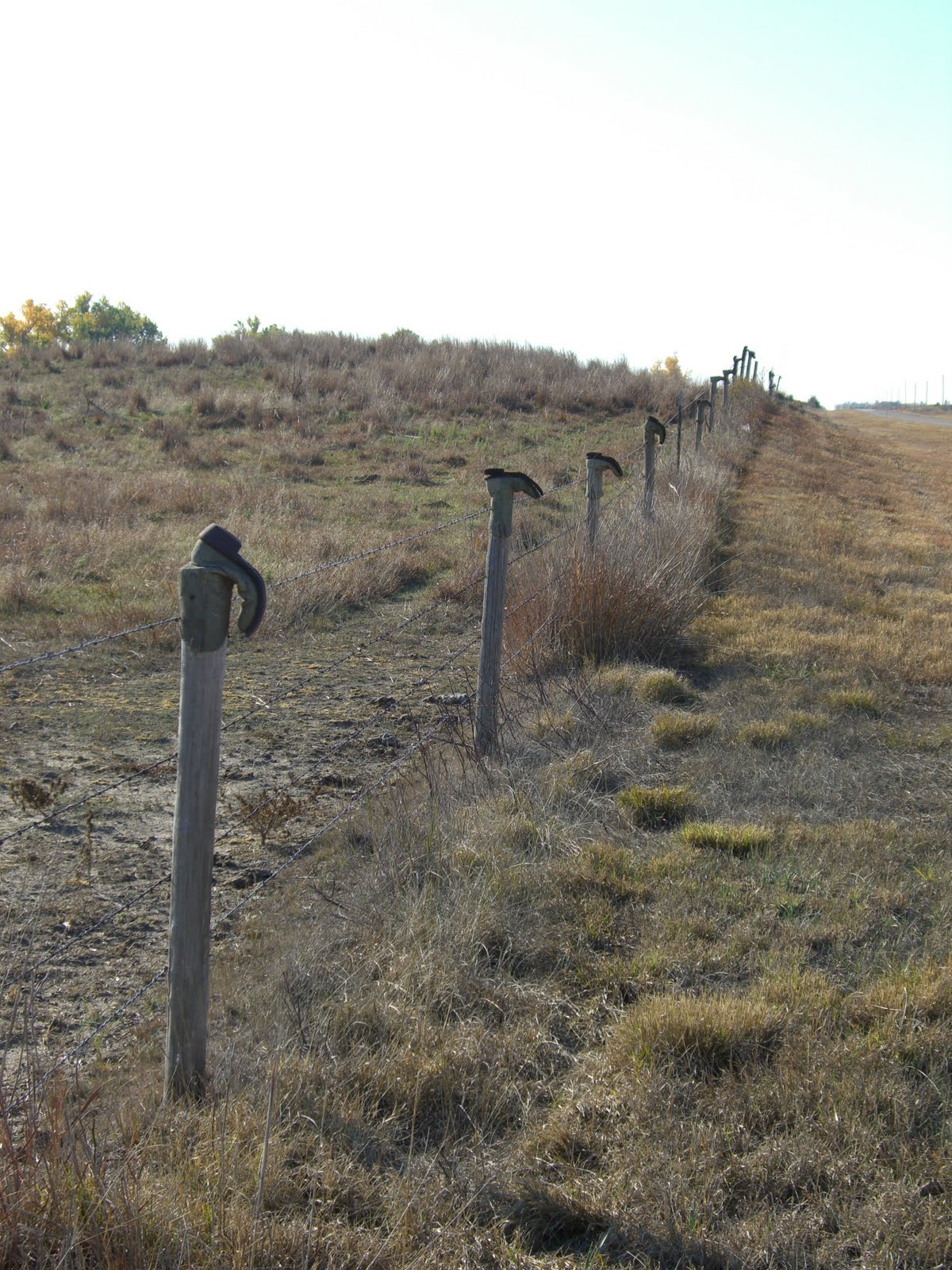
The tornado post, with a picture that included old boots on fence posts, drew this response: "The story was told that when a cowboy died his boots went up on the fence posts." A.M. [Isaac Sees 1st Tornado, 12/9/2011]

As more of you began to check the boxes at the ends of each post to let me know which ones you found particularly interesting and what you wanted to read more of, I was glad that so many of you enjoyed the political cartoons. Kansas was the center of the Farmers' Alliance and the political party that grew out of grass roots organizations formed by farmers and other laborers. Much of Isaac's Journal includes his political experiences and opinions. It is remarkable how many parallels there are between politics in the 1890s and today. [Politics Hardly Seem to Change, 11/24/2011]

When I mentioned some of my favorite illustrators of children's books in the post about Isaac and L. Frank Baum, I was delighted to receive e-mails from two of those illustrators. Michael Hague wrote, "I think it is important for the kids to value their creativity and imaginations and have people around them who are active in the arts and embrace it as an important part of their lives." Pop-up engineer and artist Robert Sabuda's animated tornado in his Oz book certainly drew excited Ohs and Ahs from the children. Sabuda wrote to me, "I love to see everyone enjoy my books. It makes the hard work worthwhile." [Isaac & the Wizard of Oz, 12/15/2011]

No post generated more enthusiasm among those of you who follow my blog than the one about disappearing traces of the past, and part of that was the impact of the photographs. "...so poignant and haunting. Those images and emotions speak to me as no other. I've always been that way, finding interest and increased curiosity toward the lonely, the forgotten, the lost." T.K.B. "Of the hundreds of reasons that houses might be left as you portrayed that house, surely one of them is that people live their lives until the end, but they don't 'finish' them as one might finish a skein of knitting." S.S. "I, like you, remember my grandfather farming and how all the homes have disappeared." J.R. "Just finished your latest blog. It makes me sad to confront what I already know about the familiar things we grew up with." A.B.C. "The older I get the more I miss what I had when I was a kid. That is life for most folks, I guess." R.B. [Disappearing Traces of the Past, 12/23/2011]

The encouragement and support that so many people, friends and strangers, have extended to me since I began this blog three months ago matter very much on a personal level, but I am especially pleased that what I am doing touches the feelings of many of you. Writing the blog has made me observe things that in my hurry to tend to business I was overlooking. It has enriched every day for me to practice the habit of seeing and reflecting, and I hope some of that has been transmitted to all of you.

Yesterday as my husband and I drove a road we've traveled hundreds of times, I saw an old house in a grove of dying cottonwood trees, and I had to have a photograph of it to share with all of you who loved the posts about cottonwoods and disappearing traces of the past. My husband, who generously tolerates my affection for another man--Isaac, of course--patiently turned around and went back so I could photograph the old house.

Thanks to all of you who are following my blog and who communicate with your checks in the boxes, clicks on +1, e-mails, and face-to-face encouragement. The comments at the end of posts are wonderful, and if you haven't been opening those, you might enjoy going back to read them, or adding comments of your own. Of all the wonderful responses people have shared with me, this simple statement sums up very well what I am trying to accomplish: "I feel like I knew Isaac!" D.K. I hope you will enjoy the future posts and will spread the word so more people can get to know Isaac too!!

Since Isaac did not provide me with a New Year's message to share, I will pass along the words of Benjamin Franklin: "Be always at war with your vices, at peace with your neighbors, and let each new year find you a better man."

Friday, December 23, 2011

Disappearing Traces of the Past

My best friend from childhood lived in a 2-story, clapboard house not much different from my own. A few years ago, with wiring, plumbing, and water lines deteriorating from age, and few tenants willing to pay even minimal rent for old country homes, her family made the decision to raze the house and barn. It is a pattern many Kansas families have followed as parents who farmed the land retire or die, and their offspring, who have left the farm for careers in the city, lack the ability or desire to take their parents' places on the farm. For a while the empty house is left to await a new occupant, but when no tenant appears, the house begins to sag and vandals break out the windows, hastening its deterioration. At last, the decision to tear the house down is made, and all that remains to tell the tale of a family who once lived there are a few trees clustered around an empty space.

Near my childhood home is a house grayed with age, the roof a skeleton of horizontal lath capped at the peak by a few defiant wood shingles, clinging where they were nailed decades ago. When I was young enough to ride the school bus, a family lived there, and I remember stopping at the edge of the road to await the child who came running out each morning to board the bus. I do not know how long the house has stood empty, but believing it long abandoned, I paused one afternoon to visit a house on the cusp of disappearing forever. I assumed it contained nothing but the debris that had fallen from and through the skeletal roof, but as I peered through a broken window I saw traces of the family who had last occupied the house--clothing and furnishings left behind as if they had only intended a short absence. Soon, I suspect, all of it will be gone, except for what remains in a few memories.

Not only rural homes have disappeared but also entire small towns. My father used to refer to places that were already gone when I was a child. "He lived down around Strickland," Daddy would say, although that meant nothing to me, Strickland having disappeared before I was born. I could not understand why he gave directions using nonexistent places.

Now I find myself doing the same thing. Roads around our farm have been given numbers to facilitate deliveries to country homes and assist 911 responders. I struggle to remember the numbers when I am giving directions, falling back to the names of roads familiar from my childhood--Emerson Road and Antrim Road, references to schools that closed in the 1940s and structures that have been torn down. My father always called the land just north of our home the "Old Dick's Place," or at least I thought that was the name he used. Only while transcribing Isaac's Journal did I learn that it was the "Old Dix's Place." Isaac's friend, "Doc" Dix, claimed the north half of the section as his homestead and timber claim. He was a medical doctor who decided to try his hand at farming. His family home included a store and the community post office, of which he was the postmaster. After living there long enough to mature his claims, he and his family moved into Pratt Center--actually into Saratoga, another disappeared town which in Isaac's day was a bustling commercial community that faded away after losing the battle with Pratt Center for the county seat.

Today, like my father, I refer to land around our farm by the names of farmers who have been dead for decades, even generations--the Dix Place, the Kennedy quarter, the Cotton Place, Southard's Place. My husband, who did not grow up in the community, has learned the names from me, although he has no memories to associate with the names, just as I learned them from my father. Once there were families living on the land to which their names are affixed, with houses and barns and dreams that their hard work was building a legacy for future generations. Today not one of those places is owned by a descendant of the farmer who once lived there, despite those dreams. The buildings are gone and the original trees are old and dying.

Even the land itself has often been transformed by farmers leveling the terrain for irrigation. Isaac wrote about his "pinnacle hill" which he would climb to watch fireworks in distant towns on the 4th of July. I could not identify much of a pinnacle on either his homestead or the timber claim, but recently I spoke with the current owner of the land, who told me there was once an exceptionally high hill on the property. He described the location, which retains a small elevation, and told me that Isaac's pinnacle hill was once at least thirty feet higher before grading.

As our conversation continued, he recalled having to clean up the remains of an old house. I eagerly asked him to describe what he remembered, and he said it was a 2-story, wooden house, fairly large, but in too much decay to describe any details. I asked if it had a cellar, and he confirmed that it had a small one with an exterior entry. He could not tell me whether it also had an interior stair, because of the deterioration of the house. I shared with him Isaac's description of his 2-story, wooden house, and how he added exterior stairs so he no longer needed to carry potatoes through the house when he stored them in the cellar during harvest. As winter approached, he would tramp straw into the exterior stairs for insulation from the cold, using only the interior stairs until spring. The current owner recalled the approximate location of the house, so I learned where to picture Isaac's home although it is long gone.

Nearly all traces of Isaac's life have disappeared--the trees about which he felt such pride reduced to a few scraggly rows at the edges of fields, his dugouts filled, his house torn down, even his land transformed. Only his words survive.

Thursday, December 15, 2011

Isaac & "The Wizard of Oz"


For most readers, especially the children for whom L. Frank Baum wrote, The Wonderful Wizard of Oz is as Baum intended, "a modernized fairy tale, in which the wonderment and joy are retained and the heartaches and nightmares are left out." In his Introduction for the book, Baum left little doubt about his intentions: "Folklore, legends, myths, and fairy tales have followed childhood through the ages, for every healthy youngster has a wholesome and instinctive love for stories fantastic, marvelous, and manifestly unreal. The winged fairies of Grimm and Andersen have brought more happiness to childish hearts than all other human creations." However, Baum believed, "...the time has come for a series of newer 'wonder tales' in which the stereotyped genie, dwarf, and fairy are eliminated, together with all the horrible and blood curdling incidents devised by their authors to point a fearsome moral to each tale." Baum never outgrew his capacity for creative fantasy, and he believed it was important to encourage a child's sense of wonder and imagination.

Yet, as clearly as Baum stated his intention, adults have repeatedly imposed their own interpretations and ideas upon Baum's work. The 1939 movie has several minor changes, ruby rather than silver slippers being one example. The biggest change, however, was to begin the movie with a sepia-colored sequence at Dorothy's prairie home, with actors that were easily recognizable later in the movie as the Scarecrow, the Tin Woodsman, the Cowardly Lion, and the Wicked Witch. The movie, as wonderful as it is, declined to trust children's imaginations to accept that the tornado actually transported Dorothy to a real Land of Oz, suggesting instead that Dorothy's trip to Oz had only been a dream. While L. Frank Baum would surely have loved the movie, as so many generations of children already have, I suspect he would have been disappointed by the movie producers' decision to present Dorothy's visit to Oz as a dream.

So, why am I writing about L. Frank Baum and Oz on Isaac B. Werner's blog? One reason is to share how some scholars have gone even further in pre-empting Baum's fairytale for children. In 1954 a history teacher named Henry M. Littlefield suggested that The Wonderful Wizard of Oz could be interpreted as a parable of the Populist movement, using Baum's characters as stand-ins for people or places connected to The People's Party: the Scarecrow as the farmer; the Tin Woodsman as the industrial laborer; the Emerald City as Washington, D.C.; the Wicked Witch of the East as Eastern millionaires, monopolists, and bankers; and depicting the Populist opposition to the gold standard and belief in a return to bimetallism and renewed coinage of silver represented as the Yellow Brick Road misleading people toward reliance on the gold standard; Dorothy's silver slippers representing the untested power of returning to silver; and the Cowardly Lion as Populist (and Democratic) 1896 Presidential candidate William Jennings Bryan. Littlefield's theories about the allegorical meanings of the book led others to propose their own historical and political interpretations, one of the most interesting being that the name of Oz itself came from the bimetallism ratio of sixteen ounces of silver to one ounce of gold, suggesting to one scholar that Baum had used the abbreviation for an ounce as the name of the Emerald City.

Eventually, Michael Patrick Hearn, who is widely recognized as the leading scholar on L. Frank Baum and who authored the Introduction, Notes & Bibliography for The Annotated Wizard of Oz, weighed in on the debate with a letter to the New York Times, stating that he had found "no evidence that Baum's story is in any way a Populist allegory." A few weeks later, Henry M. Littlefield wrote a letter in reply, agreeing that "there is no basis in fact to consider Baum a supporter of turn-of-the-century Populist ideology." All of this makes an interesting connection between Baum and Isaac, and although Isaac died before the book was published, he was active in the Farmers' Alliance and supportive of Populist candidates.


A second reason is historical, since Dorothy's adventure begins on a farm on the Kansas prairie during the hard times Isaac described in his journal. While I agree with Michael Patrick Hearn that Baum intended to write a book for children and not an elaborate allegory about the populist movement and the election of 1896, I think it is natural that Baum was influenced by the events of his time. After the collapse of the Baum family's theatrical business, L. Frank Baum moved his family to Aberdeen, South Dakota to open a general store, but the hard times meant there were too few customers with money to purchase his goods, and the bank foreclosed on his store. He then purchased and ran a newspaper, which certainly made him familiar with the news of the day. It seems inevitable that some of what he saw around him would weave its way into his story.

Except for the fact that Isaac and some of his neighbors had planted trees on their timber claims and homesteads, Baum's fictional description of the Kansas plains on the opening pages of the book is not too different from what farmers in parts of Kansas might have seen during the years of drought in the late 1880s and 1890s. Baum wrote: "When Dorothy stood in the doorway and looked around, she could see nothing but the great gray prairie on every side. Not a tree nor a house broke the broad sweep of flat country that reached the edge of the sky in all directions. The sun had baked the plowed land into a gray mass, with little cracks running through it. Even the grass was not green, for the sun had burned the tops of the long blades until they were the same gray color to be seen everywhere."


The connection between Isaac's Journal and L. Frank Baum's Oz book was recalled to my attention as we prepared for a special event. The Macksville City Librarian, Jody Suiter, asked my husband and me to share our love of Oz with the K thourgh 5th grade students, and it was decided to use the larger space of the grade school library for the presentations. The picture at the right is of my husband handing out diplomas, signed by Oz and awarding each student a Degree of ThD (Doctor of Thinkology).


We had a wonderful time preparing for the day--baking cookies, making bookmarks, selecting which parts of the book to read to the students, printing diplomas, and choosing pictures from some of our favorite Oz illustrators to show them--Michael Hague, Charles Santore, W.W. Denslow, Robert Ingpen, Scott Gustafson, Robert Sabuda, and the unusual Lisbeth Zwerger. We decorated a tree with our collection of Oz ornaments, shared our one-of-a-kind Oz chess board with the 4th & 5th graders, told the story of Oz to the kindergarten & 1st graders with the help of hand-crafted Oz dolls, and compared how different illustrators imagined Oz in unique ways with 2nd & 3rd graders. In short, the innocence and enthusiasm of the students provided us with an afternoon of the very magic Baum wished for children when he wrote his stories, and through them, we experienced it too.

So, the movie makers can be forgiven for using artistic license to alter Baum's story for the screen, and the scholars can be humored for twisting Oz into a historical & political allegory, so long as children can still find magic in the Land of Oz as Baum intended.

(To see more pictures and information about our sessions with the children, visit Jody Suiter's wonderful website at http://macksville.mykansaslibrary.org/.)

Friday, December 9, 2011

Isaac Sees First Tornado

When our careers took my husband and me away from Kansas, we quickly learned what many people's impression of our home state was. When they learned we had been born and raised in Kansas, they were likely to ask, "Have you ever seen a tornado?" Today, sport's fans might be more inclined to comment on Kansas University basketball or Kansas State University football, but the Wizard of Oz has definitely left the impression with many people that Kansas is the land of tornadoes.

In fact, I have never seen a tornado, and I hope I never do. Kansas is not even in the top three states with the most reported tornadoes, those being Oklahoma, Texas and Florida. Every state has a reported tornado on record, although for a few states, tornadoes are extremely rare. The Great Plains is frequently called 'Tornado Alley,' and the states in the Mid-West with the greatest number of tornadoes are Kansas, Missouri, Nebraska, Iowa and South Dakota. During 2011 severe tornadoes struck states where that seemed an unexpected weather phenomena.

Isaac came to Kansas to stake his claim in 1878, yet it was a decade before he saw his first tornado. On May 9, 1888, he wrote in his journal,"Clouds gathering over S. of us and a 'Twister' down S.E., the first I seen, a tapering white sock hanging down, slanting from clouds and in a mere streak connecting down to ground raising the dust at time[s] then raising & vanishing & moving on down again & renewing the dark dust funnel." The tornado disappeared before coming near Isaac's homestead and timber claim, but the power and potential for destruction left a lingering impression with Isaac, for he later wrote,"One looks for 'Twisters' now at any cloud raising."

If Isaac had been living on his homestead in May of 2007, he would surely have seen the nest of tornadoes that hung from the clouds over three nights of destruction in his community. Homes were destroyed, lives were lost, and the small city of Greensburg about twenty-five miles to the southwest was nearly obliterated. Although Greensburg dominated the news reports, the rural area around my childhood home also suffered two deaths and severe property damage.


Tornadoes are certainly frightening, but they are also quirky in their destruction. Recently I took this photograph of two tree rows on opposite sides of a road. The edge of the 2007 tornado can be seen from the destruction of the tree belt on the east side of the road, while the tree belt on the west side was practically untouched. Devastation or survival may be the result of a distance of only a few feet. Many groves and rows of trees in our community are little more than mutilated remants of once stately shelter belts.


About a mile to the south of the tree rows, the home of our friends was destroyed, along with the farm equipment and the metal grain bins of their farming operation. Metal from those grain bins, and from the bins and metal buildings of other farms, was carried by the tornadoes for miles, driven into tree trunks and buried in fields to ruin tractor tires, unless sharp-eyed farmers spot the protruding metal. Perhaps the piece of heavy metal wrapped around the guywire of this pole to create a piece of nature's art from tragedy came from our friends' farm several miles to the south. The force of the whirling tornado bent the metal around the guywire like a sheet blowing on a clothes line.

The pasture posts topped with old boots extend in both directions for a quarter of a mile or so--just a bit of rural whimsy for passersby to enjoy.

May of 2008 also brought serious injuries and loss of property from tornadoes in our community. Although winter is the likely time for tornadoes in the South, it is spring when Kansans make sure the NOAA (National Oceanic & Atmospheric Administration's weather alert) is plugged into an outlet and the storm shelter has been sprayed to get rid of spiders and is stocked with candles, matches, flashlights, blankets, and maybe a gallon of water and some packaged peanut butter crackers--just in case. It was May when Isaac saw his first tornado, and luckily for him, he never saw another.

Friday, December 2, 2011

Isaac Plants Cottonwood Trees

Cowboy poet Larry McWhorter had a business building pipe and cable fencing in Texas, and his business card read "Fiddlestrings." He prided himself on building sturdy and beautiful fences with taut cable--like a well-tuned fiddle. Because he took such pride in his work, he took his time about it. That also allowed him to write poems in his head as he worked, and he didn't mind a bit of conversation when I stopped by. One hot day he noticed a little volunteer cottonwood tree growing on our property, and he walked over to remove a few leaves and slip them around the inner hatband of his cowboy hat. He laughed at my perplexed expression, saying, "That's an old cowboy trick to help keep a fella' cool when he's workin' in the sun."

I don't know if Isaac knew that trick or not, but he definitely knew how to grow cottonwood trees from cuttings. He explained the procedure he had perfected, writing on April 22, 1885: "...cottonwoods quite leaved [sic] out too much so to make reliable cuttings...I lately making my cuttings 15 inches long, 3 to stick out & 12 in ground, to better withstand droughty spells, and surer to grow." Isaac arrived to stake a homestead and a timber claim in 1878, when there were no trees on the prairie. On March 1, 1885, he wrote in his journal: "During middle of day counted the trees on my homestead alive & thrifty...on Homestead & Timber claim...total 3400 growing trees."

Among the trees on the prairie, the cottonwood towers above most of the others. The spade- or heart-shaped leaves have a smooth, shiny texture, and when the trees are stirred by a breeze, the leaves make a rustling noise like a lady's taffeta petticoats or that gentle sound of light rainfall on the roof. The shiny surfaces catch the light and reflect the movement of each leaf, a shimmering gold when the leaves turn in the autumn.

Cottonwood trees are fast growing--seven feet or more per year, and long-living--up to one hundred years, and they tolerate drought better than most trees. Naturally, they were a popular tree with the early settlers. During the dust bowl years in the "dirty thirties" cottonwood trees were usually included among the other varieties of trees planted in rows as windbreaks to help control soil erosion. These strong, healthy giants are the trees of my childhood memories, their cottony seeds drifting down in late spring, their sturdy limbs great for climbing and building tree houses in summer, and their bright yellow leaves for raking into piles, jumping into, and raking again in autumn.

Today, many tree rows look like graveyards, the trunks of fallen trees bleaching white in the sun as aging neighbors await their turn to fall. Many old shelterbelts have been bulldozed to make more room for farming; others have been destroyed by tornadoes and ice storms; and even more are succumbing to old age, as few of today's farmers plant trees as Isaac and his neighbors did.

The actress Kim Novak wrote: "...when you touch these trees, you have such a sense of the passage of time, of history. It's like you're touching the essence, the very substance of life." I understand her feelings of connection with ancient trees, knowing that ancestors enjoyed standing in their shade. Perhaps that is why I find it so sad to watch the gradual disappearance of the prairie cottonwoods.

While their numbers may be declining and their vigor nearing an end, those that remain lift their golden crowns into the clear blue of the autumn sky with the same regal beauty that Isaac must have admired over a century ago.

(Please continue to let me know what you enjoy with your comments, clicking on +1, and checking boxes.)

Thursday, November 24, 2011

Politics Hardly Seem to Change

It is disappointing how unaware most of us are of the past, and although I consider myself a history buff, Isaac's Journal led me to more discoveries about the history of my own community, state, and nation than I can count. One of the intriguing discoveries involves the political history of our country in the later quarter of the 1800s, for there are so many similarities to today. As examples: there was a grassroots movement challenging the two established parties, and willing to work within one of the major parties to defeat the other; there were women who became political celebrities, known for their ability to generate great enthusiasm for candidates and issues through their impassioned speeches; and, there was popular opposition among the laboring classes against the power and greed of Wall Street, corporations, and the wealthy.

Isaac's personal experiences as a homesteader on the Kansas prairie first made me want to tell his story, but as I read further in his journal, I realized he had experienced and described a significant period in history that is nearly forgotten. As he struggled to create a successful and beautiful farm, coped with falling prices and rising interest, and raised crops that now barely covered taxes and interest on his loans, he personified the economic crisis of other farmers and laborers in America at that time. When he joined the Farmers' Alliance, he was only one of many farmers, factory workers, and other laborers who saw themselves as the producers of wealth that was going into the pockets of bankers, speculators, monopolists, and corporate and Wall Street tycoons while many of the working classes were literally starving. The wealth of the nation was being disproportionately distributed, and technology was displacing workers in ways they struggled to combat, giving rise to public demonstrations and political activity. When newspapers owned or influenced by the wealthy published biased "news," laborers established newspapers of their own. Does any of this sound familiar to what we see on television, the newspapers, and on the internet today? I certainly thought so.

These two political cartoons appeared in Isaac's local newspaper, the County Capital in the 1890s, and both address issues still being argued in media today. Carl Sagan believed, "You have to know the past to understand the present." I agree with Sagan. It is essential that history is taught in our schools, and remembered and referenced accurately by adults, if we are to progress. Yet, George Bernard Shaw reminded us: "If history repeats itself, and the unexpected always happens, how incapable must Man be of learning from experience." Forgotten history, or history intentionally distorted, cannot pass the wisdom learned by one generation to generations in the future. Instead, we are condemned to repeat the inevitable struggles without the benefits of knowing history's lessons.

I hope that by telling Isaac's story, I can bring alive the times in which he lived, and in that way offer a context for history's lessons that will make them relevant today. As David McCullough has said, "No harm's done to history by making it something someone would want to read."

(If you enjoy this post, please remember to add your comments and click on +1 so that I will know what posts you would enjoy more of in the future.)

Friday, November 18, 2011

Isaac's Land from the Air Today

Movies and western songs have left the romantic impression of wide open spaces on the lonesome prairie. That description is more accurate today than it was during Isaac's life, when settlers hurried to claim homesteads on quarter-sections of 160 acre parcels of land. Because the homesteader was required to live on the property he or she claimed, it was possible for each square mile of land to have four different homesteaders living there, in some cases even more if the homesteaders claimed smaller parcels of land. A timber claim did not require that the claimant live on the property, so not every quarter of land contained a dwelling. The best land was claimed first, so poor, sandy acreage was available a while longer, but many settlers in Stafford County arrived in 1878, when Isaac staked his claim.

Isaac did not own a horse for several years following his arrival. He had to break the prairie sod with "man-power" or trade his labor in exchange for the use of a neighbor's horse and plow, and during that time he devoted most of his effort to cultivating trees. Understandably, a quarter-section homestead provided more than enough for one man to farm. During the early 1880s, when prices for crops were good and hopes for the future were high, Isaac and most other farmers acquired horses, mules, or oxen, and machinery for the animals to pull. Although this allowed one man to farm more land, it often meant the farmer had mortgaged his property to secure the money for his purchases. Within a few years, drought, mortgages, and falling prices for their crops caused many settlers to abandon their claims, and the population density declined. As even better machinery was invented, the number of farmers was further reduced.

Today, huge equipment allows a farmer to cover more ground in a few hours than Isaac could have covered in many days. In addition, the massive expenses of equipment, land, and such things as fuel, herbicides, and fertilizers have forced the remaining family farms to become large business operations, one family farming thousands of acres, with only a few exceptions. The use of irrigation has also contributed to the change. Isaac was an agriculturalist who advocated modern farming techniques and personally conducted experiments with different farming methods and seed varieties, as well as inventing and modifying equipment to improve what was available for farmers to buy. As forward thinking as Isaac was, he would probably be amazed by today's farms.


Let me use a recent aerial photograph of the land that was once Isaac's homestead and timber claim to illustrate some of the differences in today's farms. To orient yourself, imagine that you are sitting in the airplane looking out toward the northwest horizon. In the middle of the picture are two circular fields with green, growing crops. The circle that is only about half green-covered was Isaac's homestead; the nearly full circle of green to the north was Isaac's timber claim. The remnants of Isaac's tree rows are along the east side of both quarters of ground and a partial row still exists between them. The road that runs along the south side of Isaac's homestead is the county line between Stafford County to the north (where Isaac's land is located) and Pratt County to the south. Notice how the land is laid out in a grid pattern of square mile sections. The circles are created by irrigation systems that pivot in the center of a quarter-section field to water the crop growing within the circle of its path. The corners of the square field are often planted in a dry-land crop that doesn't require as much water. What was once Isaac's land occupies the west half of that section. The two quarters on the east half of the section appear gray in this photograph. Together, those four quarters form a square-mile section of land. When Isaac lived there, only his timber claim did not have a residence.

If you look closely at the land receding in the distance to the west in the photograph, you can identify another square-mile section. The SE/4 has a circle irrigation system, the SW/4 has a tree row between it and the NW/4, and the NE/4 is an empty gray square. There are no longer any homes in that section, although there were in Isaac's time. Continue looking to the west and you will see a small cluster of trees along the edge of the SE/4 in the next section. That is where my childhood home is located, with only a square mile section separating Isaac's old home and mine.

Isaac wrote in his Journal that in 1890 sixty-six registered voters appeared to cast their ballots in Albano Township, which at that time would have meant sixty-six men. Women did not have the vote, although there were female heads of households living in the thirty-six square miles of the township. Currently there are twenty-nine registered voters in Albano Township, which includes both men and women. The "wide open spaces" between homes are definitely greater and the prairie more lonesome today than in Isaac's time.

I hope this gives those of you who are not familiar with farms on the Kansas plains an idea of how they look today, as well as a sense of how different it would have looked in Isaac's day, with three or four families living on each square mile of land, farming irregularly shaped fields, and carefully tending tree groves, treasured for their shade in an age before air conditioning and their purpose as a wind break to slow erosion caused by winds racing unimpeded across the prairie.

In a future blog, I will return to this photograph to identify where some of Isaac's neighbors lived. I enjoy receiving your comments, clicks, and checks at the end of every posting, to discover which blogs you particularly like. My followers now include people from many states, both urban and rural, which makes your input even more appreciated as I include a variety of topics in the blog. Let me hear from all of you!

Friday, November 11, 2011

I can see Isaac's farm from my house

When I began transcribing Isaac's Journal, I did not know where his homestead and timber claim were located. Eventually, he included the legal description, identifying his land as being in Clear Creek Township. Since that is the township to the west of my childhood home, I was pleased to discover he had lived so near. Later, I learned that his home was even nearer, for the original Clear Creek Township had been divided in half, the west half retaining the name but the east half being given the new name of Albano Township. Isaac lived one mile straight east of my childhood home!


Standing at my front door, I can see the trees that are currently on what were Isaac's homestead and timber claim. While these trees may not be old cottonwoods that he planted, they are quite likely to have grown from seeds dropped by trees Isaac started from cuttings on the treeless prairie that existed when he arrived. The sunrise photograph, taken from my front yard, shows Isaac's trees to the right of the rising sun, bathed in a purple morning haze at the edge of the horizon. The mid-day photograph, also taken from my front yard, shows the same row of trees, located on the east edge of Isaac's old timber claim.


In 1878 when Isaac arrived, there were no trees on the prairie. A "timber claim" did not designate land covered with trees but rather land that could be claimed by planting ten acres of prairie in trees and keeping them alive for eight years in order to claim the title. If drought did not kill them, weeds did not choke them, pests did not destroy them, and prairie fires did not burn them during the required eight years, the settler could acquire 160 acres. As Willa Cather wrote about the hardy trees that managed to survive on the prairie, "I like trees because they seem more resigned to the way they have to live than other things do." In addition to acquiring land as a timber claim, 160 acres could also be claimed as a homestead by building some sort of dwelling, living in it for five years, and improving the land by gradually breaking the thick prairie sod and planting crops or grazing livestock on the prairie grass.

The land was divided into square mile sections which contained 640 acres. These squares were then divided into four smaller squares, each containing 160 acres and being one-fourth of a square-mile section, or a quarter-section of land. These were identified by the compass direction they occupied in the full section. Isaac's homestead was in the southwest quarter of the section; his timber claim was in the northwest quarter of the section. Other homesteaders claimed the quarters in the eastern half of that section.

Today there are roads around most square-mile sections, and fences or changes in the crop from one farmer's field to another's usually make it apparent where one quarter section of ground ends and another begins. In Isaac's day, there were not so many roads, although farmers did mow along the edges of their property for two reasons: to make travel easier and to create fire guards to slow prairie fires.

If you could have viewed Isaac's farm from the air in 1888, you would have seen neat tree rows around 30 and 40 acre fields and carefully maintained fire guards mowed or plowed around his property line. The view from the air is very different today, and I will share it with you in next week's blog.

Tuesday, November 8, 2011

2011 Victorian Tea

Thank you to the Lucille M. Hall Museum volunteers who supported my efforts in sharing Isaac's Journal by recognizing me at the Victorian Tea this past Sunday and by encouraging people to visit my blog. I attended with Sandra, Courtney, & Bailey again this year, and we plan to make it an annual event.


Afterward, we walked over to the park, which has been decorated for Christmas early for the particular pleasure of those attending the Tea. When St. John was founded, the St. John Town Company had one square block surveyed as a town square. In 1882 the land was deeded to the Stafford County Board of Commissioners, and after some disagreement over whether the space should be used as a park or the site of the courthouse, the courthouse was located on the southeast corner across from the open square and the center of town became the park. Real beautification began after the turn of the century, and on October 17, 1913, the fountain was dedicated in memory of Tom Mosely, the man who had played such a significant role in creating the beautiful space it remains today.

Isaac would not have seen the landscaping as it exists today, but as I posed by the fountain in my Victorian costume after the Tea, I certainly felt transported to Isaac's era. Thank you to everyone who expressed their interest in Isaac and my book, and I hope you visit my blog regularly to read my progress and add your comments.

Friday, November 4, 2011

Isaac's Birth & Childhood

On the 23rd of May, 1844, twin boys were born to William and Rebecca Werner, the couple's first children. Just over two months later, on August 4th, the baby boys were baptized at St. John's (Hain's) Reformed Church in Lower Heidelberg, Berks County, Pennsylvania. One of the boys was named Henry Beckley Werner; the other boy was named Isaac Beckley Werner, both boys having been given their mother's maiden name as their middle name. The church in which the babies were baptized was the center of their community, built on a hill said to be the highest point in Lebanon Valley.

The boys' parents had married in November of 1842, when William was forty-one years old and Rebecca twenty-five. The year the twins were born, William built a two-story limestone house for his family on the fifty-two acre farm he owned. In 1855, with two surviving daughters added to the family (one daughter having died as an infant), William hired a surveyor to plat a town on twenty-two acres of his farm. He used family names for the streets--William, Werner, Rebecca, Beckley, and Reber, his mother's maiden name. It is believed that part of the consideration for granting the Lebanon Valley Railroad passage through the platted town was requiring that the depot built by the railroad be called Wernersville.

Isaac and his siblings grew up in a community with many aunts, uncles and cousins living nearby. Schooling for children had been provided by the Hain's Church in earlier years, but when Isaac and his brother were five years old, Lower Heidelberg erected its first public school building. In 1861, Isaac and Henry were seventeen years old and still attending school, offering some indication of the importance their parents placed on giving their children a good education. The teacher, Francis Trout Hoover, taught seventy-two students, the youngest age 4 and the oldest age 17. Over three decades later, Isaac's old teacher published a book titled, Enemies in the Rear, or a Golden Circle Squared, about a community modeled after Wernersville. The plot of Hoover's novel involved a secret society of draft resisters during the Civil War, and locals said of the book that it was probably based on two-thirds fact and one-third fiction. Historians agree that there was organized draft resistance in that region of Pennsylvania. Neither young Isaac nor Henry served during the Civil War, but Werner cousins did fight to preserve the Union.


Isaac's father William died on June 13, 1865, and Isaac left soon after with an older cousin who had been a Union soldier during the Civil War. Eventually both cousins ended up in Rossville, Illinois. By 1878 Isaac was homesteading in Kansas. No record was found to indicate that Isaac ever returned to his home of Wernersville after leaving in about 1865.


Richard Bach wrote: "The simplist questions are the most profound. Where were you born? Where is your home? Where are you going? What are you doing? Think about these once in a while and watch your answers change." Isaac Werner knew where he was born. At different times during his life he changed locations and occupations, and sometimes imagined moving on, even after he seemed to have settled on the Kansas plains, so his answers to the last two questions Bach suggested would definitely have changed. What I cannot know is how he would have answered the second question--Where was Isaac's home? Was it back in Pennsylvania where he was born and raised, or was it in Rossville where he kept for many years the lots he had bought, or was his heart on the Kansas prairie where he had staked his claim and built a beautiful farm of which he was deservedly proud?

What I do know is that Isaac was an intriguing man. He read widely about history, the Bible, the arts, philosophy, engineering, law and business; when he could not find equipment to do the job for which it was purchased he modified it or invented something better; when he learned of the illness of a neighbor boy, he intervened and probably saved the boy's life; when he observed the world around him he recognized its changing nature and photographed the present to preserve it.

It is always beneficial to start at the beginning, so I have included this post of Isaac's beginnings to help you appreciate the posts about him which will follow.